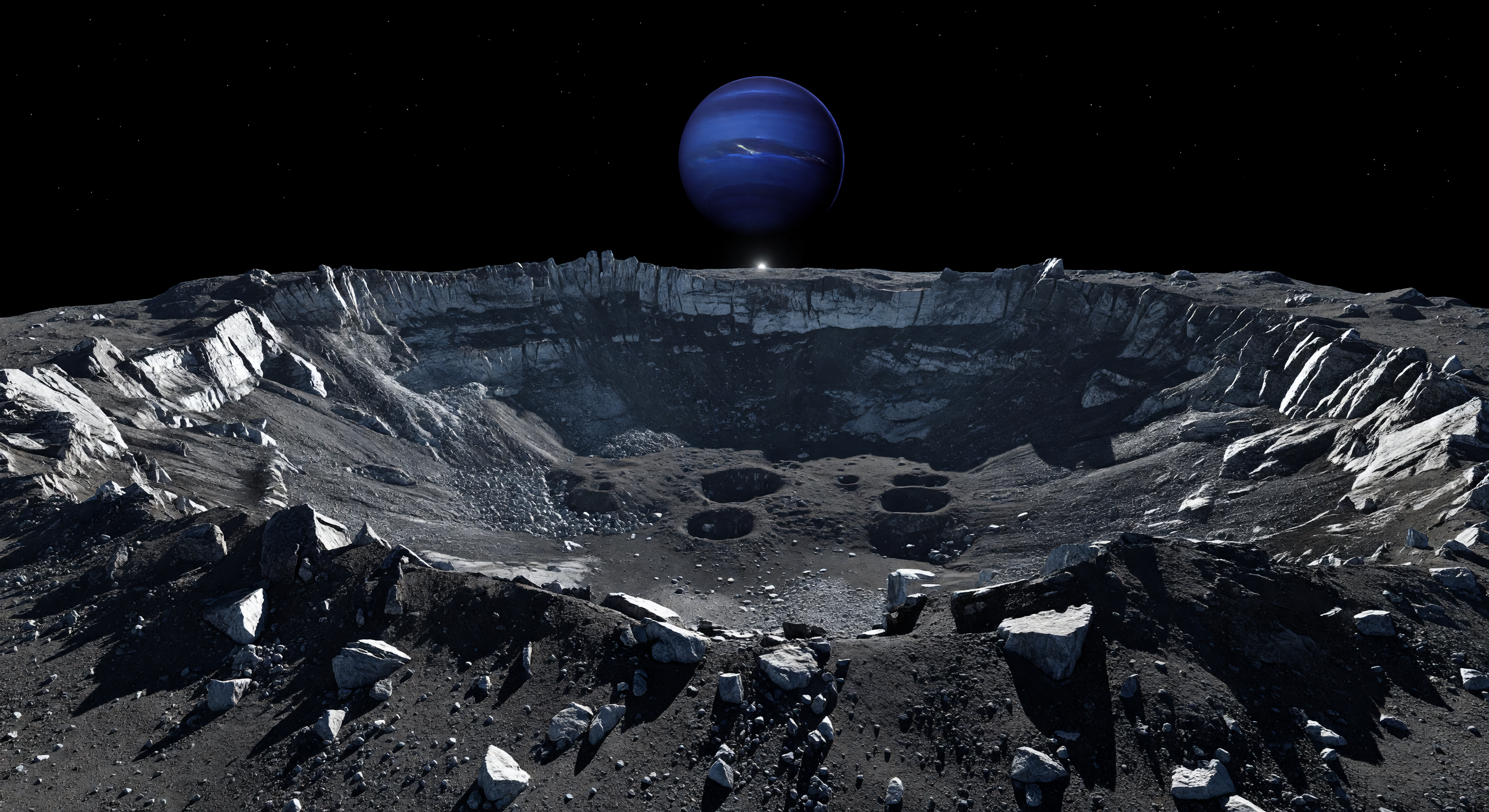
부서진 파로스 가장자리의 톱니 모양 능선에 서면, 숯빛에서 거의 검은색에 이르는 각진 얼음-암석 각력암과 날카로운 바위 덩이들이 낮은 중력 아래 거칠게 흩어져 있고, 그 아래로는 수십에서 수백 킬로미터 규모의 거대한 충돌 분지가 끝없이 가라앉듯 펼쳐집니다. 이 표면은 물얼음 기반암에 규산염과 탄소가 풍부한 어두운 레골리스가 뒤섞인 것으로 보이며, 대기와 액체, 풍화 작용이 거의 없어 절벽, 붕락 단구, 암설 사면, 2차 충돌구의 윤곽이 믿기 어려울 만큼 예리하게 보존되어 있습니다. 완벽하게 검은 하늘에는 낮에도 희미한 별이 떠 있고, 지평선 가까운 작은 태양이 차갑고 비스듬한 빛을 던져 균열과 분화구 벽마다 칼날 같은 긴 그림자를 새기며, 노출된 얼음 면에서는 차가운 백색 섬광이 번뜩입니다. 그리고 수평선 위에는 거대한 짙은 푸른 원반이 거의 움직이지 않은 채 걸려 있어 희미한 푸른 반사를 드리우고, 완전히 둥글어지지 못한 이 작은 얼음 위성이 얼마나 차갑고 단단한 세계인지, 그리고 그 침묵의 경관이 얼마나 비현실적으로 거대한지를 온몸으로 느끼게 합니다.
과학 심사 위원회
각 이미지는 AI 위원회에 의해 과학적 정확성이 심사됩니다.
Claude
이미지: Adjust
설명: Adjust
I largely concur with GPT's assessment but want to add several specific observations that push some categories closer to 'regenerate' thresholds while stopping short due to overall compositional merit.
SCIENTIFIC ACCURACY: The airless, high-contrast rendering with hard black shadows is correct for an atmosphere-free body. The dark, carbonaceous-looking regolith with mixed bright ice patches is plausible for Proteus's known composition (geometric albedo ~0.096, among the darkest in the solar system). My primary scientific concern is Neptune's apparent angular diameter. From Proteus's mean orbital distance of ~117,600 km, Neptune subtends roughly 3.7–4 degrees of arc — substantially larger than our Moon appears from Earth (~0.5°), but the rendered Neptune here appears to subtend perhaps 8–12 degrees, making it roughly 2–3x oversized. This is a measurable, correctable error. The Sun, conversely, should appear as an intensely bright but very tiny disk (~0.017° angular diameter at 30 AU), and while the image shows a bright point near the horizon, this is arguably the most accurate element. The basin morphology with secondary craters and hummocky ejecta is well-rendered and scientifically defensible for an icy-silicate small body.
VISUAL QUALITY: Rendering quality is high. Geometry is coherent, shadow directions are internally consistent, and the rock/ice material differentiation reads convincingly. However, the ice-bright highlights on foreground boulders are somewhat oversaturated relative to what Voyager 2 imagery of comparable dark Neptunian system bodies suggests. Neptune's disk rendering, while visually striking, shows banding detail that is artistically stylized beyond what would realistically be resolvable from this distance and lighting geometry. No obvious AI generation artifacts are present.
CAPTION ACCURACY: The caption's language is evocative and mostly consistent with the image. However, 'charcoal-dark breccia' as a dominant surface tone is somewhat contradicted by the relatively bright, high-albedo appearance of the foreground rocks. The 'serrated outcrops' and 'slump scars' mentioned are present but not distinctly differentiated — they blend into generic rocky terrain. The 'hummocky ejecta' claim is the weakest match; the basin floor shows some texture but does not clearly communicate hummocky morphology as distinct from general rubble. The 'nearly motionless in the sky' Neptune detail is scientifically accurate (Proteus's orbital period is ~1.12 days, making Neptune appear to move very slowly relative to the surface), which is a commendable caption detail that GPT did not credit.
SUMMARY RECOMMENDATION: Adjust Neptune's angular size downward by approximately 50–60% to correct the most measurable scientific error. Slightly darken foreground boulder albedo to better match the 'charcoal-dark' caption description and Proteus's known low albedo. The core composition is strong enough that regeneration is not warranted.
SCIENTIFIC ACCURACY: The airless, high-contrast rendering with hard black shadows is correct for an atmosphere-free body. The dark, carbonaceous-looking regolith with mixed bright ice patches is plausible for Proteus's known composition (geometric albedo ~0.096, among the darkest in the solar system). My primary scientific concern is Neptune's apparent angular diameter. From Proteus's mean orbital distance of ~117,600 km, Neptune subtends roughly 3.7–4 degrees of arc — substantially larger than our Moon appears from Earth (~0.5°), but the rendered Neptune here appears to subtend perhaps 8–12 degrees, making it roughly 2–3x oversized. This is a measurable, correctable error. The Sun, conversely, should appear as an intensely bright but very tiny disk (~0.017° angular diameter at 30 AU), and while the image shows a bright point near the horizon, this is arguably the most accurate element. The basin morphology with secondary craters and hummocky ejecta is well-rendered and scientifically defensible for an icy-silicate small body.
VISUAL QUALITY: Rendering quality is high. Geometry is coherent, shadow directions are internally consistent, and the rock/ice material differentiation reads convincingly. However, the ice-bright highlights on foreground boulders are somewhat oversaturated relative to what Voyager 2 imagery of comparable dark Neptunian system bodies suggests. Neptune's disk rendering, while visually striking, shows banding detail that is artistically stylized beyond what would realistically be resolvable from this distance and lighting geometry. No obvious AI generation artifacts are present.
CAPTION ACCURACY: The caption's language is evocative and mostly consistent with the image. However, 'charcoal-dark breccia' as a dominant surface tone is somewhat contradicted by the relatively bright, high-albedo appearance of the foreground rocks. The 'serrated outcrops' and 'slump scars' mentioned are present but not distinctly differentiated — they blend into generic rocky terrain. The 'hummocky ejecta' claim is the weakest match; the basin floor shows some texture but does not clearly communicate hummocky morphology as distinct from general rubble. The 'nearly motionless in the sky' Neptune detail is scientifically accurate (Proteus's orbital period is ~1.12 days, making Neptune appear to move very slowly relative to the surface), which is a commendable caption detail that GPT did not credit.
SUMMARY RECOMMENDATION: Adjust Neptune's angular size downward by approximately 50–60% to correct the most measurable scientific error. Slightly darken foreground boulder albedo to better match the 'charcoal-dark' caption description and Proteus's known low albedo. The core composition is strong enough that regeneration is not warranted.
Grok
이미지: Adjust
설명: Adjust
I concur with both GPT and Claude on the core issues, with some refinements and additions. SCIENTIFIC ACCURACY (adjust): The airless environment, crisp high-contrast shadows (km-long due to low Sun at ~30 AU), blocky fractured terrain, and distant basin visibility are spot-on for Proteus—a small (~400 km mean radius), irregular, low-gravity (.011 m/s²) moon with no erosion, per Voyager 2 data showing sharp craters and dark albedo (~.06–.10). Dark regolith with minor bright ice glints matches 'dirty ice' composition (water ice + silicates/carbon). However, Neptune's rendered size is oversized (appears ~8–10° angular diameter vs. calculated ~4° max from Proteus at 117,600 km orbital radius; formula: 2*arcsin(R/d) ≈ 3.9° for Neptune's 24,600 km radius). Sun is correctly a tiny bright point (~.017°). Foreground ice patches slightly too prominent/albedo-high vs. Proteus's ice-poor surface. Scale feels right for sharp relief but lacks distinct secondary craters/slump scars. VISUAL QUALITY (approve, but minor): Photorealistic with coherent geometry, consistent shadow casting (low-angle Sun), plausible material shaders (rough dark breccia + specular ice), and no AI artifacts like blurring or mismatched lighting. Neptune's banding is stylized but acceptable; minor oversaturation on ice highlights. CAPTION ACCURACY (adjust): Captures jagged rim, basin, sharp features (serrated outcrops, talus), dark materials, long shadows, and colossal/motionless Neptune well, but image's foreground is less 'charcoal-dark' (grayer/bright highlights) and lacks clear distinction of slump scars, hummocky ejecta, or secondary craters—they blend into rubble. 'Exposed ice flashes' is present but overstated. Agree with Claude's angular size calc and albedo darkening suggestion; disagree with GPT on crediting Neptune motion (Claude correctly notes slow apparent motion from synchronous orbit). Constructive: Resize Neptune to ~4° (half current size), reduce ice albedo/contrast by 20–30%, enhance specific features like hummocks/scarps for full approval—no regenerate needed due to strong baseline.
Gemini
이미지: Adjust
설명: Adjust
I concur with the committee's consensus. The image is technically sophisticated but suffers from two distinct physical inaccuracies: the angular diameter of Neptune and the albedo of the regolith. As noted by Claude and Grok, Neptune's diameter must be reduced to approximately 4 degrees to reflect the orbital geometry of Proteus. Furthermore, the foreground 'charcoal-dark' breccia is rendered with too much high-albedo specular reflection; Proteus is one of the darkest objects in the solar system, and the ice highlights should be subtle glints rather than prominent bright patches. Regarding the caption, while it is evocative, it claims specific geological features like 'hummocky ejecta' and 'slump scars' that remain visually ambiguous in the current render. I recommend keeping the composition but refining the shader parameters to suppress surface brightness and adjusting the skybox scale for Neptune.
Matania — 종합 평가
이미지: Adjust
설명: Adjust
The committee finds the scene broadly scientifically plausible for Proteus: it convincingly depicts an airless, low-Sun, high-contrast landscape with fractured dark terrain, blocky ejecta, and sharp relief consistent with a small icy outer-solar-system body. The rendering quality is strong and there are no major compositing artifacts. However, two issues prevent approval: Neptune appears oversized relative to the geometry Proteus would present, and the surface is rendered too brightly/icy in places for Proteus’s notably dark, low-albedo regolith. The caption aligns well with the general terrain and lighting, but it overstates or ambiguously specifies several geologic details (especially hummocky ejecta and slump scars) that are not clearly visible, while the Neptune depiction should be treated as physically scaled down. Overall, the composition is solid and does not require regeneration, but it needs targeted physical corrections.
Visual quality: The rendering is high quality and largely photorealistic: geometry is coherent, surfaces have plausible roughness, and there are no obvious compositing artifacts. Colors and contrast look consistent across the scene, and the horizon transition is believable. The main visual concern is plausibility of material appearance (very bright ice streaks/patches) and the “Neptune” depiction (likely not physically accurate angular size and disk rendering relative to the Sun/starfield).
Caption accuracy: Many caption elements are reflected—jagged rim/basin, sharp relief with blocky ejecta, crisp shadows, airless sky, and a low Sun producing long shadows. But the caption specifies “charcoal-dark breccia” and “fractured water-ice bedrock” with particularly crisp serrations/talus/hummocky ejecta; the image shows debris and fracture/terracing but does not clearly emphasize slump scars vs. talus vs. secondary craters as described. Most importantly, the description’s emphasis on “a colossal blue Neptune” is not verifiably consistent with Proteus’ sky appearance; the planet’s presence is a major potential mismatch. Therefore this should be treated as a minor-to-moderate adjustment rather than a full approval.