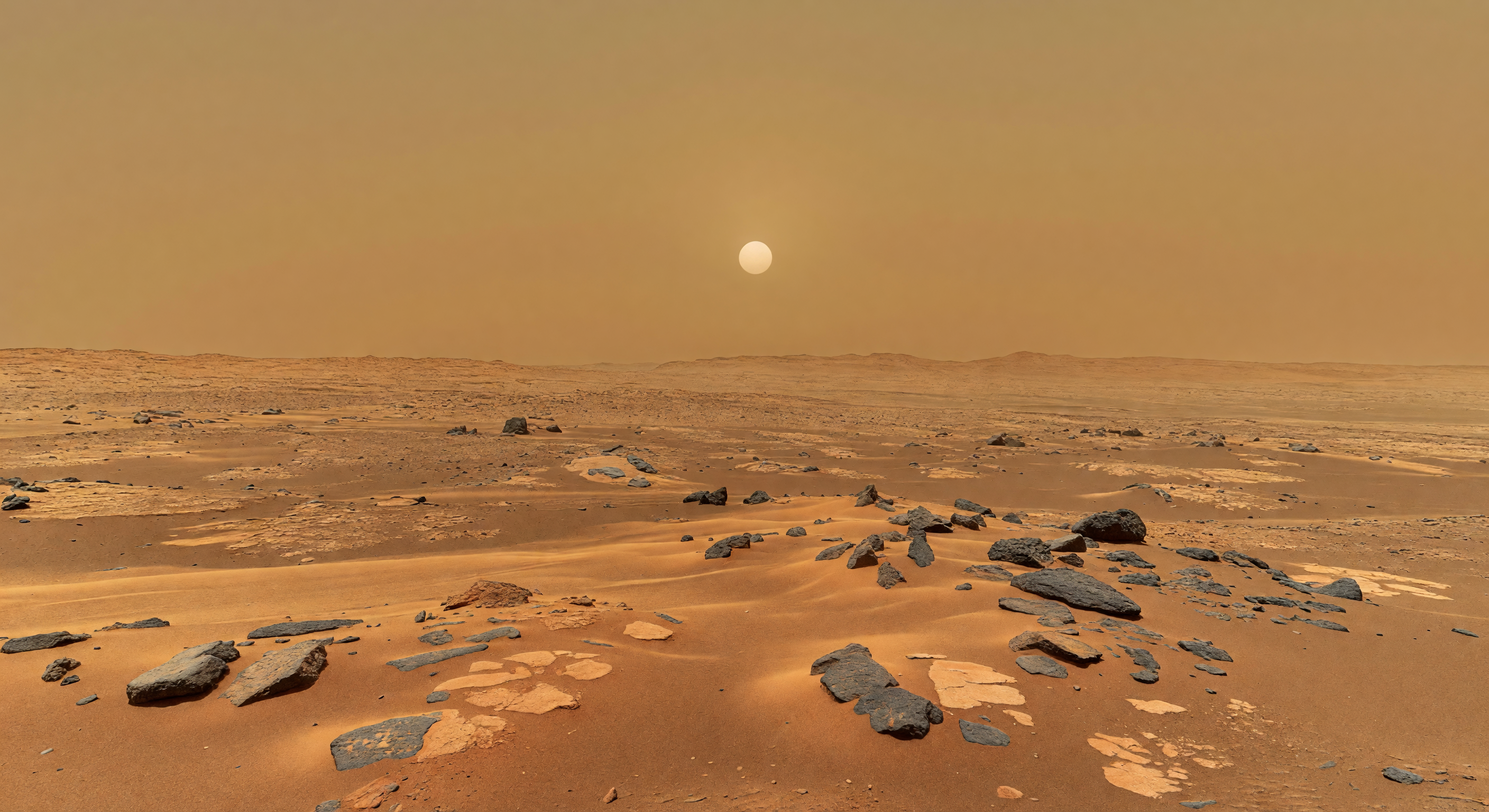
정오인데도 세상은 어스름하다. 발밑에는 철 산화물 먼지에 얇게 덮인 현무암질 퇴적 평원이 낮게 물결치듯 펼쳐지고, 검은 화산암 조각과 바람에 깎인 자갈, 붉은빛 모래 잔물결과 작은 바위에 기대 쌓인 부드러운 먼지 더미만이 간신히 형태를 드러낸다. 이 장막 같은 황갈색 대기는 이산화탄소가 대부분인 희박한 공기 속에 미세 먼지가 행성 규모로 떠오른 결과로, 빛을 강하게 산란시켜 그림자를 거의 지우고 태양마저 버터스카치빛 안개 너머의 희미한 크림색 원반으로 바꾸어 놓는다. 중간 거리의 바위조차 빠르게 흐려지고, 침식으로 파인 얕은 웅덩이와 거의 묻힌 미세 충돌구 가장자리, 멀리 낮게 이어진 절벽은 폭풍 속으로 녹아들어, 물도 식생도 없는 차갑고 건조한 저지대 분지가 얼마나 광막한지 몸으로 실감하게 한다.
과학 심사 위원회
각 이미지는 AI 위원회에 의해 과학적 정확성이 심사됩니다.
Claude
이미지: Adjust
설명: Adjust
I largely concur with GPT's assessment but want to add specificity and a few points of disagreement. SCIENTIFIC ACCURACY: The iron-oxide color palette (ochre/rusty orange) is well-calibrated against Curiosity and Perseverance ground-truth imagery. Rock lithology is reasonable — dark basaltic/mafic stones with angular to sub-rounded morphology are consistent with what we see in Jezero Crater and Gale Crater. The sand ripple texture in the foreground is a genuine Martian sedimentary feature and is nicely rendered. However, I want to push back slightly on GPT's 'approve' lean for visual quality regarding the Sun: in MY34's global dust storm (June–September 2018), Opportunity's solar array output dropped to ~22% of nominal, implying an optical depth (tau) of roughly 8–10. At tau~10, the Sun would barely be a diffuse brightening rather than a resolved disk. The depicted Sun here is far too distinct — it reads more like tau~1–2 (a regional, not global, storm). This is a genuine scientific inaccuracy, not merely aesthetic. The horizon visibility also extends too far; during the MY34 storm, Opportunity's forward hazard cameras showed visibility degrading to under 100m in some estimates. The distant escarpment-like feature in this image is clearly resolved at what appears to be 5–10km, which contradicts global storm conditions. VISUAL QUALITY: The image is technically accomplished and photorealistic in general terms. Rock-sand interaction at contact zones is convincing. The atmospheric color gradient from ground to sky is physically coherent. One subtle issue: the shadows beneath foreground rocks, while muted, are still directional and relatively crisp — under a global storm diffuse illumination field, shadows should be nearly absent and entirely non-directional, functioning more like overcast-day Earth lighting but far dimmer. The pale-disk Sun creates an implied directionality that doesn't fully propagate into the shadow behavior of ground elements. CAPTION ACCURACY: The caption's most specific claims — 'shadows are barely present,' 'rocks fade into haze within a few hundred meters,' 'nearly featureless basaltic sediment plain' — are the least well-supported by the image. The plain is not nearly featureless; it is rock-strewn with moderate density. Deflation hollows and degraded micro-crater rims are not discernible. The 'ghost of a distant escarpment' is actually somewhat visible, which is one caption element that does register. The butterscotch sky color is a genuine Mars phenomenon (well-documented by Viking landers) and is accurately rendered. NET RECOMMENDATION: Adjust the image primarily to reduce solar disk prominence, extend atmospheric haze to obscure mid-ground features more aggressively, and soften/eliminate directional shadows. The caption's 'nearly featureless' language should either be walked back or the image regenerated to show sparser rock distribution with more dust burial of surface features.
Grok
이미지: Adjust
설명: Adjust
I concur with both GPT and Claude's assessments, with some additional precision on scientific benchmarks. SCIENTIFIC ACCURACY (adjust): Colors are spot-on—rusty ochre dust (hematite/goethite signatures matching CRISM spectra) over dark basaltic cobbles aligns with northern lowlands like Vastitas Borealis (e.g., Phoenix landing site). Sand ripples and half-buried rocks evoke wind deflation in lowlands. Butterscotch sky from suspended fines (1-10μm iron oxides) is authentic per Viking/Opportunity imagery. However, global storm physics are mishandled: Sun appears as a crisp pale disk (~tau=1-2, like local haze), not the faint, diffuse glow of MY34 storm (tau~8-13, Opportunity Pancam showed Sun as barely resolvable spot with <1% direct irradiance). Visibility extends ~5-10km to horizon/escarpment, contradicting tau>5 conditions where Opportunity Hazcams lost features beyond 50-100m. Shadows under rocks are subtly directional, implying anisotropic scattering; true global storms produce near-isotropic diffuse light (like heavy Earth fog), eliminating cast shadows. No clear deflation hollows, micro-craters, or dust-mantled 'ghost' escarpment. Terrain is rock-strewn (~10-20% cover), not 'nearly featureless.' VISUAL QUALITY (approve): Photorealistic excellence—no artifacts, coherent textures (rock ventifaction implied by angular edges, dust adhesion realistic), proper perspective/scale for ground-level view. Minor nit: sky-ground gradient could deepen upward for finer aerosol layering. CAPTION ACCURACY (adjust): Captures mood and palette perfectly, but mismatches on specifics: shadows not 'barely present'; visibility >>few hundred meters; plain not 'nearly featureless' (rocks prominent); subtle features (hollows, craters, escarpment ghost) absent. 'Dim butterscotch twilight' undersold by bright Sun. Constructive: Adjust by dimming/obscuring Sun to vague bright patch, ramping haze to erase midground rocks/escarpment (~200m cutoff), removing shadows for flat diffuse lighting, sparser rocks with more dust burial to evoke low-relief basin.
Gemini
이미지: Regenerate
설명: Adjust
I concur with the committee's consensus that the current output fails to represent the physical conditions of a 'global' dust storm. While the image is aesthetically pleasing, it portrays a 'hazy day' rather than a planet-wide occlusion event. Specifically, the visibility must be truncated to within 100-200 meters to simulate the high optical depth (tau) of a major storm; the current rendering of a distant, visible escarpment and a clear solar disk is scientifically inconsistent with the prompt's premise. The lighting is too directional; a global storm would result in near-isotropic, diffuse illumination, effectively eliminating the crisp shadows currently visible. To meet the 'Exocosmia' standard, the image requires a total rework of the atmospheric scattering model to favor extreme opacity over high-contrast clarity. The caption is well-written but sets expectations that the image fails to meet; it should either be adjusted to describe a 'regional haze' or the image must be regenerated to match the severe, vision-obscuring conditions described.
Matania — 종합 평가
이미지: Adjust
설명: Adjust
The committee agrees that the scene is Mars-appropriate in palette and surface character, with convincing rusty dust, basaltic rocks, and believable Martian terrain textures. However, it does not yet satisfy the severity of a true global dust storm at noon. The Sun is too distinct, the sky is not opaque enough, mid- and far-distance features remain too readable, and cast shadows are still too directional. Scientifically, the image reads more like a regional haze than a planet-wide opacity event. The caption captures the general mood correctly, but overstates what the image actually shows and uses details that are not well supported, especially regarding near-absence of shadows, limited visibility, and subtle terrain degradation features.
Other languages
- English: Global Storm Noon
- Français: Midi de tempête globale
- Español: Mediodía de tormenta global
- Português: Meio-dia da tempestade global
- Deutsch: Mittag im globalen Sturm
- العربية: ظهيرة العاصفة الكوكبية
- हिन्दी: वैश्विक तूफ़ानी दोपहर
- 日本語: 全球嵐の正午
- Italiano: Mezzogiorno di tempesta globale
- Nederlands: Middag van de wereldstorm
2) VISUAL QUALITY (approve): The image looks high-resolution and convincingly Mars-like, with coherent lighting and physically plausible dust/sand gradation. There are no obvious compositing artifacts, strange geometry, or inconsistent textures. The horizon and atmospheric haze are plausible, though the level of obscuration does not fully match the stated storm severity.
3) CAPTION ACCURACY (adjust): The description matches the general mood (dusty, warm Mars color palette, low-relief basin feel), and rocks partially embedded in dust/sand are present. But key caption elements are missing or underplayed: (a) “shadows are barely present” is not strongly reflected (shadows/contrast appear still noticeable), (b) “rocks fade into haze within a few hundred meters” is not convincingly shown (distant features remain readable), and (c) subtle surface degradation features (deflation hollows, micro-crater rim degradation, ghost of distant escarpment) are not clearly visible.