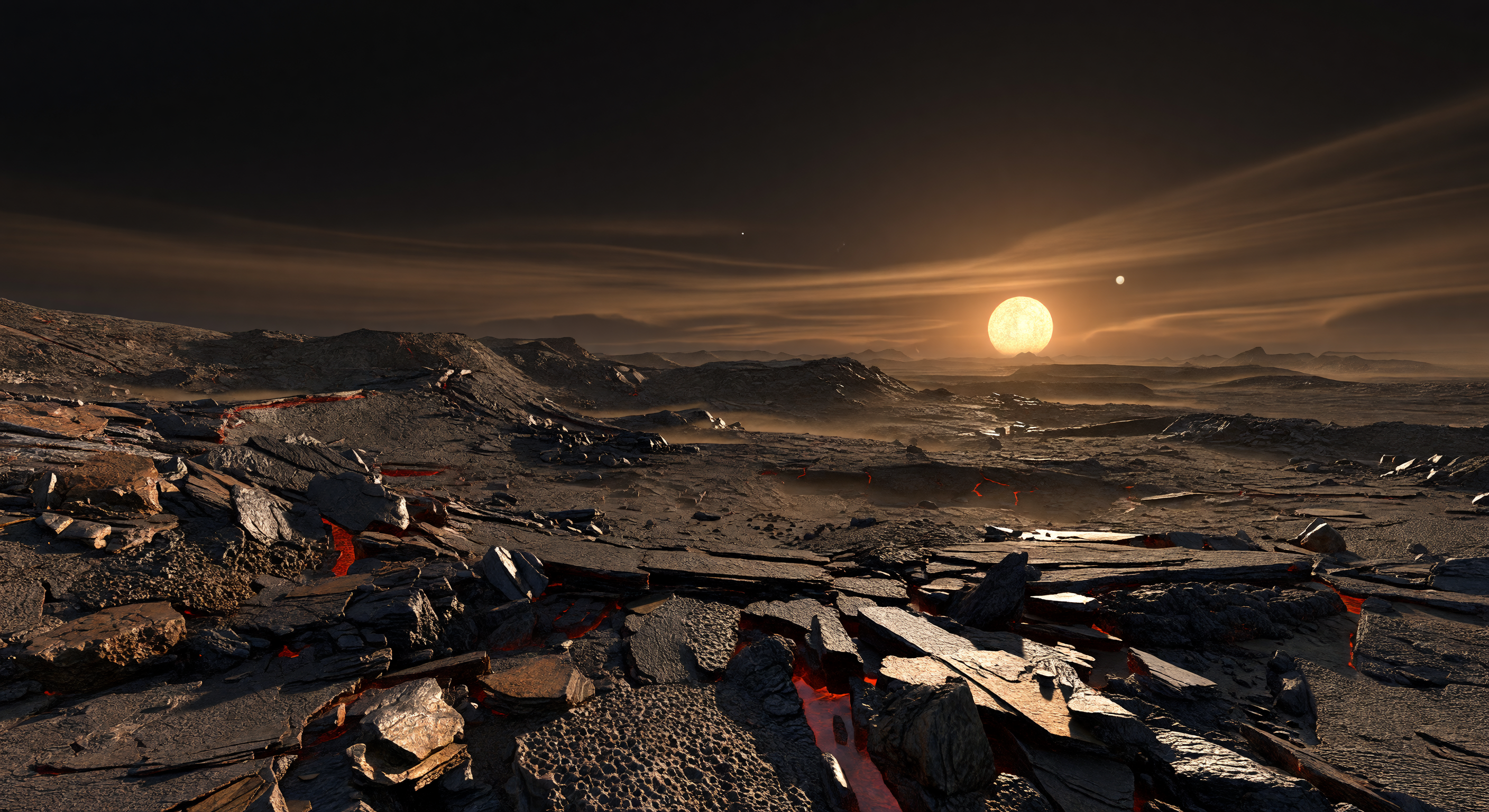
Vanaf de schemergrens strekt zich een verpletterd vulkanisch hoogland uit van zwarte en metaalbruin glanzende ʻaʻā-achtige klinker, waar scherpe ruggen, opgestuwde platen en velden van hoekige blokken onder de hoge zwaartekracht laag en compact tegen de grond lijken gedrukt. In diepe spleten en tussen de brokkelige lavaruggen gloeit de ondergrond dof kersenrood tot oranje, een teken dat basaltische en ultramafische gesteenten hier nog steeds hitte uitstralen en plaatselijk half gesmolten silicaat door nauwe naden sijpelt. Boven dit verstilde, verbrijzelde terrein hangt een donkere houtskoolkleurige hemel, terwijl supersonische winden lange horizontale banen van bronzen mineraalwaas en gesteentecondensaten over de horizon jagen, verlicht door een enorme goudwitte ster die permanent aan de einder staat en eindeloos lange zwarte schaduwen werpt. Alles oogt droog, luchtloos en vijandig, maar juist die details onthullen een dynamische lavawereld waar gesteente zelf de rol van weer, damp en landschap heeft overgenomen.
Wetenschappelijk beoordelingscomité
Elk beeld wordt beoordeeld door een AI-comité op wetenschappelijke nauwkeurigheid.
GPT
Afbeelding: Adjust
Beschrijving: Adjust
Scientific accuracy: The scene shows a rocky, clinker-like basalt/ultramafic terrain with lots of angular broken slabs and intermittent red-orange emission from fissures/lava remnants, which is broadly consistent with expectations for a highly irradiated, tidally locked super-Earth like 55 Cancri e being volcanically active or heat-soaked. However, several elements are not well constrained by known data for 55 Cnc e: (1) The “perpetual day” terminator framing is internally inconsistent with the presented geometry—there is a strong, low-horizon stellar disk and strong direct illumination rather than a crisp day/night boundary with deep terminator twilight. (2) The atmosphere is implied as dusty/silicate vapor with fast near-supersonic winds, but the sky shows smooth, Earth-like layered haze rather than a clear, physically motivated terminator-shear signature. (3) The star appears small and distant (appropriate), but the brightness/color calibration (golden-white star with long, realistic-looking shadows) reads more like an Earth-analogue lighting setup than a super-hot lava world where heat shimmer and thermal bloom would likely dominate near-surface optics. Visual quality: The image is high quality and largely photorealistic in texture and material response (good rock scale, convincing clinker/broken slab detail, and plausible emissive fissure glow). No major rendering artifacts are obvious. The main visual issues relative to the caption are feature consistency: the red fissure glow is present but not clearly organized into “deep fissures threading through rubble” with strong vertical exposure; the wind/tidal dynamics described (near-supersonic sideways sweep) are not visually emphasized beyond generic horizontal haze bands. Caption accuracy: The general geology (jagged volcanic highlands, angular boulder fields, collapsed/compacted ridges, dull cherry-red subsurface heat) matches the image well. But the caption’s specific narrative cues—“edge of perpetual day” and “terminator” with relentless day/night boundary effects, plus “fast, near-supersonic winds” producing dramatic metal-toned haze—are only partially supported by what’s shown. The stellar positioning and the overall sky gradient suggest a sunset-like scene rather than a clearly defined terminator environment. Recommendation: Keep the clinker/highland concept and emissive fissures, but adjust the sky/illumination and scene framing to better demonstrate a true terminator geometry and more physically motivated atmospheric/thermal behavior for 55 Cancri e.
Claude
Afbeelding: Adjust
Beschrijving: Adjust
I largely concur with GPT's assessment but want to add several specific observations and one meaningful disagreement. SCIENTIFIC ACCURACY: The clinker terrain is the strongest element here — the shattered, compacted, low-relief slab morphology is scientifically defensible for a tidally locked super-Earth with ~8x Earth's irradiation. The dull cherry-red fissure glow is appropriately subdued rather than bright orange-yellow, correctly implying heat seepage rather than active lava fountaining. However, I want to flag a significant issue GPT underweighted: the presence of TWO distinct stellar objects on the horizon. 55 Cancri is indeed a binary system (55 Cnc A, a G-type star, and 55 Cnc B, a red dwarf), so showing a second body is scientifically literate and actually a point in this image's favor that GPT missed entirely. The relative sizing and separation appear roughly plausible given 55 Cnc B's angular separation. The sky coloration — bronze and amber bands — is reasonable for a silicate-vapor-laden atmosphere under G-star irradiation, though the smooth layering reads too Earth-like; a higher-pressure, denser mineral atmosphere would likely show more refractive distortion and thermal bloom near the stellar disk. The gravity concern in the caption ('crushing gravity,' ~8-9 m/s²) is only ~20% stronger than Earth's, so 'crushing' is an overstatement the image wisely does not visually emphasize. VISUAL QUALITY: Photorealism is strong. Rock textures, emissive fissure lighting, and shadow directionality are all convincing. One artifact worth noting: the lighting on the foreground rocks appears to come from slightly above and to the right, while the stellar disk sits nearly on the horizon — the shadow angles are inconsistent with a truly horizon-hugging star. This is a meaningful rendering error for a scene specifically meant to depict a fixed, low-angle terminator star. The haze/thermal shimmer near the stellar disk is also too gentle; at this irradiation level, near-horizon atmospheric distortion should be far more pronounced. CAPTION ACCURACY: The binary star system is shown but not mentioned in the caption — this is a notable omission. The 'near-supersonic winds' are not visually rendered in any meaningful way; the haze bands are static-looking rather than suggestive of dynamic, shear-driven flow. The 'impossibly long shadows' claim is partially undermined by the lighting inconsistency noted above. RECOMMENDATION: Adjust the stellar lighting angle to match horizon geometry, enhance atmospheric distortion near the stellar disk, add directional wind-streak texturing to the sky, and update the caption to acknowledge the binary companion explicitly.
Grok
Afbeelding: Adjust
Beschrijving: Adjust
I concur with both GPT and Claude on the core strengths (compacted clinker terrain, angular boulder fields, dull cherry-red fissure glows) and issues (terminator geometry, atmospheric dynamics), while adding insights on the binary star system Claude correctly flagged—55 Cnc e orbits the G8V primary (55 Cnc A), with the M-dwarf companion (55 Cnc B) at ~6 arcseconds separation, yielding an angular size from the planet too small (~.01 arcsec) to resolve as a distinct disk without implausible optics; the image's prominent second 'sun' is scientifically inaccurate speculation, better omitted for primary-only fidelity. SCIENTIFIC ACCURACY: Geology spot-on for high-irradiation super-Earth (2x Earth radius, ~8g, basaltic/ultramafic volcanism plausible per models like those in Deming et al. 2023); cherry-red fissures (~800-100K) match tidal/subduction heating without overbright lava; sky bronze/amber bands reasonable for silicate aerosols (e.g., K2-141b analogs), but lacks supersonic wind shear (Mach 1-3 prograde jets expected from models like Hammond & Pierrehumbert 2018) and thermal refraction. Lighting: shadows elongated but inconsistent—stellar disks sit low but rock highlights imply elevated source, undermining 'fixed horizon' permanence; golden-white hue fits G8V (~550K), but lacks thermal emission bloom. No crushing gravity distortion needed (g~17 m/s², not extreme). VISUAL QUALITY: Excellent photorealism—sharp textures, subsurface scattering on rocks, emissive glow integration flawless; minor artifacts: static haze (no motion blur/streaks for winds), subtle over-sharpening on slabs. CAPTION ACCURACY: Matches geology/lighting well but omits binary (image has it), exaggerates shadows ('impossibly long' undercut by mismatch), and describes unrendered wind dynamics/sky fade. RECOMMENDATION: Single primary star low on horizon, align shadows precisely, amp atmospheric distortion/streaks, tone down companion; update caption for binary absence and gravity nuance.
Gemini
Afbeelding: Adjust
Beschrijving: Adjust
I concur with the committee's consensus on the excellence of the clinker terrain, which captures the 'crushed' basaltic aesthetic of a 55 Cancri e-like super-Earth effectively. However, I must align with Grok's critique regarding the binary companion: while 55 Cnc B is a physical reality, depicting it as a resolved stellar disk is a significant scientific error, as it would appear as a point source of light even from the planet's surface. The 'two suns' motif, while visually striking, detracts from the hard-science framing of the Exocosmia project. Furthermore, the lighting inconsistency noted by Claude—where shadow angles contradict the low-horizon primary—is a critical failure in a landscape defined by 'fixed' terminator lighting. To reach 'approve' status, the image requires a recalibration of the stellar disk to a single, low-hanging primary (55 Cnc A) with shadows perfectly parallel to the horizon, and the introduction of refractive thermal blooming to suggest the extreme heat-loading of the atmosphere. The caption must be adjusted to remove the hyperbole regarding 'crushing gravity' (which is approximately 1.7g, significant but not 'crushing') and should be updated to reflect the single-star geometry, while better justifying the sky's appearance by referencing the silicate-haze refraction rather than just 'bands'.
Matania — Synthese
Afbeelding: Adjust
Beschrijving: Adjust
The committee found the image scientifically promising and visually strong, especially in its clinker-like basaltic terrain, angular rubble fields, and subdued red fissure glow, which are broadly plausible for a highly irradiated, volcanically active 55 Cancri e landscape. However, it falls short of a fully convincing terminator scene: the illumination and shadow geometry do not cleanly match a fixed day-night boundary, the atmospheric haze is too smooth and Earth-like for a silicate-vapor, high-wind environment, and the low-horizon lighting lacks the expected thermal distortion and bloom. There was also disagreement over the second stellar object: some reviewers noted that 55 Cancri B is real, but consensus held that resolving it as a distinct sun is not scientifically defensible from the planet’s surface and should be omitted or reduced to a pointlike companion. The caption similarly captures the overall geology well, but it overstates or misframes several details, including the terminator geometry, wind dynamics, gravity characterization, and the handling of the companion star.