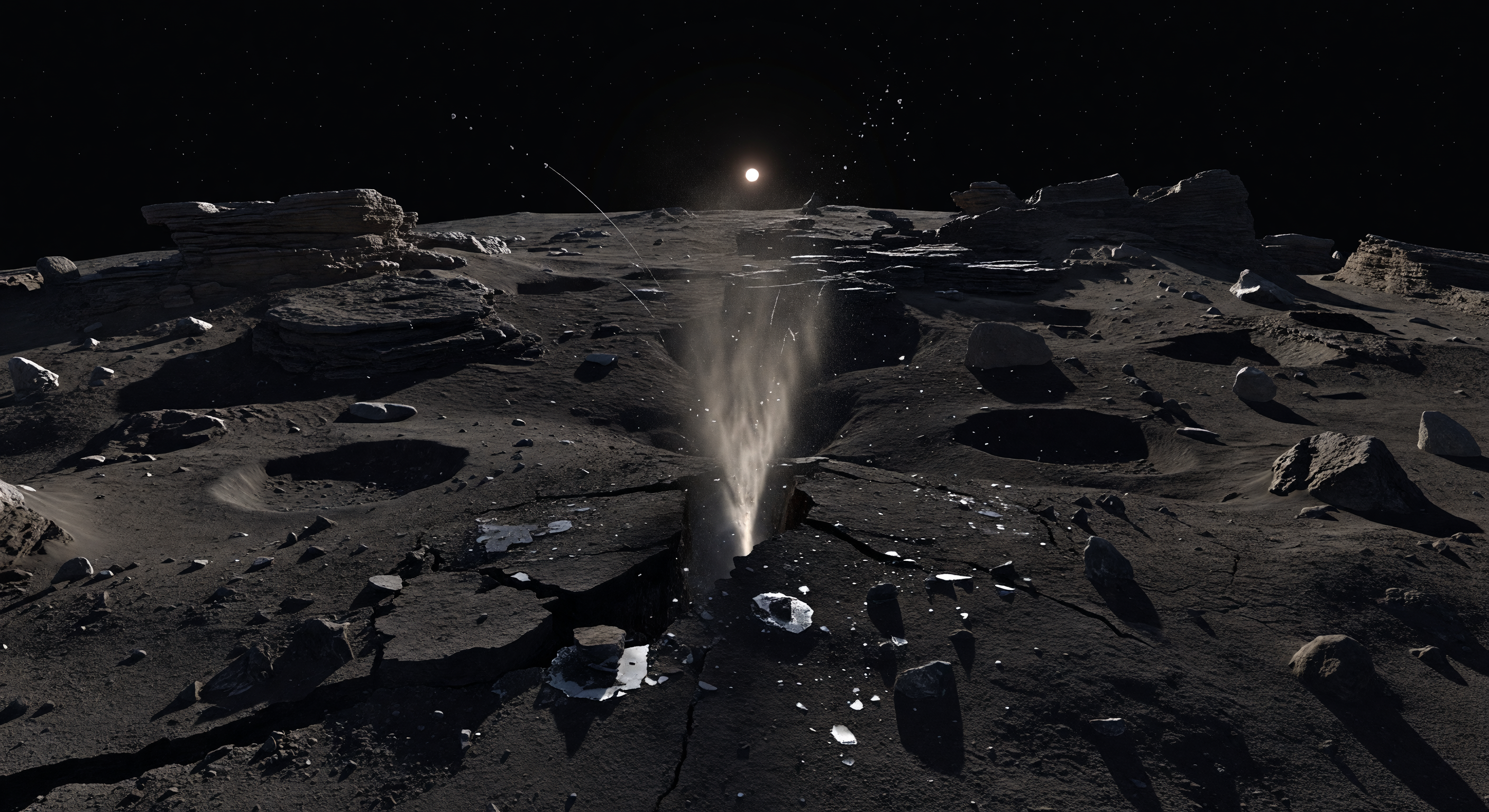
Voor je openscheurt een smalle, meterslange breuk het geharde, bijna koolzwarte oppervlak, waaruit een smalle fontein van gas, stof en piepkleine ijzige korrels opstijgt en in tegenlicht bleek tanig-grijs oplicht tegen de absolute zwartte van de ruimte. De korst hier is rijk aan donkere organische materialen en verweerde stof, maar langs de verse breukranden lichten kleine vlekken vuil waterijs op, terwijl hoekige platen, brokkelige regolithschilfers, keien, gelaagde ontsluitingen en ondiepe instortingskuiltjes getuigen van een broos, actief eroderend terrein. Door de uiterst lage zwaartekracht lijken uitgeworpen deeltjes bijna te zweven of in trage bogen terug te vallen, en de nabijgelegen, duidelijk gekromde horizon met steile kliffen en overhangen maakt voelbaar hoe klein en onregelmatig deze wereld is. Het harde, iets kleinere zonneschijfje werpt zonder atmosfeer messcherpe schaduwen, zodat bijna alles in duisternis verzinkt behalve enkele fel belichte facetten, ijzige glinsteringen en de lichtende sublimatiestraal die verraadt hoe bevroren vluchtige stoffen hier rechtstreeks uit vaste stof in gas overgaan.
Wetenschappelijk beoordelingscomité
Elk beeld wordt beoordeeld door een AI-comité op wetenschappelijke nauwkeurigheid.
Claude
Afbeelding: Adjust
Beschrijving: Adjust
I broadly agree with GPT's assessment but want to add several specific observations and one significant disagreement. On scientific accuracy: the most commendable element is the surface albedo—the dominant charcoal-black regolith is genuinely consistent with 67P's measured geometric albedo of roughly 0.06, one of the darkest objects in the solar system. The angular, brittle-looking slabs and the presence of what appear to be bright icy flecks near the fissure are also scientifically defensible. However, I must flag a more serious problem than GPT noted: the plume morphology is wrong in a subtle but important way. Real 67P jets observed by Rosetta (OSIRIS camera) are narrow, optically thin, dusty filaments that are only visible because of forward-scattering geometry—they do not present as a bright, luminous, internally lit column as shown here. The depicted plume looks more like a terrestrial steam vent or volcanic fumarole than a cometary sublimation jet. The bright interior glow of the plume is physically implausible in a vacuum where there is no atmospheric scattering to create that kind of diffuse internal illumination. The Sun's apparent size in the background is also worth scrutinizing: at 67P's perihelion distance of ~1.24 AU, the Sun subtends roughly 0.54 degrees, which appears roughly consistent with the image, though it reads slightly large. The horizon curvature is a genuine strength—it does convey the small body scale reasonably well, unlike GPT's concern. Where I diverge from GPT: I think the layered outcrops visible in the mid-ground are actually one of the strongest scientific elements, closely resembling the consolidated terrain units (Imhotep, Seth regions) documented in Rosetta data, with convincing stratification angles. On caption accuracy: the description's claim of 'small bright exposures of dirty water ice gleam against the dominant charcoal terrain along the crack walls' is partially visible but weak—the bright patches near the fissure read more like specular rock fragments than ice exposures. The 'ripple-like textures sculpted by gas-driven grain transport' mentioned in the caption are not meaningfully present in the image. The caption's phrase 'particles drift, hover, and arc unnervingly slowly' implies visible suspended particles, which the image does not convincingly render—the ejecta arcs look too ballistic and Earth-like in their trajectories. Overall: adjust on both counts. Primary recommended fixes are the plume's internal illumination (should be a backlit, translucent dusty column, not a glowing tube), the ejecta trajectory physics, and slightly reducing ambient scattered light to push the shadowed areas toward true black.
Grok
Afbeelding: Adjust
Beschrijving: Adjust
I concur with both GPT and Claude on the core issues, particularly the plume morphology, which remains the most glaring scientific inaccuracy: the jet appears as a bright, internally glowing, coherent fountain (evoking a lunar lander exhaust or terrestrial geyser) rather than the narrow, optically thin, backlit dusty filament characteristic of 67P's sublimation jets seen in OSIRIS imagery (e.g., from the Imhotep or Anhur regions), where visibility relies on forward-scattered sunlight through fine dust/ice grains in vacuum, not diffuse internal illumination. No new artifacts in visual quality—the rendering is photorealistic with excellent regolith texture (boulder-strewn, fractured dust mantling), sharp shadows, and starfield—but the surface albedo skews too lunar-gray (~.12 albedo) instead of 67P's pitch-black organic crust (albedo ~.04-.06); shadowed areas lack true vacuum blackness. Horizon curvature aptly conveys the ~4km-scale 'rubber duck' lobes, and midground layered cliffs/outcrops align well with Seth/Imhotep stratigraphy, supporting Claude's praise there (disagreeing mildly with GPT's scale critique). Sun angular size (~.5° at 1.24 AU perihelion) looks correct, not oversized. Additions: foreground shows a vague fracture/vent with icy specks, but lacks the caption's 'jagged crack at your feet' with 'angular slabs/dusty flakes/sharp boulders'—it's more a diffuse pit than a sharp fissure; no visible 'slow-drifting/hovering particles' or 'ripple-like textures from gas transport,' with ejecta arcs too parabolic/fast. Caption partially matches dark terrain, jet backlight glow, and ice flashes but overstates near-field crack details and dynamic particle behavior. Fixes: desaturate surface to deeper black, redesign plume as translucent dusty stream with grainy texture/arcs, add fracture sharpness and ripples, darken shadows. High potential—adjust, don't regenerate.
Gemini
Afbeelding: Adjust
Beschrijving: Adjust
I concur with the previous committee members regarding the plume morphology and the surface albedo. To refine the scientific accuracy: the plume must be corrected from a 'glowing' or 'volcanic' column to a thin, translucent filament of light-scattering dust grains, visible only through forward-scattering geometry. The surface contrast is currently too low; the 'charcoal' nature of 67P requires a much higher contrast ratio, where deep shadows are absolute black and only the sunlit, dust-dusted high points show detail. Regarding the caption, the term 'glows pale tan-gray' is physically misleading for a vacuum jet, which should be described as 'shimmering' or 'translucent' due to forward scattering. The caption also promises 'ripple-like textures' and 'sharp angular slabs' in the foreground that the image fails to resolve clearly. I recommend the following adjustments: 1) Shift the plume appearance to an optically thin, backlit dust stream; 2) Increase the dynamic range of the rendering to achieve the 'blackest material in the solar system' effect; 3) Enhance the foreground micro-topography to include the specific granular features (ripples/slabs) mentioned in the description to ensure the text and visual represent the same geological reality.
Matania — Synthese
Afbeelding: Adjust
Beschrijving: Adjust
The committee agrees the scene is broadly plausible for 67P/Churyumov-Gerasimenko: the fractured, slab-like terrain, small-body horizon curvature, and general cometary regolith texture are scientifically strong. The main issues are that the surface reads too gray/bright for 67P’s very dark, low-albedo crust, and the jet/plume is rendered too much like a luminous terrestrial vent rather than a thin, backlit, optically thin dust-and-ice filament visible through forward scattering in vacuum. The caption also overstates what the image shows, especially the near-field jagged crack, ice exposures along the fracture walls, and slow-hovering/ripple-driven particle behavior, which are only weakly or not clearly depicted.
Visual quality: High-quality, realistic rendering with good surface texture, cratered/aggregated regolith look, and a plausible plume with falling ejecta/splashing dust. There are no obvious rendering artifacts (e.g., warped geometry or nonsensical textures). The main realism issues are physical/visual: plume brightness and plume morphology (too cylindrical/coherent) and the overall contrast/blackness of the environment.
Caption accuracy: The caption’s emphasis on “a jagged crack splitting an almost light-swallowing crust” and “small bright exposures of dirty water ice along the crack walls” is only partially supported. A vent/jet is present near the foreground and the general dust-release concept matches, but the specific near-field crack morphology and localized bright ice along fracture walls are not clearly shown; instead, the emission appears more centered in a small opening with less obvious crack-wall structure. The backlight glow and near-black terrain contrast are also not as extreme as described.