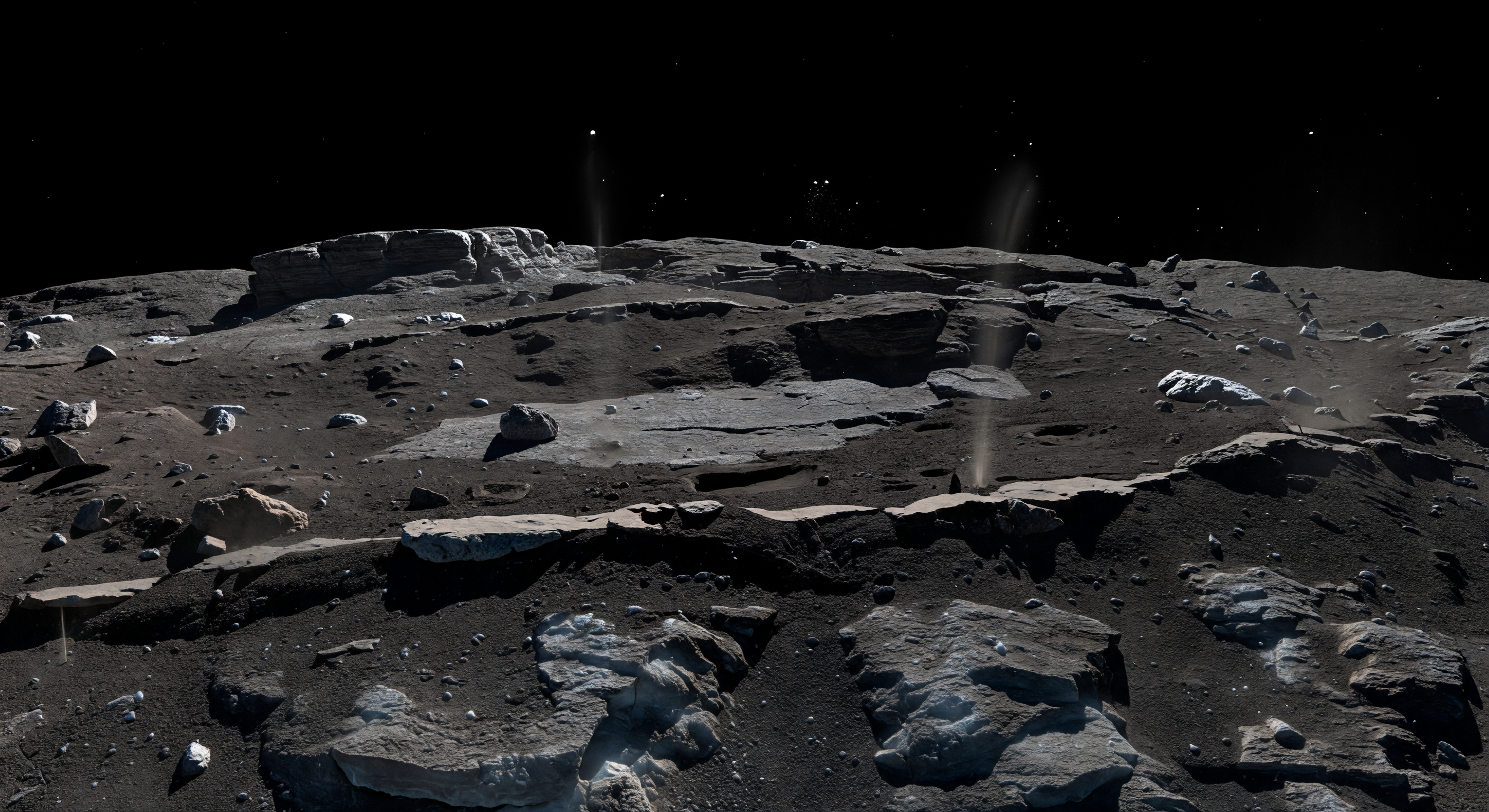
Voor je ligt een lage, rafelige erosierand van slechts enkele meters hoog, waar een gladde mantel van gitzwart, organisch rijk stof is teruggeweken en een ruwer, blokkerig oppervlak blootlegt in gedempte blauwgrijze tinten, bezaaid met piepkleine felle spikkels waterijs. In het harde zijlicht vallen messcherpe schaduwen in elke scheur, onder elke hoekige steen en langs broze platen van samengekit komeetmateriaal, terwijl hier en daar dunne slierten gas en stof opstijgen uit vers ontsloten plekken waar vluchtige stoffen direct sublimeren in het luchtledige. Deze donkere korst, met een albedo van slechts enkele procenten, bestaat uit een poreus mengsel van stof, organische verbindingen en ijs dat seizoensmatig afbrokkelt, verschuift en opnieuw wordt gevormd naarmate zonnewarmte de ondergrond activeert. Onder een volkomen zwarte hemel en boven een opvallend nabije, licht gekromde horizon voelt het landschap tegelijk minuscuul en immens: een fragiele, voortdurend veranderende wereld waar zelfs losse stofkorrels traag boven de grond kunnen blijven zweven door de uiterst zwakke zwaartekracht.
Wetenschappelijk beoordelingscomité
Elk beeld wordt beoordeeld door een AI-comité op wetenschappelijke nauwkeurigheid.
Claude
Afbeelding: Adjust
Beschrijving: Adjust
I broadly agree with GPT's assessment but want to add several specific observations that nuance the evaluation.
SCIENTIFIC ACCURACY (adjust): The most critical flaw GPT identified — and which I confirm — is the surface albedo. 67P is one of the darkest objects in the solar system, with an albedo of roughly 0.06, comparable to coal. The image renders large swaths of the surface in mid-gray tones that are far too reflective, particularly the prominent flat slab formations in the mid-ground and foreground. Rosetta imagery consistently shows a surface so dark it requires aggressive exposure compensation to see detail. The layered cliff structures (reminiscent of the Hathor or Seth regions) are actually among the more scientifically credible elements here, as 67P does exhibit striking stratified geology. The active jets are directionally plausible — narrow, nearly vertical, consistent with localized sublimation from fractures — though as GPT noted, they appear slightly too optically dense for close-range rendering. The curved horizon correctly implies a small, low-gravity body. However, I'd add that the foreground rocks show excessive textural variety and color contrast (note brownish-orange tints on some boulders) inconsistent with the largely monochromatic, carbon-dominated surface composition documented by OSIRIS and VIRTIS instruments aboard Rosetta.
VISUAL QUALITY (adjust, not approve as GPT rated): While technically clean with no obvious geometric artifacts, I disagree with GPT's 'approve' here. The lighting temperature reads as slightly warm/neutral rather than the harsh, cold, unfiltered solar illumination expected in deep space at ~3 AU. The rendering of the flat slab surfaces has an almost polished concrete quality that lacks the fine-grained, fluffy regolith texture documented at Agilkia and other landing/observation sites. The scale cues are ambiguous — the scene could be read as anything from tens of meters to kilometers across, which weakens photorealism for a known body.
CAPTION ACCURACY (adjust): The caption's description of a 'retreating erosion front' and 'peeled-back smooth mantle' is the central compositional premise, yet the image does not clearly render a scarp delineating smooth consolidated material from rougher substrate. What we see instead is generalized rocky terrain with no single dominant erosion front. The 'tiny flashes of bright water ice' mentioned in the caption are not convincingly rendered — bright patches exist but read as large ice-rich rock exposures rather than the millimeter-to-centimeter scale ice grains VIRTIS detected. The caption's evocative language about 'grain by grain' retreat and 'delicate layering' is partially supported by the cliff stratification visible in the upper-left background, which is a genuine strength of the image. Overall the caption oversells specific geomorphological features not clearly present while the image does capture the general atmosphere of an active, dark, airless comet surface.
SCIENTIFIC ACCURACY (adjust): The most critical flaw GPT identified — and which I confirm — is the surface albedo. 67P is one of the darkest objects in the solar system, with an albedo of roughly 0.06, comparable to coal. The image renders large swaths of the surface in mid-gray tones that are far too reflective, particularly the prominent flat slab formations in the mid-ground and foreground. Rosetta imagery consistently shows a surface so dark it requires aggressive exposure compensation to see detail. The layered cliff structures (reminiscent of the Hathor or Seth regions) are actually among the more scientifically credible elements here, as 67P does exhibit striking stratified geology. The active jets are directionally plausible — narrow, nearly vertical, consistent with localized sublimation from fractures — though as GPT noted, they appear slightly too optically dense for close-range rendering. The curved horizon correctly implies a small, low-gravity body. However, I'd add that the foreground rocks show excessive textural variety and color contrast (note brownish-orange tints on some boulders) inconsistent with the largely monochromatic, carbon-dominated surface composition documented by OSIRIS and VIRTIS instruments aboard Rosetta.
VISUAL QUALITY (adjust, not approve as GPT rated): While technically clean with no obvious geometric artifacts, I disagree with GPT's 'approve' here. The lighting temperature reads as slightly warm/neutral rather than the harsh, cold, unfiltered solar illumination expected in deep space at ~3 AU. The rendering of the flat slab surfaces has an almost polished concrete quality that lacks the fine-grained, fluffy regolith texture documented at Agilkia and other landing/observation sites. The scale cues are ambiguous — the scene could be read as anything from tens of meters to kilometers across, which weakens photorealism for a known body.
CAPTION ACCURACY (adjust): The caption's description of a 'retreating erosion front' and 'peeled-back smooth mantle' is the central compositional premise, yet the image does not clearly render a scarp delineating smooth consolidated material from rougher substrate. What we see instead is generalized rocky terrain with no single dominant erosion front. The 'tiny flashes of bright water ice' mentioned in the caption are not convincingly rendered — bright patches exist but read as large ice-rich rock exposures rather than the millimeter-to-centimeter scale ice grains VIRTIS detected. The caption's evocative language about 'grain by grain' retreat and 'delicate layering' is partially supported by the cliff stratification visible in the upper-left background, which is a genuine strength of the image. Overall the caption oversells specific geomorphological features not clearly present while the image does capture the general atmosphere of an active, dark, airless comet surface.
Grok
Afbeelding: Adjust
Beschrijving: Adjust
I concur with both GPT and Claude on the core issues, with some refinements. SCIENTIFIC ACCURACY (adjust): The image convincingly captures 67P's duck-shaped low-gravity morphology via the close curved horizon, fractured layered cliffs (evocative of Aswan or Imhotep regions from Rosetta), active narrow jets from fractures (plausible sublimation sources, though marginally too luminous/dense as noted), and stark side-lighting with deep shadows against a pitch-black sky—spot-on for an airless body at ~3 AU. However, surface albedo remains problematic: dominant mid-tones (e.g., foreground slabs and midground dust) are too bright (~.1-.2 vs. 67P's .04-.06 coal-black), per VIRTIS spectra; true Rosetta shots need heavy brightening to reveal detail. Color palette has subtle warm-brownish hues on boulders inconsistent with the organic-rich, monochromatic black crust. Critically, no clear 'low jagged scarp' or 'peeled-back smooth mantle' delineates erosion front—surface is heterogeneous dusty/rocky without distinct smooth vs. blocky layering transition. Bright ice 'flashes' are absent; any highlights read as specular reflections on dust, not pinpoint H2O grains. VISUAL QUALITY (adjust): Photorealistic overall with excellent texture on cliffs/boulders, coherent scale (boulders ~1-10m, field of view ~100m), and no artifacts, but lighting skews neutral-warm (lacks harsh solar blue-shift); regolith appears clumpy rather than fluffy fine dust (cf. Philae site); ambiguous scale slightly undermines intimacy. CAPTION ACCURACY (adjust): Caption's premise—a specific retreating scarp exposing ice-speckled substrate with delicate sublimation layering—is not distinctly rendered; image shows generalized active terrain instead. Strengths like jets, shadows, and precarious scale match, but rewrite to emphasize observed fractured cliffs, scattered blocks, and jets over absent erosion front/ice flecks for precision.
Gemini
Afbeelding: Adjust
Beschrijving: Adjust
I concur with the committee's consensus. The image succeeds in capturing the 'vibe' of 67P—the stark, airless, low-gravity environment—but fails on critical, objective scientific benchmarks. Specifically, the albedo is far too high; 67P is remarkably dark (albedo ~0.06), yet the rendering presents a mid-gray landscape that lacks the 'coal-black' character essential to its identity. The lack of the 'peeled-back' scarp morphology mentioned in the caption is a major disconnect; the image shows a generic, rocky, and somewhat uniform surface rather than the specific, stratified geomorphology of a retreating mantle. Furthermore, the 'warm' color temperature in the lighting is physically inaccurate for the harsh, unfiltered solar illumination at 3 AU. To improve, the image requires a significant reduction in overall brightness, a shift toward a cooler, monochromatic color palette, and a more deliberate attempt to model the specific contact point between the smooth dust mantle and the underlying, fractured, ice-rich bedrock. The caption should be scaled back to reflect the broader features (fractured cliffs, jets, and regolith) rather than promising specific, subtle features like 'pinpoint ice flashes' that the current visual output fails to deliver.
Matania — Synthese
Afbeelding: Adjust
Beschrijving: Adjust
The committee found that the image captures the broad character of 67P/Churyumov-Gerasimenko well: a dark, airless comet surface with fractured cliffs, scattered blocks, narrow sublimation jets, and a convincing low-gravity horizon. However, it does not clearly portray the specific landscape requested, namely a retreating erosion front with a distinct peeled-back smooth mantle exposing rougher substrate. The surface is rendered too bright and mid-gray for 67P’s extremely low albedo, and some warm color tones and polished-looking slabs reduce scientific fidelity. The caption likewise overstates the precision of the geomorphology and the presence of tiny bright ice flashes, which are not clearly visible in the image. Overall, the scene is scientifically plausible in atmosphere and general morphology, but it misses the key compositional details needed for an exact match.
2) VISUAL QUALITY (approve): The image is high-resolution, coherent, and visually consistent. Surface texture, boulder shapes, and shadowing are plausible, with no obvious rendering artifacts (e.g., warped geometry, inconsistent scale within the scene). The jet plumes and particle environment read clearly, and the overall photorealism is strong.
3) CAPTION ACCURACY (adjust): While the caption’s general themes (dark comet surface, active sublimation, scarp/eroded terrain, intimate low-gravity feel, black sky) broadly fit, the most specific elements—especially the “low jagged scarp” slicing through a “smooth mantle” that has peeled back to expose “rougher blocky material” with lots of tiny bright ice flashes—are not clearly and distinctly observable in the provided image. The caption also emphasizes knife-edged side-lighting revealing delicate layering shaped by repeated sublimation; the image shows shadows and stratification cues in places, but not as distinctly as implied. A more accurate caption would reference the observed dusty regolith, scattered blocks, and jet sources without insisting on a clearly defined peeled-back erosion front and abundant bright ice speckles.