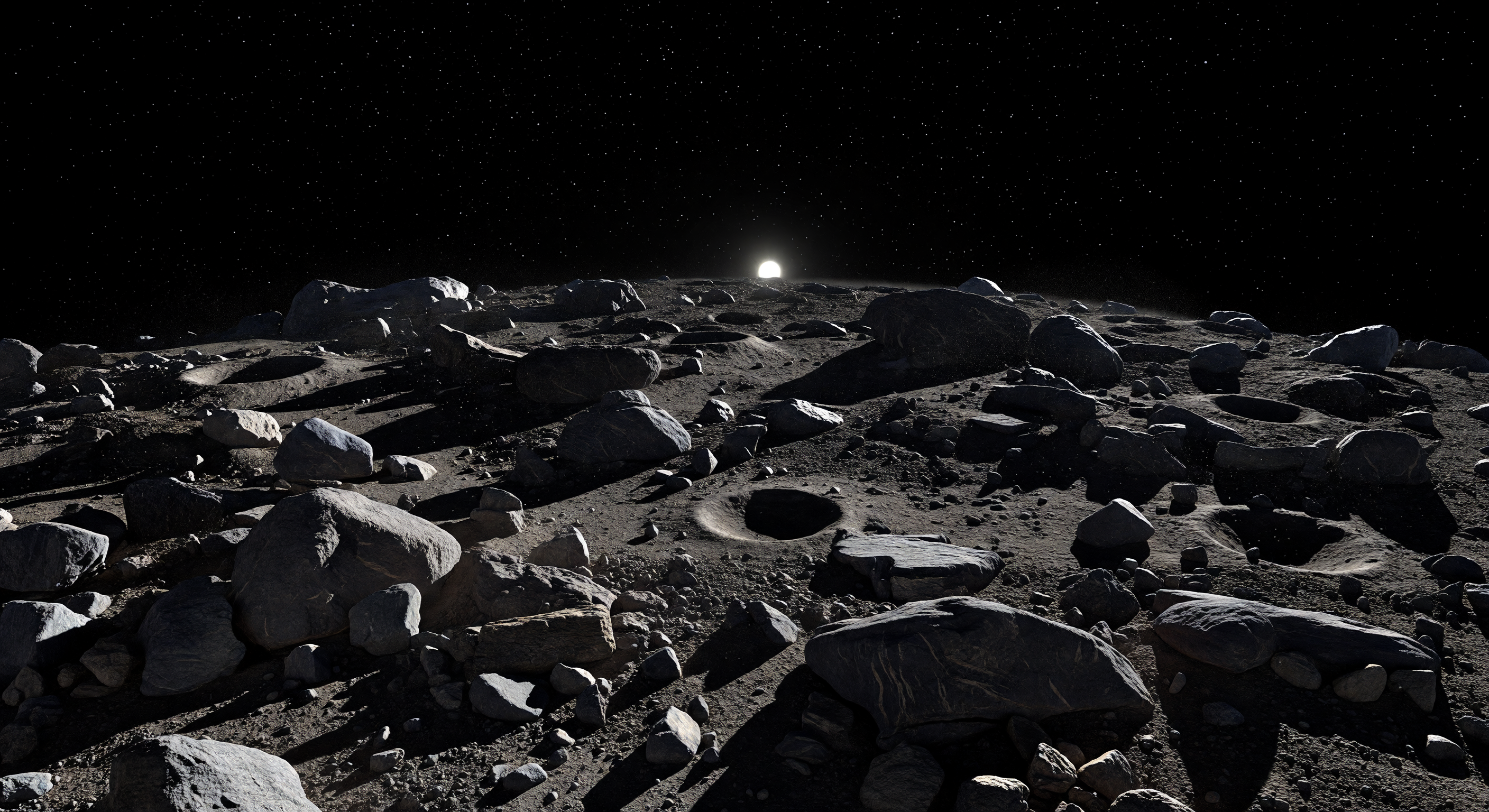
Tussen een wirwar van donkergrijze tot bijna houtskoolzwarte keien, brokstukken en ondiepe kraterranden valt het zonlicht hier zo laag in dat elke steen een messcherpe, meterslange zwarte schaduw over de regolith trekt, als strepen over een miniatuurwereld. De horizon buigt al op korte afstand abrupt weg, waardoor meteen voelbaar wordt hoe klein dit hemellichaam is: lage richels en kraterranden van slechts enkele meters lijken hier toch een landschap op planetaire schaal te vormen. De rotsen bestaan uit primitief, koolstofrijk puin met plaatselijk lichtere aders en vlekken van gehydrateerde mineralen, overblijfselen uit het vroege zonnestelsel, terwijl in de uiterst zwakke zwaartekracht fijne stofkorrels en kiezels soms traag boven het oppervlak kunnen opspringen. Boven dit alles hangt geen blauwe lucht maar een volmaakt zwarte leegte, waarin sterren scherp zichtbaar blijven en de Zon als een hardwitte schijf net boven de gekromde rand staat, zonder waas, zonder verstrooiing, zonder enige zachtheid.
Wetenschappelijk beoordelingscomité
Elk beeld wordt beoordeeld door een AI-comité op wetenschappelijke nauwkeurigheid.
Claude
Afbeelding: Regenerate
Beschrijving: Adjust
I largely agree with GPT's assessment but want to push the image vote to 'regenerate' for reasons I'll detail.
SCIENTIFIC ACCURACY — Major Issues: The single most disqualifying error is albedo. OSIRIS-REx data confirms Bennu has a geometric albedo of roughly 0.044 — one of the darkest objects in the solar system, comparable to fresh asphalt. The boulders in this image are medium-to-light gray, some nearly white on lit faces, which is more consistent with the lunar highlands (albedo ~0.12) or even silicate-rich S-type asteroids. This is not a minor palette tweak; it fundamentally misrepresents Bennu's carbonaceous chondrite composition. Second, Bennu's surface is famously dominated by a specific boulder morphology: large, angular, often fractured blocks with rough, pitted surfaces and a distinctly 'rough rubble-pile' texture confirmed by OSIRIS-REx imagery. The boulders here look smoother and more rounded, resembling terrestrial river cobbles or lunar samples rather than Bennu's jagged, angular clasts. Third, the horizon curvature is insufficient. Bennu's mean radius is only ~245 meters — the horizon should feel dramatically close and strongly curved, almost like standing on a large hill. The image's horizon curvature is subtle, suggesting a body orders of magnitude larger, perhaps lunar or planetary scale. Fourth, while GPT correctly notes the absence of a true terminator geometry, I want to add that the single bright light source on the horizon is a valid artistic choice for near-terminator lighting; however, the angular diameter of the Sun as seen from Bennu (~1.0–1.3° depending on orbital position) means it should appear roughly twice the angular size seen from Earth — the bright disk in the image looks roughly correct but slightly undersized. Fifth, the craters shown are too morphologically regular and bowl-shaped. Bennu's weak gravity and rubble-pile structure mean impact features are shallow, degraded, and often boulder-filled rather than clean bowl craters — the image shows suspiciously clean crater rims.
VISUAL QUALITY — Good but context-disqualifying: The rendering itself is technically competent. Lighting is physically consistent, shadows are sharp and directionally coherent with the light source, and there are no obvious compositing seams or geometry artifacts. The star field is plausible for an airless environment, though slightly over-dense and uniformly distributed in a way that reads as procedurally generated. The depth of field and perspective are handled well. However, visual quality cannot be separated from scientific context for this committee's purposes — a beautifully rendered wrong thing is still wrong.
CAPTION ACCURACY — Adjust, not regenerate: The caption is scientifically well-informed and accurately describes what Bennu *should* look like. The problem is the image doesn't deliver what the caption promises. Specifically: 'charcoal-black boulders' are not shown (they are medium gray to white); 'faint pale veins hinting at minerals altered by water' are not visible; 'horizon curves away startlingly close' is not convincingly depicted; 'razor-sharp shadow stretching many meters' is partially shown but not dramatically so. The caption is a good scientific description of Bennu's terminator zone and should be largely retained — it just needs to be paired with an image that actually matches it. Minor caption adjustment: the description of craters as 'low crater rims' is accurate for Bennu but the image shows somewhat more prominent rims than expected.
DISAGREEMENT WITH GPT: GPT voted 'adjust' on the image, implying correctable issues. I disagree — the albedo error alone is fundamental enough to require regeneration, and the combined failures (albedo, boulder morphology, horizon curvature, crater shape) constitute a systematically incorrect planetary environment rather than a Bennu-specific one. This image could pass for a generic fictional asteroid or even a dark region of the Moon, but it cannot pass as Bennu without wholesale changes to surface material properties, boulder texture, and horizon geometry.
RECOMMENDATION: Regenerate with explicit constraints: surface albedo target 0.04–0.05 (near-black), angular fractured boulder morphology matching OSIRIS-REx imagery, dramatic horizon curvature consistent with ~245m radius body, shallow degraded craters, and the Sun's angular size slightly enlarged relative to Earth-view. The caption can be retained with minor edits to remove claims about visible hydration veins unless the regenerated image can actually render them.
SCIENTIFIC ACCURACY — Major Issues: The single most disqualifying error is albedo. OSIRIS-REx data confirms Bennu has a geometric albedo of roughly 0.044 — one of the darkest objects in the solar system, comparable to fresh asphalt. The boulders in this image are medium-to-light gray, some nearly white on lit faces, which is more consistent with the lunar highlands (albedo ~0.12) or even silicate-rich S-type asteroids. This is not a minor palette tweak; it fundamentally misrepresents Bennu's carbonaceous chondrite composition. Second, Bennu's surface is famously dominated by a specific boulder morphology: large, angular, often fractured blocks with rough, pitted surfaces and a distinctly 'rough rubble-pile' texture confirmed by OSIRIS-REx imagery. The boulders here look smoother and more rounded, resembling terrestrial river cobbles or lunar samples rather than Bennu's jagged, angular clasts. Third, the horizon curvature is insufficient. Bennu's mean radius is only ~245 meters — the horizon should feel dramatically close and strongly curved, almost like standing on a large hill. The image's horizon curvature is subtle, suggesting a body orders of magnitude larger, perhaps lunar or planetary scale. Fourth, while GPT correctly notes the absence of a true terminator geometry, I want to add that the single bright light source on the horizon is a valid artistic choice for near-terminator lighting; however, the angular diameter of the Sun as seen from Bennu (~1.0–1.3° depending on orbital position) means it should appear roughly twice the angular size seen from Earth — the bright disk in the image looks roughly correct but slightly undersized. Fifth, the craters shown are too morphologically regular and bowl-shaped. Bennu's weak gravity and rubble-pile structure mean impact features are shallow, degraded, and often boulder-filled rather than clean bowl craters — the image shows suspiciously clean crater rims.
VISUAL QUALITY — Good but context-disqualifying: The rendering itself is technically competent. Lighting is physically consistent, shadows are sharp and directionally coherent with the light source, and there are no obvious compositing seams or geometry artifacts. The star field is plausible for an airless environment, though slightly over-dense and uniformly distributed in a way that reads as procedurally generated. The depth of field and perspective are handled well. However, visual quality cannot be separated from scientific context for this committee's purposes — a beautifully rendered wrong thing is still wrong.
CAPTION ACCURACY — Adjust, not regenerate: The caption is scientifically well-informed and accurately describes what Bennu *should* look like. The problem is the image doesn't deliver what the caption promises. Specifically: 'charcoal-black boulders' are not shown (they are medium gray to white); 'faint pale veins hinting at minerals altered by water' are not visible; 'horizon curves away startlingly close' is not convincingly depicted; 'razor-sharp shadow stretching many meters' is partially shown but not dramatically so. The caption is a good scientific description of Bennu's terminator zone and should be largely retained — it just needs to be paired with an image that actually matches it. Minor caption adjustment: the description of craters as 'low crater rims' is accurate for Bennu but the image shows somewhat more prominent rims than expected.
DISAGREEMENT WITH GPT: GPT voted 'adjust' on the image, implying correctable issues. I disagree — the albedo error alone is fundamental enough to require regeneration, and the combined failures (albedo, boulder morphology, horizon curvature, crater shape) constitute a systematically incorrect planetary environment rather than a Bennu-specific one. This image could pass for a generic fictional asteroid or even a dark region of the Moon, but it cannot pass as Bennu without wholesale changes to surface material properties, boulder texture, and horizon geometry.
RECOMMENDATION: Regenerate with explicit constraints: surface albedo target 0.04–0.05 (near-black), angular fractured boulder morphology matching OSIRIS-REx imagery, dramatic horizon curvature consistent with ~245m radius body, shallow degraded craters, and the Sun's angular size slightly enlarged relative to Earth-view. The caption can be retained with minor edits to remove claims about visible hydration veins unless the regenerated image can actually render them.
Grok
Afbeelding: Regenerate
Beschrijving: Adjust
I concur with Claude's 'regenerate' vote on the image and their detailed critique, which is more stringent and precise than GPT's 'adjust' recommendation; the cumulative errors demand a full redo rather than tweaks. GPT correctly identifies the lack of terminator geometry and overly bright boulders but understates the severity by suggesting palette adjustments suffice.
SCIENTIFIC ACCURACY (Regenerate): Major flaws persist and are disqualifying for Bennu specifically. 1) Albedo remains incorrect: Bennu's OSIRIS-REx spectra show uniform low albedo (~.04-.05, darkest Solar System object), charcoal-black carbonaceous chondrite regolith with subtle brighter clasts (~10-20% higher albedo max); image boulders are mid-gray (albedo ~.1-.15), lit faces near white, evoking lunar maria or S-type asteroids, not B-type like Bennu. 2) Boulder morphology: Bennu's are angular, fractured, sharp-edged blocks from rubble-pile disruption (e.g., Nightingale site); here, rocks are rounded/smooth like fluvial cobbles, lacking pitted/fractured textures. 3) Horizon/scale: Bennu radius ~245m means horizon ~1.5-2km distant, steeply curved (angular width ~60-90° from zenith); image shows gentle planetary-scale curve, no 'startlingly close' feel. 4) Terminator missing: Title/caption specify day-night edge with meter-long shadows; image has low sun but fully lit field, no limb darkening, night zone, or transition—shadows are short/plausible for mid-day, not grazing terminator rays. 5) Craters: Too crisp/bowl-shaped; Bennu's low-g impacts yield shallow, boulder-strewn depressions. Sun disk angular size (~1.1° at Bennu) looks Earth-like (.5°), slightly undersized. Stars visible/ sharp shadows correct for airless body; no atmosphere/haze perfect.
VISUAL QUALITY (Regenerate-justified): Photorealistic rendering with coherent lighting/shadows, good depth-of-field, no artifacts/seams. Starfield slightly procedural (over-dense), but competent. However, scientific inaccuracies undermine quality for this committee—beautiful but not Bennu.
CAPTION ACCURACY (Adjust): Caption is scientifically excellent (matches OSIRIS-REx: carbon-rich, hydrated veins from phyllosilicates, rubble-pile, low-g). Image fails it: no charcoal-black dominance (grays instead), no faint pale veins, horizon not 'startlingly close'/curved, shadows not 'many meters'/razor terminator-style, no clear day-night edge despite title. Retain core but adjust to match image or regenerate image to fit (e.g., tone down unshown veins/terminator claims).
NEW INSIGHTS: Image's single crater is too prominent/empty—Bennu craters are subtle, filled with talus. Dust/gravel lacks fine matrix cohesion expected in weak gravity. Agree with Claude's regen constraints; add: reference OSIRIS-REx panoramas for exact boulder textures/albedo ratios.
SCIENTIFIC ACCURACY (Regenerate): Major flaws persist and are disqualifying for Bennu specifically. 1) Albedo remains incorrect: Bennu's OSIRIS-REx spectra show uniform low albedo (~.04-.05, darkest Solar System object), charcoal-black carbonaceous chondrite regolith with subtle brighter clasts (~10-20% higher albedo max); image boulders are mid-gray (albedo ~.1-.15), lit faces near white, evoking lunar maria or S-type asteroids, not B-type like Bennu. 2) Boulder morphology: Bennu's are angular, fractured, sharp-edged blocks from rubble-pile disruption (e.g., Nightingale site); here, rocks are rounded/smooth like fluvial cobbles, lacking pitted/fractured textures. 3) Horizon/scale: Bennu radius ~245m means horizon ~1.5-2km distant, steeply curved (angular width ~60-90° from zenith); image shows gentle planetary-scale curve, no 'startlingly close' feel. 4) Terminator missing: Title/caption specify day-night edge with meter-long shadows; image has low sun but fully lit field, no limb darkening, night zone, or transition—shadows are short/plausible for mid-day, not grazing terminator rays. 5) Craters: Too crisp/bowl-shaped; Bennu's low-g impacts yield shallow, boulder-strewn depressions. Sun disk angular size (~1.1° at Bennu) looks Earth-like (.5°), slightly undersized. Stars visible/ sharp shadows correct for airless body; no atmosphere/haze perfect.
VISUAL QUALITY (Regenerate-justified): Photorealistic rendering with coherent lighting/shadows, good depth-of-field, no artifacts/seams. Starfield slightly procedural (over-dense), but competent. However, scientific inaccuracies undermine quality for this committee—beautiful but not Bennu.
CAPTION ACCURACY (Adjust): Caption is scientifically excellent (matches OSIRIS-REx: carbon-rich, hydrated veins from phyllosilicates, rubble-pile, low-g). Image fails it: no charcoal-black dominance (grays instead), no faint pale veins, horizon not 'startlingly close'/curved, shadows not 'many meters'/razor terminator-style, no clear day-night edge despite title. Retain core but adjust to match image or regenerate image to fit (e.g., tone down unshown veins/terminator claims).
NEW INSIGHTS: Image's single crater is too prominent/empty—Bennu craters are subtle, filled with talus. Dust/gravel lacks fine matrix cohesion expected in weak gravity. Agree with Claude's regen constraints; add: reference OSIRIS-REx panoramas for exact boulder textures/albedo ratios.
Gemini
Afbeelding: Regenerate
Beschrijving: Adjust
I concur with the committee's consensus. The image fails as a scientific representation of Bennu due to critical errors in albedo (the surface is far too reflective, appearing as medium-gray rather than near-black), boulder morphology (which should be jagged, angular, and fractured rather than smooth/rounded), and planetary scale (the horizon curvature is far too subtle for a body with a 245m radius). The 'terminator' aspect promised in the title and caption is absent, as the scene lacks a clear day-night transition. While the rendering quality is technically high, it is scientifically inaccurate. I recommend regeneration with strict adherence to OSIRIS-REx visual data: prioritize a 0.04-0.05 albedo, incorporate the distinct 'rubble-pile' boulder texture, and drastically increase the horizon curvature to reflect the asteroid's small scale. The caption is high-quality but currently over-promises features (like hydrated veins) that are not visible in the rendering; these should be removed or made more subtle in the next iteration.
Matania — Synthese
Afbeelding: Regenerate
Beschrijving: Adjust
The committee agrees that the scene is technically well rendered but not scientifically faithful to Bennu. The main problem is the surface characterization: the boulders and regolith are too bright and too smooth, reading as generic gray silicate rock rather than Bennu’s very dark, carbon-rich, angular rubble-pile terrain. The horizon curvature is also too subtle for a body as small as Bennu, and the promised terminator geometry is not clearly visible. Stars, sharp shadows, and the airless look are appropriate, but overall the image does not convincingly depict Bennu and should be remade rather than lightly edited. The caption is scientifically stronger than the image, but it still overstates features not visible here, especially the pale hydrated veins and the explicit terminator/horizon claims.
Visual quality: The image is largely photorealistic and coherent: consistent perspective, rock shapes, plausible shadowing, and star field. There are no glaring compositing artifacts. That said, the sky brightness and star density/placement look slightly “CG-stylized,” and the bright boulder patches/blown highlights may be too strong relative to a dark, carbon-rich regolith. The shadow behavior is convincing but not necessarily matching the caption’s “many meters” emphasis.
Caption accuracy: The caption’s general elements (asteroid, airless, crowded boulder field, hard low-angle sunlight, sharp shadows, stars plus bright Sun disk) match the image. However, several specifics are overclaimed: the “terminator” interpretation is not clearly visible in the scene; the described carbon-rich charcoal-black dominance and faint pale hydrated mineral veins are not clearly represented—rocks are significantly lighter than the caption implies, and no distinct pale veins/hydration alteration features are evident. The “no haze” aspect is consistent.
Overall: Keep the airless/black-sky and boulder-field premise, but adjust material albedo/colour toward Bennu’s darker carbonaceous regolith and clarify or visibly depict the terminator/transition geometry if retaining that narrative. Visually, it’s strong, but the scientific match is not perfect.