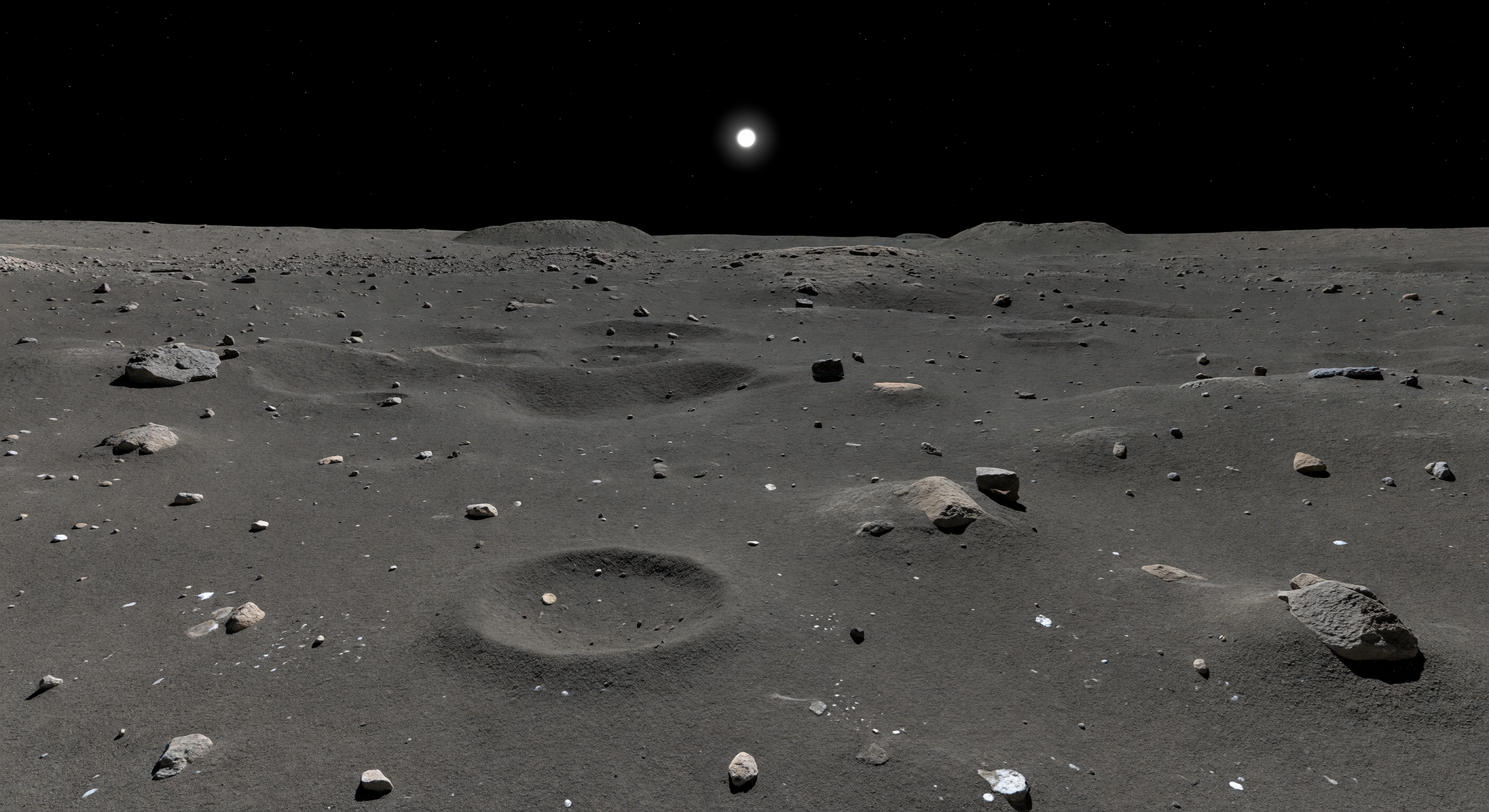
Op het middaguur strekt zich een brede, bijna vlakke vlakte van donkergrijze regoliet uit, fijn en poederig als koude as, onderbroken door zachte, ondiepe inslagkraters, verspreide kiezelvelden en hoekige blokken gebroken silicaatgesteente. De bodem bestaat hier vooral uit gehydrateerd, kleirijk materiaal vermengd met stoffige impactbreccie; hier en daar lichten minuscuul heldere spikkels op, waarschijnlijk blootgelegde zouten of een spoor van nabij-oppervlakkig ijs in een schaduwrijke spleet. Door de extreem lage zwaartekracht en het ontbreken van een echte atmosfeer oogt het landschap vreemd compact én scherp: de horizon ligt al na enkele kilometers, verre lage ruggen en kraterranden blijven ongewoon helder zichtbaar, en onder de kleine, felle zon vallen harde, messcherpe schaduwen in een perfect zwarte hemel. Alles voelt stil, droog en bevroren, alsof je op een oeroude, langzaam veranderende wereld staat waar water ooit chemisch actief was, maar nu alleen nog verborgen voortleeft in kleien, zouten en ijs diep onder het stof.
Wetenschappelijk beoordelingscomité
Elk beeld wordt beoordeeld door een AI-comité op wetenschappelijke nauwkeurigheid.
GPT
Afbeelding: Adjust
Beschrijving: Adjust
Scientific accuracy: The image plausibly depicts an airless, dark-gray regolith terrain on a small body with a near-black sky and a hard, high-contrast midday-like lighting (strong illumination, crisp shadows, small bright solar disk). Surface appearance is consistent with Ceres’ generally dark, particulate regolith with scattered angular blocks and numerous small impacts. However, the caption emphasizes an “equatorial plain” with a very close horizon (~a few km) and specifically mentions hydrated clay-bearing minerals, dry frozen churned soil, and only occasional tiny white salt/ice flecks. In the image, the composition reads more like a generic cratered regolith field; the horizon distance is hard to justify quantitatively from the render, and there are relatively bright light-toned patches/lumps and numerous high-contrast bright grains that may suggest more localized salt deposits/ice exposures than the “occasional” flecks described. The color temperature also appears somewhat muted/cool, which is broadly compatible, but the scene lacks clear clay/salt spectral-relevant cues (which are not directly visible anyway) and could better match Ceres’ common brighter salt/dark unit contrast if that was intended. Visual quality: The image is high quality and convincingly photorealistic: stable textures, consistent shadow direction, coherent scale cues from boulder sizes, and no obvious compositing artifacts. The sky and solar disk are reasonable for an airless body, and there are no glaring rendering errors. Caption accuracy: The description generally matches the depicted elements (dark powdery regolith, small craters/low rises, scattered angular rocks, no atmosphere, bright solar disk, sharp shadows). Main mismatches are (1) the claim of clay/hydrated/mineralogical specifics and near-surface ice being only minimally visible (the render shows more numerous bright light-colored grains/areas than “occasional tiny white flecks”), and (2) the implied “few km” close horizon/miniature scale is not verifiable from the image alone and may be exaggerated. Recommend adjusting the caption to reflect what is actually visible (e.g., “dark regolith with scattered light-toned grains/possible salts” without asserting specific hydration/clay proportions or strict horizon distance).
Claude
Afbeelding: Adjust
Beschrijving: Adjust
I largely concur with GPT's assessment but want to add several specific observations. SCIENTIFIC ACCURACY: The overall dark gray regolith palette, black vacuum sky, and small intensely bright solar disk are broadly consistent with Ceres' known photometric and environmental properties. Ceres has a geometric albedo of roughly 0.09, making it one of the darker bodies in the inner Solar System, and the image captures that darkness reasonably well. Shadow sharpness is appropriately extreme for an airless body with no atmospheric scattering. However, I have specific concerns: (1) The crater morphology feels slightly too Earth-Moon-like. Ceres' weaker gravity (0.028g) and the presence of subsurface ice/briny material produce shallower, more muted crater forms and occasional flow features; these craters look too conventionally 'clean' and sharp-rimmed for a body where ice-assisted relaxation has softened many features. (2) The rock angularity and boulder distribution are plausible but generic — Ceres' surface shows fewer large coherent boulders than the Moon due to its softer, more friable ice-silicate regolith. (3) The horizon distance appears too far for Ceres' ~470 km mean radius; at eye level (~1.7m), the geometric horizon on Ceres would be roughly 2.5-3 km, which should feel dramatically closer than depicted here. The scene reads more like lunar scale. VISUAL QUALITY: The rendering is technically strong — consistent lighting direction, plausible shadow softness, good texture variation, no obvious seam or compositing artifacts. The solar disk size is approximately correct for Ceres' distance (~2.77 AU), appearing smaller than from Earth, which is a meaningful detail rendered accurately. One concern: several of the lighter-toned rocks and bright grain clusters appear slightly too saturated in luminosity relative to the surrounding dark matrix, creating a contrast ratio that feels somewhat exaggerated. CAPTION ACCURACY: The caption's mineralogical specificity (hydrated clay-bearing minerals, frozen soil) is scientifically valid based on Dawn mission data but cannot be evaluated visually and functions more as interpretive flavor text. More problematically, 'occasional tiny white fleck hinting at exposed salts' does not match the image, which shows numerous bright-toned pebbles and patches distributed across the entire foreground — this is closer to a salt-rich or ice-exposed surface than the sparse, subtle exposure the caption implies. The 'few kilometers' horizon claim is consistent with Ceres' radius but the image does not render this convincingly. I recommend regenerating the image specifically to correct the horizon proximity and boulder scale/angularity, while adjusting the caption to better match the visible salt/bright material distribution rather than describing it as rare.
Grok
Afbeelding: Adjust
Beschrijving: Adjust
I concur with both GPT and Claude on the core strengths (dark regolith palette, black vacuum sky, small bright solar disk ~2-3° angular diameter at 2.77 AU, sharp midday shadows consistent with no atmosphere) and issues, but add precision on Ceres-specific metrics. SCIENTIFIC ACCURACY: Strong match to Ceres' low albedo (~.09, charcoal-slate tones spot-on per Dawn imagery); pebble-strewn regolith and small craters align with Occator/Ikapó-like plains, but (1) horizon is too distant—geometric horizon distance d ≈ 3.4 km for 1.7m eye height on 473 km radius body (d = sqrt(2Rh + h^2) ≈ 2.9 km), yet image suggests >10 km lunar-like vista; (2) craters lack Ceres' characteristic softened, shallow profiles from ice relaxation (e.g., compare to Ahuna Mons vicinity); (3) bright patches/grains overabundant vs. sporadic salts/ice in dark phyllosilicate terrains (e.g., Cerealia Facula has localized brights, not foreground-dominant). Boulders plausible but should be sparser/less angular given ice-weakened matrix. No major color temp errors (cool-white Sun correct). VISUAL QUALITY: Excellent photorealism—no artifacts, coherent shadows from single high-sun source, good texture depth, stable compositing; minor nit: some bright grains slightly oversaturated (contrast > typical Dawn ratios ~5:1 dark-to-bright). CAPTION ACCURACY: Matches broad elements (powdery regolith, craters/blocks/shadows, close horizon intent, black sky) but mismatches on 'occasional tiny white flecks' (image shows numerous prominent bright pebbles/patches) and unverifiable mineral claims (valid per Dawn spectroscopy but not visually distinct). 'Few km horizon' scientifically correct but not rendered. Agree with Claude on regenerate push for horizon/crater fixes but vote adjust as issues are improvable without full redo; suggest image tweaks for closer horizon (steeper radial drop-off), softer craters, fewer brights; caption adjust to 'scattered bright salt/ice exposures amid dark regolith'.
Gemini
Afbeelding: Regenerate
Beschrijving: Adjust
I concur with the committee's consensus regarding the technical execution, but I am voting to 'regenerate' the image due to the critical failure in capturing the 'unnervingly close' horizon. The current render presents a vista that feels like a lunar or Earth-based desert; it lacks the curvature-induced drop-off necessary to convey the scale of a body with a ~470 km radius. Furthermore, the crater morphology remains too 'sharp' and 'lunar,' ignoring the viscous relaxation expected in Ceres' ice-rich regolith. To achieve scientific accuracy, the render needs to incorporate a much steeper drop-off to the horizon and utilize shallower, more degraded crater profiles. The caption requires adjustment to align with the visual density of the bright features: the image displays a 'salt-dusted' or 'speckled' terrain rather than the 'occasional flecks' described. Future iterations should lean into the unique, 'soggy' yet frozen geological character of Ceres rather than treating it as a generic rocky asteroid.
Matania — Synthese
Afbeelding: Adjust
Beschrijving: Adjust
The committee found the scene broadly credible for Ceres: the dark, low-albedo regolith, black vacuum sky, tiny solar disk, and crisp noon shadows are all scientifically sound and rendered at high visual quality. However, several reviewers noted that the landscape still reads too lunar and too distant in scale: the horizon feels too far away for Ceres, crater forms are too sharp and conventional, and boulders/bright patches are more abundant and prominent than expected for a friable, ice-modified surface. The caption is directionally accurate but overstates or specifies details that are not clearly supported by the image, especially the sparse nature of bright salt/ice flecks and the implied close-horizon scale. Overall, the committee recommends refinement rather than full regeneration.