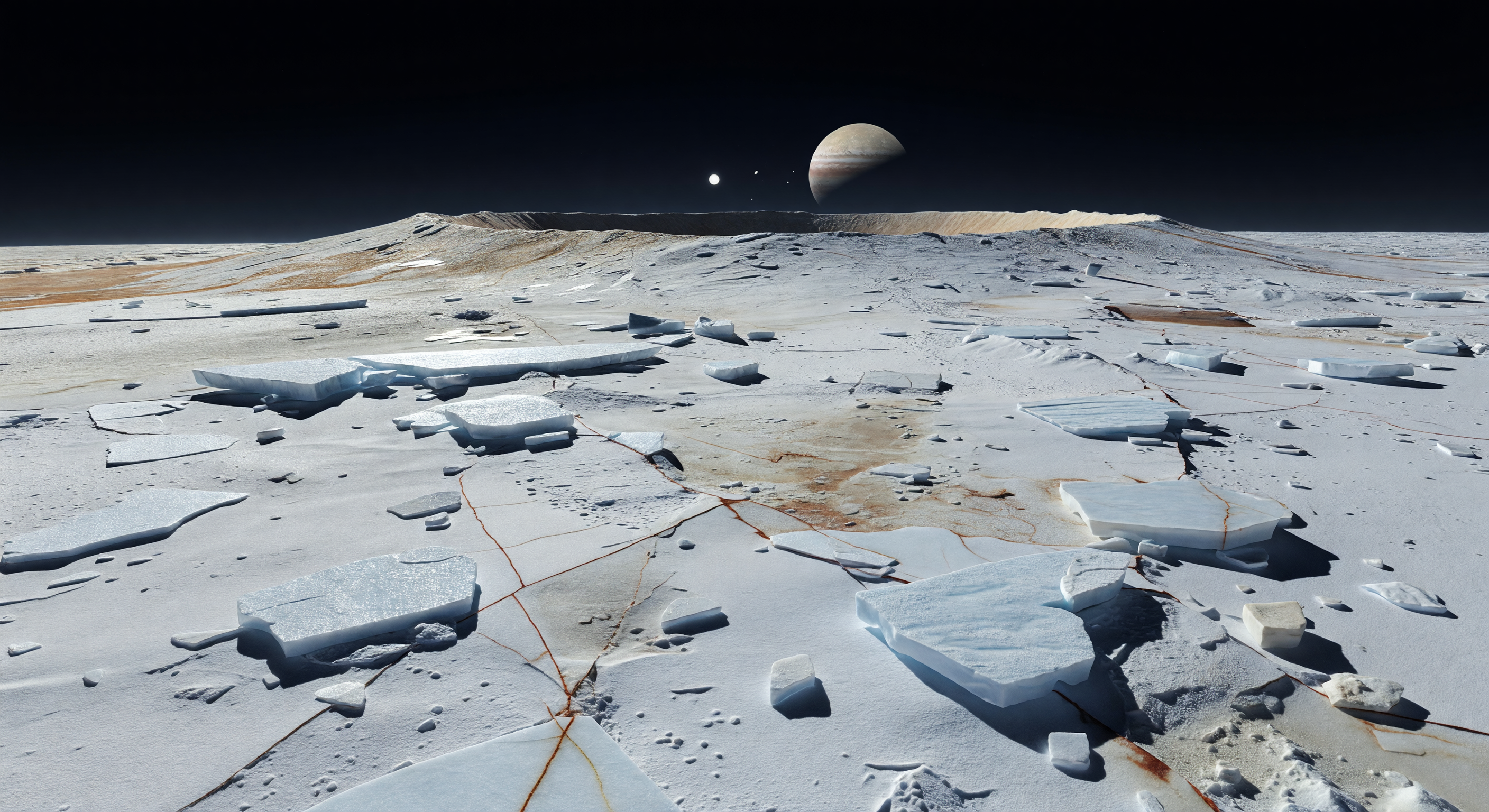
Aan de rand van deze jonge inslagkrater strekt zich een verblindend helder veld van vers uitgeworpen waterijs uit, vol hoekige brokken, gebroken platen, ruwe ijzige breccie en poederige stralenafzettingen die het gefragmenteerde landschap als sneeuwlicht bedekken. Midden in de verte rijst een lage maar scherp afgetekende kraterrand op, waarachter een donkerder kraterbodem zichtbaar wordt, subtiel aangekleurd door geelbruine tot roestbruine bestralingsproducten en gehydrateerde zouten die het zuivere ijs chemisch hebben gemerkt. Tussen de witte en blauwige ijsvlakken snijden roodbruine lineae, kleine ruggen, ondiepe troggen, secundaire inslagputjes en hobbelige ejectaheuvels door de korst, stille sporen van een recente explosieve botsing in een wereld zonder lucht, zonder vloeibaar water en met een meedogenloos stralingsmilieu. Onder een pikzwarte hemel en een kleine verre zon vallen schaduwen bijna volmaakt zwart, terwijl het felle ijs hard terugkaatst en de brede, zacht gekromde horizon de schaal voelbaar maakt: van metersgrote scherven aan je voeten tot kilometers aan opgeworpen terrein om je heen.
Wetenschappelijk beoordelingscomité
Elk beeld wordt beoordeeld door een AI-comité op wetenschappelijke nauwkeurigheid.
Claude
Afbeelding: Adjust
Beschrijving: Adjust
SCIENTIFIC ACCURACY: I largely agree with GPT's 'adjust' assessment but want to add specificity. The fractured ice slab morphology is genuinely excellent — the angular, flat-topped blocks with sharp edges are consistent with low-gravity, low-temperature brittle fracture mechanics on an icy crust. The reddish-brown lineae in the foreground are scientifically defensible as sulfate/chloride salt deposits along tension fractures. However, I flag two concrete problems GPT understated: (1) The ice blocks appear physically too large and too uniformly distributed relative to what Galileo/Juno imagery suggests for Pwyll ejecta — the real field shows more fine-grained ray material dominating, with larger blocks closer to the crater rim. The image reverses this expected size-sorting gradient. (2) The background ridge/rim reads more like a sand dune than a low-relief ice rim — the warm tan coloration and smooth curved profile suggest terrestrial desert rather than icy regolith. Europa's topographic relief is subdued by viscous relaxation; this rim looks too steep and compositionally warm. The Sun is rendered as a bright but small point, which is correct for ~5.2 AU. Shadow hardness is appropriately extreme for an airless body. Jupiter overhead is scientifically plausible in angular size and banding detail, though the additional bright object (likely Io or the Sun rendered twice?) is unexplained and potentially an artifact.
VISUAL QUALITY: Photorealism is high overall. Ice block textures, frost coatings, and hard vacuum shadows are rendered convincingly. I disagree slightly with GPT that saturation is over-stylized — the blue-white tones are within range of high-albedo fresh water ice under solar illumination. My concern is the mid-ground transition: the boundary between foreground ice field and the background ridge is compositionally abrupt and the ridge material looks texturally inconsistent with the ice-dominated foreground, suggesting two different material libraries were composited. The second bright disc near Jupiter in the sky reads as either a rendering artifact or an unlabeled moon and should be clarified or corrected.
CAPTION ACCURACY: The caption is well-written and scientifically literate, but it over-describes features not clearly visible. The 'arcing low rim across the middle distance' is present but ambiguously rendered. The 'darker crater floor stained tan to rust-brown' is visible but competes with the ridge's own warm tones in a confusing way. Most critically, the caption omits Jupiter and the secondary sky body entirely, which are among the most visually dominant elements in the image. This is a significant omission. The caption's reference to 'small distant Sun' is not matched by a clearly identifiable solar disc — the bright object near Jupiter may be the Sun, but this is ambiguous. Recommend the image be adjusted to correct the rim material appearance, clarify the sky objects, and improve the ejecta size-distribution gradient; the caption should be revised to acknowledge Jupiter and the sky context.
VISUAL QUALITY: Photorealism is high overall. Ice block textures, frost coatings, and hard vacuum shadows are rendered convincingly. I disagree slightly with GPT that saturation is over-stylized — the blue-white tones are within range of high-albedo fresh water ice under solar illumination. My concern is the mid-ground transition: the boundary between foreground ice field and the background ridge is compositionally abrupt and the ridge material looks texturally inconsistent with the ice-dominated foreground, suggesting two different material libraries were composited. The second bright disc near Jupiter in the sky reads as either a rendering artifact or an unlabeled moon and should be clarified or corrected.
CAPTION ACCURACY: The caption is well-written and scientifically literate, but it over-describes features not clearly visible. The 'arcing low rim across the middle distance' is present but ambiguously rendered. The 'darker crater floor stained tan to rust-brown' is visible but competes with the ridge's own warm tones in a confusing way. Most critically, the caption omits Jupiter and the secondary sky body entirely, which are among the most visually dominant elements in the image. This is a significant omission. The caption's reference to 'small distant Sun' is not matched by a clearly identifiable solar disc — the bright object near Jupiter may be the Sun, but this is ambiguous. Recommend the image be adjusted to correct the rim material appearance, clarify the sky objects, and improve the ejecta size-distribution gradient; the caption should be revised to acknowledge Jupiter and the sky context.
Grok
Afbeelding: Adjust
Beschrijving: Adjust
I agree with both GPT and Claude on 'adjust' for image and caption, with some refinements. SCIENTIFIC ACCURACY (adjust): Excellent capture of Europa's core traits—brittle fractured ice blocks, ray-like ejecta patterns, reddish-brown lineae from irradiated salts (e.g., hydrated sulfuric acid or magnesium sulfate), razor-sharp shadows in vacuum, small Sun at ~5.2 AU, and broad low-gravity horizon. Jupiter overhead is plausible (angular diameter ~4-6° from certain latitudes). However, Claude correctly flags block size-sorting: real Pwyll ejecta (Galileo SSI images) shows finer rays distally, larger blocks proximally; here, uniform large blocks lack gradient. The midground 'rim' appears dune-like with overly warm tan tones and steep profile, inconsistent with Europa's low-relief (~100m) icy rims softened by viscous flow (cf. JunoCam data). The second bright sky disc (likely erroneous Sun duplicate or unlabeled moon like Io) is unsupported; Europa's sky typically shows faint Jupiter limb/equatorials, not multiple bright objects. Colors are high-albedo accurate (fresh ice ~.9, rays ~.7-.8) but foreground lineae reds slightly oversaturated vs. Galileo spectra. Scale feels right for ~1.3m/s² gravity. VISUAL QUALITY (adjust): Highly photorealistic with convincing ice textures (frost rims, block edges), hard chiaroscuro lighting, and no major artifacts. Minor issues: rim textural mismatch (sandy vs. icy), abrupt foreground-background blend, and ambiguous sky discs suggest compositing tweaks needed for seamlessness—still far better than typical AI renders. CAPTION ACCURACY (adjust): Matches foreground ice chaos, lineae, pits/hummocks, and vague distant rim/crater well, but omits dominant Jupiter and extra sky disc (major visual elements), misattributes Sun position (it's far right, not clearly 'small distant'), and over-specifies unverifiable 'Pwyll' ID/'young impact' without plume/unique morphology. Rim 'arcing low' and 'tan-rust crater floor' are present but muddled by ridge warmth. Constructive: Approve with rim retexture to icy regolith, sky cleanup (Jupiter only, Sun distinct), block gradient; revise caption to include Jupiter/sky and tone down unverified specifics for better fidelity.
Gemini
Afbeelding: Adjust
Beschrijving: Adjust
I concur with the previous committee members regarding the 'adjust' status for both image and caption. The image is technically impressive in its rendering of brittle fracture mechanics and vacuum-shadow physics, but it suffers from a fundamental 'geological identity crisis' where the mid-ground rim transitions from icy ejecta to a terrestrial-style dune, likely due to a failure in the model's training data regarding Europa's viscous relaxation of crater rims. The size-sorting of the ejecta (uniform blocks vs. expected distal fine-graining) is a persistent oversight that breaks scientific immersion. Furthermore, the sky composition is poorly handled; the presence of an ambiguous second bright disc alongside Jupiter creates a 'sci-fi' rather than 'scientific' feel, which undermines the credibility of the landscape. The caption must be expanded to explicitly account for Jupiter—the most defining feature of the Jovian sky—and should be edited to remove definitive claims about the 'Pwyll' origin, which cannot be confirmed by the visual data provided. Recommendation: Adjust the mid-ground texture to match the icy foreground, remove the secondary light source in the sky, and harmonize the caption with the actual celestial features present in the render.
Matania — Synthese
Afbeelding: Adjust
Beschrijving: Adjust
The committee found the scene broadly consistent with Europa’s icy, airless surface and a Pwyll-like ejecta field: fractured bright ice blocks, ray-like streaking, hard vacuum shadows, and reddish fracture lineae are all scientifically plausible. However, the image leans too cinematic and shows several fidelity issues: the mid-ground rim reads as warm, dune-like terrestrial material rather than subdued icy Europa relief; the ejecta appears too uniformly blocky with an unrealistic size distribution; and the sky contains ambiguous bright discs and a prominent Jupiter that are not properly handled by the caption. The caption is well-written but overcommits to features that are only vaguely visible, especially the Pwyll identification, the specific crater-rim description, and the implied impact details, while omitting the visually dominant Jovian sky context. Overall, the committee agreed the piece is strong but needs correction rather than approval.
2) VISUAL QUALITY (adjust): The image is high-resolution and looks photorealistic in terms of texture detail on ice blocks and shadow hardness. There are no obvious rendering glitches, but the “glittering frost” and overall contrast/saturation may be slightly art-enhanced rather than consistent with typical icy satellite imagery (e.g., block edges and color transitions look a bit too crisp/idealized). The horizon/scale is believable, though the overall composition uses cinematic elements (planet overhead + bright disc objects) that may feel more illustrative than scientifically faithful.
3) CAPTION ACCURACY (adjust): The caption’s general elements—recent impact excavation, bright shattered ice blocks, fractured crust, and reddish-brown lineae with some darker stained crater region in the distance—are directionally supported. However, several caption specifics are likely not directly evidenced: (a) no clearly visible small “fresh water-ice blasted out by a young impact” jet/plume—only blocks and rays; (b) the named “Pwyll Ejecta Field” is not verifiable from morphology alone in this single view; (c) the described “arcing low rim across the middle distance” and “darker crater floor faintly stained tan to rust-brown” are not distinctly identifiable; (d) the caption does not mention the large overhead planet or the bright disc(s) in the sky that are prominent in the image.
Overall: strong general Europa-like ejecta visuals and good realism, but some scientific/geometric specifics in the caption and some sky/contrast choices prevent full approval.