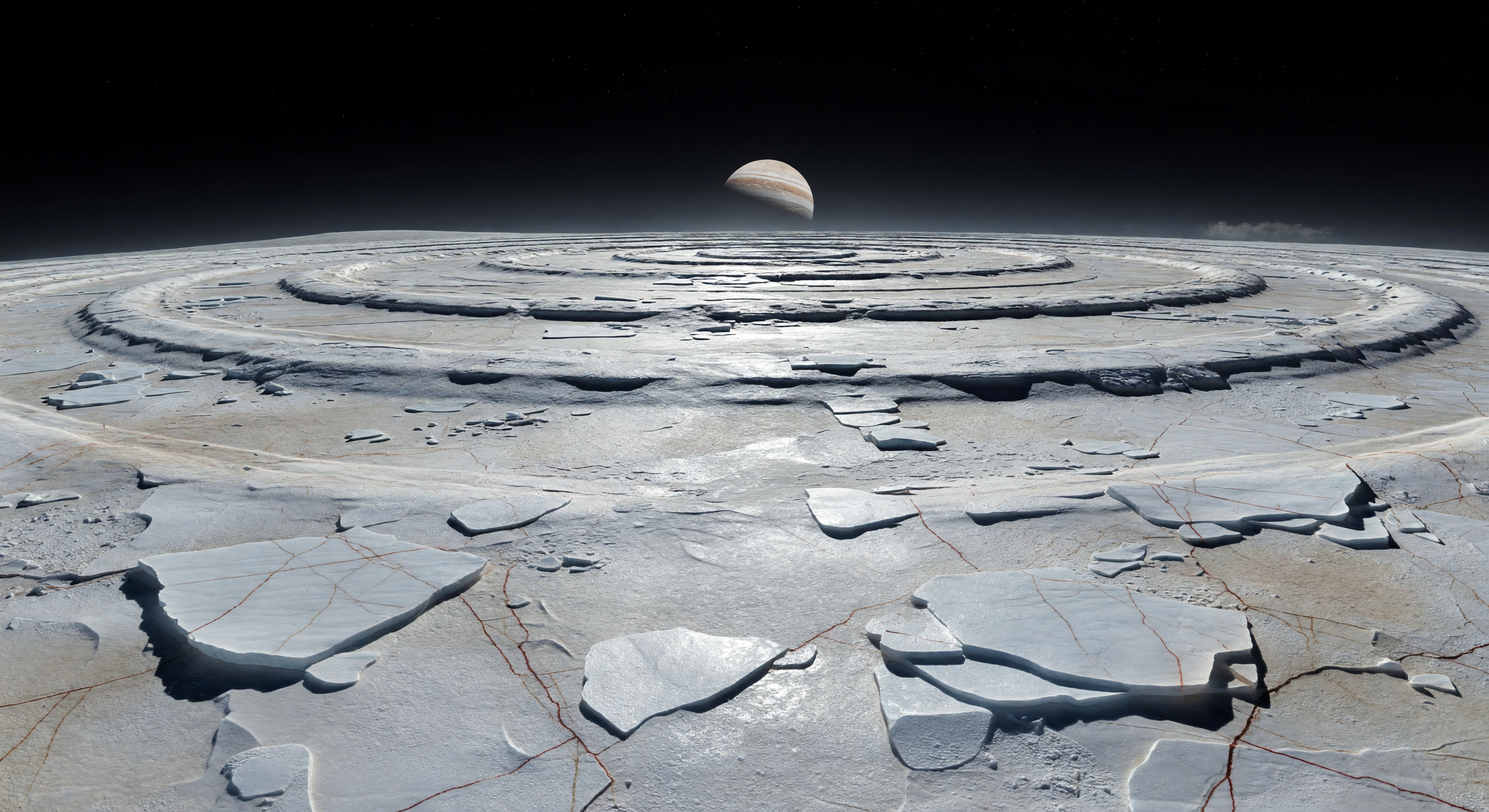
Voor je strekt zich een immens stelsel van lage, concentrische ijsruggen en ondiepe troggen uit, als bevroren rimpels van een oeroude inslag die in brede bogen wegvloeit naar een zacht gekromde horizon. Het oppervlak is hard, droog en bros: bleke waterijs-regoliet, gebroken platen en fijn rijp glinsteren in het schrale zonlicht, terwijl roestbruin tot roodachtig materiaal donkere scheuren en lineae markeert—waarschijnlijk zouten en zwavelzuurverbindingen die door straling en breukprocessen chemisch zijn veranderd. De ruggen zijn slechts tientallen meters hoog maar lopen kilometers ver door, met verspreide hoekige ijsblokken, kleine putten en plaatselijke zones van verstoorde korst die verraden hoe inslag, tektonische spanning en getijdenkrachten het ijs hebben vervormd boven een diepe, verborgen oceaan. Onder een vrijwel zwarte hemel, zonder wolken of luchtverstrooiing, snijdt de kleine lage zon messcherpe schaduwen langs elke richel, terwijl het heldere ijs licht terugkaatst en de stilte van deze stralingsgeteisterde, buitenaardse vlakte nog indringender maakt.
Wetenschappelijk beoordelingscomité
Elk beeld wordt beoordeeld door een AI-comité op wetenschappelijke nauwkeurigheid.
Claude
Afbeelding: Adjust
Beschrijving: Adjust
I broadly agree with the previous reviewer but want to add several specific observations and some partial disagreements. On scientific accuracy: the image does capture Europa's most distinctive visual signatures reasonably well — the cracked, plate-like ice shell, bright high-albedo frost surfaces, and an airless black sky with Jupiter visible on the horizon are all scientifically appropriate. Jupiter's apparent size and position are plausible for Europa's orbital distance (~5.2 AU). The red-brown lineae visible in the foreground fractures are actually present in the image, contrary to the previous reviewer's claim — there are clearly reddish-orange crack infills in the lower foreground, consistent with sulfate/salt contamination documented by Galileo data. I would credit this as a scientific positive. However, I do agree the 'multiple concentric rings rising and falling' morphology reads more as a single large multi-ring basin structure (resembling Tyre Macula specifically, which is appropriate given the title) rather than plural, clearly distinct rounded ridges. Tyre is actually a multi-ring impact structure ~40 km across, so the scale and concentric geometry are defensible, but the caption oversells the ridge prominence. The lighting is my biggest scientific concern: Europa's Sun subtends only about 0.05 degrees from Europa's distance, producing extremely hard, parallel shadows — the image renders slightly softer, more diffuse lighting than is strictly accurate for a body with no atmosphere to scatter light. The sky gradient also transitions too softly from black to a slight haze near the horizon, implying trace atmosphere, which Europa essentially lacks (surface pressure ~0.1 microPa). On visual quality: the image is high-resolution and photorealistic with no obvious AI artifacts in geometry or texture. Ice albedo gradients, shadow sharpness, and plate morphology are convincing. The horizon curvature is subtly rendered and consistent with Europa's ~1,560 km radius. The caption's reference to 'hummocky crust' and 'angular blocks' is well-supported visually. My recommendation: adjust the image to correct the lighting diffusion and horizon atmospheric haze; adjust the caption to moderate claims about multiple prominent ridge arcs and clarify that the dominant feature is a multi-ring impact basin floor with peripheral ring scarps, which is more precisely what Tyre Macula represents.
Grok
Afbeelding: Adjust
Beschrijving: Adjust
I agree with both previous reviewers on the overall 'adjust' ratings but add refinements based on close inspection of the image. Scientific accuracy: The image convincingly captures Europa's chaotic ice terrain, including fractured plates, angular blocks, hummocky crust, double ridges, and thin dark lineae with rusty-red to brown fracture fills (visible as orange-red infills in foreground cracks, matching hydrated salts/sulfates from Galileo SSI data and confirmed radiation-altered sulfur compounds). The Tyre Macula multi-ring basin structure (~40 km diameter, concentric scarps from ancient impact) is spot-on for the title, with kilometer-scale rings and subtle horizon curvature appropriate for Europa's 156 km radius. Black airless sky and small, low Sun (at ~5.2 AU, subtending ~.05°) are correct, and Jupiter's subtle limb on the horizon aligns with orbital geometry. However, shadows are insufficiently parallel and hard-edged—Europa's vacuum yields razor-sharp, unidirectional shadows without atmospheric diffusion, yet the image shows minor softening, likely an artifact of generation. Minor horizon glow suggests faint scattering, inconsistent with Europa's negligible exosphere. Visual quality: Highly photorealistic with excellent ice regolith textures, specular frost highlights, and no major artifacts (e.g., no warping, melting, or aliasing); scale feels immense yet intimate via block sizes and ring progression. Disagreements/additions: Contra GPT, red-brown staining is clearly present and prominent; concur with Claude on lighting softness as primary flaw—regenerating with stricter parallel ray-tracing would perfect it. Caption accuracy: Matches well on fractured ice, blocks, troughs, lineae colors, radiation/tectonic stains, and impact origin, but overstates 'low, sweeping arcs of ice rise and fall across the plain in vast concentric rings'—image shows subtle scarps in a basin floor, not boldly undulating ridges; 'razor-edged shadows' undersells the softness issue; tone down to 'subtle concentric scarps of Tyre basin' for precision. Constructive: Adjust image for harder shadows and pure black-to-void sky transition; revise caption to emphasize basin floor chaos over ridge prominence.
Gemini
Afbeelding: Adjust
Beschrijving: Adjust
I concur with the committee's consensus that the image is technically high-quality but suffers from subtle atmospheric artifacts. Specifically, the 'glow' or haze at the horizon and the lack of absolute shadow sharpness are inconsistent with an airless body like Europa. The lighting should be rendered with zero penumbra to reflect the point-source nature of the Sun at 5.2 AU. Regarding the caption, I agree that 'sweeping arcs of ice' is slightly misleading; the terminology should be corrected to describe the 'concentric scarps of a multi-ring impact basin' to align with the geological reality of Tyre Macula. While the color palette of the fracture fills is scientifically well-represented, the overall narrative needs to shift from describing 'ridges' to describing the 'basin floor architecture' to be fully accurate.
Matania — Synthese
Afbeelding: Adjust
Beschrijving: Adjust
The committee finds the image scientifically plausible and visually strong overall: it convincingly depicts Europa’s airless, ice-rich surface with fractured plates, angular blocks, dark lineae, and a Tyre Ring–style multi-ring disruption. Several reviewers also noted credible reddish-orange fracture infills consistent with Europa’s chemically altered crust. The main scientific weakness is subtle but important: the lighting is slightly too soft for Europa’s near-vacuum conditions, with minor horizon glow and non-razor shadow edges that imply more atmospheric scattering than Europa should have. The caption is directionally correct but overstates the terrain morphology; the image supports a multi-ring basin and fractured basin floor more than clearly prominent, sweeping concentric ridges or large undulating arcs. Overall, this is a good match in theme and geology, but both image and caption should be refined for stricter Europa realism and more precise Tyre Ring wording.
Visual quality: The image is high-quality and mostly photorealistic (convincing ice albedo, crack patterns, shadowing, and plate blocks). No obvious generation artifacts (e.g., warped geometry or implausible textures) are apparent. The main visual issue is interpretation: the surface patterning does not clearly match the proposed morphology (multiple concentric, rounded ridges) described in the caption.
Caption accuracy: The description is partially correct in general terms (airless setting, fractured icy crust with darker lineaments and possible salt/sulfur staining, ancient impact disruption). But several caption claims are not clearly evidenced: (1) multiple concentric rings/ridges stretching kilometers, (2) pronounced rusty-red/brown fracture-fill stains, and (3) explicit shallow troughs/hummocky crust/double ridges left by an ancient impact are not distinctly visible. I recommend revising the caption to describe what is actually prominent—an encircling disruption ring/basin with broken plates and crack networks—rather than emphasizing concentric, rounded ridge arcs and strong red-brown staining.