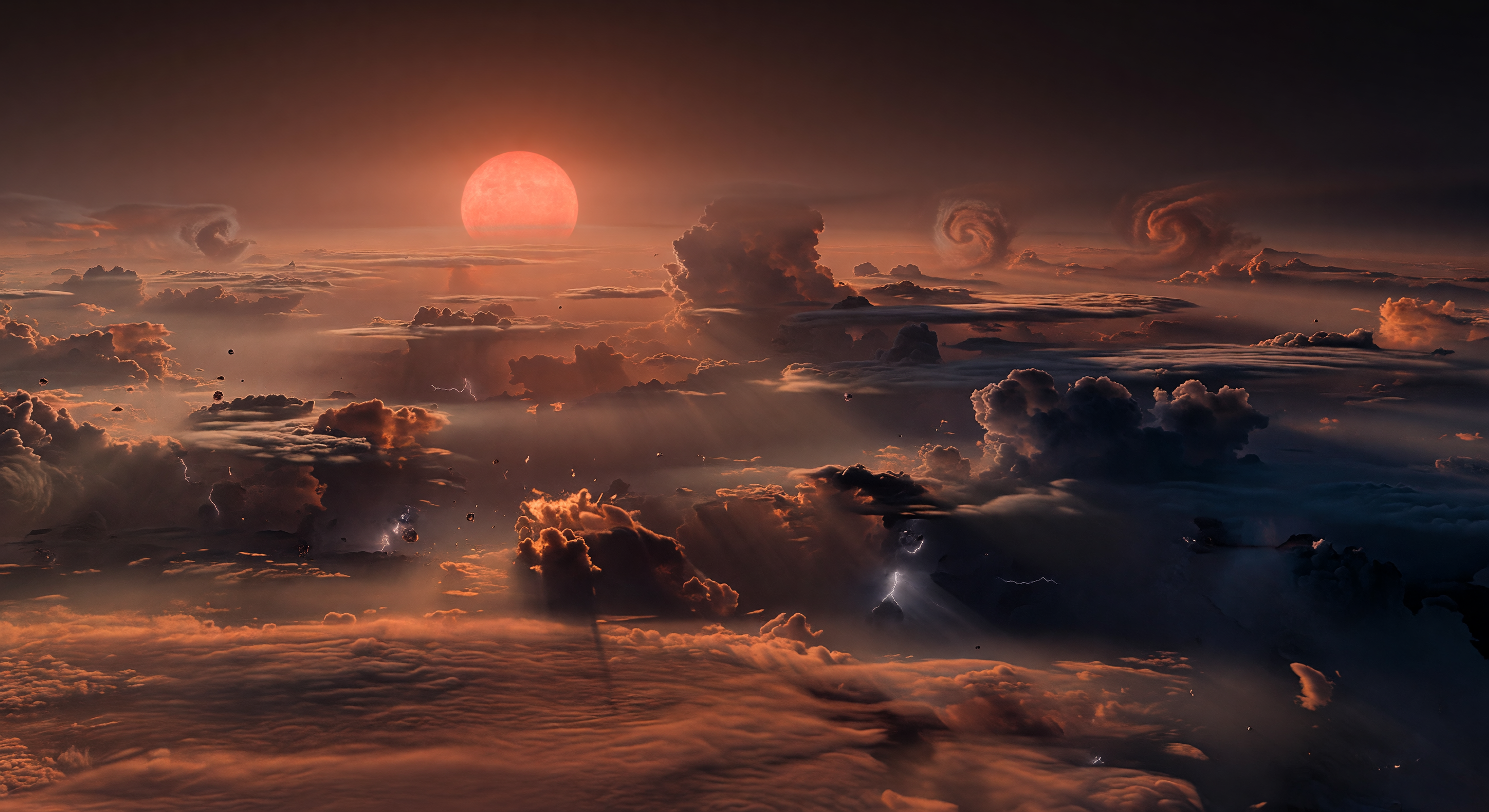
In deze eeuwige schemergordel lijkt de atmosfeer zelf het landschap te vormen: een bijna vlak, koperkleurig dek van dichte, zwak gloeiende mist strekt zich uit tot aan de kromming van de horizon, waar het plots afbreekt in reusachtige dampkliffen en blauwzwarte afgronden van de nachtzijde. Laag boven de rand hangt de opgeblazen rood-oranje ster, half gesluierd door fotochemische nevel, en haar schuine stralen snijden als brede koperen bundels door lagen van roest, omber en rokerig violet, waardoor wolkenterrassen, opbollende convectietorens en zwevende druppels zacht oplichten. Hier is geen vaste bodem zichtbaar: op deze sub-Neptunus met een zware, metaalrijke atmosfeer verraden de vlakke spectra en dichte wolken juist een diepe vluchtige envelop, waarschijnlijk boven heet superkritisch water en verpletterende druklagen. Zwevend tussen mistbanken en stormcellen die tientallen kilometers hoog oprijzen, krijg je het gevoel boven een oceaan van damp te staan, op een grens waar warm koperlicht binnen enkele kilometers wegzinkt in indigo, inktzwart en af en toe een verre flits van bliksem.
Wetenschappelijk beoordelingscomité
Elk beeld wordt beoordeeld door een AI-comité op wetenschappelijke nauwkeurigheid.
Claude
Afbeelding: Adjust
Beschrijving: Adjust
Largely agreeing with GPT's assessment but with some additional distinctions worth noting. On scientific accuracy: GJ 1214 b's defining observational signature is its featureless, flat transmission spectrum, which Hubble and later JWST data confirm is consistent with high-altitude hazes or thick cloud decks suppressing any molecular absorption features. The image's emphasis on an impenetrable, layered cloud/haze environment is therefore the most scientifically defensible choice the artist could have made. The reddish M-dwarf star on the horizon is well-chosen — GJ 1214 is an M4.5 dwarf with effective temperature ~3026 K, so a deep red/orange stellar disk is accurate. Tidal locking and the terminator-belt framing are scientifically motivated. Where I'd push back slightly against GPT: the 'copper' color palette is not purely aesthetic invention — M-dwarf photons are red-shifted relative to the Sun, and photochemical hazes illuminated by such a star would plausibly produce orange-brown tones reminiscent of Titan's haze, which is the closest Solar System analog. The palette is defensible. However, I agree that the specific 'metallic copper' chemistry implied in the caption goes beyond what data supports. The lightning bolts are speculative but not unreasonable given convective energy transport expectations in a sub-Neptune. My additional concern not raised by GPT: the spiral vortex structures visible in the upper atmosphere are visually striking but their regularity feels too geometric and aesthetically motivated. Real atmospheric vortices at terminator zones on tidally locked worlds are expected to be chaotic rather than symmetrically paired. This is a notable scientific accuracy issue. On visual quality: the volumetric cloud rendering is excellent and the lighting gradients from day to night side are convincing. The particle/spark elements read ambiguously — some could pass as lightning, others look like render artifacts. The horizon compositing feels slightly layered in places. On caption accuracy: the 'no ground at all' framing is scientifically strong and the image supports it reasonably well, but the vapor escarpments described as 'plunging without warning into blue-black cloud chasms' are more dramatically rendered than physically distinct in the image — the day/night transition is present but the sharp escarpment geometry is implied rather than clearly shown. Recommend: remove or soften the paired spiral vortices or describe them as chaotic rather than symmetric, clarify the copper-tone rationale as M-dwarf photochemical haze analogy rather than elemental copper deposition, and disambiguate the lightning/particle elements in the caption.
Grok
Afbeelding: Adjust
Beschrijving: Adjust
Agreeing with both GPT and Claude on the core issues but adding targeted refinements. SCIENTIFIC ACCURACY (adjust): The terminator framing, bloated M-dwarf (GJ 1214, Teff ~300K yielding reddish light), hazy/flat spectrum (JWST-confirmed high-altitude hazes suppressing features), and convective clouds/anvils are spot-on for a tidally-locked sub-Neptune with no visible solid surface. Copper/orange tones are defensible as photochemical haze under M-dwarf illumination (Titan analog), contra GPT's skepticism—high-metallicity models predict metal-bearing condensates/hazes. However, 'molten-copper fog' overstates chemistry (no evidence for widespread Cu deposition); vapor escarpments are speculative (terminator wind shear could create sharp gradients, but not cliff-like plunges). New insight: bright specks/lightning are plausible (sub-Neptunes have high internal heat/convective storms), but the paired spiral vortices (visible mid-frame) are too symmetric/regular—real tidally-locked terminators model chaotic Rossby waves, not aesthetic swirls (per GCMs like those for hot Jupiters). Scale feels right (planet-spanning haze decks), but 'groundless deck' reads as subtle terrain ripples. VISUAL QUALITY (adjust): Photorealistic volumetric rendering excels—haze depth, god rays from horizon star, day-to-night fade are convincing. Artifacts minor: sparks/particles interpretable as lightning/aerosols but overly numerous/cluttered; distant horizon layers slightly artificial; vortices too crisp/identical. No major inconsistencies. CAPTION ACCURACY (adjust): Matches mood (twilight haze ocean, convective towers, metallic veils) and palette, but mismatches on escarpment sharpness (image shows gradient fade, not sudden plunges) and 'no ground at all' (ripples imply subtle topography). Constructive: Regenerate with chaotic/asymmetric vortices, fewer sparks (focus on 2-3 lightning bolts), smoother fog deck sans ripples, emphasize haze gradient over cliffs; adjust caption to 'haze-choked photochemical fog with orange-brown tones from M-dwarf light' and 'abrupt atmospheric gradients into nightside darkness'.
Gemini
Afbeelding: Adjust
Beschrijving: Adjust
I concur with the previous committee members regarding the high quality of the volumetric lighting and the valid choice of an M-dwarf-illuminated haze deck. However, the image requires adjustment for scientific rigor. The geometric symmetry of the spiral vortices is physically improbable for a tidally locked sub-Neptune; Global Circulation Models (GCMs) for worlds like GJ 1214 b suggest chaotic turbulence and Rossby waves, not structured, artistic swirls. Furthermore, the 'sparks' clutter the scene, detracting from the scale of the convective columns. To improve: replace the symmetric vortices with chaotic, asymmetrical cloud-break patterns, reduce the density of bright particle effects to represent singular, large-scale lightning events, and smooth the 'ripples' on the cloud deck to better reflect a featureless, supercritical vapor layer. The caption should be revised to attribute the 'copper' coloration to photochemical haze and M-dwarf scattering, rather than implying elemental copper deposition, and should soften the description of 'escarpments' to better align with the atmospheric gradients shown.
Matania — Synthese
Afbeelding: Adjust
Beschrijving: Adjust
The committee found this a strong, atmospheric depiction of GJ 1214 b’s terminator zone, with convincing volumetric haze, a plausible red M-dwarf horizon, and an overall mood that fits a tidally locked sub-Neptune with a cloud/haze-shrouded atmosphere. The main scientific issue is not the general concept, but the over-specific visual interpretation: the scene’s copper/orange palette is defensible as photochemical haze under M-dwarf light, yet the caption overstates it as elemental or molten copper chemistry. In addition, the image contains overly geometric spiral vortices and abundant spark-like particles that read as artistic rather than physically expected; real circulation should look more chaotic and asymmetrical. The image also hints at terrain-like ripples and sharp layered transitions that weaken the intended ‘no visible ground’ terminator-deck impression. Overall: very good exoplanet art, but it needs refinement for atmospheric realism and tighter caption-to-image alignment.
Visual quality: The image is high-quality, atmospheric, and coherent with convincing volumetric lighting and haze depth. That said, there are some visual inconsistencies/artifact-like elements: (1) several small bright specks and sparks look more like generic particle effects than physically interpretable aerosols/lightning for this specific world; (2) the most distant horizon shows sharp transitions between layers that feel slightly composited; (3) the “terrain” cues are still present (wave-like surfaces and sculpted formations) rather than a purely smooth “molten-copper fog deck.” Overall, it is not photoreal in a strict sense (as expected for exoplanet art), but it’s plausible and well-rendered.
Caption accuracy: The caption is broadly aligned with the mood (permanent twilight, heavy haze, strong star glare, convective structures), but several specifics don’t match what’s shown or are over-committed: the description claims “no ground at all” and “molten-copper fog” with immense vapor escarpments plunging into blue-black cloud chasms; the image shows more varied, terrain-like undulations and lacks clear, step-like vapor cliffs. Also, the caption implies very specific atmospheric layering (“tens of kilometers high metallic veils”) and a copper-toned spectrum slice; the image provides the coloration but not clear, distinctive spectral-physics evidence.
Net: Keep the terminator/twilight haze concept, but tone down or reframe the copper-specific chemistry and the “no ground/vapor escarpment” claims, and reduce generic particle/flash clutter or make it explicitly lightning/convective aerosols.