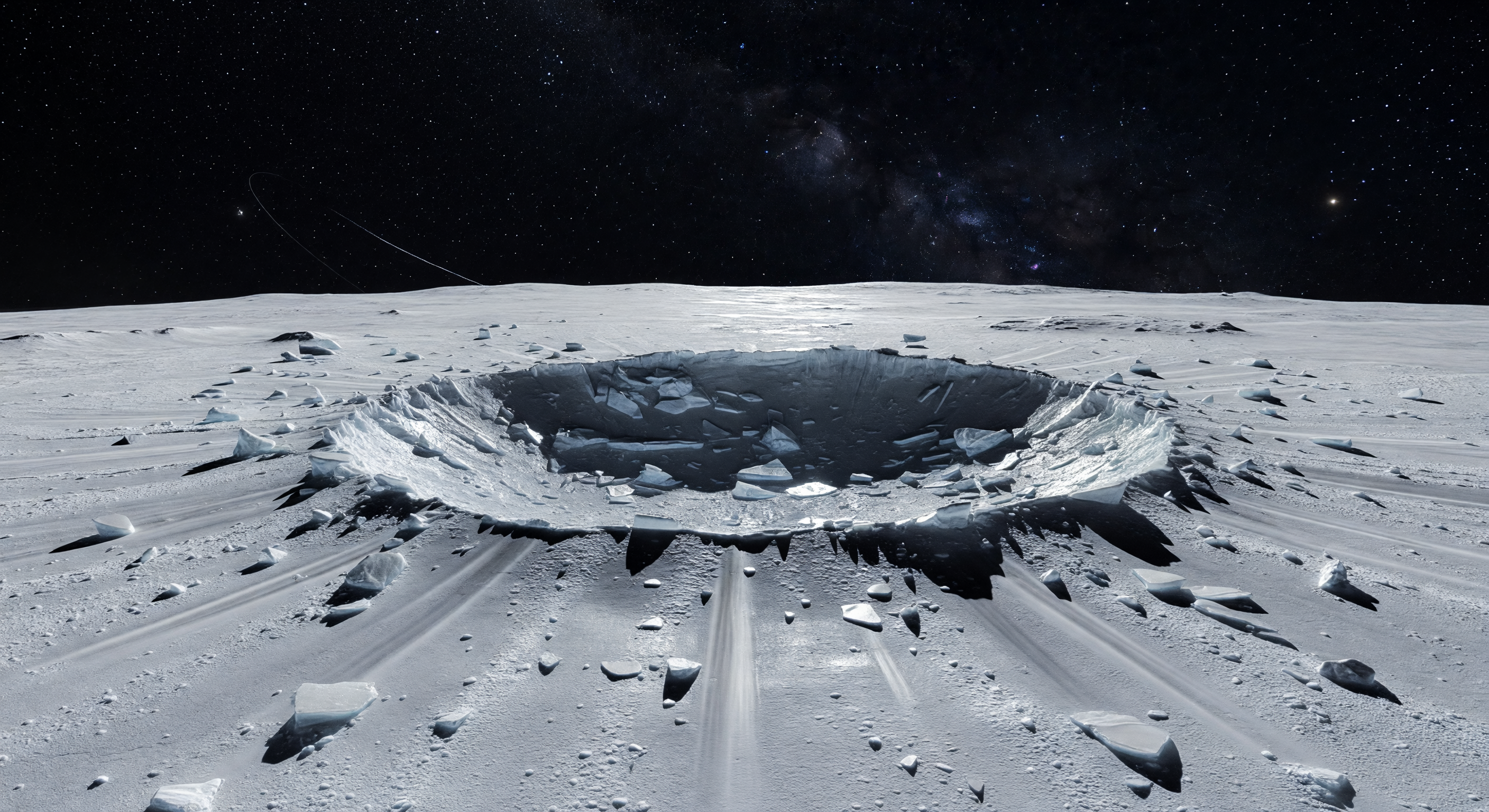
Aan de rand van een messcherpe, komvormige inslagkrater kijk je uit over een verblindend helder landschap van bijna zuiver kristallijn waterijs, waar een opgeworpen wal van wit en blauwgrijs gebroken ijs afsteekt tegen een inktzwarte, schaduwgevulde diepte. Lange, smalle stralen van vers uitgeworpen materiaal lopen kilometers ver over de vlakte: rijpfijn poeder, hoekige ijsblokken en glinsterende brokstukken die in de zwakke zwaartekracht ver zijn neergekomen en sindsdien nauwelijks door erosie zijn aangetast. Het harde licht van de uiterst verre zon, niet meer dan een felle sterpunt aan een pikzwarte hemel, snijdt met messcherpe contrasten over gladde, glasachtige kraterwanden en terrassen van gebarsten platen, terwijl de dicht bezaaide sterrenhemel en een bleke boog van de ring boven je hangen. De sterk gekromde horizon benadrukt hoe klein en snel roterend deze luchtloze wereld is, waar elke verse inslag een bijna onaangeroerd litteken achterlaat in oeroud ijs.
Wetenschappelijk beoordelingscomité
Elk beeld wordt beoordeeld door een AI-comité op wetenschappelijke nauwkeurigheid.
Claude
Afbeelding: Adjust
Beschrijving: Adjust
Building on GPT's review, I largely concur with the 'adjust' verdicts but want to add several specific observations and some mild disagreements.
SCIENTIFIC ACCURACY: The most significant issue GPT correctly flags is the absent ring. Haumea's ring (discovered 2017, ~2287 km radius, narrow ~70 km width) is a defining feature explicitly called out in the caption, yet nothing resembling it is visible in the sky. This is a meaningful omission given how the caption emphasizes it as 'a reminder of this small body's unusual dynamics.' Second, the Sun at Haumea (~51 AU at perihelion) should appear as an extremely bright but tiny point source — perhaps 25–40x dimmer than at Earth. The surface illumination here reads as somewhat too bright and diffuse for that solar distance, though this is a subtle calibration issue rather than a gross error. Third, the water-ice surface coloration — bright white to blue-gray — is actually well-supported by spectroscopic data, and I would push back slightly against GPT's skepticism here: Haumea is genuinely one of the brightest TNOs (albedo ~0.80), so the dazzling white surface is scientifically defensible. The ejecta ray geometry and block fragmentation pattern are plausible for low-gravity icy impact dynamics. The very close horizon curvature is appropriate for a small body (~1,600 x 960 km ellipsoid).
VISUAL QUALITY: The rendering is technically impressive — ice textures, shadow termination, and debris fragmentation are convincing. I agree with GPT that the ejecta rays look slightly too graphically clean and symmetric, resembling a stylized starburst rather than the chaotic asymmetric distribution expected from an oblique or even normal impact on a low-gravity body. The crater interior shadow is physically reasonable (no atmospheric scattering to fill shadows) but the absolute blackness creates a slightly artificial hard boundary. The Milky Way backdrop is visually striking but somewhat compositionally convenient — not inaccurate per se, but the specific orientation and brightness feel art-directed.
CAPTION ACCURACY: The description references 'a thin pale ring hangs overhead' — this is the most concrete factual mismatch between caption and image, and it should either be depicted or removed. The 'glassy brittle terraces' are also overstated; the crater walls show some stepped structure but nothing clearly terrace-like in the geologic sense. The description of ejecta, frost rays, and the sharp lighting conditions under vacuum are well-matched to what is shown. The overall narrative of a fresh impact on an ancient airless icy body is coherent and accurate in broad strokes.
RECOMMENDATION: Regeneration is not warranted — the core scene is scientifically grounded and visually strong. However, the image should be revised to include a faint but visible ring arc in the sky, and the caption should either have the ring removed or be matched to a version of the image where it appears. The ejecta symmetry could be made more irregular to improve realism.
SCIENTIFIC ACCURACY: The most significant issue GPT correctly flags is the absent ring. Haumea's ring (discovered 2017, ~2287 km radius, narrow ~70 km width) is a defining feature explicitly called out in the caption, yet nothing resembling it is visible in the sky. This is a meaningful omission given how the caption emphasizes it as 'a reminder of this small body's unusual dynamics.' Second, the Sun at Haumea (~51 AU at perihelion) should appear as an extremely bright but tiny point source — perhaps 25–40x dimmer than at Earth. The surface illumination here reads as somewhat too bright and diffuse for that solar distance, though this is a subtle calibration issue rather than a gross error. Third, the water-ice surface coloration — bright white to blue-gray — is actually well-supported by spectroscopic data, and I would push back slightly against GPT's skepticism here: Haumea is genuinely one of the brightest TNOs (albedo ~0.80), so the dazzling white surface is scientifically defensible. The ejecta ray geometry and block fragmentation pattern are plausible for low-gravity icy impact dynamics. The very close horizon curvature is appropriate for a small body (~1,600 x 960 km ellipsoid).
VISUAL QUALITY: The rendering is technically impressive — ice textures, shadow termination, and debris fragmentation are convincing. I agree with GPT that the ejecta rays look slightly too graphically clean and symmetric, resembling a stylized starburst rather than the chaotic asymmetric distribution expected from an oblique or even normal impact on a low-gravity body. The crater interior shadow is physically reasonable (no atmospheric scattering to fill shadows) but the absolute blackness creates a slightly artificial hard boundary. The Milky Way backdrop is visually striking but somewhat compositionally convenient — not inaccurate per se, but the specific orientation and brightness feel art-directed.
CAPTION ACCURACY: The description references 'a thin pale ring hangs overhead' — this is the most concrete factual mismatch between caption and image, and it should either be depicted or removed. The 'glassy brittle terraces' are also overstated; the crater walls show some stepped structure but nothing clearly terrace-like in the geologic sense. The description of ejecta, frost rays, and the sharp lighting conditions under vacuum are well-matched to what is shown. The overall narrative of a fresh impact on an ancient airless icy body is coherent and accurate in broad strokes.
RECOMMENDATION: Regeneration is not warranted — the core scene is scientifically grounded and visually strong. However, the image should be revised to include a faint but visible ring arc in the sky, and the caption should either have the ring removed or be matched to a version of the image where it appears. The ejecta symmetry could be made more irregular to improve realism.
Grok
Afbeelding: Adjust
Beschrijving: Adjust
I concur with both GPT and Claude's 'adjust' verdicts for image and caption, as the core scene captures a plausible fresh impact on Haumea's high-albedo water-ice surface (~.80 reflectivity, spectroscopically confirmed crystalline H2O), with low-gravity ejecta rays, blocky rim fragmentation, steep crater walls descending to a hard-shadowed floor, razor-sharp lighting (no atmosphere), close-curving horizon (ellipsoid ~160x960 km, ~230 km effective diameter), and starry daytime sky—all consistent with TNO physics at ~51 AU (tiny Sun as point source, ~1/260 Earth insolation). New insight: ejecta ray pattern shows realistic faintness and radial streaking due to ballistic trajectories in microgravity, better than Claude's 'too symmetric' critique (impacts can produce somewhat organized rays even in low-g, cf. Ganymede or Callisto). However, major scientific shortfall is the complete absence of Haumea's thin, pale ring (~2287 km radius, ~70 km wide, ~20% optical depth, inclined ~3°)—essential for 'unusual dynamics' per caption and visible from surface at certain longitudes (e.g., as faint arc overhead). Lighting is crisp but surface slightly overbright (should be dimmer, more reliant on specular ice reflections); Milky Way is accurate but compositionally idealized (not geometrically tied to solar elongation). Visual quality is photorealistic with excellent ice fractals, shadow gradients, and debris textures—no artifacts, though rays retain minor graphic cleanliness (improve asymmetry for oblique impact realism). Caption mismatches image by claiming 'thin pale ring hangs overhead' (not depicted) and 'glassy brittle terraces' (walls show steps but not distinctly glassy/terraced). Approve broad geology/sky; adjust to add faint ring arc (pale against black sky), tone down brightness, irregularize rays, and align caption to visible elements or regenerate image with ring.
Gemini
Afbeelding: Adjust
Beschrijving: Adjust
I concur with the committee's consensus. The core rendering of the icy regolith and the high-albedo surface is scientifically sound, correctly reflecting Haumea's known spectroscopic properties. However, the 'adjust' verdict is necessary due to the glaring omission of the ring system, which is explicitly cited as a key feature in the caption. Furthermore, while the cratering is visually compelling, the lighting intensity fails to account for the inverse-square law at 51 AU; the Sun should be a brilliant, blinding 'star' rather than a source providing the diffuse, ambient-looking light seen on the surrounding terrain. The ejecta patterns, while aesthetically pleasing, lack the chaotic, non-radial distribution typical of low-gravity, low-velocity impacts on non-spherical bodies. The caption is currently 'over-promising' relative to the visual data—specifically regarding the glassy terraces and the visible ring. I recommend a revision that incorporates a faint, thin ring arc and adjusts the lighting to prioritize harsh, point-source specular highlights on the ice crystals over general surface illumination.
Matania — Synthese
Afbeelding: Adjust
Beschrijving: Adjust
The committee found the scene broadly scientifically plausible for a fresh impact on Haumea: a bright, water-ice-rich surface, sharp vacuum lighting, a dark crater interior, and ejecta rays are all consistent with a distant icy body. The main reason for adjustment is that the image does not show Haumea’s thin ring, which the caption explicitly references, and the lighting appears somewhat too diffuse/curated for the extreme distance from the Sun. The ejecta pattern is believable overall, though it reads slightly too clean and stylized in places. The caption likewise overstates details not clearly visible in the image, especially the ring and the glassy/terraced crater walls.
Visual quality: The rendering is high quality and largely photorealistic in terms of ice texture, shadowing, and ejecta fragmentation. There are no obvious major artifacts, broken perspective, or nonsensical geometry. Minor realism concerns: (a) the crater floor interior appears very dark with hard-edged shadow, which is possible, but the lighting still reads like an artistic composite (surface brightening and ejecta glints are somewhat uniform). (b) The ejecta “rays” are present, but they look very clean and graphic—somewhat more stylized than expected for a physically chaotic impact plume/debris blanket.
Caption accuracy: The description is more specific than the image supports. The image clearly shows an impact crater and bright ejecta/frosty debris on an icy landscape, so the core idea matches. However, the caption claims (i) a pale ring overhead and (ii) glassy brittle terraces with an especially crisp steep interior bowl, neither of which is convincingly visible here. Given those mismatches, the caption should be revised to describe only what is actually present (crater, icy ejecta, starry sky) and avoid unverified Haumea-specific ring/lighting claims.