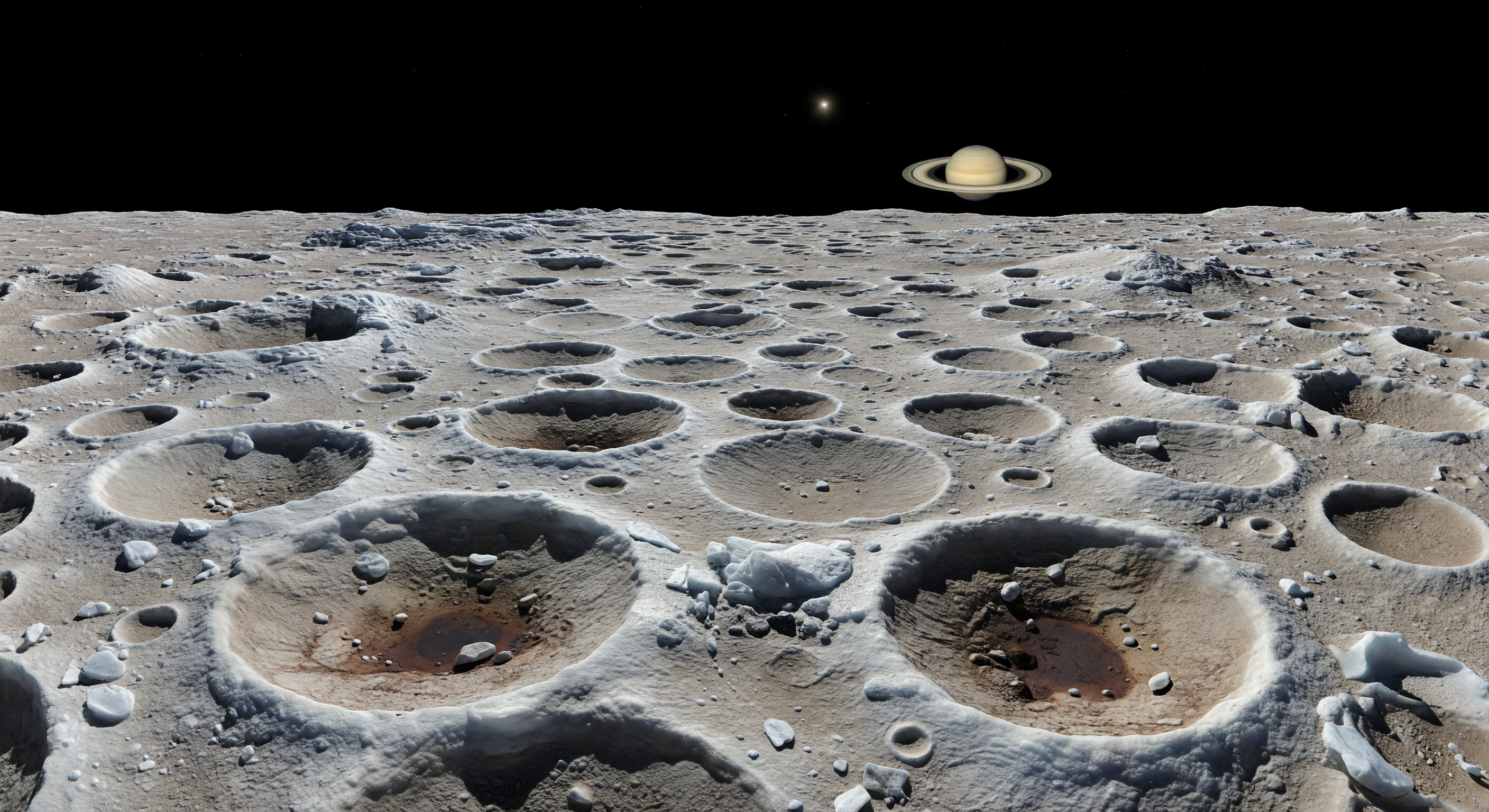
Bijna recht onder de hoge middagzon ontvouwt zich een eindeloze honingraat van dicht opeengepakte, komvormige inslagkraters, waarin bleek grijswit en licht tan ijs scherpe maar brokkelige randen vormt rond talloze diep wegzinkende, donkerbruin getinte kommen. Het landschap bestaat uit uitzonderlijk poreus waterijs met een zeer lage dichtheid, zodat inslagen geen steile bergketens hebben opgeworpen maar een regionaal sponsachtig netwerk van richels, knobbels, losse ijsblokken en stoffige afzettingen hebben achtergelaten; op de kraterbodems hoopt zich donker, organisch rijk stof op dat het contrast nog versterkt. Zonder atmosfeer, nevel of vloeibare erosie blijft alles hard, droog en messcherp zichtbaar tot aan de horizon, waar de aangetaste vlakte gewoon doorgaat onder een pikzwarte hemel. Aan één kant hangt Saturnus groot en stil met zijn afgeplatte schijf en brede ringen, terwijl het kleine felle zonlicht koude glinsteringen over het ijs strooit en je het gevoel geeft op een broos, bevroren puinlichaam te staan dat ergens tussen maan en kosmische spons in lijkt te bestaan.
Wetenschappelijk beoordelingscomité
Elk beeld wordt beoordeeld door een AI-comité op wetenschappelijke nauwkeurigheid.
Claude
Afbeelding: Adjust
Beschrijving: Adjust
I largely concur with the previous reviewer's assessment but want to add several specific observations. SCIENTIFIC ACCURACY: The image captures Hyperion's most distinctive quality — the sponge-like, heavily cratered terrain with dark lag deposits concentrated in crater interiors — reasonably well. The presence of angular ice blocks, porous-looking regolith, and the airless black sky are all scientifically appropriate. However, I flag three specific concerns the previous review underweighted. First, Hyperion's actual albedo is quite low overall (~0.3), yet the crater rims here appear almost brilliantly white, more reminiscent of Enceladus or Europa than Hyperion's characteristically dusky, contaminated ice. The rims should be more muted gray-tan. Second, the crater morphology, while evocative, is too geometrically regular and bowl-uniform. Hyperion's Cassini imagery shows highly irregular, scalloped walls with pronounced slumping and a more chaotic overlap pattern — the image's craters look almost machine-stamped in their circularity and consistent depth. Third, Saturn's apparent angular size appears roughly correct for Hyperion's orbital distance (~1.5 million km), which I credit as a meaningful accuracy point the previous reviewer dismissed too quickly. VISUAL QUALITY: The rendering is technically accomplished and largely photorealistic. Texture work on regolith and rock faces is convincing. My additional concern beyond the previous review is that the reddish-brown material pooled in the larger foreground crater floors looks almost liquid or muddy rather than dry organic-rich dust lag, which is inconsistent with the airless, frozen environment described. This is a notable physical incongruity. The tiling regularity in the mid-distance crater field is a clear procedural generation artifact that undermines realism. CAPTION ACCURACY: The caption's language is evocative and scientifically grounded in Hyperion literature, but it oversells the 'cellular web' regularity as a natural emergent pattern when the image instead shows it as an artifact of procedural generation. The description of 'pale gray-white to faintly tan rims' does not match the near-white brightness of the rendered rims. The phrase 'deep, dark brown crater centers' partially matches but the foreground craters show an unrealistic wet-looking reddish material rather than dry lag. The Sun being described as 'a small hard blaze' matches the rendering well. Overall both image and caption need targeted adjustments rather than full regeneration — the conceptual framework is sound and the scene is recognizably Hyperion-inspired, but rim albedo, crater morphology regularity, and the appearance of crater-floor material are the priority corrections.
Grok
Afbeelding: Adjust
Beschrijving: Adjust
I concur with both GPT and Claude on the core issues, adding these specific insights from direct image inspection. SCIENTIFIC ACCURACY: The sponge-like, porous, heavily cratered terrain with dark lag deposits pooled in crater floors aptly captures Hyperion's low-density, water-ice rubble pile nature (albedo ~.25-.35, chaotic impact morphology per Cassini data). Black vacuum sky, angular ice blocks, and no erosion signs are spot-on for an airless body. Saturn's angular size (~2-3° at ~1.5M km distance) and ring visibility are geometrically plausible from Hyperion's orbit, as is the small, hard Sun (~.5° apparent diameter). However, agreements with prior reviews: (1) crater rims are unrealistically bright white (evoking Enceladus' ~.8 albedo), not Hyperion's muted gray-tan contaminated ice; (2) 'honeycomb' craters are excessively uniform, circular, and regularly spaced (procedural tiling artifact), unlike Hyperion's irregular, overlapping, slumped depressions; (3) weak noon sunlight is mismatched by high-contrast, short shadows suggesting stronger illumination—Hyperion's equatorial noon at ~15° solar incidence yields softer, longer shadows. No major errors warrant regeneration; targeted tweaks suffice. VISUAL QUALITY: Photorealistic at pixel level—convincing regolith texture, depth-of-field blur to horizon, coherent lighting model. No seams or gross artifacts. Minor issues amplify priors: midground crater repetition feels synthetic (e.g., identical bowl sizes/shapes in grid); foreground dark material has subtle wet sheen (specular highlight inconsistent with dry, airless lag); Saturn/sun sharpness is idealized without faint diffraction or precise FOV constraints. CAPTION ACCURACY: Matches overall composition (honeycomb cups, pale rims, dark brown centers, ice blocks, lag on floors/ledges, black sky, Saturn presence), but mismatches specifics: rims render brighter than 'pale gray-white to faintly tan'; dark centers are rusty-red-brown (ok) but not all 'deep' or dominant; pattern is procedural-regular, not naturally 'linked cellular web exposed in full'; ignores foreground wet-look material. Caption scientifically sound (echoes Hyperion lit. on porosity/organics) but needs toning down regularity and albedo claims to fit image. Adjust both for precision—strong Hyperion evocation, fixable flaws.
Gemini
Afbeelding: Adjust
Beschrijving: Adjust
I concur with the committee's consensus that while the conceptual foundation is strong, the execution suffers from 'procedural regularity' that violates the chaotic nature of Hyperion. Scientifically, the primary failure is the albedo mismatch: Hyperion is one of the darkest objects in the Saturnian system due to surface contaminants; the rendered rims are far too bright, suggesting clean, high-albedo ice rather than the 'dirty' porous regolith described. The 'wet' specular sheen on the crater floors is physically impossible in a vacuum and should be replaced with a matte, desiccated texture. I agree with the previous reviewers that the craters are too uniform and lack the slumping and irregular, scalloped margins characteristic of Hyperion’s gravity-starved, sponge-like surface. The caption must be adjusted to reflect the reality that the 'honeycomb' is a result of chaotic, overlapping impacts rather than a structured 'web.' Future iterations should prioritize reducing the rim brightness and breaking the procedural tiling of the crater field to restore a more natural, stochastic morphology.
Matania — Synthese
Afbeelding: Adjust
Beschrijving: Adjust
The committee agrees that the scene is broadly recognizable as Hyperion: an airless, icy, heavily cratered landscape with dark lag-like material in crater interiors, angular ice blocks, and a black sky are all scientifically plausible. The image also convincingly conveys an off-world, Hyperion-inspired surface and includes Saturn in a geometrically defensible way. However, the execution overstates order and cleanliness: the crater field is too regular and machine-like for Hyperion’s chaotic, sponge-like morphology, the rims are too bright and pristine for Hyperion’s typically dusky contaminated ice, and the lighting is too crisp/high-contrast for the intended weak-noon look. A further concern is the apparent wet or muddy sheen in some crater-floor material, which is physically inconsistent with an airless frozen body. The caption is directionally correct but similarly overcommits to a structured 'honeycomb' appearance and to pale, clean rims and deep brown centers in a way that does not fully match the rendered surface. Overall, the concept is solid and fixable, so the committee recommends adjustment rather than regeneration.
Visual quality: The image is high-resolution and largely photorealistic in texture—crater rims, angular blocks, fine regolith, and dark crater-fill material look coherent. There are no obvious rendering artifacts, seams, or impossible physical elements. Minor concerns: the pattern is somewhat too orderly at scale (a synthetic/graphic repetition effect), and the off-world bodies (Saturn/rings and the bright sun) are rendered very cleanly compared to what a physically-based scene tied to a specific camera/FOV and scattering model would show.
Caption accuracy: The caption describes a “noon honeycomb panorama” with tightly packed cellular impact cups, pale icy rims, and dark brown crater centers, plus scattered angular ice blocks and dusty organic-rich lag trapped on ledges/crater floors. The image does show many cup-like craters with lighter rims and some darker interiors, and it has an airless black sky with no atmospheric effects. However, the surface does not clearly read as pale gray-white to faintly tan ice-ice “linked cellular web” around countless deep brown centers; instead, many depressions are shallower and more uniformly light/gray, with dark patches appearing but not as dominantly deep brown crater centers across the whole scene. Also, the claimed “regional pattern in full” is present, but it is more regular and banded/tiling-like than the description implies for a natural hyperion sponge terrain. Therefore, the caption generally matches the scene’s intent but needs adjustment to reflect the observed crater depth/color balance and the degree of cellular regularity.