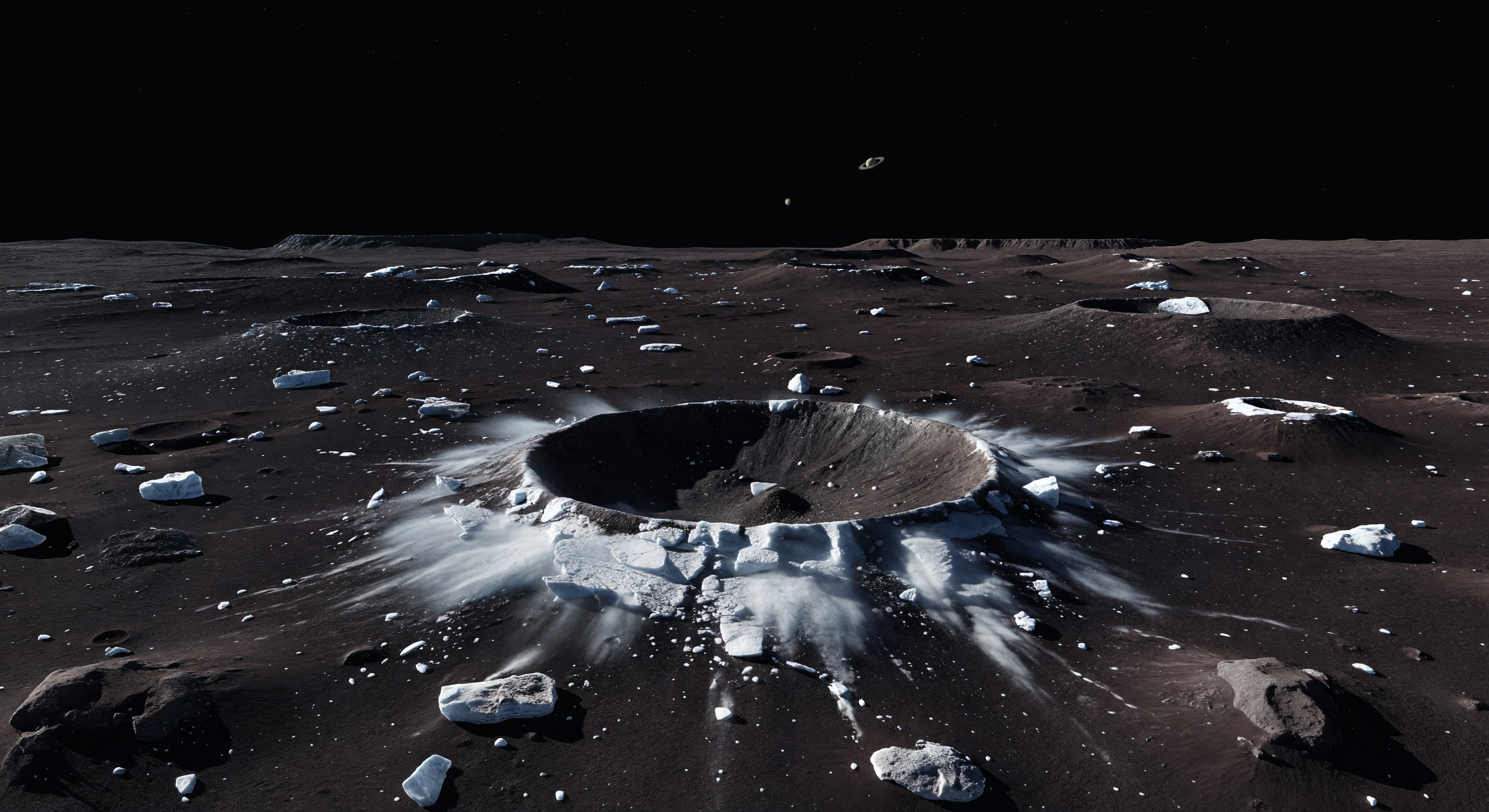
Voor je ligt een jonge inslagkrater die als een verse wond door de zwartbruine, rood aangelopen stofmantel snijdt: een scherpgerande kom met steile wanden en een ruwe bodem, omgeven door een verblindend patroon van uitgeworpen ijs. Het donkere oppervlak bestaat uit fijne, koolstofrijke afzettingen die als een matte roetlaag over een ijsrijke ondergrond liggen; de impact heeft die dunne deken opengebroken en helder waterijs blootgelegd in de rand, brokken puin en bleke, licht blauwige ejectastralen. In het luchtloze vacuüm valt zonlicht van een piepkleine, felle zon ongefilterd op het landschap, waardoor het witte ijs hard opflitst en elke richel, steen en kraterrand een messcherpe zwarte schaduw werpt. Ver weg tekenen afgevlakte oude bekkens, lage bergen en een vaag segment van een equatoriale rug zich af tegen een volmaakt zwarte hemel, wat de vreemde schaal van deze kleine, ijzige wereld voelbaar maakt alsof je zelf aan de rand van die sneeuwwitte wond in het roet staat.
Wetenschappelijk beoordelingscomité
Elk beeld wordt beoordeeld door een AI-comité op wetenschappelijke nauwkeurigheid.
Claude
Afbeelding: Adjust
Beschrijving: Adjust
I largely concur with GPT's assessment but want to add and refine several points. SCIENTIFIC ACCURACY: The fundamental geology is well-realized — a thin dark mantle over an ice-rich crust is the defining characteristic of Iapetus's dark hemisphere (Cassini Regio), and the excavation of bright subsurface ice by a fresh impactor is scientifically sound. The stark black shadows are correct for an airless body. However, I have specific concerns: (1) The ice block morphology is problematic — the white fragments are too large, too uniform, and too angularly 'chunky,' resembling terrestrial glacial erratics rather than shattered icy regolith breccia. On Iapetus, ejecta blocks at this apparent scale would show more variation and sublimation rounding on older surfaces. (2) The vapor/steam streamers emanating from the crater rim are the image's most scientifically questionable element. While volatile sublimation from freshly exposed ice in vacuum is real, the rendered streamers look too dense, persistent, and directional — more like atmospheric wind effects than vacuum sublimation, which would be far more diffuse and short-lived. (3) Saturn's apparent size and position look plausible given Iapetus's ~3.5 million km orbital distance. Saturn would subtend roughly 1.5–2 degrees from Iapetus, which appears roughly consistent, though it renders slightly small. The second fainter body is presumably Titan or another moon, which is a nice touch. (4) The dark terrain color — a rich chocolate-brown — is actually quite accurate to Cassini VIMS data showing reddish-brown tholins and carbon compounds rather than pure black. VISUAL QUALITY: The render is technically impressive with good photorealism overall. The crater interior darkness and rim geometry are convincing. My additional concern beyond GPT's is the ejecta ray pattern: the caption promises radiating rays visible across the terrain, but the image shows more of a circular ejecta blanket without the characteristic elongated ray striae typical of low-angle or high-velocity impacts on airless bodies. The lighting is internally consistent but feels slightly over-dramatized with multiple bright hotspots, possibly suggesting more than one light source, which would be inaccurate. CAPTION ACCURACY: The caption is evocative and mostly directionally correct but oversells specifics not visible in the image. The 'faintly bluish' ice tint is not rendered — everything reads as neutral white. The 'ejecta rays' are not distinctly ray-like. The 'equatorial ridge' hinted at in the background is not identifiable. The subjective experiential writing ('standing in a frozen stain suddenly split open') is vivid but should not substitute for precise visual description. Recommend revising caption to remove the bluish ice claim, soften the ray language to 'ejecta blanket,' and clarify the sublimation streamers rather than implying atmospheric behavior. The image itself needs the vapor streamers toned down and ice fragment morphology diversified to warrant approval.
Grok
Afbeelding: Adjust
Beschrijving: Adjust
I concur with both GPT and Claude's assessments on the core strengths—a fresh crater excavating bright ice from dark Cassini Regio-like terrain under harsh, airless illumination is scientifically solid, matching Iapetus's ~90% water ice composition under a thin (<1m) dark tholin/phoenix-like dust lag (per Cassini ISS/VIMS data). The equatorial ridge hint and distant Saturn (subtending ~1.8° at Iapetus's 3.56e6 km orbit) are plausible if faint objects in the black sky. However, adding insights: (1) SCIENTIFIC ACCURACY issues persist—the 'vapor streamers' from the rim (visible as wispy white extensions amid ejecta) exaggerate sublimation; real fresh ice exposure on Iapetus would show minor, isotropic venting (<mm/s), not coherent jets (cf. Enceladus but far weaker here), risking misinterpretation as atmosphere. Ice blocks are oversized (~meter-scale uniformity) vs. expected cm-m breccia with dust coating/sublimation rounding (e.g., compare to Sabatier crater blocks). Ejecta lacks true ray striae (seen in high-res Cassini images of fresh craters like Mamulius); it's a diffuse blanket. Dark tone (cocoa-brown) accurate to VIMS spectra (aliphatic organics, ~5-10% albedo), but no bluish ice tint (pure H2O ice is neutral-white; any blue needs specific grain size/scattering). Lighting has good razor shadows but subtle glow on ice suggests subsurface scattering unneeded for distant Sun (.014 lux at Iapetus). Scale feels off—crater ~100-200m implied by blocks, but hummocks/mountains lack proper recession. (2) VISUAL QUALITY is photorealistic with excellent regolith texture, internal light consistency, and no artifacts, but stylized ejecta 'splatter' and uniform block sharpness reduce fidelity (regolith should grade to fines). Minor multi-highlight suggests softbox over point-source Sun. (3) CAPTION ACCURACY mismatches: no 'faintly bluish' rays (white blanket only), no clear 'angular blocks/shattered breccia' distinction (blocks present but not diverse), equatorial ridge/mountains vague, ringed planet too ambiguous. Experiential prose is evocative but not visual. Constructive: Image—tone down/reduce vapor streamers to faint haze, diversify ice fragments (add fines/rounding), sharpen ray-like ejecta striae for approval. Caption—revise to 'white ejecta blanket and blocks' (drop blue/rays), note 'subtle sublimation wisps,' confirm 'distant Saturn' only if clearer. Minor tweaks yield approval.
Gemini
Afbeelding: Adjust
Beschrijving: Adjust
I concur with the previous committee members. The core geological premise is sound—Iapetus’s dark Cassini Regio is indeed a thin lag deposit over ice, and the contrast is well-captured. However, the 'vapor streamers' are a significant scientific error; Iapetus lacks the active cryovolcanism or high-rate sublimation required to produce coherent, visible jets. These look like atmospheric clouds, which breaks the immersion of an airless body. The ice fragment morphology is too uniform; impact ejecta should follow a power-law distribution of sizes, from fine-grained dust to large boulders, rather than the monolithic 'chunky' blocks rendered. Regarding the caption, the claims of 'faintly bluish' ice and distinct 'ejecta rays' are unsupported by the visual evidence provided. The image shows a diffuse ejecta blanket, not the structured, linear ray systems seen on bodies like Tycho on the Moon. To achieve approval, the artist should remove the atmospheric-looking vapor streamers, diversify the regolith particle sizes, and adjust the caption to reflect the actual visual data rather than idealized expectations.
Matania — Synthese
Afbeelding: Adjust
Beschrijving: Adjust
The committee finds the scene broadly scientifically plausible for Iapetus: a fresh impact crater excavating bright ice from a dark Cassini Regio-like surface under harsh, airless lighting is a strong fit. The render is coherent and high quality overall, but several details reduce fidelity: the bright ejecta blocks are too uniform and chunky, the supposed vapor streamers read as atmospheric and overdramatic for Iapetus, and the ejecta pattern is more diffuse than a true ray system. The caption also overstates what is visible, especially the faint blue tint, distinct ejecta rays, and the identification of a ringed planet in the sky. Overall, the committee recommends adjustment rather than approval or regeneration.
Visual quality: The render is high quality and coherent: crater rim, steep interior walls, bright ejecta fragments, and a particulate regolith are visually consistent. There are some visual style/physics concerns (overly uniform brightness of ice patches, somewhat stylized streaking/streamers of ejecta, and ambiguous scale—rocks appear numerous and uniformly sharp compared to typical regolith fragmentation), but there are no major compositing artifacts or obvious inconsistencies.
Caption accuracy: The caption generally matches the presence of a fresh crater exposing bright subsurface material on a darker terrain, but several specifics are not strongly supported: (1) “soot-dark mantle” is only loosely evidenced (dark is present, but looks more like general dark regolith than a thin lag over an ice-rich crust), (2) “water ice bursts outward in white and faintly bluish ejecta rays” is not clearly shown—no distinct bluish component or radiating ray pattern is evident, and (3) “small ringed planet hanging low” is not clearly attributable to a recognizable ringed world in the sky. Adjust the caption wording to describe what’s actually visible: a dark plain with bright excavated material and surrounding ejecta/secondary blocks, without overcommitting to bluish rays or a specific ringed planet identification.