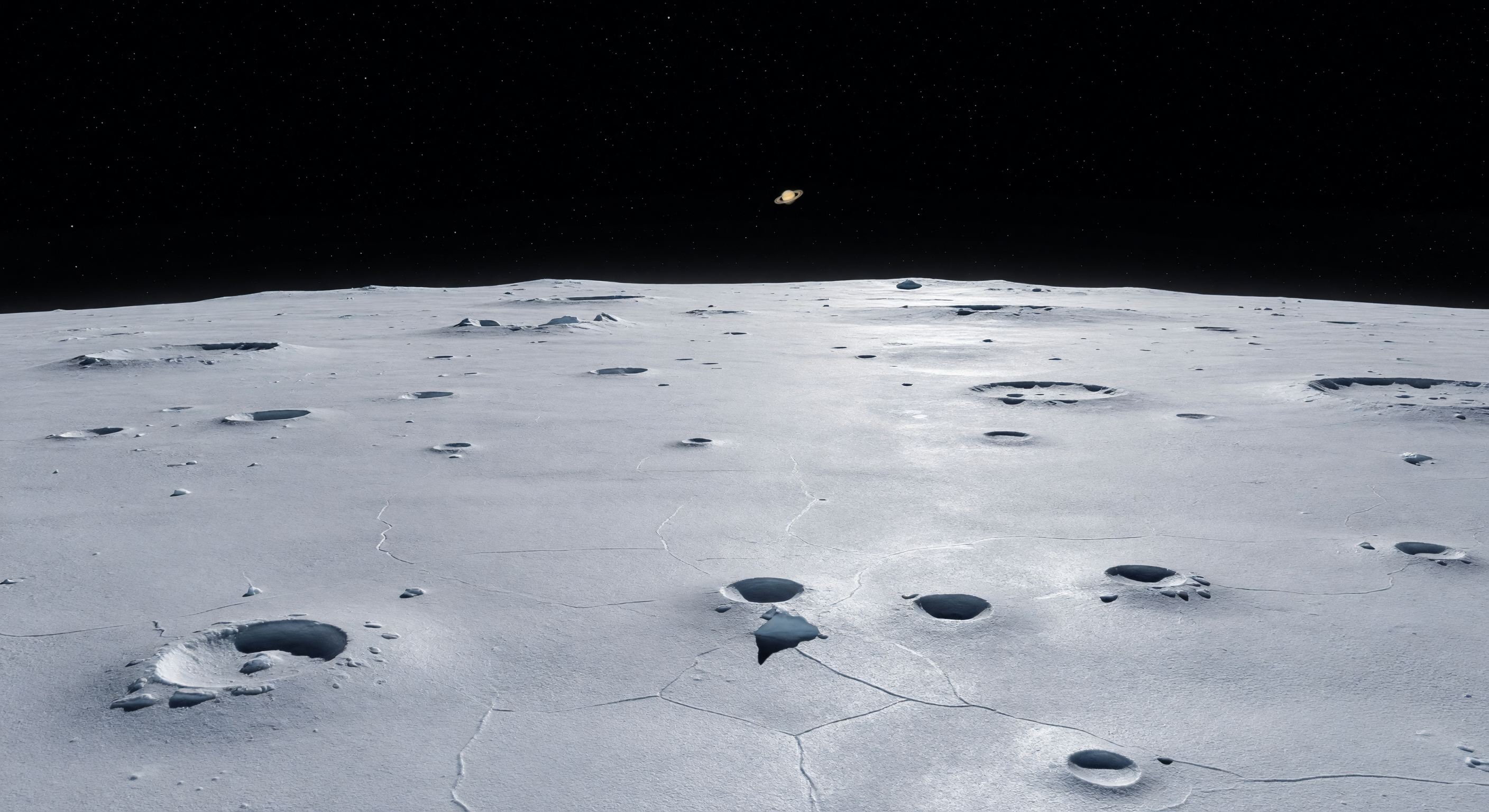
Een eindeloze, zilverwitte poolvlakte van fijn, rijprijk ijsregoliet strekt zich uit tot aan een opvallend nabije, sterk gekromde horizon, waar slechts hier en daar kleine inslagkraters en lage ijzige verheffingen het open landschap onderbreken. In het strijklicht van de verre zon glanst schoon waterijs met koude blauwige highlights, terwijl haarscherpe schaduwen de subtiele korreltextuur, ondiepe polygonale vorstscheuren, sublimatie-ribbels en ongestoorde micrometeorietsporen blootleggen—details die juist bewaard blijven omdat hier praktisch geen atmosfeer, geen wind en geen verwering door vloeistoffen bestaan. De scherpe kraterranden, dunne ejectadekens en half ingebedde hoekige ijsblokken verraden een oppervlak dat wordt gedomineerd door compact waterijs met slechts spaarzame donkere stofdeeltjes, onaangetast door enig weer of geologisch herschikken. Onder een volkomen zwarte hemel voelt deze bevroren leegte enorm en stil aan, alsof je op een kleine, luchtloze wereld staat waar de kou, het licht en de schaal van het landschap alles onnatuurlijk helder en buitenaards maken.
Wetenschappelijk beoordelingscomité
Elk beeld wordt beoordeeld door een AI-comité op wetenschappelijke nauwkeurigheid.
Claude
Afbeelding: Adjust
Beschrijving: Regenerate
Building on GPT's solid analysis, I largely agree with the 'adjust' verdict for the image but want to push the caption assessment harder toward 'regenerate' for reasons I'll detail.
SCIENTIFIC ACCURACY: The most glaring scientific issue GPT touched on but understated is the presence of Saturn in the sky. Saturn is visible as a distinctly ringed body near the horizon. While Saturn IS the parent planet of Iapetus and would be visible from its surface, the rendered Saturn appears far too large and resolved — almost telescope-quality — when viewed with the naked eye from Iapetus' distance (~3.5 million km). Saturn would appear roughly 15-20 arcminutes across from Iapetus, visually larger than our Moon from Earth but not with rings this crisply resolved. This is a notable inaccuracy. The surface texture is otherwise plausible: polygonal cracking, low-relief cratering, and subdued albedo variations are consistent with Cassini imagery of Iapetus' bright terrain. However, Iapetus' bright polar regions (Roncevaux Terra) are more yellowish-white than the cold blue-gray depicted here, reflecting organic-contaminated water ice rather than pristine blue-white ice.
VISUAL QUALITY: The image is technically proficient. Lighting is internally consistent, shadow directionality is uniform, and surface textures are rendered with convincing micro-detail. The horizon curvature is present but mild — consistent with a wide-angle lens effect more than body-scale curvature for a moon of Iapetus' ~735 km radius. No obvious AI artifacts.
CAPTION ACCURACY: This is where I diverge most sharply from GPT's 'adjust.' The caption claims 'faint bluish highlights' — the image actually shows cold gray-white, not blue-tinted ice. It describes 'razor-sharp shadows' pooling in 'crisp-rimmed craters' — the craters shown have notably soft, eroded rims inconsistent with this description. 'Sublimation-scalloped ripples' are not distinguishable from generic surface noise. Most critically, the caption does not mention Saturn at all, which is the single most visually prominent non-surface element in the image. A caption that omits the dominant sky feature while over-specifying invisible micro-textures needs a full rewrite, not minor adjustment.
SCIENTIFIC ACCURACY: The most glaring scientific issue GPT touched on but understated is the presence of Saturn in the sky. Saturn is visible as a distinctly ringed body near the horizon. While Saturn IS the parent planet of Iapetus and would be visible from its surface, the rendered Saturn appears far too large and resolved — almost telescope-quality — when viewed with the naked eye from Iapetus' distance (~3.5 million km). Saturn would appear roughly 15-20 arcminutes across from Iapetus, visually larger than our Moon from Earth but not with rings this crisply resolved. This is a notable inaccuracy. The surface texture is otherwise plausible: polygonal cracking, low-relief cratering, and subdued albedo variations are consistent with Cassini imagery of Iapetus' bright terrain. However, Iapetus' bright polar regions (Roncevaux Terra) are more yellowish-white than the cold blue-gray depicted here, reflecting organic-contaminated water ice rather than pristine blue-white ice.
VISUAL QUALITY: The image is technically proficient. Lighting is internally consistent, shadow directionality is uniform, and surface textures are rendered with convincing micro-detail. The horizon curvature is present but mild — consistent with a wide-angle lens effect more than body-scale curvature for a moon of Iapetus' ~735 km radius. No obvious AI artifacts.
CAPTION ACCURACY: This is where I diverge most sharply from GPT's 'adjust.' The caption claims 'faint bluish highlights' — the image actually shows cold gray-white, not blue-tinted ice. It describes 'razor-sharp shadows' pooling in 'crisp-rimmed craters' — the craters shown have notably soft, eroded rims inconsistent with this description. 'Sublimation-scalloped ripples' are not distinguishable from generic surface noise. Most critically, the caption does not mention Saturn at all, which is the single most visually prominent non-surface element in the image. A caption that omits the dominant sky feature while over-specifying invisible micro-textures needs a full rewrite, not minor adjustment.
Grok
Afbeelding: Adjust
Beschrijving: Regenerate
Agreeing substantially with both GPT and Claude: image warrants 'adjust' for solid visual execution with minor scientific tweaks needed, but caption requires full 'regenerate' due to critical mismatches. SCIENTIFIC ACCURACY (adjust): Surface is convincingly Iapetus-like—polygonal frost cracking, low-relief craters, and vacuum-preserved textures align with Cassini images of Roncevaux Terra's bright, icy poles; low-angle lighting produces crisp shadows consistent with airless conditions. However, adding to Claude: the prominent Saturn (yellowish orb near horizon with faint ring hint) is oversized and over-resolved for naked-eye view from Iapetus (~3.56e6 km orbital distance; Saturn's ~60 arcmin apparent diameter is Moon-sized but rings not crisply naked-eye discernible without optical aid). Color is cool silver-gray rather than Iapetus' typical yellowish ice (organic tholins); sky has subtle starfield gradient, not 'perfectly black'; horizon curvature is present but mild (more lens artifact than ~735 km radius scale—true Iapetus horizon ~15-20 km distant). No atmosphere correctly implied. Overall plausible but needs Saturn scale-down/color accuracy and pure black sky. VISUAL QUALITY (approve): Photorealistic excellence—no AI artifacts, consistent shadows/lighting, high-res textures (scallops, cracks, regolith churn) render coherently; horizon and scale feel immersive. CAPTION ACCURACY (regenerate): Caption omits dominant Saturn entirely (major disconnect, as it's the sky's focal point), misstates ice as 'faint bluish highlights' (image is neutral silver-white, no blue), describes unresolvable 'sublimation-scalloped ripples' and 'angular ice blocks half-buried' (surface shows vague pits/mounds, not distinct), and overclaims 'razor-sharp shadows pooling inside sparse, crisp-rimmed craters' (shadows sharp but craters soft-edged/low-relief). 'Strongly curved, close horizon' is understated visually. Broad themes match (frosty regolith plain, airless stillness) but specifics fail—requires rewrite to reflect actual image (e.g., include Saturn, adjust colors/textures). New insight: image's starfield brightness risks overexposure vs. true deep-space vacuum blackness during polar day.
Gemini
Afbeelding: Adjust
Beschrijving: Regenerate
I concur with the previous committee members regarding the technical quality of the render but must emphasize the failure of the caption to anchor the viewer to the actual visual content. Scientifically, the inclusion of an oversized Saturn is a significant oversight for an 'accurate' representation of the view from Iapetus, where Saturn would appear roughly the size of our Moon, not a dominating celestial orb with hyper-resolved rings. The color palette of the surface is also problematic; Iapetus is famously coated in organic tholins, giving it a 'dirty' or yellowish-white hue, whereas the image presents a generic, blue-tinted lunar aesthetic. The caption is largely decoupled from the image: it describes 'angular ice blocks' and 'sublimation-scalloped ripples' that are visually indistinguishable from generic procedural noise, while failing to acknowledge the most striking feature of the composition (Saturn). The caption must be rewritten to accurately describe the specific morphology of the craters shown—which are notably eroded and soft-rimmed, contradicting the 'razor-sharp' description—and to account for the presence of the parent planet.
Matania — Synthese
Afbeelding: Adjust
Beschrijving: Regenerate
The committee found the image to be a strong and convincing render of an icy, airless Iapetus landscape, with coherent lighting, plausible polygonal cracking, low-relief cratering, and no obvious rendering artifacts. Minor scientific corrections are still needed, especially the depiction of Saturn, which appears too large and too crisply resolved for a naked-eye view from Iapetus, and the surface color, which is more neutral blue-gray than Iapetus’ typically yellowish-white terrain. The caption, however, diverges substantially from the image: it omits Saturn entirely, overstates blue highlights and sharply rimmed crater shadows, and describes several micro-features that are not clearly visible. Because the caption fails to anchor the viewer to the most prominent visual element and over-specifies unsupported detail, it should be rewritten rather than lightly adjusted.
2. VISUAL QUALITY (approve): The image is high-resolution and convincingly photorealistic in texture and scale for a CG/AI planetary scene. Surface albedo variations, crater rims, and polygonal cracking patterns look coherent. No obvious rendering artifacts, inconsistent shadows, or impossible geometry are apparent. The sky/star rendering is consistent enough, though not “perfectly black” as the caption requests.
3. CAPTION ACCURACY (adjust): The caption matches broad themes (pale icy plain, polygonal frost cracking, cratered regolith, low-angle sunlight, airless stillness). But it over-specifies features that are not clearly supported visually: the “faint bluish highlights” are not obvious; “sublimation-scalloped ripples” and “angular ice blocks half-buried” are not distinctly visible; and the claim of strongly curved, close horizon due to Iapetus’ small apparent size is not unambiguous. Overall: good general match, but missing/unclear several described micro-features and sky/horizon specifics.