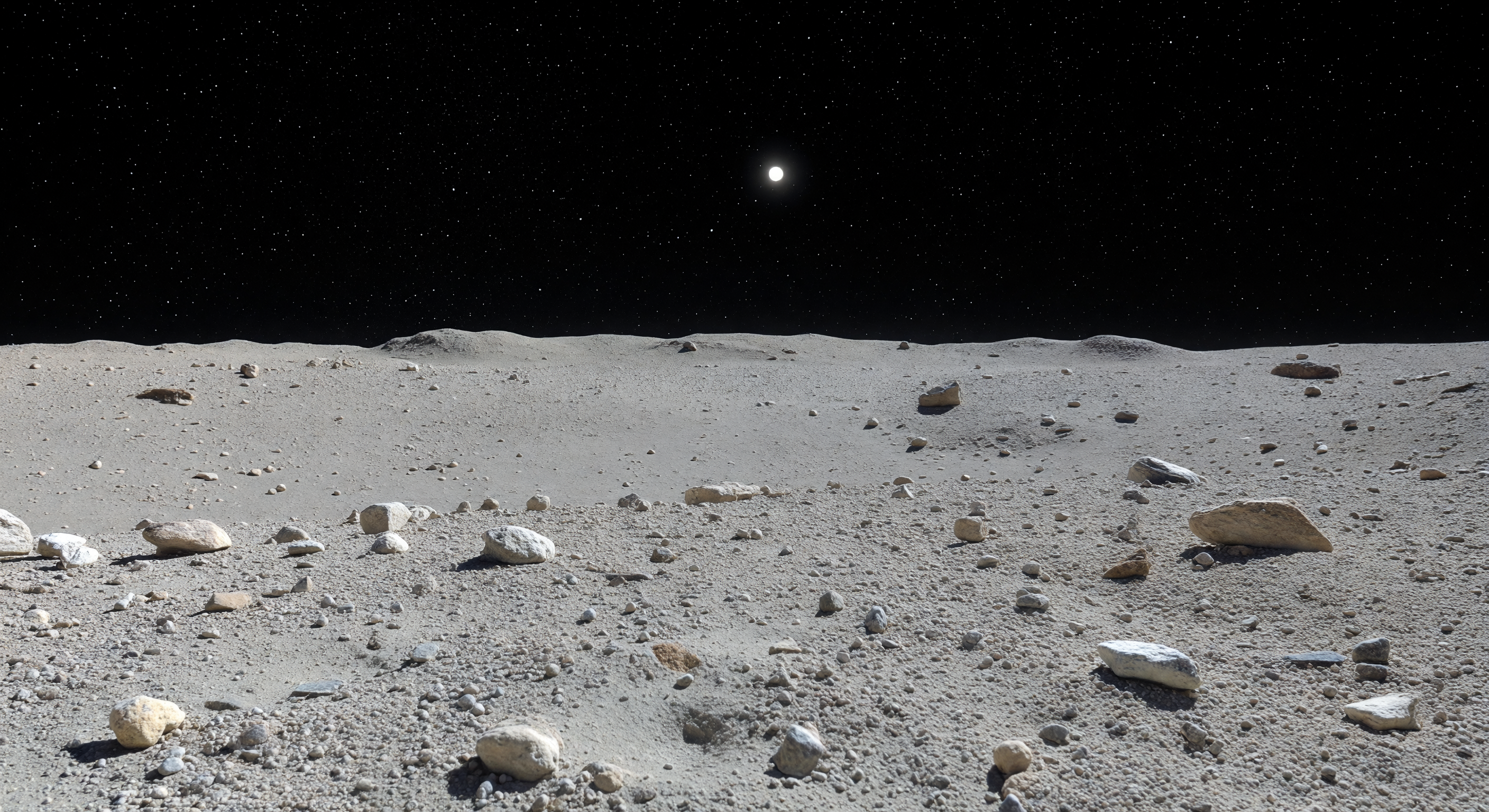
Voor je strekt zich de vlakke laagte van Muses Sea uit als een zacht golvende, licht grijs-beige grindvlakte, waar fijn regoliet, afgeronde kiezels en verspreide keien in het harde zonlicht scherpe, inktzwarte schaduwen werpen onder een volkomen zwarte hemel. Dit gladde terrein is geen strand of stofvlakte zoals op aarde, maar een door extreem zwakke zwaartekracht gesorteerde afzetting op een poreuze puinhoopasteroïde, opgebouwd uit gewone chondritische, silicaatrijke brokstukken waarvan sommige fragmenten donkerder zijn geworden door ruimteverwering. Van dichtbij vallen de korrelige textuur, half ingebedde stenen, minieme kuiltjes en zeldzame blootliggende plekken rots op, terwijl de horizon al na korte afstand merkbaar krom wegvalt — een direct gevolg van een wereld die slechts enkele honderden meters groot is. In het luchtledige ontbreken nevel, wind en elk spoor van erosie door vloeistoffen, zodat je hier lijkt te staan op een stille hoop zonnelicht en steen, klein van schaal maar onmiskenbaar buitenaards.
Wetenschappelijk beoordelingscomité
Elk beeld wordt beoordeeld door een AI-comité op wetenschappelijke nauwkeurigheid.
Claude
Afbeelding: Regenerate
Beschrijving: Adjust
I largely agree with the previous reviewer's 'adjust' assessments but want to escalate the image vote to 'regenerate' based on several compounding inaccuracies specific to Itokawa that I believe are more serious than characterized.
SCIENTIFIC ACCURACY (major issues): The most critical problem is that this image looks like a generic lunar or large-body asteroid surface, not Itokawa specifically. Itokawa is only ~535m x 294m x 209m — one of the smallest visited asteroids. The horizon on Itokawa would be dramatically, almost absurdly close (tens to perhaps 100 meters depending on terrain), far more extreme than shown here. The gentle, rolling hills extending hundreds of apparent meters to the horizon are fundamentally inconsistent with Itokawa's scale. On Itokawa, those 'hills' would literally be small boulder clusters visible in their entirety. The Muses Sea specifically is famously ultra-smooth with very fine-grained regolith and a characteristic absence of large boulders — yet this image shows a profusion of fist-to-head-sized rocks distributed uniformly, which is more characteristic of Itokawa's rougher Sagamihara or boulder-strewn regions, not Muses Sea. The regolith color is also somewhat too light/lunar-gray; Itokawa's surface has a warmer, slightly browner ordinary chondrite tone based on Hayabusa data. The solar disk depicted near zenith is a small glowing orb without the sharp, unfiltered character expected in vacuum — it reads visually as a distant moon or lamp rather than the Sun at ~1 AU. Shadow edges on rocks appear softened, inconsistent with the complete absence of atmospheric scattering.
VISUAL QUALITY: The image is technically photorealistic in render quality, with no obvious CGI seams or artifacts. However, the compositional and physical plausibility issues undermine its value. The illumination appears to come from a different direction than the depicted solar disk — rocks in the foreground cast shadows that don't consistently align with the bright object overhead. This is a physically incoherent lighting setup that a photorealistic render should not exhibit.
CAPTION ACCURACY: The caption is well-written and scientifically informed about Itokawa, referencing size-sorting, ordinary-chondrite composition, ultra-low gravity migration, and the Muses Sea specifically. However, almost none of these described features are clearly visible or convincingly represented in the image. The 'startlingly close' horizon is described but not delivered. The 'razor-edged shadows' are described but contradicted by the render. The size-sorting of grains is described but not visually evident. The caption is better science communication than the image is science visualization — which means the caption deserves only an 'adjust' (tighten claims to match what is actually shown) while the image needs a full regeneration with Itokawa-specific constraints: dramatically closer horizon, Muses Sea smoothness with finer regolith dominance, warmer color tone, and corrected shadow physics.
SCIENTIFIC ACCURACY (major issues): The most critical problem is that this image looks like a generic lunar or large-body asteroid surface, not Itokawa specifically. Itokawa is only ~535m x 294m x 209m — one of the smallest visited asteroids. The horizon on Itokawa would be dramatically, almost absurdly close (tens to perhaps 100 meters depending on terrain), far more extreme than shown here. The gentle, rolling hills extending hundreds of apparent meters to the horizon are fundamentally inconsistent with Itokawa's scale. On Itokawa, those 'hills' would literally be small boulder clusters visible in their entirety. The Muses Sea specifically is famously ultra-smooth with very fine-grained regolith and a characteristic absence of large boulders — yet this image shows a profusion of fist-to-head-sized rocks distributed uniformly, which is more characteristic of Itokawa's rougher Sagamihara or boulder-strewn regions, not Muses Sea. The regolith color is also somewhat too light/lunar-gray; Itokawa's surface has a warmer, slightly browner ordinary chondrite tone based on Hayabusa data. The solar disk depicted near zenith is a small glowing orb without the sharp, unfiltered character expected in vacuum — it reads visually as a distant moon or lamp rather than the Sun at ~1 AU. Shadow edges on rocks appear softened, inconsistent with the complete absence of atmospheric scattering.
VISUAL QUALITY: The image is technically photorealistic in render quality, with no obvious CGI seams or artifacts. However, the compositional and physical plausibility issues undermine its value. The illumination appears to come from a different direction than the depicted solar disk — rocks in the foreground cast shadows that don't consistently align with the bright object overhead. This is a physically incoherent lighting setup that a photorealistic render should not exhibit.
CAPTION ACCURACY: The caption is well-written and scientifically informed about Itokawa, referencing size-sorting, ordinary-chondrite composition, ultra-low gravity migration, and the Muses Sea specifically. However, almost none of these described features are clearly visible or convincingly represented in the image. The 'startlingly close' horizon is described but not delivered. The 'razor-edged shadows' are described but contradicted by the render. The size-sorting of grains is described but not visually evident. The caption is better science communication than the image is science visualization — which means the caption deserves only an 'adjust' (tighten claims to match what is actually shown) while the image needs a full regeneration with Itokawa-specific constraints: dramatically closer horizon, Muses Sea smoothness with finer regolith dominance, warmer color tone, and corrected shadow physics.
Grok
Afbeelding: Regenerate
Beschrijving: Adjust
I concur with both previous reviewers on the core issues and escalate to full consensus on 'regenerate' for the image due to multiple compounding scientific inaccuracies specific to Itokawa and the Muses Sea region.
1. SCIENTIFIC ACCURACY: Major problems persist. Itokawa's Muses Sea is characterized by exceptionally smooth, fine-grained regolith with minimal coarse gravel or cobbles—Hayabusa imagery shows it as a dust-blanketed 'sea' with subtle undulations, not the boulder-strewn gravel flat depicted here (which evokes rougher areas like Sagamihara Ridge). Horizon curvature is far too shallow; on Itokawa's ~300m scale, from ground level, it should arc dramatically within 20-50m, making the world feel like a 'miniature pebble'—not the hundreds-of-meters vista shown with rolling hills that would span the entire asteroid. Color is overly lunar-pale gray; Itokawa's S-type ordinary chondrite surface has a warmer beige-gray tone (albedo ~.053, with reddish hues in spectra). Lighting is incoherent: the small, hazy white orb at top-center doesn't align with shadow directions (foreground rocks shadow inconsistently rightward/downward, not radially from the 'Sun'), and edges lack true razor sharpness expected in vacuum (no penumbra from scattering). Black star-filled sky is correct for no atmosphere. Low-gravity particle sorting is claimed but not visible—no clear fine-grain pooling amid coarser bits.
2. VISUAL QUALITY: Photorealistic render quality with fine regolith texture and rock details, no glaring artifacts or seams. However, physically implausible lighting mismatch (Sun position vs. shadows) and overly expansive scale destroy immersion, making it read as a generic Moon/asteroid sim rather than precise Itokawa recreation.
3. CAPTION ACCURACY: Excellent, scientifically precise description drawing directly from Hayabusa data (Muses Sea smoothness, chondrite rubble dynamics, low-g sorting)—it accurately educates on Itokawa. But it overclaims relative to the image: no evident size-sorting, inconsistent 'inky razor-edged' shadows, horizon not 'startlingly close,' and no smooth 'seas' vs. boulder fields transition. Minor tweak to align claims with visible elements.
Constructive: Regenerate with prompts enforcing: extreme horizon closeness (e.g., 'horizon 30m away, asteroid-sized world'), dominant fine pale-beige regolith with sparse/subtle pebbles only, warmer tones, single glaring Sun disk with perfectly radial ultra-sharp shadows, pure black starry sky. Caption just needs qualifiers like 'as depicted.' This would yield a landmark visualization.
1. SCIENTIFIC ACCURACY: Major problems persist. Itokawa's Muses Sea is characterized by exceptionally smooth, fine-grained regolith with minimal coarse gravel or cobbles—Hayabusa imagery shows it as a dust-blanketed 'sea' with subtle undulations, not the boulder-strewn gravel flat depicted here (which evokes rougher areas like Sagamihara Ridge). Horizon curvature is far too shallow; on Itokawa's ~300m scale, from ground level, it should arc dramatically within 20-50m, making the world feel like a 'miniature pebble'—not the hundreds-of-meters vista shown with rolling hills that would span the entire asteroid. Color is overly lunar-pale gray; Itokawa's S-type ordinary chondrite surface has a warmer beige-gray tone (albedo ~.053, with reddish hues in spectra). Lighting is incoherent: the small, hazy white orb at top-center doesn't align with shadow directions (foreground rocks shadow inconsistently rightward/downward, not radially from the 'Sun'), and edges lack true razor sharpness expected in vacuum (no penumbra from scattering). Black star-filled sky is correct for no atmosphere. Low-gravity particle sorting is claimed but not visible—no clear fine-grain pooling amid coarser bits.
2. VISUAL QUALITY: Photorealistic render quality with fine regolith texture and rock details, no glaring artifacts or seams. However, physically implausible lighting mismatch (Sun position vs. shadows) and overly expansive scale destroy immersion, making it read as a generic Moon/asteroid sim rather than precise Itokawa recreation.
3. CAPTION ACCURACY: Excellent, scientifically precise description drawing directly from Hayabusa data (Muses Sea smoothness, chondrite rubble dynamics, low-g sorting)—it accurately educates on Itokawa. But it overclaims relative to the image: no evident size-sorting, inconsistent 'inky razor-edged' shadows, horizon not 'startlingly close,' and no smooth 'seas' vs. boulder fields transition. Minor tweak to align claims with visible elements.
Constructive: Regenerate with prompts enforcing: extreme horizon closeness (e.g., 'horizon 30m away, asteroid-sized world'), dominant fine pale-beige regolith with sparse/subtle pebbles only, warmer tones, single glaring Sun disk with perfectly radial ultra-sharp shadows, pure black starry sky. Caption just needs qualifiers like 'as depicted.' This would yield a landmark visualization.
Gemini
Afbeelding: Regenerate
Beschrijving: Adjust
I concur with the previous committee members. The visual representation fails to capture the unique, 'miniature' scale of Itokawa, which is the defining characteristic of this body. The current image depicts a generic, expansive rocky plain rather than the claustrophobic, immediate horizon one would experience on a 500-meter-long object. The 'Muses Sea' is specifically documented by JAXA's Hayabusa as being remarkably devoid of large boulders—a smooth, fine-grained regolith pond—whereas the image presents a cluttered, coarse-grained field that contradicts the geological classification of the region. Furthermore, the lighting inconsistency (the disconnect between the solar disk position and shadow vectors) is a fatal flaw for a scientific visualization. To improve: 1) Dramatically lower the camera height to emphasize the extreme, curved horizon; 2) drastically reduce the density and size of surface boulders to reflect the smooth nature of the Muses Sea; 3) implement a single-point, high-intensity light source to ensure mathematically sharp, radial shadows; and 4) shift the color palette from 'lunar gray' to the warmer, S-type chondrite beige-brown. The caption is excellent in its scientific intent but must be adjusted to acknowledge that the visual is an interpretive representation, as it currently promises a level of size-sorting and shadow-sharpness that the rendering fails to deliver.
Matania — Synthese
Afbeelding: Regenerate
Beschrijving: Adjust
The committee agrees the image is a technically competent but scientifically insufficient rendering of Itokawa’s Muses Sea. It captures the broad idea of an airless, rocky asteroid surface, but it fails the most distinctive constraints of this target: Itokawa’s dramatically small scale and close horizon, the smoother and finer-grained character of the Muses Sea, its warmer ordinary-chondrite color palette, and coherent vacuum lighting with a clearly placed solar source and consistently razor-sharp shadows. The image instead reads as a generic asteroid or lunar plain with a larger apparent scale and too much coarse rubble. The caption is scientifically strong and clearly informed, but it overstates details that are not convincingly visible in the image, especially size-sorting, smooth-sea transitions, and ultra-sharp shadow behavior. Thus, the image requires regeneration, while the caption needs tightening to match the current visual evidence more closely.
2. VISUAL QUALITY: The image is photorealistic in style and has plausible regolith granularity and rock shapes. There are no major obvious artifacts. The main visual issue is physical plausibility of illumination: the bright object near the top center resembles a Sun/moon, but the shadowing and overall illumination cues don’t cleanly match the described lighting model (nearly unfiltered solar glare + consistently sharp shadows). Horizon curvature is present but modest; it helps convey low-gravity intimacy but doesn’t strongly match the “startlingly close” impression claimed.
3. CAPTION ACCURACY: The caption’s general elements—pale gray-beige rubble/pebbles, scattered half-buried cobbles, black sky, airless appearance, and gently rolling terrain—are largely supported. But several specifics are not well evidenced: (a) “subtly sorted by size—fine grains pooled among coarser fragments” is not clearly demonstrated; (b) “inky, razor-edged” shadows are not consistently visible/consistent; and (c) “smooth ‘seas’ between rougher boulder fields” is not clearly shown as a distinct transition—most of the scene appears uniformly rubble-covered.
Overall: scientifically and visually credible as an airless asteroid surface, but the illumination/shadow physics and the more detailed ‘Muses Sea’ sorting/landscape specificity are not strong enough. Minor corrections to shadow direction/sharpness cues and clearer size-sorting or smoother lowland character are recommended.