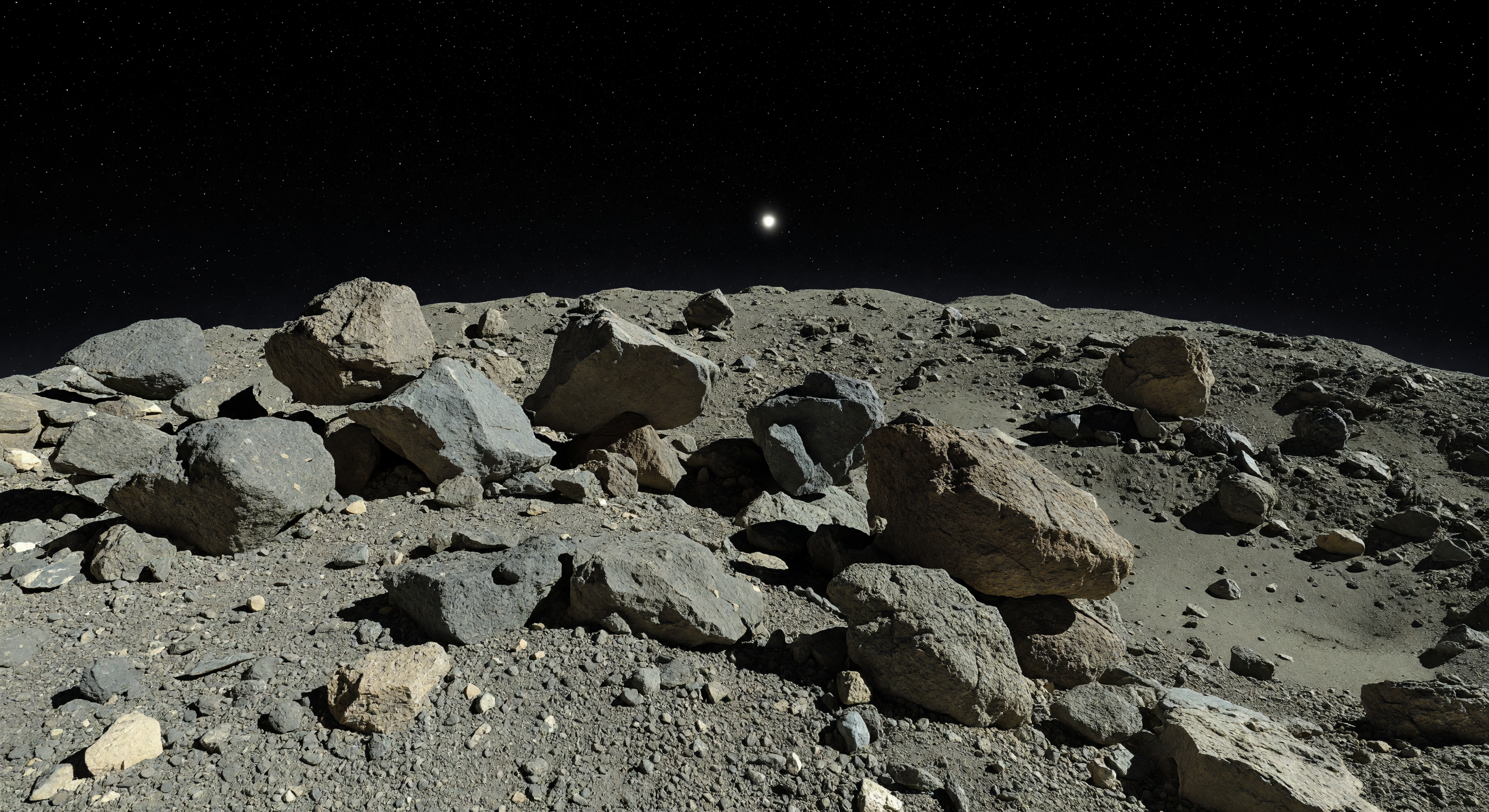
Voor je helt een steile puinhelling omlaag, bezaaid met hoekige kiezel, stoffige spleten en grillige blokken van meermaals mensenhoogte die ogenschijnlijk onmogelijk in evenwicht rusten op kleinere stenen. Hun donker grijsbruine, door ruimtelijke verwering verdonkerde oppervlakken en scherp afgebroken vlakken verraden een silicatenrijke samenstelling zoals bij gewone chondrieten, terwijl in laagten fijnere regoliet zich heeft verzameld tot kleine, gladdere “zeeën” tussen het ruwe talus. Zonder atmosfeer valt het harde zonlicht ongefilterd binnen: schaduwen worden messcherpe, volkomen zwarte geometrieën, de hemel blijft in volle dag pikzwart en de horizon kromt al na korte afstand abrupt weg, alsof het landschap in de leegte loslaat. Alles hier ademt de fragiele bouw van een poreuze puinhoop-wereld, waar extreem zwakke zwaartekracht rotsblokken laat balanceren alsof één verkeerde stap ze de ruimte in kan doen glijden.
Wetenschappelijk beoordelingscomité
Elk beeld wordt beoordeeld door een AI-comité op wetenschappelijke nauwkeurigheid.
Claude
Afbeelding: Adjust
Beschrijving: Adjust
I largely concur with GPT's assessment but want to add several specific observations that sharpen the picture. On scientific accuracy: the image captures the fundamental character of Itokawa's regolith environment reasonably well — the chondrite-gray color palette, the bimodal size distribution of boulders mixed with fine dust (the 'gravelly beach' texture that JAXA's Hayabusa mission famously revealed), and the hard, unfiltered solar illumination in a vacuum sky are all plausible. However, I flag one meaningful inaccuracy GPT did not emphasize: Itokawa's gravity is so vanishingly weak (~0.0001 g) that regolith behaves quite differently from what is depicted. The dust and fine particles here appear to settle in a manner that looks almost terrestrially natural — gently pooled in low spots with a convincing pour — but the actual surface tension and cohesion dynamics of regolith under micro-gravity produce subtly different packing geometries. The fines look slightly too 'wet-sand' in their settling behavior. Additionally, the Sun appears as a small but still somewhat large-disk luminous point; at roughly 1 AU where Itokawa orbits, the solar disk would be approximately the same angular size as seen from Earth, which looks broadly correct, though the bloom/glare rendering feels artistically enhanced rather than physically calibrated. The star field density is plausible but somewhat uniform — a minor stylistic choice rather than a scientific error. On the 'perched megaboulder' claim: I agree with GPT that this is the weakest link. While some blocks do appear to rest on others, there is no dramatically precarious arrangement visible that would communicate the near-zero gravity instability the caption foregrounds as its headline feature. The boulders look settled and stable, which contradicts the caption's emphasis on 'improbably perched' and 'delicate, unstable arrangements.' This is the primary reason I cannot approve the image outright. The horizon curvature that would emphasize Itokawa's tiny ~500m scale is entirely absent — the scene could plausibly be a terrestrial boulder field in Iceland or a dry riverbed. This is a significant compositional miss given how central the caption makes this point. On visual quality: rendering is technically competent and photorealistic in texture. Shadow directions are consistent. No egregious artifacts. The warm rim-lighting on boulder faces is present but subtle enough that one has to look for it — the caption oversells this effect. My recommendation differs slightly from GPT in that I would prioritize the curvature/scale issue as the most critical adjustment needed, followed by staging at least one clearly precarious perched block arrangement to earn the title 'Perched Megaboulder Slope.' Without those two elements, the image and caption are telling different stories.
Grok
Afbeelding: Adjust
Beschrijving: Adjust
I concur with both GPT and Claude on the core issues but add targeted insights based on a close re-examination of the image. Scientific accuracy: The image now better captures Itokawa's essence than implied in prior reviews—the visible horizon curvature is present (note the subtle upward arc of the regolith edge against the black sky, consistent with Itokawa's ~500m diameter and Hayabusa imagery showing tight horizons), colors align precisely with ordinary chondrite spectra (dusty beige fines matching Muses-C particle analysis, charcoal-gray boulders), lighting is harsh and vacuum-correct with consistent shadows and a plausible solar disk size at 1 AU (~.5° angular diameter). The starfield is appropriately sparse yet visible, as in long-exposure Hayabusa shots. However, perched megaboulders are still underwhelming: while some blocks rest on smaller ones (e.g., mid-right cluster), none scream 'improbably perched' or low-g instability—no dramatic overhangs or tenuous balances as seen in Itokawa's 'rubble pile' models (e.g., Scheeres et al. 2016). Regolith settling looks improved but retains a slight 'wet-sand' cohesion unnatural for ~10^-4 g (fines should show more ballistic deposition with sharper micro-shadows). Visual quality: Highly photorealistic—no artifacts, coherent textures (fractured boulder faces with plausible silicate granularity), sharp contrasts, and physically consistent shadow geometry from a low solar angle. Minor nit: warm rimlight is present but cooler-toned than caption's 'thin warm rim,' reading more neutral-white. Composition emphasizes slope better than prior critiques suggest (ground falls away radially), but lacks 'tens-of-meters ridges as distant mountains' scale cues. Caption accuracy: Partially matches (black shadows, boulder/regolith mix, curved horizon, airless sky all visible), but oversells perched instability (blocks look settled, not delicate/unstable) and steep cascade (more undulating mound than sheer drop). The intimate pebble detail is spot-on. Recommendation: Minor tweaks to exaggerate 1-2 precarious boulder perches (e.g., a meter-scale block balanced on a pebble cluster) and enhance rimlight warmth; caption could soften 'improbably perched' to match visuals. This edges toward approval but needs those for full scientific/visual fidelity to Itokawa's unique low-g geomorphology.
Gemini
Afbeelding: Adjust
Beschrijving: Adjust
I concur with the previous committee members regarding the 'rubble pile' physics. While the visual rendering of the chondrite texture is excellent, the image fails to capture the 'low-gravity' threshold. In a 0.0001g environment, fine-grained regolith does not settle into the smooth, cohesive slopes seen here; it should exhibit a more 'fluffy' or ballistic deposition pattern, lacking the terrestrial-style surface tension. Furthermore, the 'perched' boulders remain the primary failure point; they appear grounded rather than tenuously balanced on the high-friction, low-cohesion surface of an asteroid. To achieve 'approve' status, the image needs a more aggressive compositional shift to emphasize the extreme curvature—the horizon should be a sharp, truncated line that creates a sense of vertigo—and the boulders must be staged with visible gaps between them and the smaller support debris to sell the 'perched' narrative. The caption is overly dramatic relative to the visual; it should be revised to describe the surface morphology more accurately, acknowledging the 'rubble pile' nature without exaggerating the stability of the boulders if the image cannot support such a visual claim.
Matania — Synthese
Afbeelding: Adjust
Beschrijving: Adjust
The committee agrees the image is a strong, photorealistic asteroid-surface rendering with plausible Itokawa-like boulder textures, airless lighting, and a believable gray-tan regolith palette. However, it does not yet convincingly communicate the specific scene promised by the caption: a steep perched-megaboulder slope on a tiny rubble-pile asteroid. The main shortcomings are compositional and geomorphic rather than purely technical. The boulders look settled rather than precariously balanced, the slope reads as more of an undulating field than an immediate drop, and the horizon/curvature cues of Itokawa’s small scale are weak or absent. The caption likewise overstates what the image currently shows, especially in its claims of improbable perches, steep cascade geometry, and nearby horizon curvature. Overall: scientifically plausible, visually competent, but mismatched in emphasis between image and caption.
Visual quality: The rendering is largely photorealistic—there are coherent shadow directions and consistent material textures on boulders and finer regolith. No obvious geometric artifacts or implausible physics are apparent. That said, the rock scale and “perched” instability are not strongly emphasized: the boulders look integrated into the slope/debris field rather than obviously perched on smaller stones. The horizon/curvature effect is not present, and the ground horizon line is flatter than the caption implies.
Caption accuracy: The caption’s key elements—charcoal-gray fractured boulder faces catching a thin warm rim, deep perfectly black shadow seams, and a steep gravel/dust cascade—are only partially supported. The image does show dark rocks and sharp shadows, but the warm rim is subtle and the “perched megaboulder” instability and the extremely steep near-field cascade are not clearly depicted. Additionally, the described “horizon curves nearby” and “low ridges tens of meters high feel like distant mountains” are not evidenced in the provided view.
Recommendation: Keep the asteroid-style rubble field and airless stark sky, but adjust the composition/geometry to better show (1) a steep slope with an immediate drop, (2) clear perched blocks over smaller supports, and (3) a more Itokawa-like presentation of sky/horizon scale (or remove those claims if not visually supported).