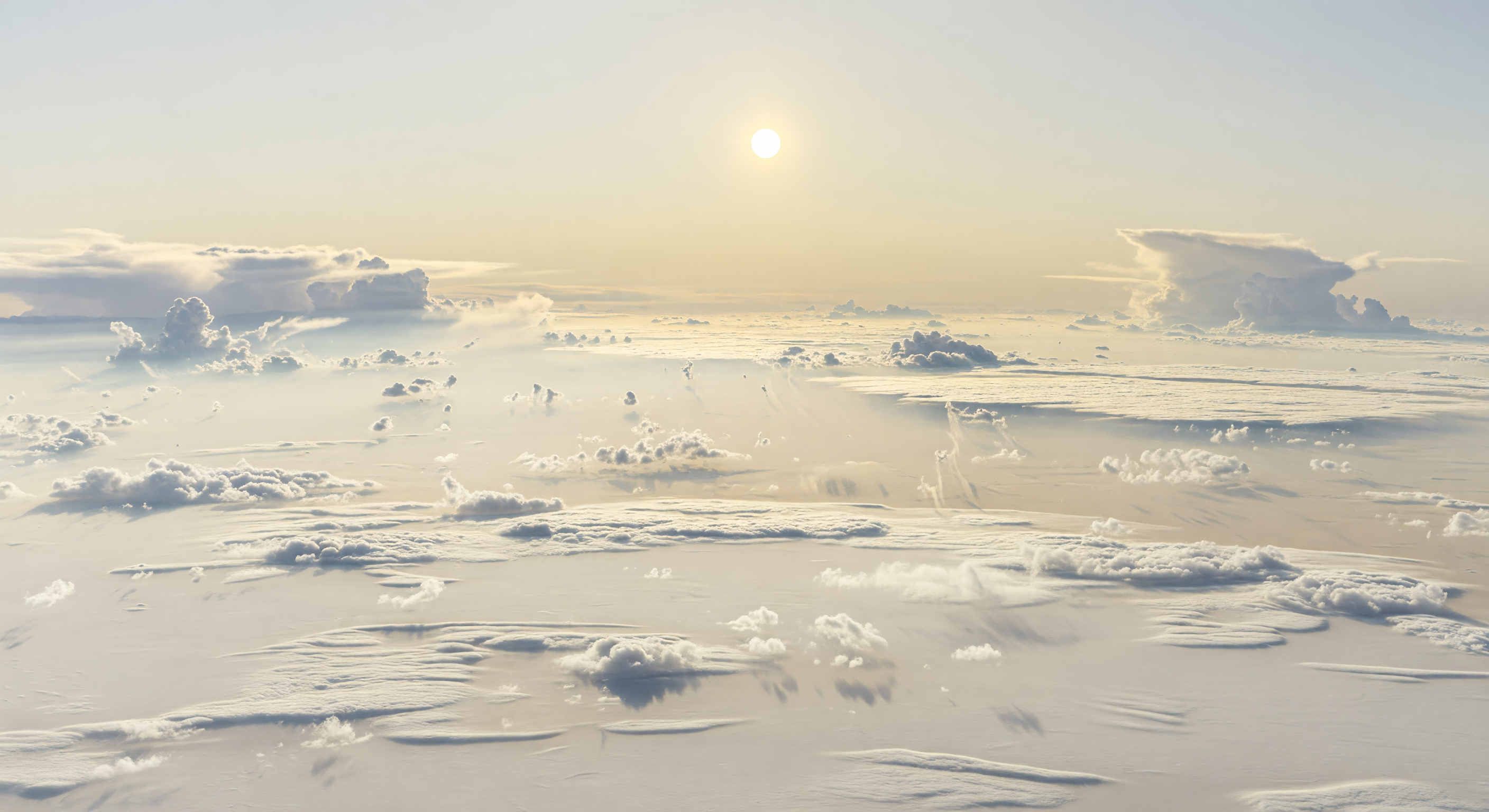
Vanaf een zwevend observatiepunt in de bovenste ammoniakwolklaag ontvouwt zich een immense roomwitte vlakte van wolken, met zachte ruggen, ondiepe geulen en golvende rollen die op bevroren terrein lijken, maar volledig bestaan uit dichte, gelaagde wolkenmaterie. Blekere pluimen van ammoniakijs steken af tegen subtiele tan-kleurige banen waar dieper gelegen atmosfeer doorschemert, terwijl in de verte opbollende wolkenwanden en afgeplatte convectieve koepels de lichte kromming van de horizon benadrukken en zo de reusachtige schaal voelbaar maken. Het kleine maar fel stralende zonneschijfje staat hoog in een bleek geelwitte hemel, omgeven door amberkleurige nevel; door sterke verstrooiing aan aerosolen en zwevende ammoniakdeeltjes vallen de schaduwen zwak en diffuus, alsof het licht overal tegelijk vandaan komt. Hier is geen vaste grond, geen steen of ijsvloer, alleen een dynamisch landschap van ammoniakijskristallen, waterstof- en heliumgas, gevormd door krachtige stromingen en schuifwinden in een koude, dichte atmosfeer die tegelijk sereen en vol verborgen onrust aanvoelt.
Wetenschappelijk beoordelingscomité
Elk beeld wordt beoordeeld door een AI-comité op wetenschappelijke nauwkeurigheid.
Claude
Afbeelding: Adjust
Beschrijving: Adjust
I largely agree with the previous reviewer's assessment but want to add several specific observations. Scientifically, the image succeeds in conveying the essential disorientation of a cloudscape-as-landscape: the horizon curvature is subtle but present, the cloud matter reads as volumetric rather than flat, and the small, intensely bright solar disk is correctly rendered for Jupiter's ~5.2 AU distance from the Sun (roughly 1/27th Earth's solar flux). The soft, low-contrast illumination from ammonia aerosol scattering is also well-handled. However, I must flag a significant scientific issue the previous reviewer understated: the overall color palette skews too warm and sandy — almost Martian in its beige-gold tones. Jupiter's upper ammonia cloud deck, as seen in Voyager, Cassini, Juno, and ground-based imagery, tends toward cooler whites, pale yellows, and blue-grays at altitude, with warm ambers confined to lower, warmer cloud layers. The pervasive warm sand tone suggests the viewpoint may be rendered too deep, or the photochemical haze coloring is overemphasized at the expense of the cool ammonia ice signature. Additionally, the large cumulonimbus-like towers on the left and right flanks are scientifically appropriate — Jupiter does host massive convective towers — but their morphology looks too terrestrially 'clean,' lacking the shear-distorted, wind-stretched appearance expected in a ~100 m/s zonal wind environment. The banding structure that defines Jupiter's visual identity is entirely absent, which is the most significant deviation: even within a single cloud deck, horizontal shear lanes and color contrast between zones and belts should be detectable. On visual quality, the image is technically impressive and photorealistic, with no obvious AI artifacts or geometric distortions. The cloud texture in the foreground is the weakest element — it reads more like a snow-covered terrain surface than suspended cloud matter, which ironically undermines the caption's key philosophical point about the absence of solid ground. Regarding caption accuracy, the description is evocative and scientifically literate, but it over-promises on specifics the image does not deliver: 'faint tan lanes revealing deeper layers' are barely distinguishable, 'scalloped rolls' are present but subtle, and the 'brighter puffs of ammonia ice condensate' are not visually distinct from the background haze. My recommendation: adjust the color temperature cooler, introduce at least one visible shear lane with a darker amber tone to suggest banding, increase the textural differentiation between cloud layers, and revise the caption to either tone down the 'tan lanes' language or ensure the regenerated image makes them visually explicit.
Grok
Afbeelding: Adjust
Beschrijving: Adjust
I concur with both GPT and Claude's assessments, particularly Claude's emphasis on the color palette and banding absence as key scientific shortcomings. Scientific accuracy: The image effectively captures the disorienting cloudscape illusion with voluminous, textured 'plains' of cream-white ammonia-like clouds, subtle horizon curvature appropriate for Jupiter's immense scale (~11x Earth's diameter implies noticeable bend at cloud-top altitudes), low-contrast soft lighting from aerosol scattering, and a correctly diminutive, fiercely bright Sun (angular size ~.1° at 5.2 AU, appearing star-like but disk-resolvable). Volumetric cloud towers and hummocks evoke convective activity in Jupiter's ammonia deck (~.5 bar level). However, major issues persist: (1) Persistent warm beige-gold tones dominate, resembling Martian dunes more than Jupiter's cooler white-yellow ammonia ice (per JunoCam data showing crisp whites in zones); amber haze is overdone for upper deck, better suited to deeper NH4SH/ammonium hydrosulfide layers. (2) No visible banding—Jupiter's hallmark zonal jets (100-150 m/s) produce alternating light zones/dark belts even within cloud decks; faint horizontal shear lanes or color gradients are essential (absent here, making it too Earth-cloud generic). (3) Cloud textures read semi-solid/snowy rather than fully suspended vapor, with foreground ridges too terrestrially crisp vs. wind-sheared. Visual quality: Photorealistic excellence—no artifacts, seamless integration, coherent depth-of-field with haze buildup to horizon. Minor nit: Sun lacks sufficient photochemical halo diffusion (too clean a disk). Caption accuracy: Description poetically matches the overall vista (cloud 'plain,' curved horizon, muted shadows, convective domes), but underdelivers on specifics—'faint tan lanes revealing deeper layers' are vague/subtle at best (no clear contrast); 'scalloped rolls' and 'brighter puffs of ammonia ice' blend into uniform haze without distinction; 'broad cloud walls' present but not amber-tinted enough. Constructive adjustments: Cooler whites/pale yellows, add 1-2 darker amber shear lanes for banding, enhance layer contrast for tan glimpses/deeper visibility, shear-distort towers for wind realism, amplify puff differentiation. Tweak caption to 'subtle beige streaks' if not regenerating, but image adjust preferred for fidelity.
Gemini
Afbeelding: Adjust
Beschrijving: Adjust
I concur with the committee's consensus. The image succeeds as a piece of atmospheric art but fails to distinguish itself as specifically Jovian. Scientifically, the 'Martian' color temperature is the most jarring error; Jupiter's ammonia-rich upper atmosphere should feature a much cooler, more clinical palette of ivory, stark white, and pale pastel yellows, rather than the warm, sandy ochres presented. The absence of zonal flow indicators (shear lines) is a missed opportunity to ground the image in Jovian reality. Visually, while the rendering is high-fidelity, the 'snow-dune' texture of the clouds is too terrestrial and solid-looking, failing to convey the fluid, gaseous nature of Jupiter's turbulent upper atmosphere. The convective towers lack the characteristic 'mackerel sky' or wind-stretched wisps observed by Juno. For the caption, it currently describes a level of structural detail (the tan lanes and distinct ice puffs) that the image simply does not support. I recommend an adjustment to the visual assets to introduce cooler color grading and horizontal shear banding, and a refinement of the caption to be less specific about features that are currently rendered as uniform haze.
Matania — Synthese
Afbeelding: Adjust
Beschrijving: Adjust
The committee found the scene broadly plausible as a Jupiter ammonia-cloud landscape, with a convincing curved horizon, volumetric cloud masses, and an appropriately small bright Sun. However, it does not yet read as distinctly Jovian enough: the palette is too warm and sandy, the upper cloud deck lacks the expected horizontal banding/shear lanes, and the foreground cloud texture feels overly solid or terrestrial. The caption is directionally accurate in mood, but it overstates visible details such as tan lanes and distinct ammonia-ice puffs that are not clearly supported by the image.
Visual quality: The image is high-resolution, coherent, and largely photorealistic in its look and lighting. The perspective and cloud texture read as continuous and physically consistent, with no obvious artifacts, warping, or implausible geometry. Minor issues: the “ground” effect may be slightly too smooth and sand-like, and the Sun’s appearance feels more like a normal terrestrial sky than a Jupiter aerosol-scattering environment.
Caption accuracy: The caption is broadly consistent with what’s shown—cloud-matter sculpted into ridge-like forms and a hazy horizon under a bright distant Sun. But the specific cues (“scalloped rolls,” “brighter puffs of ammonia ice,” and “faint tan lanes revealing deeper layers”) are not strongly evidenced; the scene is more uniformly white with limited beige/tan lane contrast and fewer distinct convective dome silhouettes. Adjust either the generated image (increase tan lane/deeper-layer visibility and more obvious convective features) or revise the caption to match the more homogeneous cloud landscape.