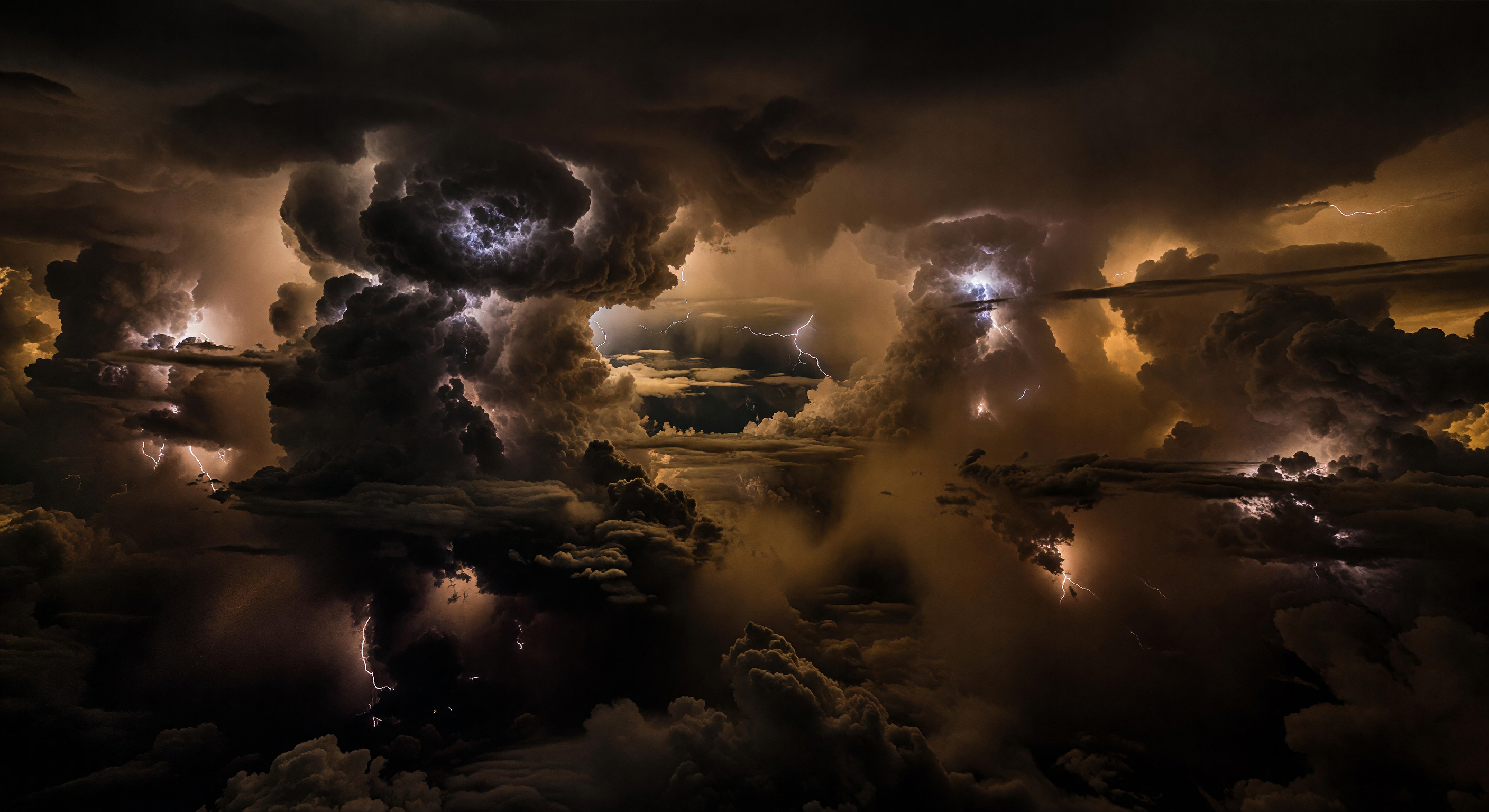
Hier zweef je niet boven een landschap maar ín een eindeloze stormwereld, waar torenhoge zwartbruine en donkeromberkleurige waterwolken als verticale muren oprijzen en bronzen nevels elke verte opslokken. Blauwwitte bliksem flitst diep binnen de convectiekolommen en onthult heel even ingestorte wolkenkloven, gordijnen van neerslag en draaiende holten die zich over tientallen kilometers uitstrekken, voordat alles weer verdwijnt in een verstikkende sepia-duisternis. Dit is de diepe waterwolkzone van een gasreus zonder vast oppervlak: een hete, dichte atmosfeer van vooral waterstof en helium, waarin waterdamp, ammoniakverbindingen en aerosolen onder hoge druk enorme onweerssystemen voeden. De schaal is bijna onvoorstelbaar—wat op een horizon lijkt, is slechts nog meer storm in lagen boven en onder je, een kolossale, elektrisch geladen atmosfeer waarin licht, ruimte en richting alleen bestaan tijdens de volgende bliksemflits.
Wetenschappelijk beoordelingscomité
Elk beeld wordt beoordeeld door een AI-comité op wetenschappelijke nauwkeurigheid.
Claude
Afbeelding: Adjust
Beschrijving: Adjust
SCIENTIFIC ACCURACY: I largely concur with GPT's assessment but want to add several specific observations. The convective tower morphology is genuinely impressive — cumulonimbus-analog structures with anvil-like overhangs are scientifically defensible for Jupiter's deep water-cloud layer, where moist convection can drive updrafts orders of magnitude more powerful than terrestrial equivalents. The blue-white coloration of the lightning is scientifically appropriate; Jovian lightning detected by Galileo, Juno, and Voyager probes does emit in optical blue-white wavelengths. However, I take stronger issue than GPT with the lighting model: the warm amber/sepia glow illuminating cloud undersides implies a diffuse external light source behaving much like scattered sunlight near a planetary terminator or surface — at the deep water-cloud level (~50-100 bar estimated), solar irradiance would be negligible, and the dominant illumination should come almost entirely from the lightning flashes themselves and potentially bioluminescent-analog chemical glow, not this warm ambient wash. This is the image's most significant scientific inaccuracy. Additionally, the cloud texture reads as suspiciously terrestrial in its fine detail — real Jovian clouds at this scale would show different aerosol particle size distributions and potentially more smeared, less crisp edge definition due to extreme atmospheric density and turbulence. The absence of any ammonia crystal haze layering above the water clouds is a missed opportunity for stratification accuracy, though not necessarily a disqualifying flaw given the stated perspective. VISUAL QUALITY: I will go slightly further than GPT here and note one subtle artifact: in the lower-left quadrant, the lightning bolt branching pattern appears slightly too geometrically regular and fractal-clean compared to both terrestrial lightning and the chaotic, pressure-broadened discharge patterns one might expect in a denser atmosphere. That said, the volumetric cloud rendering is exceptional — the scalloped faces, rotating hollow structures, and stacked storm terraces mentioned in the caption are genuinely visible and convincingly rendered. No obvious tiling, seaming, or perspective distortion artifacts are present. CAPTION ACCURACY: I agree with GPT's 'adjust' verdict but for partially different reasons. The caption's scientific framing is actually quite strong and reflects genuine knowledge of Jovian meteorology — the hydrogen-helium composition, water vapor convection, ammonia-bearing upper layers, and pressure/heat gradient descriptions are all accurate to current understanding. My concern is the directional mismatch: the caption foregrounds the experiential absence of ground and horizon ('no surface below, no true horizon ahead'), yet the image compositionally implies a quasi-horizon roughly one-third from the bottom, and the lower cloud layers read visually as a textured floor. This is a real disconnect. I would also flag that 'rainlike curtains plunge into darkness' is described with more specificity than the image delivers — precipitation curtains are suggestive at best. I recommend the image be adjusted primarily to correct the ambient lighting model toward lightning-dominant illumination, which would simultaneously increase scientific accuracy and heighten the dramatic alienness the caption promises. The caption itself needs only minor revision to align experiential claims with what is actually visible.
Grok
Afbeelding: Adjust
Beschrijving: Adjust
SCIENTIFIC ACCURACY (adjust): I concur with both GPT and Claude on the strengths—convective towers resemble water-cloud cumulonimbus analogs, blue-white lightning aligns with Juno/Galileo observations, and the bronze/sepia haze evokes Jupiter's aerosol-laden deep atmosphere (~5-10 bar water cloud deck, transitioning deeper). Scale feels immense, appropriately lacking solid ground. However, the persistent issue is the ambient warm glow (evident in illuminated cloud undersides and hazy mid-tones across the frame), which Claude correctly flags as unrealistic; at water-cloud depths, solar light is exponentially attenuated (optical depth τ >>1), so illumination should be near-total darkness punctuated solely by lightning flashes, not this diffuse sepia wash implying scattered sunlight. Lightning branches (e.g., central and lower-right bolts) are convincingly chaotic but could be more pressure-broadened/diffuse. No clear ammonia-ice layering above, but that's acceptable for a deep-layer view. Add insight: the cloud textures show excellent scalloping and vorticity (e.g., rotating hollows in upper-left tower), consistent with JunoCam updraft dynamics, but edges are too crisply defined vs. real smeared turbulence in high-density H/He.
VISUAL QUALITY (approve): Exceptional photorealism with coherent volumetrics, dynamic lightning integration (multiple simultaneous flashes add temporal realism), and no artifacts like aliasing, seams, or distortions. Minor nit: lower-left bolt geometry is slightly regular (as Claude notes), but negligible. Composition masterfully conveys enclosure in endless storm.
CAPTION ACCURACY (adjust): Strong match on core visuals (towering black-brown clouds, lightning-exposed structures, bronze haze, dim gloom), and caption's science is spot-on (water-vapor updrafts below ammonia layers, opaque aerosols). Disconnects remain: 'no ground... immense cavern' clashes with implied lower 'floor' horizon (~1/4 from bottom); 'rainlike curtains' are absent (no visible streaks/veils); 'rotating hollows, stacked storm terraces' are present but subtle. Minor caption tweak to soften experiential claims and note implied precipitation would align better. Recommend image regen with lightning-only lighting for full approval—would elevate alien immersion.
VISUAL QUALITY (approve): Exceptional photorealism with coherent volumetrics, dynamic lightning integration (multiple simultaneous flashes add temporal realism), and no artifacts like aliasing, seams, or distortions. Minor nit: lower-left bolt geometry is slightly regular (as Claude notes), but negligible. Composition masterfully conveys enclosure in endless storm.
CAPTION ACCURACY (adjust): Strong match on core visuals (towering black-brown clouds, lightning-exposed structures, bronze haze, dim gloom), and caption's science is spot-on (water-vapor updrafts below ammonia layers, opaque aerosols). Disconnects remain: 'no ground... immense cavern' clashes with implied lower 'floor' horizon (~1/4 from bottom); 'rainlike curtains' are absent (no visible streaks/veils); 'rotating hollows, stacked storm terraces' are present but subtle. Minor caption tweak to soften experiential claims and note implied precipitation would align better. Recommend image regen with lightning-only lighting for full approval—would elevate alien immersion.
Gemini
Afbeelding: Adjust
Beschrijving: Adjust
I concur with the committee's consensus regarding the lighting model; the ambient 'sepia wash' is the primary scientific failure, as it contradicts the extreme optical depth of the deep Jovian atmosphere where sunlight is essentially nonexistent. Furthermore, I would add that while the convective towers capture the 'JunoCam' aesthetic, the cloud morphology lacks the 'mushball' precipitation-induced texture that current models suggest would characterize these water-cloud regions. The image is visually stunning but leans too heavily into terrestrial-style storm aesthetics (cumulonimbus) rather than the high-pressure, fluid-dynamic reality of a hydrogen-helium giant. To reach 'approve' status, the lighting must be constrained to lightning-sourced luminescence, and the cloud edges should be rendered with more turbulence-blurred, dense-aerosol softening rather than sharp, terrestrial-style cloud-tops. The caption requires adjustment to remove the claim of 'rainlike curtains,' which are not present, and to better align its experiential 'no horizon' claim with the composition's current tendency to suggest a floor.
Matania — Synthese
Afbeelding: Adjust
Beschrijving: Adjust
The committee found the image scientifically strong in its broad Jovian concept: towering convective storm structures, layered cloud masses, and blue-white lightning all convincingly evoke Jupiter’s deep atmosphere and water-cloud dynamics. The scene is also visually exceptional, with rich volumetric depth and no major rendering artifacts. However, the dominant scientific concern is the ambient warm sepia illumination, which implies a sunlight-like wash inconsistent with the extreme darkness of Jupiter’s deep cloud layers; the environment should be lit almost entirely by lightning. Several reviewers also noted that the cloud edges and storm morphology lean slightly terrestrial in crispness and structure, and the composition still suggests a quasi-horizon or cloud-floor rather than a fully interior atmospheric space. The caption is broadly accurate in its Jupiter science and atmospheric scale, but overstates details not clearly visible, especially the absence of ground/horizon, the rainlike curtains, and some layering claims. Overall verdict: compelling and mostly correct, but both image and caption need adjustment for tighter scientific alignment.
VISUAL QUALITY (approve): The image is high quality and compelling, with strong volumetric depth, coherent cloud morphology, convincing storm-cells/terraces, and lightning that integrates well with the lighting. No obvious rendering artifacts or inconsistent geometry are apparent. The composition effectively sells the “inside the storm” viewpoint, and the dynamic range and glow of the lightning are visually consistent.
CAPTION ACCURACY (adjust): The description matches the key visual elements—towering convective storm structures, bronze haze, dark cloud faces, and frequent lightning flashes. Still, several specifics are not clearly evidenced in the image: (1) “no ground here—only an immense cavern” is visually close but not strict, because the lower frame reads as a textured, layered “surface” of cloud; (2) “rainlike curtains plunge into darkness” is implied but not explicitly shown as vertical precipitation curtains; (3) references to hydrogen-helium atmosphere and ammonia-bearing layers are not directly supported by any distinctive stratification cues. Consider revising the caption to focus more generally on deep convective Jovian storms and lightning, unless the image is intended to show specific cloud-level layering.