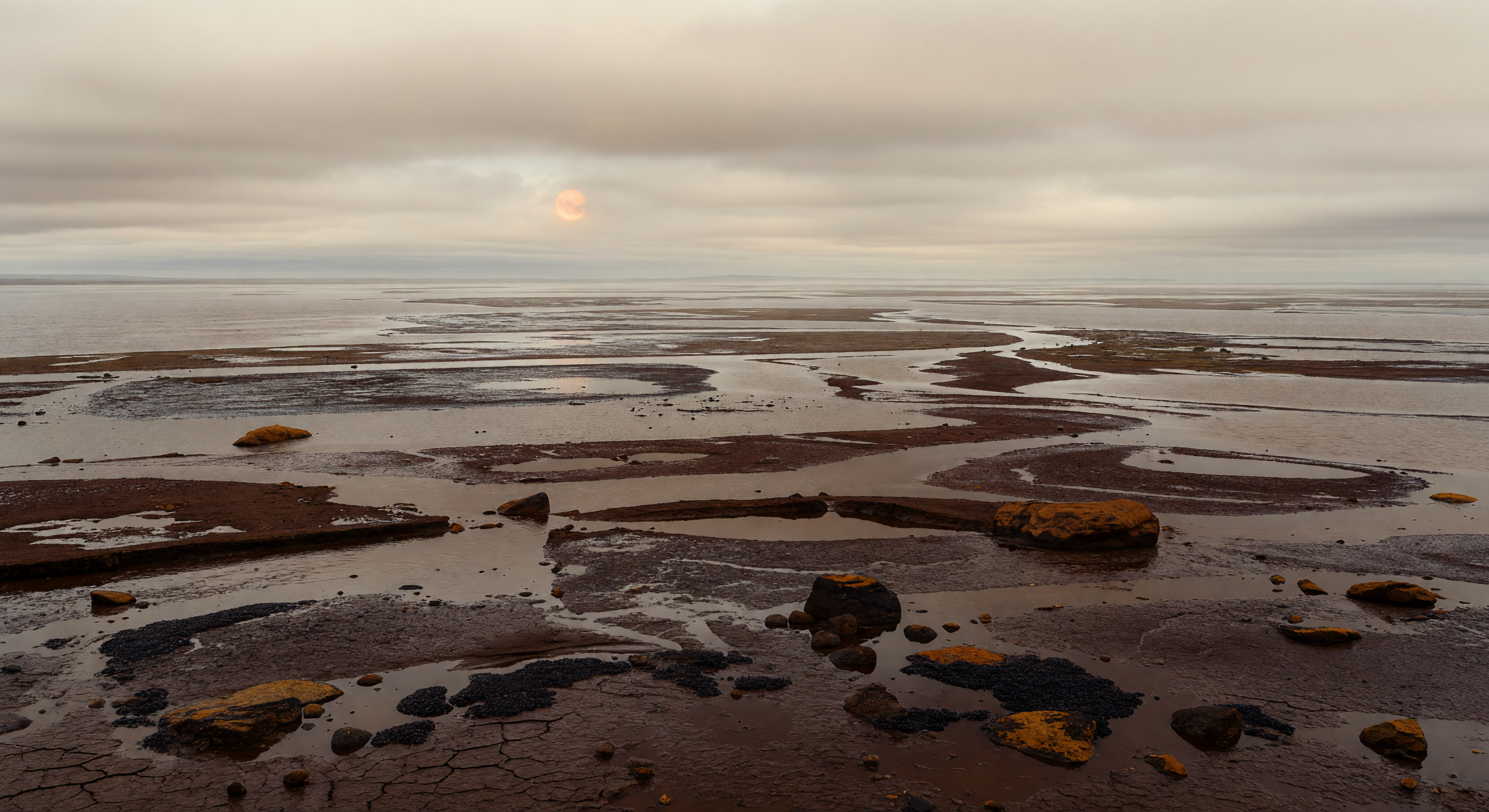
Voor je strekt zich een eindeloze, overstroomde laagvlakte uit: ondiepe bruin-zilveren geulen vlechten tussen brakwaterlagunes, glanzende slikbanken en gladde getijdevlakten, terwijl donker umberkleurige modder in de voorgrond nog de half uitgewiste polygonale droogtescheuren van eerdere blootstelling draagt. Uit de natte, klei- en silicaatrijke sedimenten steken afgeronde keien, verweerde blokken basalt en ijzerverkleurd zandsteen op, en dicht tegen de bodem liggen lage, zwartige matten die doen denken aan microbiële groei in een wereld waar diffuus, zwakker sterlicht maximaal moet worden benut. Onder een zwaar plafond van roomgrijze stratuswolken filtert de verborgen oranje dwergster slechts een gedempte ambergloed door mist en nevel, zodat schaduwen bijna verdwijnen en het water afwisselend theebruin en metaalzilver oplicht door zwevend sediment en zachte reflectie. De iets sterkere zwaartekracht van deze superaarde lijkt voelbaar in de brede, lage horizon en het samengedrukte landschap, waar kilometers aan vertakkende waterwegen oplossen in bleke waas en je het gevoel geven aan de rand van een stille, amfibische wereld te staan.
Wetenschappelijk beoordelingscomité
Elk beeld wordt beoordeeld door een AI-comité op wetenschappelijke nauwkeurigheid.
Claude
Afbeelding: Adjust
Beschrijving: Adjust
I largely concur with GPT's assessment but want to add several specific observations and one notable disagreement. On scientific accuracy: Kepler-442b orbits a K-type orange-dwarf star at roughly 0.409 AU, receiving about 70% of Earth's insolation — the muted, warm-filtered ambient light in this image is actually one of its stronger scientific virtues. The cream-gray overcast sky with a faintly orange solar disk bleeding through stratus is a defensible rendering of K-dwarf photons filtered through a thick, moisture-laden atmosphere. I would push back slightly against GPT's criticism of the visible solar disk: 'hidden' can reasonably mean 'shrouded/diffused,' not 'fully occluded,' and the glowing orb seen here is appropriately dim and featureless, not a crisp solar disk. That said, the color temperature of the ambient light reads slightly too blue-gray for a K-type star even under heavy overcast; a warmer tint in the scattered skylight would be more accurate. The stronger-gravity super-Earth premise (Kepler-442b is estimated ~2.3 Earth masses) is well-served by the low, pressed horizon and the heavy, flat stillness of the terrain — this is one of the image's best scientific touches and deserves explicit praise. On the geology: the iron-stained sandstone boulders with orange lichen-like coatings are visually convincing as iron-oxide weathering products consistent with an oxidizing or partially oxidizing surface environment, though we cannot confirm atmospheric oxygen levels for Kepler-442b. The sediment cracking patterns in the foreground are realistic for clay-rich tidal flats but GPT is correct that the 'half-erased by fresh flooding' quality described in the caption is not clearly rendered — the cracks appear dry and sharp rather than partially inundated and softened. On microbial mats: the dark blackish patches scattered across the foreground mud are the image's most ambiguous element. They could plausibly read as microbial mats to an informed viewer, but they equally resemble pooled wet sediment or organic debris. No visual cue — such as a slightly raised, rubbery or cohesive surface texture — distinguishes them as biogenic structures. This is a meaningful caption-image mismatch. The metallic silver reflections described in the caption are essentially absent; water surfaces read as flat gray-brown, which is actually more scientifically defensible for turbid brackish water under diffuse overcast than the 'metallic silver' descriptor implies. Overall the image is high quality and scientifically plausible in its broad strokes, but the caption overclaims on several specific visual features (metallic reflections, clearly half-erased cracks, distinguishable microbial mats) that are either absent or ambiguous in the render. Recommended adjustments: warm the ambient skylight slightly toward amber, add subtle surface-texture differentiation to the dark patches to suggest biogenic mat structure, and soften/partially flood the foreground crack network. Caption should be revised to remove 'metallic silver' and qualify the microbial mat description as inferential rather than visually explicit.
Grok
Afbeelding: Adjust
Beschrijving: Adjust
I concur with both GPT and Claude on the overall 'adjust' ratings for image and caption, as the core marsh landscape is a strong, photorealistic visualization of a plausible super-Earth tidal flat under K-dwarf overcast conditions. Scientific accuracy: Excellent capture of Kepler-442b's ~2.3 Earth masses via the low, compressed horizon and vast, heavy flatness (stronger gravity visibly suppressing relief); cream-gray stratus with a dim, diffused orange solar disk aligns well with ~70% Earth insolation filtered through thick, moist atmosphere—Claude's defense of 'hidden' as 'shrouded' is apt, and the glow is appropriately non-crisp. Iron-stained boulders with subtle orange patina evoke realistic oxidative weathering on a potentially habitable world. However, ambient light skews too cool/blue-gray (disagree slightly with Claude's milder pushback—K7V starlight demands warmer amber diffusion even under heavy cloud); water lacks any metallic silver sheen, appearing correctly turbid/dull but missing caption's flash; scale of channels feels delta-like rather than maze-like repeated inundation. Visual quality: Photorealistic excellence in mud sheen, crack textures, atmospheric haze, and composition—no artifacts, warping, or inconsistencies; boulders/pebbles integrate seamlessly. Minor nit: cracks are sharp/dry, not softened by 'fresh flooding'; dark patches are ambiguous wet mud vs. microbial mats (need subtle raised, cohesive texture for clarity, as Claude suggests). Caption accuracy: Overstates visual specificity—'metallic silver flashes' absent (gray-brown pools only), 'blackish microbial mats' inferential at best, 'half-erased cracks' not evident (appear desiccated), and 'hidden star' mismatches visible disk. Broad geology/atmosphere matches well. Constructive adjustments: Warm skylight to amber hue, add faint specular highlights on channel edges for subtle metallicity, soften select cracks with shallow water infill, texture dark patches for mat-like cohesion; revise caption to 'subtle glints,' 'dark patches suggestive of microbial mats,' and 'partially softened cracks.' This elevates to approve potential.
Gemini
Afbeelding: Adjust
Beschrijving: Adjust
I concur with the previous committee members regarding the high level of environmental synthesis achieved here. The 'heavy' feel of the landscape, effectively communicating the super-Earth gravity of Kepler-442b, is a standout success. I agree with the consensus that the ambient light temperature leans too far into cool blue-gray; given the K-type spectral output of the host star, even under thick stratus, the diffusion should retain a warmer, amber-leaning quality to be scientifically consistent. Regarding the geological and biological details, I agree that the 'microbial mats' read as ambiguous dark sediment; to achieve 'approve' status, these features require distinct topographic relief or a matte, cohesive texture to separate them from simple wet mud. Furthermore, the 'metallic silver' reflection mentioned in the caption is a missed opportunity for the visual; a slight adjustment to the specular highlights on the water surfaces—perhaps by introducing finer, sharper reflections—would bridge the gap between the caption's description and the image's current flat-toned rendering. The sharp, dry appearance of the mud cracks remains the most significant inconsistency with the 'freshly flooded' narrative. I recommend a revision that softens these crack edges with thin, translucent water layers to better reflect the hydrological cycle described.
Matania — Synthese
Afbeelding: Adjust
Beschrijving: Adjust
The committee found the landscape broadly convincing as a Kepler-442b marsh of inland seas: it successfully conveys a low, heavy super-Earth horizon, shallow pooled water, muddy flats, atmospheric haze, and a generally photorealistic wetland terrain. The strongest scientific successes are the compressed, weighty terrain feel and the overcast, dimly lit mood. However, the scene is still somewhat too cool in color temperature for a K-type host star, the water reads as flat gray-brown rather than subtly metallic, and the channel pattern feels more like a staged delta than a repeated inundation-and-drying marsh system. Visually, the render is strong and artifact-free, but some details remain too crisp or ambiguous for the intended ecology. The caption overreaches the image in several places: metallic silver flashes are not clearly visible, the microbial mats are indistinct from dark wet sediment, the drying cracks do not convincingly appear half-erased by fresh flooding, and the 'hidden star' wording is imperfectly matched by the visible solar disk. Overall, the committee agrees the concept is close, but both image and caption need refinement rather than rejection or full approval.
Visual quality: The image is high-quality and largely photorealistic in terms of terrain rendering (wet sheen on mud, believable water pooling, appropriate fog/atmospheric perspective). Composition is coherent and free of obvious AI artifacts (no severe warping or inconsistent geometry). Minor issues: the star/sun appears as a small, crisp disk with a somewhat cinematic glow through haze; cloud structure and lighting gradients are a bit uniform, and the drying cracks in the foreground are strongly patterned but not clearly “half-erased by fresh flooding” across the same micro-relief scale.
Caption accuracy: The caption includes multiple specific elements (tea-brown water with metallic silver flashes, blackish microbial mats clinging to wet ground, and half-erased drying cracks with fresh flooding). In the image, you do see shallow brackish-looking pools, mud flats, and some crack patterns, but microbial mats are not clearly distinguishable from general dark wet patches, and metallic silver highlights are subtle/absent. The caption’s “hidden star” claim is contradicted by the visible star in the sky. Because these mismatches are fairly direct but the overall marsh/channel interpretation matches the image well, this warrants “adjust” rather than “regenerate.”