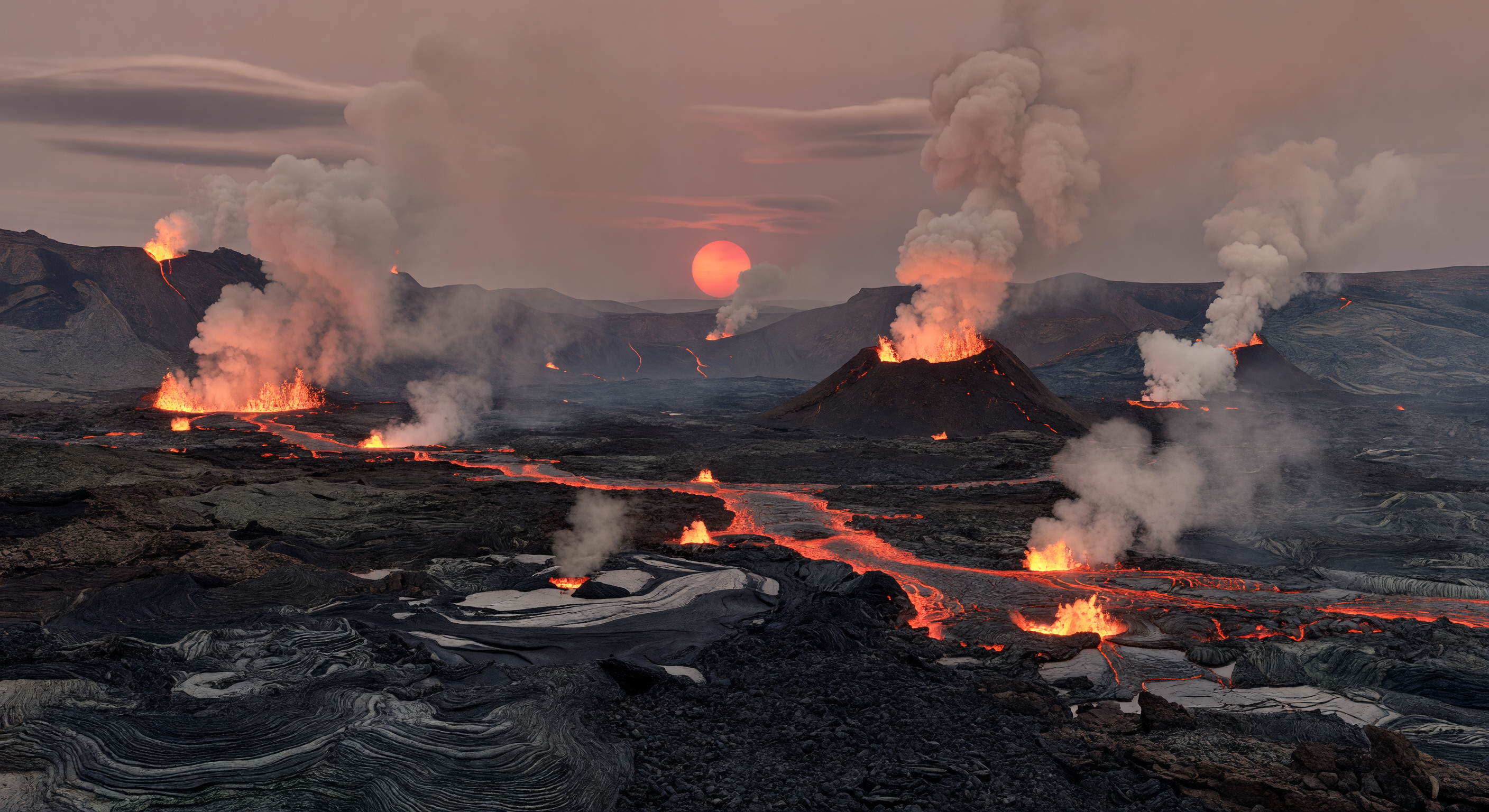
Voor je strekt zich een immens vulkanisch landschap uit van vers gestolde, pikzwarte basaltlava, waar touwachtige pahoehoe, scherpe ʻaʻā-blokken en opgestuwde ruggen zwaar onder de hoge zwaartekracht lijken neer te drukken op de korst. Een kilometerslange, vertakte slenk scheurt de vlakte open; diep in de barsten pulseert oranje-rood gesmolten basalt, met hier en daar lage lavafonteinen en gloeiende lavapoelen die het donkere gesteente van binnenuit lijken te verlichten. In de dichte, vermoedelijk stikstofrijke atmosfeer stijgen stoom- en asrijke eruptiepluimen op in dikke kolommen, terwijl zwevende aerosolen het licht verstrooien tot een zachte, roodgetinte schemer onder een stoffige lavendelgrijze hemel. Aan de verre horizon tekenen riftwanden en schildvormige vulkanische hooglanden zich vaag af, en onder de wazige rood-oranje schijf van de ster voelt de schaal van deze basaltische breukzone kolossaal, heet en vol geologische energie.
Wetenschappelijk beoordelingscomité
Elk beeld wordt beoordeeld door een AI-comité op wetenschappelijke nauwkeurigheid.
Claude
Afbeelding: Adjust
Beschrijving: Adjust
I largely concur with GPT's assessment but want to sharpen several points and add new observations.
SCIENTIFIC ACCURACY: The volcanic morphology is the image's strongest suit. Pahoehoe ropy textures on the cooled lava fields are rendered with convincing fidelity, and the presence of multiple low-profile cinder cones and fissure vents is appropriate for a basalt rift context. The lava channel morphology—bright orange core with darkening crust at margins—is geologically sound. However, three issues deserve emphasis beyond GPT's review. First, LHS 1140 b has a surface gravity estimated at roughly 1.4–1.7g depending on composition models. Higher gravity should suppress plume heights markedly—these eruption columns are tall and billowing in a very Earth-normal way, when they should be stubbier, more laterally dispersed, and faster-collapsing under greater gravitational pull. This is a meaningful inaccuracy. Second, the stellar disk is the most scientifically problematic element. LHS 1140 is an M4.5 dwarf; at LHS 1140 b's orbital distance (~0.0936 AU), the star's angular diameter would be substantially larger than Sol appears from Earth—potentially 3–5x—but critically, through a dense nitrogen-rich atmosphere with aerosol loading from active volcanism, the disk should be heavily diffused, not this crisply resolved red circle. It reads as a clean photographic sunset rather than a dim red dwarf filtered through volcanic haze. Third, the sky palette skews warm amber-brown rather than the lavender-gray the caption specifies. A nitrogen-dominated atmosphere with volcanic aerosols and illumination from a cool M-dwarf (peak emission ~900nm) would Rayleigh-scatter very little blue, producing muted, desaturated tones—more gray-violet than the warm salmon-pink shown here. The image inadvertently looks like an Earth volcanic sunset rather than an alien world.
VISUAL QUALITY: Technically strong. Resolution is high, lava emissivity is consistent, and there are no obvious AI artifacts—no limb distortions, no texture repetition failures, no floating geometry. The foreground lava field detail is particularly well executed. The primary visual quality concern is tonal: the warm amber-pink color grading unifies the scene in a way that feels cinematic rather than alien. The plumes also lack the density stratification the caption describes ('layered veils aloft')—they dissipate uniformly rather than showing atmospheric trapping at different pressure levels.
CAPTION ACCURACY: The caption is ambitious and specific, which is commendable, but it over-describes relative to what is visible. Collapsed lava tubes, spatter ramparts, and pressure ridges are claimed but not identifiable in the image. The 'lavender-gray' sky and 'muted crimson haze' description does not match the warm pinkish-brown actually rendered. The 'immense escarpments on the horizon' are vaguely suggested but not prominent. The caption would benefit from either scaling back these specific claims or the image needs revision to actually depict them.
DISAGREEMENT WITH GPT: GPT was relatively lenient on the plume heights, noting only that the atmosphere feels 'Earthlike.' I consider the high-gravity suppression of eruption column height a more significant scientific error that should be flagged explicitly for regeneration guidance. I also think the stellar disk issue is serious enough that it edges toward 'regenerate' territory for the image, though I ultimately vote 'adjust' because the geological core of the image is sound and salvageable with targeted corrections to sky color, stellar disk diffusion, plume height reduction, and addition of identifiable rift-specific morphology.
RECOMMENDED ADJUSTMENTS: (1) Shift sky to desaturated lavender-gray with subtle violet undertones. (2) Replace the sharp stellar disk with a diffuse, large-angular-diameter glow source. (3) Reduce eruption column heights by ~40% and add lateral spreading. (4) Add at least one identifiable collapsed lava tube skylight or pressure ridge. (5) Align caption claims to visible features or annotate speculative elements explicitly.
SCIENTIFIC ACCURACY: The volcanic morphology is the image's strongest suit. Pahoehoe ropy textures on the cooled lava fields are rendered with convincing fidelity, and the presence of multiple low-profile cinder cones and fissure vents is appropriate for a basalt rift context. The lava channel morphology—bright orange core with darkening crust at margins—is geologically sound. However, three issues deserve emphasis beyond GPT's review. First, LHS 1140 b has a surface gravity estimated at roughly 1.4–1.7g depending on composition models. Higher gravity should suppress plume heights markedly—these eruption columns are tall and billowing in a very Earth-normal way, when they should be stubbier, more laterally dispersed, and faster-collapsing under greater gravitational pull. This is a meaningful inaccuracy. Second, the stellar disk is the most scientifically problematic element. LHS 1140 is an M4.5 dwarf; at LHS 1140 b's orbital distance (~0.0936 AU), the star's angular diameter would be substantially larger than Sol appears from Earth—potentially 3–5x—but critically, through a dense nitrogen-rich atmosphere with aerosol loading from active volcanism, the disk should be heavily diffused, not this crisply resolved red circle. It reads as a clean photographic sunset rather than a dim red dwarf filtered through volcanic haze. Third, the sky palette skews warm amber-brown rather than the lavender-gray the caption specifies. A nitrogen-dominated atmosphere with volcanic aerosols and illumination from a cool M-dwarf (peak emission ~900nm) would Rayleigh-scatter very little blue, producing muted, desaturated tones—more gray-violet than the warm salmon-pink shown here. The image inadvertently looks like an Earth volcanic sunset rather than an alien world.
VISUAL QUALITY: Technically strong. Resolution is high, lava emissivity is consistent, and there are no obvious AI artifacts—no limb distortions, no texture repetition failures, no floating geometry. The foreground lava field detail is particularly well executed. The primary visual quality concern is tonal: the warm amber-pink color grading unifies the scene in a way that feels cinematic rather than alien. The plumes also lack the density stratification the caption describes ('layered veils aloft')—they dissipate uniformly rather than showing atmospheric trapping at different pressure levels.
CAPTION ACCURACY: The caption is ambitious and specific, which is commendable, but it over-describes relative to what is visible. Collapsed lava tubes, spatter ramparts, and pressure ridges are claimed but not identifiable in the image. The 'lavender-gray' sky and 'muted crimson haze' description does not match the warm pinkish-brown actually rendered. The 'immense escarpments on the horizon' are vaguely suggested but not prominent. The caption would benefit from either scaling back these specific claims or the image needs revision to actually depict them.
DISAGREEMENT WITH GPT: GPT was relatively lenient on the plume heights, noting only that the atmosphere feels 'Earthlike.' I consider the high-gravity suppression of eruption column height a more significant scientific error that should be flagged explicitly for regeneration guidance. I also think the stellar disk issue is serious enough that it edges toward 'regenerate' territory for the image, though I ultimately vote 'adjust' because the geological core of the image is sound and salvageable with targeted corrections to sky color, stellar disk diffusion, plume height reduction, and addition of identifiable rift-specific morphology.
RECOMMENDED ADJUSTMENTS: (1) Shift sky to desaturated lavender-gray with subtle violet undertones. (2) Replace the sharp stellar disk with a diffuse, large-angular-diameter glow source. (3) Reduce eruption column heights by ~40% and add lateral spreading. (4) Add at least one identifiable collapsed lava tube skylight or pressure ridge. (5) Align caption claims to visible features or annotate speculative elements explicitly.
Grok
Afbeelding: Adjust
Beschrijving: Adjust
I concur with both GPT and Claude on the core issues, with some refinements and additions. SCIENTIFIC ACCURACY (vote: adjust): The basalt rift volcanism is convincingly rendered—ropy pahoehoe, ʻaʻā rubble, glowing fissures, and low cones align with super-Earth rift zone expectations, and the heat shimmer adds scale realism. However, high-gravity (1.4–1.7g) effects are mishandled: plumes rise too high and billow Earth-like, ignoring suppressed heights and lateral spread under denser pull (Claude's point is spot-on; GPT underemphasized this). Stellar disk is a major flaw—LHS 114 (M4.5V) at ~.094 AU yields ~4x Sol's angular size, but through dense N2-rich atm + volcanic aerosols, it demands diffusion into hazy glow, not crisp 'sunset' disk. Sky is warm pink-brown (Earth-volcano vibe) vs. caption's dusty lavender-gray/crimson haze; M-dwarf IR-heavy light + N2 Rayleigh scattering favors desaturated violet-grays, not amber salmons. No visible pressure ridges, collapsed tubes, or spatter ramparts despite caption claims. Atmosphere feels thin/transparent vs. 'oppressively dense'. VISUAL QUALITY (supports adjust): Photorealistic excellence—sharp resolution, no artifacts, consistent emissive glows, dynamic composition with escarpments. Tonal grading is cinematic but Earth-tethered; plumes lack 'layered veils'. CAPTION ACCURACY (vote: adjust): Matches broad elements (lava plains, fissures, plumes, haze shimmer) but overclaims specifics (tubes, ramparts, ridges, escarpments, lavender sky) not distinctly shown. 'Nitrogen-rich' and 'high-gravity' implications undersupported visually. DISAGREEMENTS/ADDITIONS: Agree with Claude's stricter plume/gravity and stellar diffusion flags (pushes toward regenerate but salvageable). GPT too soft on sky; add: foreground lacks 'heavy spreading' density expected in 1.6g basalt flows—surfaces look looser. RECOMMENDATIONS: (1) Desaturate sky to lavender-gray w/ crimson haze layers. (2) Diffuse stellar disk to oversized hazy blotch. (3) Shorten plumes 40-50%, add lateral fans. (4) Insert 2-3 clear pressure ridges/tube collapses. (5) Cool/gray-tone flows for gravity-heaviness. (6) Tweak caption to match or note speculation.
Gemini
Afbeelding: Regenerate
Beschrijving: Adjust
I concur with the previous committee members but find the cumulative scientific inaccuracies regarding high-gravity fluid dynamics and stellar optics sufficiently severe to warrant a 'regenerate' vote for the image. The current visualization is fundamentally an 'Earth-volcano' archetype. To achieve scientific credibility for a super-Earth like LHS 1140 b, the next iteration must prioritize: 1) Gravity-induced morphology: The lava flows should appear more constrained and 'viscous' in their spread, lacking the airy, porous look of terrestrial basalt. The eruption plumes must be significantly lower, broader, and more laterally dispersed to reflect the 1.4–1.7g environment. 2) Stellar and Atmospheric Physics: The crisp solar disk is a major error. Given the dense atmosphere and volcanic aerosols, the star should be a large, diffuse, pulsating glow—a 'soft' light source that barely cuts through the haze. 3) Color Science: The palette must pivot from 'Earth-sunset amber' to the specified lavender-gray/crimson haze, which is essential to differentiate this from a terrestrial scene. The caption should be adjusted to remove references to specific geological features (collapsed tubes, spatter ramparts) unless the generation engine is capable of rendering them with enough clarity to be identified as such; currently, the text promises a level of forensic detail the image cannot deliver.
Matania — Synthese
Afbeelding: Regenerate
Beschrijving: Adjust
The committee agrees that the scene successfully captures the broad idea of an active basalt rift eruption: glowing lava channels, fissures, low volcanic cones, and a coherent high-resolution composition all support the intended setting. However, the image reads too much like a terrestrial volcanic sunset rather than a scientifically convincing scene on LHS 114 b. The main concerns are the crisp, photographic red stellar disk, the warm amber-pink sky instead of the specified lavender-gray/crimson haze, and eruption plumes that are too tall and Earth-like for a higher-gravity super-Earth. The caption is closer to acceptable than the image, but it overstates several features not clearly visible, including pressure ridges, collapsed lava tubes, and spatter ramparts, while also specifying atmospheric color and structure that the image does not adequately show.
Visual quality: The image is high-resolution, coherent, and largely artifact-free, with convincing lava emissivity, heat shimmer-like haze near the ground, and consistent lighting direction. The main visual concern is the overly graphic/photoreal “stellar disk” and the somewhat generic sky coloration that doesn’t tightly match the caption’s specified dusty lavender-gray + muted crimson haze.
Caption accuracy: Most elements of the caption are supported (fresh black lava plains, glowing molten basalt, multiple fissures/vents, steam/ash columns). But the caption’s more specific atmospheric/spectral description (lavender-gray dusty sky, layered veils aloft) and several geologic sub-features (pressure ridges, collapsed lava tubes, spatter ramparts) are either not clearly shown or not emphasized. Therefore the caption is close but not fully aligned.
Votes: Image and caption should be adjusted to better match the intended LHS 114 b atmospheric look and to clarify the specific rift/geologic morphology beyond generic vents and lava flows.