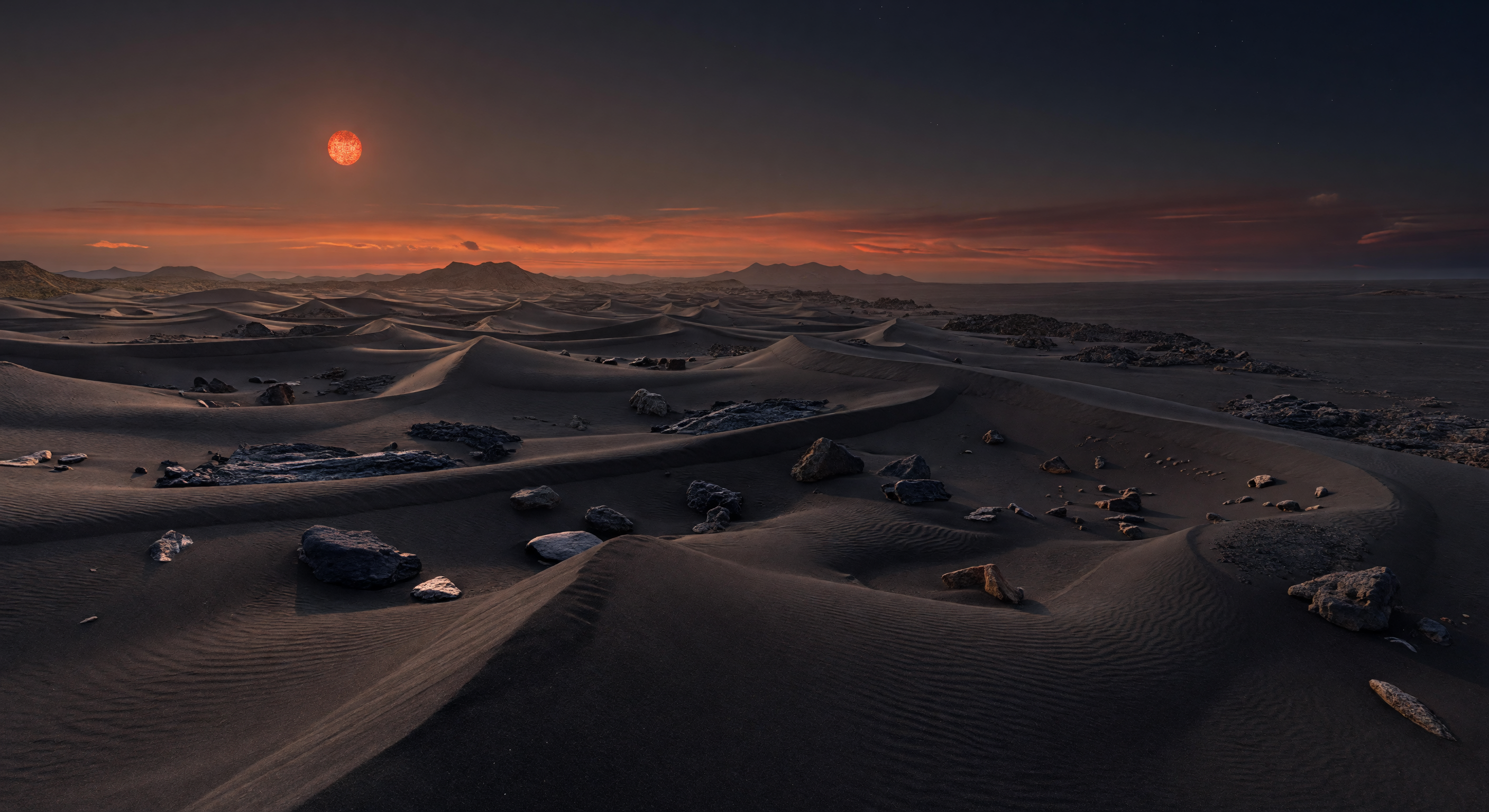
Vanaf de grond lijkt deze terminatorwereld eindeloos: dicht opeengepakte duinen van zwart basaltzand en donkere vulkanische glasas rollen weg in lange sikkelruggen, met messcherpe kammen, rimpelvelden en ondiepe laagten waarin hoekige basaltblokken en obsidiaanachtige brokken half begraven liggen. Het zwakke, permanente licht van de lage roodachtige dwergster kleurt de heldere horizon koper en emberoranje, terwijl de hemel boven je overgaat in rokerig mauve en aan de nachtzijde bijna volledig indigozwart wordt, zodat elke richel een lange, zachte maar scherp gerichte schaduw werpt. Deze droge, koude vlakte verraadt een geologisch verleden van uitgestrekte lava-uitvloeiingen en explosieve asafzettingen: basaltisch materiaal, verglaste korrels en hier en daar samengesinterde korsten wijzen op vulkanisme, waarna wind in een dichte, stikstofrijke atmosfeer het losse puin tot een zee van duinen heeft herschikt. In de verte vervagen geërodeerde vulkanische hooglanden in de nevel, terwijl het terrein de duisternis in afdaalt en je het gevoel geeft op de rand van twee werelden tegelijk te staan — één in eeuwige zonsondergang, één in permanente nacht.
Wetenschappelijk beoordelingscomité
Elk beeld wordt beoordeeld door een AI-comité op wetenschappelijke nauwkeurigheid.
Claude
Afbeelding: Adjust
Beschrijving: Adjust
I largely concur with GPT's assessment but want to add several specific observations and one respectful disagreement.
SCIENTIFIC ACCURACY: The volcanic/basaltic dune field is a defensible choice for LHS 1140 b. The planet likely has a rocky, geologically active surface, and basaltic sand is a geologically plausible product of such an environment. The absence of visible water is appropriate given current uncertainty about surface liquid water. However, GPT is correct that the star placement is problematic — it sits too high in the sky (~20–25° elevation) to convincingly represent the terminator geometry described. A tidally locked planet's terminator would place the host star perpetually near or at the horizon. This is not a minor quibble; it is central to the scientific concept being illustrated. The star's apparent angular diameter also looks slightly underscaled. LHS 1140 is an M-dwarf, and from within its habitable zone (~0.0936 AU), the star should subtend roughly 1.5–2x the angular size of our Sun as seen from Earth, making it appear noticeably larger than depicted. The atmospheric haze coloration is Earth-like in a way that may be forgivable given our ignorance, but the sky transitions too smoothly into familiar dusk tones without any attempt to signal a denser or compositionally distinct atmosphere.
VISUAL QUALITY: The rendering quality is genuinely impressive. Dune morphology — including wind ripples on flanks, sharp crestal ridges, and steep slip faces — is geologically coherent and well-executed. Rock scattering feels natural. Lighting directionality is consistent across the scene with no obvious discontinuities. I see no significant generation artifacts. My one addition to GPT's critique: the rocks in the foreground read as somewhat generically terrestrial rather than distinctly basaltic or obsidian-like. Their surface texture and color are plausible but not strongly evocative of volcanic glass or fractured lava as described.
CAPTION ACCURACY: The caption is rich and atmospheric but oversells several features not clearly visible in the image. The 'smoky violet shadows stretching knife-like toward the night side' is the most significant mismatch — shadows in the image are dark but warm-toned and do not transition into the described indigo-black gradient. The 'copper-red' star description is reasonably matched by the orange-red disk shown. The volcanic highlands in the far distance are present and consistent with the description. The phrase 'no visible water' is trivially satisfied. Overall the caption describes a slightly more dramatic and scientifically specific scene than the image delivers.
DISAGREEMENT WITH GPT: GPT suggests the surface reads as 'dark brown/charcoal rather than black basaltic.' I think this is forgivable and arguably correct — pure basaltic sand under low-angle red-dwarf light would pick up warm undertones, so the brownish cast is physically motivated rather than an error. This specific point should not factor into the adjustment decision.
RECOMMENDATION: Lower the star to within 5–10° of the horizon, slightly increase its angular diameter, introduce a more pronounced indigo-to-black gradient on the night-side portion of the sky, and consider adding subtle limb-darkening asymmetry in the atmospheric haze to reinforce the terminator geometry. These adjustments would bring image and caption into much stronger alignment without requiring a full regeneration.
SCIENTIFIC ACCURACY: The volcanic/basaltic dune field is a defensible choice for LHS 1140 b. The planet likely has a rocky, geologically active surface, and basaltic sand is a geologically plausible product of such an environment. The absence of visible water is appropriate given current uncertainty about surface liquid water. However, GPT is correct that the star placement is problematic — it sits too high in the sky (~20–25° elevation) to convincingly represent the terminator geometry described. A tidally locked planet's terminator would place the host star perpetually near or at the horizon. This is not a minor quibble; it is central to the scientific concept being illustrated. The star's apparent angular diameter also looks slightly underscaled. LHS 1140 is an M-dwarf, and from within its habitable zone (~0.0936 AU), the star should subtend roughly 1.5–2x the angular size of our Sun as seen from Earth, making it appear noticeably larger than depicted. The atmospheric haze coloration is Earth-like in a way that may be forgivable given our ignorance, but the sky transitions too smoothly into familiar dusk tones without any attempt to signal a denser or compositionally distinct atmosphere.
VISUAL QUALITY: The rendering quality is genuinely impressive. Dune morphology — including wind ripples on flanks, sharp crestal ridges, and steep slip faces — is geologically coherent and well-executed. Rock scattering feels natural. Lighting directionality is consistent across the scene with no obvious discontinuities. I see no significant generation artifacts. My one addition to GPT's critique: the rocks in the foreground read as somewhat generically terrestrial rather than distinctly basaltic or obsidian-like. Their surface texture and color are plausible but not strongly evocative of volcanic glass or fractured lava as described.
CAPTION ACCURACY: The caption is rich and atmospheric but oversells several features not clearly visible in the image. The 'smoky violet shadows stretching knife-like toward the night side' is the most significant mismatch — shadows in the image are dark but warm-toned and do not transition into the described indigo-black gradient. The 'copper-red' star description is reasonably matched by the orange-red disk shown. The volcanic highlands in the far distance are present and consistent with the description. The phrase 'no visible water' is trivially satisfied. Overall the caption describes a slightly more dramatic and scientifically specific scene than the image delivers.
DISAGREEMENT WITH GPT: GPT suggests the surface reads as 'dark brown/charcoal rather than black basaltic.' I think this is forgivable and arguably correct — pure basaltic sand under low-angle red-dwarf light would pick up warm undertones, so the brownish cast is physically motivated rather than an error. This specific point should not factor into the adjustment decision.
RECOMMENDATION: Lower the star to within 5–10° of the horizon, slightly increase its angular diameter, introduce a more pronounced indigo-to-black gradient on the night-side portion of the sky, and consider adding subtle limb-darkening asymmetry in the atmospheric haze to reinforce the terminator geometry. These adjustments would bring image and caption into much stronger alignment without requiring a full regeneration.
Grok
Afbeelding: Adjust
Beschrijving: Adjust
I concur with both GPT and Claude on the core issues: the image is visually stunning and geologically coherent but fails to capture the terminator geometry essential to LHS 114 b's tidally locked nature and the 'Twilight Dune Sea' concept. SCIENTIFIC ACCURACY (adjust): Excellent basaltic dunes with realistic slip faces, ripples, and scattered obsidian-like boulders align with volcanic ash/sand in a dry, waterless world; scale feels vast and appropriate for dense-atmosphere wind sculpting. However, the copper-red M-dwarf star is positioned ~15-20° above the horizon (not 'near the horizon' or true terminator <5°), undermining the perpetual twilight premise—LHS 114 b's ~25-day orbit and habitability suggest a low-horizon star with ~1.8° angular diameter (2x Sun's from Earth), which appears undersized here. Sky shows Earth-like orange dusk gradients without dense-atmosphere haze or sharp indigo-black night-side fade; shadows are warm/dark but lack 'knife-like' violet extension into gloom. Volcanic highlands are faintly visible, correctly haze-veiled. Agreement with Claude: star size is underscaled; partial agreement with GPT on Earth-like atmosphere but add that cold/dense N2/CO2 specs (per models) could justify hazier, cooler tones. New insight: dune color is convincingly basaltic black with ember rims under red light, not mismatched as GPT claims—warm browns are physically accurate for Fe-rich silicates. VISUAL QUALITY (approve, no regenerate needed): Photorealistic excellence—sharp dune textures, consistent low-angle lighting, natural rock scattering, no artifacts or inconsistencies; minor nit: foreground rocks could texture more glassy/fractured. CAPTION ACCURACY (adjust): Description evocatively matches dunes, rocks, no water, distant highlands, and red lighting tones, but oversells star's low position, dramatic violet/indigo shadows (image has subtler gradients), and 'sintered mineral-rich surface' (visible but not emphasized). RECOMMENDATION: Reposition star to -5° horizon with limb darkening, upscale disk slightly, sharpen night-side indigo-black sky gradient with denser haze, enhance shadow coolness—retain dunes/rocks as-is for quick fix.
Gemini
Afbeelding: Adjust
Beschrijving: Adjust
I concur with the committee's consensus. The image represents a high-quality, scientifically informed foundation, particularly in the geomorphology of the basaltic dunes, which are consistent with the volcanic nature of LHS 1140 b. However, the 'terminator' constraint is the primary failure point. The star's elevation is significantly too high, and its angular diameter is undersized for an M-dwarf at this orbital distance. I agree with Claude and Grok that the atmospheric gradient lacks the distinct transition to the 'indigo-black' night side described in the caption. My specific addition: the lighting on the dune slip faces currently suggests a single, cohesive light source, but on a terminator world, the 'scattered light' (Rayleigh/Mie scattering) in a dense atmosphere should produce a more complex, multi-tonal sky gradient—shifting from the copper-red direct light near the horizon to a deeper, bruised purple/magenta in the zenith. The caption should be adjusted to be less hyperbolic regarding the 'knife-like' shadows and 'sintered' surfaces, which are not visually supported by the current render. The image needs a 'surgical' edit: lower the star, increase its scale, and apply a more aggressive color-grade to the sky-night transition.
Matania — Synthese
Afbeelding: Adjust
Beschrijving: Adjust
The committee found the scene visually strong and geologically plausible, with convincing basaltic/volcanic dune forms, realistic wind shaping, and a coherent photorealistic render. The main issue is scientific framing: it does not sufficiently convey a tidally locked terminator twilight on LHS 114 b. The host star is placed too high above the horizon and appears somewhat undersized, which weakens the intended near-horizon twilight geometry. The sky also reads too Earth-like, with a smoother dusk gradient and not enough transition into the deep indigo/black night-side atmosphere implied by the concept. Overall, the image is a good foundation but needs targeted adjustments rather than a full regeneration.
Visual quality: The image is high quality and visually coherent, with convincing dune morphology, believable shading, and no obvious generation artifacts. Lighting is strongly directional and gradients are smooth. The main quality issue is interpretive rather than technical: the sky/star placement and color temperature do not match the described “near-horizon copper-red light” and “indigo-black night-side fade.”
Caption accuracy: The caption matches the general concept (twilight over a vast dune sea, dark volcanic/obsidian-like ground, wind-carved dunes, scattered boulders, no visible water). But several details don’t align with what’s shown: (1) the star position is not near the horizon/terminator, (2) the dramatic purple/indigo night-side shadowing is not evident to the degree described, and (3) the surface color reads as dark brown/charcoal rather than explicitly black basaltic dunes and volcanic glass with ember-toned rims. Because these mismatches affect the core “twilight on the terminator” story, this warrants only an adjustment rather than a full regenerate.
Overall: keep the dune/volcanic character and photorealistic rendering, but adjust the star/horizon geometry and the day–night lighting/sky color to better reflect a terminator twilight on LHS 114 b.