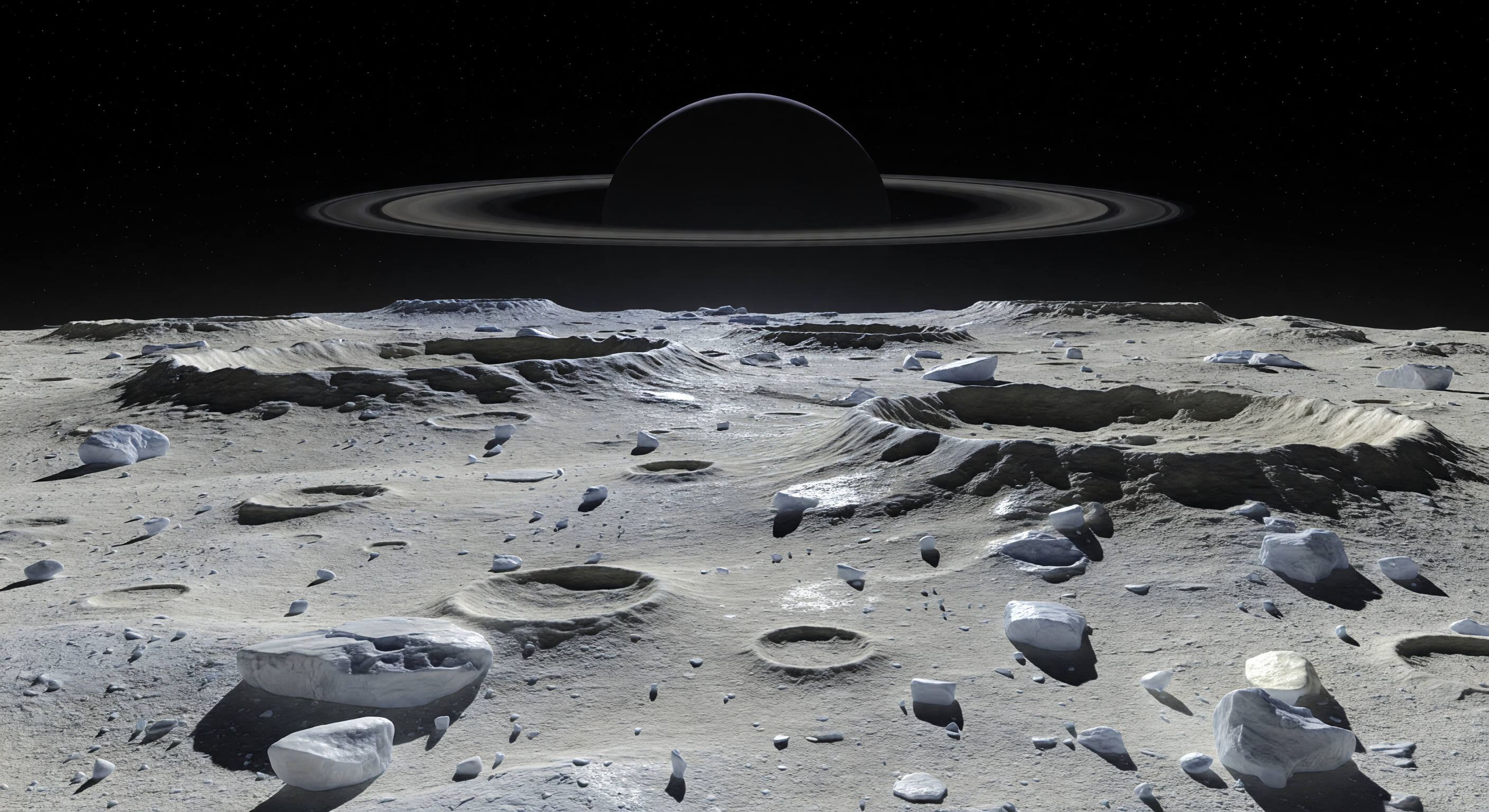
Tijdens de verduistering verandert deze oude, hobbelige tussenkrater-vlakte van waterijs in een bijna geluidloze schemerwereld: poederige grijswitte tot crèmekleurige regolith, korrelige rijp, hoekige ijsblokken en kleine uitgeworpen fragmenten liggen uitgespreid tussen ondiepe overlappende kraters en zachte verheffingen die door miljarden jaren inslagen zijn afgesleten. Omdat er hier vrijwel geen atmosfeer is, blijft de hemel volkomen zwart en messcherp, terwijl de enorme schijf van de planeet de Zon afdekt en alleen zwak ringlicht en gereflecteerde gloed de randen van kraters, gebarsten keien en sinterharde ijsplekken in koel zilver en bleek room omlijnen. De ondergrond bestaat hoofdzakelijk uit kristallijn waterijs, vermengd met wat donkerder verontreinigde korrels door micrometeorietbombardement, met hier en daar frisse blauwachtig-witte breukvlakken die helderder oplichten dan de stoffige omgeving. Op deze piepkleine maan, waar de zwaartekracht extreem laag is, rijzen kraterranden van enkele tientallen meters hoog onnatuurlijk scherp op boven de voorgrondblokken van een paar meter, terwijl het zwaar bekraterde landschap wegzakt naar een merkbaar gekromde horizon en de sterren onverwacht fel boven de bevroren leegte branden.
Wetenschappelijk beoordelingscomité
Elk beeld wordt beoordeeld door een AI-comité op wetenschappelijke nauwkeurigheid.
Claude
Afbeelding: Adjust
Beschrijving: Adjust
I largely concur with GPT's assessment but want to add several specific observations and one meaningful disagreement.
SCIENTIFIC ACCURACY: The surface palette — gray-white regolith, cream-toned ice, angular fractured blocks with brighter exposed faces — is broadly consistent with Cassini VIMS and ISS data on Mimas' water-ice-dominated composition. The airless sky with hard-edged, pitch-black shadows is physically correct: no atmosphere means no penumbral softening or Rayleigh scattering. The cratered terrain with overlapping shallow bowls and hummocky relief is generally plausible for a heavily bombarded small moon. However, I flag two accuracy concerns GPT did not fully develop: (1) ECLIPSE LIGHTING IS THE CENTRAL SCIENTIFIC FAILURE. If Saturn is occulting the Sun, the primary illumination source should be essentially removed, leaving only ringlight and Saturnshine — dim, diffuse, bluish-gray illumination from Saturn's disk and ring-scattered sunlight. Instead, the surface appears lit by what reads as direct, high-angle sunlight: strong specular highlights on ice blocks, crisp high-contrast shadows, and vivid surface texture all inconsistent with an eclipse condition where irradiance drops dramatically. This is not a minor caption mismatch — it is a physically incorrect lighting regime for the described scenario. (2) Saturn's apparent angular size is plausible (Saturn subtends roughly 6–7 degrees from Mimas, much larger than our Moon appears from Earth), but the ring system's geometry looks slightly too face-on and symmetric for a moon that orbits close to Saturn's equatorial plane — from Mimas' surface, the rings would appear nearly edge-on as a thin bright line, not the broad oval presented here. This is a notable scientific inaccuracy. The surface lacks any suggestion of Herschel Crater's massive scale, but that is an acceptable omission for a non-Herschel-facing locale.
VISUAL QUALITY: The rendering is technically accomplished — perspective is coherent, texture work on the regolith is convincing, and the ice block specularity reads as physically plausible under the rendered lighting. No obvious AI artifacts such as floating geometry, inconsistent scale gradients, or texture tiling are apparent. My disagreement with GPT is here: I would rate visual quality slightly higher than 'adjust' in isolation — the image is genuinely photorealistic as a standalone render. The problem is that the lighting is internally consistent but scientifically wrong for the described scenario, which makes it a scientific accuracy issue rather than a rendering quality issue.
CAPTION ACCURACY: The caption's most specific and evocative claims — ringlight tracing boulder edges, stars blazing with clarity, crisp crater rims, deep black shadow voids — are broadly supported visually. However, the eclipse framing ('Saturn blotting out the Sun') is the caption's central narrative premise and it is entirely unsupported by the image's lighting. The ground is not in eclipse. The caption also claims bluish-white coloration on freshly fractured ice faces; while some brighter blocks are visible, the bluish tint is not clearly rendered. The ring geometry description also conflicts with what is physically shown.
SUMMARY RECOMMENDATION: 'adjust' for both image and caption. The primary corrective actions should be: (1) rerender with eclipse-appropriate lighting — dramatically reduced overall illumination, dominant blue-gray Saturnshine wash, loss of strong specular highlights; (2) correct Saturn's ring geometry to near-edge-on as seen from Mimas' equatorial orbit; (3) revise the caption's eclipse lighting language to match either the actual rendered lighting or the corrected render. The foundation is strong and the concept is compelling — these are fixable scientific calibration issues, not fundamental failures.
SCIENTIFIC ACCURACY: The surface palette — gray-white regolith, cream-toned ice, angular fractured blocks with brighter exposed faces — is broadly consistent with Cassini VIMS and ISS data on Mimas' water-ice-dominated composition. The airless sky with hard-edged, pitch-black shadows is physically correct: no atmosphere means no penumbral softening or Rayleigh scattering. The cratered terrain with overlapping shallow bowls and hummocky relief is generally plausible for a heavily bombarded small moon. However, I flag two accuracy concerns GPT did not fully develop: (1) ECLIPSE LIGHTING IS THE CENTRAL SCIENTIFIC FAILURE. If Saturn is occulting the Sun, the primary illumination source should be essentially removed, leaving only ringlight and Saturnshine — dim, diffuse, bluish-gray illumination from Saturn's disk and ring-scattered sunlight. Instead, the surface appears lit by what reads as direct, high-angle sunlight: strong specular highlights on ice blocks, crisp high-contrast shadows, and vivid surface texture all inconsistent with an eclipse condition where irradiance drops dramatically. This is not a minor caption mismatch — it is a physically incorrect lighting regime for the described scenario. (2) Saturn's apparent angular size is plausible (Saturn subtends roughly 6–7 degrees from Mimas, much larger than our Moon appears from Earth), but the ring system's geometry looks slightly too face-on and symmetric for a moon that orbits close to Saturn's equatorial plane — from Mimas' surface, the rings would appear nearly edge-on as a thin bright line, not the broad oval presented here. This is a notable scientific inaccuracy. The surface lacks any suggestion of Herschel Crater's massive scale, but that is an acceptable omission for a non-Herschel-facing locale.
VISUAL QUALITY: The rendering is technically accomplished — perspective is coherent, texture work on the regolith is convincing, and the ice block specularity reads as physically plausible under the rendered lighting. No obvious AI artifacts such as floating geometry, inconsistent scale gradients, or texture tiling are apparent. My disagreement with GPT is here: I would rate visual quality slightly higher than 'adjust' in isolation — the image is genuinely photorealistic as a standalone render. The problem is that the lighting is internally consistent but scientifically wrong for the described scenario, which makes it a scientific accuracy issue rather than a rendering quality issue.
CAPTION ACCURACY: The caption's most specific and evocative claims — ringlight tracing boulder edges, stars blazing with clarity, crisp crater rims, deep black shadow voids — are broadly supported visually. However, the eclipse framing ('Saturn blotting out the Sun') is the caption's central narrative premise and it is entirely unsupported by the image's lighting. The ground is not in eclipse. The caption also claims bluish-white coloration on freshly fractured ice faces; while some brighter blocks are visible, the bluish tint is not clearly rendered. The ring geometry description also conflicts with what is physically shown.
SUMMARY RECOMMENDATION: 'adjust' for both image and caption. The primary corrective actions should be: (1) rerender with eclipse-appropriate lighting — dramatically reduced overall illumination, dominant blue-gray Saturnshine wash, loss of strong specular highlights; (2) correct Saturn's ring geometry to near-edge-on as seen from Mimas' equatorial orbit; (3) revise the caption's eclipse lighting language to match either the actual rendered lighting or the corrected render. The foundation is strong and the concept is compelling — these are fixable scientific calibration issues, not fundamental failures.
Grok
Afbeelding: Adjust
Beschrijving: Adjust
I concur with both GPT and Claude on the core issues, adding targeted insights on physics and geometry for refinement. SCIENTIFIC ACCURACY (adjust): Surface geology is spot-on—overlapping shallow craters, hummocks, angular ice blocks with brighter fresh exposures match Mimas' Cassini imagery of water-ice regolith (albedo ~.9, gray-white/cream tones). Airless black sky, crisp shadows, and sharp rims are perfectly rendered for 1/6g vacuum conditions (no slumping or erosion). Stars' clarity is correct. However, two major flaws: (1) ECLIPSE LIGHTING MISMATCH—image shows direct high-contrast sunlight (strong specular glints on blocks, defined rim shadows) incompatible with Saturn occulting the Sun; true eclipse on Mimas would yield ~90% irradiance drop, dominated by faint ringlight (scattered UV-blue sunlight) and Saturnshine (albedo ~.5, cool-toned diffuse glow), not this bright, warmish scene. (2) RING GEOMETRY ERROR—from Mimas (semi-major axis 185,539 km, near Saturn's equatorial plane, inclination <1°), rings appear nearly edge-on (~.5° thick, subtending <1 arcmin vertically), as a slender bright line, not the broad face-on oval disk shown (implies >10° tilt). Saturn's ~6° angular diameter is accurate. No Herschel Crater is fine for a generic plain. VISUAL QUALITY (high but adjust): Photorealistic excellence—coherent perspective, no artifacts (e.g., no tiling, floating elements), believable ice textures, consistent internal lighting. Issue is scientific, not rendering quality. CAPTION ACCURACY (adjust): Matches terrain (hummocks, bowls, blocks, shadows, ringlight band, curved horizon) and desolation vibe, but 'Saturn blotting out the Sun' and 'dim silver band of ringlight' are unsupported—lighting isn't eclipse-dimmed, rings aren't thin/edge-on, bluish-white flashes are subtle/not dominant. Constructive fixes: Regenerate with eclipse physics (dim blue-gray Saturnshine only, no direct Sun), edge-on rings (thin line over dark Saturn disk), retain surface details. Caption tweak: Align eclipse claims with render or generalize to 'ringlit twilight'.
Gemini
Afbeelding: Regenerate
Beschrijving: Adjust
I concur with the previous committee members regarding the fundamental disconnect between the physics of an eclipse and the rendered lighting. While the surface texture and geological modeling are excellent, the lighting is the most critical element of the prompt's premise, and its failure renders the image scientifically inaccurate. The current image shows high-intensity, direct-source lighting (likely a single, strong 'sun' light), which is the exact opposite of what should occur during a total occultation. Furthermore, the geometric error regarding the rings—rendering them as a wide, face-on oval rather than the nearly edge-on line visible from Mimas's equatorial orbit—is a significant oversight. Because the lighting regime and celestial geometry are foundational to the 'Eclipse on Mimas' concept, this requires a 'regenerate' rather than a simple 'adjust' to ensure the scene is physically coherent. The caption is evocative and technically well-written, but it promises an eclipse-physics experience that the current image fails to deliver. I suggest the next iteration prioritize the 'Saturnshine' and 'Ringlight' color palette (muted, cool, and diffuse) over the currently high-contrast 'sunny' lighting.
Matania — Synthese
Afbeelding: Regenerate
Beschrijving: Adjust
The committee agrees that the scene is generally strong in surface texture and overall photorealism, with a plausible airless, icy Mimas-like landscape, crisp shadows, and credible cratered regolith. However, the core scientific premise is not correctly rendered: the image reads as if lit by direct sunlight rather than by an eclipse condition, and Saturn’s rings are depicted too broadly and face-on instead of near edge-on as they should appear from Mimas. Because the eclipse lighting and celestial geometry are foundational to the prompt, the image needs a full regenerate rather than a minor edit. The caption is well written and matches the general terrain, but it overstates the eclipse mechanics and lighting details that are not supported by the image, so it should be adjusted to align with the actual visual or with a corrected render.
Visual quality (covered implicitly by votes): The rendering is high quality and largely photorealistic in style, with coherent ground shading, believable ice specularity, and consistent perspective. There are no major obvious artifacts, but the physical plausibility of the eclipse lighting is the main scientific shortfall.
Caption accuracy (adjust): The caption is detailed and matches the overall vibe (airless, icy plain, cratered/impact-shattered terrain, hard shadows, distant Saturn with rings). But it over-specifies aspects that are not directly evidenced: (1) the Sun occultation mechanism (“Saturn looms… blotting out the Sun”) is not visually established—there is no visible Sun or eclipse shadow/illumination change that clearly indicates an occultation event; (2) the caption’s mention of many specific small bowl/crater-rim behaviors and bluish-white freshness flashes is not clearly discernible across the terrain. Because the image supports the general setting but not the most diagnostic eclipse/lighting claims, adjust rather than approve.