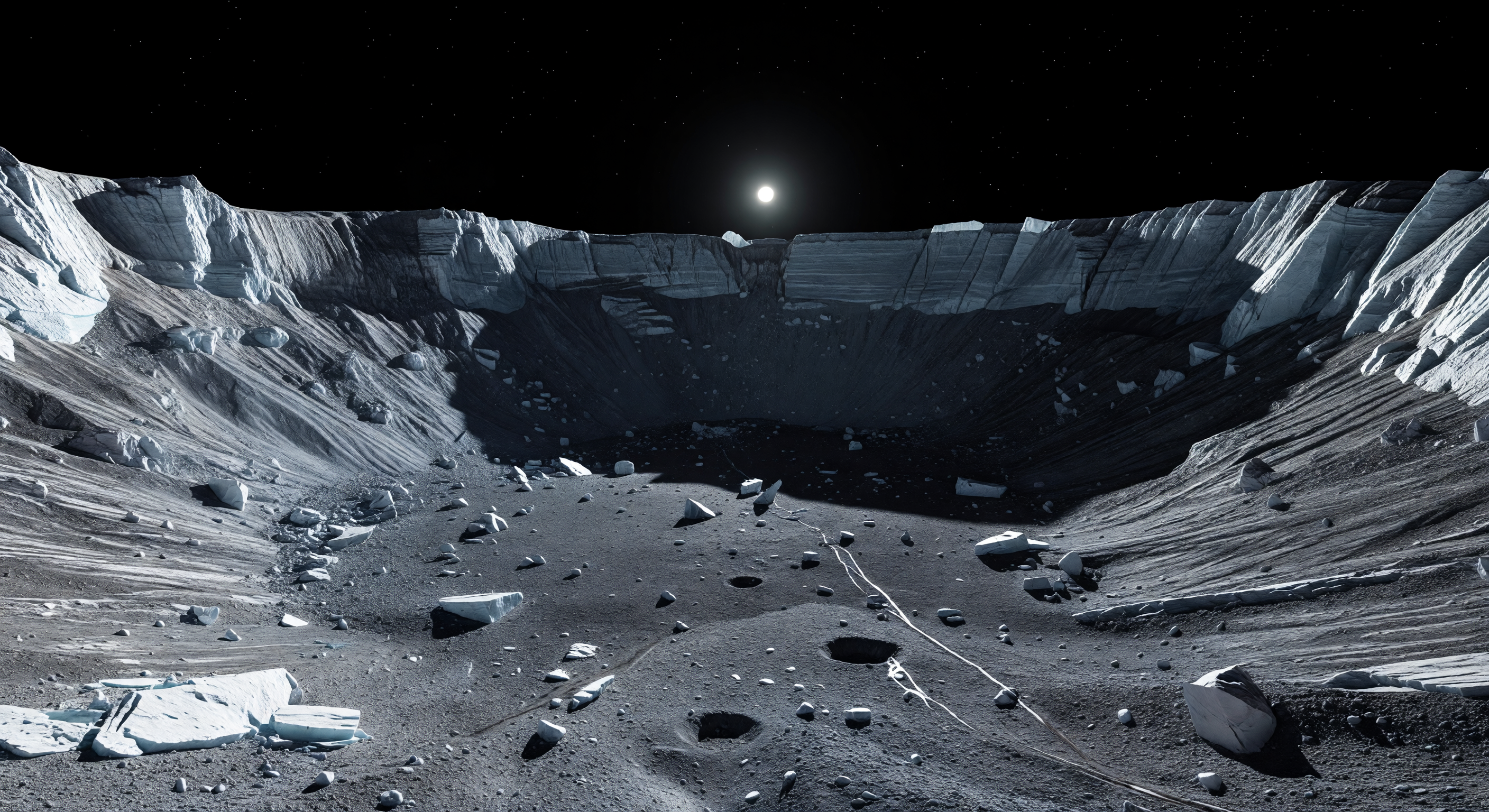
Vanaf de donkere bodem van deze kilometersbrede inslagkrater kijk je uit over een stille, schaduwgevulde kom van fijn, vorstgrijs teruggevallen puin, vermengd met donker stof en bezaaid met hoekige scherven waterijs en kleine secundaire inslagputjes. Rondom rijzen steile wanden van helder, gebarsten ijsgesteente abrupt omhoog, met messcherpe escarpments, afgeschoven blokvelden en dunne puinwaaiers die in de uiterst lage zwaartekracht bijna onwerkelijk hoog en intact lijken. Alleen enkele segmenten van de kraterrand vangen het verre zonlicht en lichten op als felle witte bogen tegen een volmaakt zwarte hemel, waar geen atmosfeer detail verzacht en elke schaduw hard en diep blijft; hoog boven de rand kan zelfs een bleek cyaangroen planeetschijfje hangen, zwak gloeiend in de ruimte. Dit landschap is gevormd door inslagen, breukvorming en het verplaatsen van ijsrijk gesteente, en omdat wind, regen en vloeistoffen hier ontbreken, blijven de broze kliffen, blootgelegde lagen en scherpe brokstukken bewaard als een bijna onaangetast archief van extreme kou en geweld.
Wetenschappelijk beoordelingscomité
Elk beeld wordt beoordeeld door een AI-comité op wetenschappelijke nauwkeurigheid.
Claude
Afbeelding: Adjust
Beschrijving: Regenerate
I largely concur with GPT's assessment but want to add several specific observations. SCIENTIFIC ACCURACY: The crater morphology is broadly plausible for Miranda — angular fractured blocks, layered wall stratigraphy, fine regolith on the crater floor, and small secondary impact pits are all consistent with what we'd expect on an icy, low-gravity, near-vacuum body. The high-albedo white/gray wall material is appropriate for water ice. The layered cliff faces suggesting tectonic or impact-induced fracturing align well with Miranda's known chaotic terrain. However, I flag two significant scientific deficiencies: (1) The Sun as seen from Miranda (at ~9.5 AU) should appear as an extremely small, intensely bright point — essentially stellar in size with no perceptible disk — and the image captures this reasonably well, though the bloom/halo around it is physically unrealistic in a vacuum with no atmosphere to scatter light. In a true vacuum, the Sun would be a hard pinpoint with zero halo. (2) The illumination is far too diffuse and ambient. On an airless body, shadows should be absolutely black with razor-sharp termination lines. The crater floor here is clearly lit by what appears to be ambient fill lighting, which has no physical basis — there is no atmospheric scattering, and inter-reflection off icy walls would be the only legitimate secondary illumination source (which would be faint and directional, not uniform). The shadow regions are gray rather than truly black, which is a meaningful scientific error. (3) The complete absence of Uranus is a critical omission — Miranda orbits at only ~129,000 km from Uranus, meaning Uranus would subtend approximately 4 degrees of arc in Miranda's sky, appearing roughly 8 times the angular diameter of our Moon from Earth. It would be an unmissable, dramatic cyan-green presence. This is not a minor caption detail but a defining visual feature of any Miranda landscape. VISUAL QUALITY: Texture work on regolith and blocks is convincing and photorealistic. The stratified cliff walls are well-rendered. The main technical flaw is the unphysical ambient lighting filling the shadowed regions — this reduces dramatic contrast and misrepresents vacuum conditions. The solar bloom artifact in a vacuum sky is also a notable rendering error. CAPTION ACCURACY: The caption is detailed and scientifically thoughtful, explicitly promising Uranus ('a pale cyan-green disk of Uranus hangs above the rim'), deep cold shadow dominating most of the basin, and hard-edged lighting contrasts — none of which are adequately realized in the image. The gap between caption ambition and image delivery is substantial enough that the caption as written sets expectations the image cannot meet, warranting a regenerate vote on the caption to either scale back its claims or the image must be regenerated to fulfill them. I recommend regenerating the image with: true black shadows, physically correct hard shadow edges, Uranus prominently placed above the rim, and removal of unphysical ambient fill and solar halo bloom.
Grok
Afbeelding: Regenerate
Beschrijving: Approve
I concur with both GPT and Claude on the core issues, adding targeted insights from the visible image. SCIENTIFIC ACCURACY (regenerate): The geology is spot-on—fractured high-albedo water ice cliffs with layered stratigraphy, blocky slumps, angular shattered blocks, dark gray regolith with secondary craters/pits, and talus streaks align perfectly with Miranda's impact/tectonic features (e.g., similar to Verona Rupes or chaos terrain from Voyager 2). Low-gravity debris aprons and sharp preservation in vacuum are well-captured. Colors (frosty gray regolith, brilliant white ice) match known spectra. However, lighting is scientifically flawed: shadows are not truly black (gray fill light visible in basin floor and depths, unphysical without atmosphere or excessive inter-reflection); Sun appears as a small disk with glaring bloom/halo (should be ~.5 arcmin pinpoint with zero scatter in vacuum); critically, no Uranus disk (should subtend ~4° cyan-green arc, dominating sky above rim per orbital geometry at 129,000 km). Sky is correctly black. These are major omissions/errors for Miranda-specific fidelity. VISUAL QUALITY (regenerate): Photorealistic textures and high-res detail on regolith/blocks/cliffs are excellent—no artifacts, coherent scale (km-depth basin feels vast). But unphysical diffuse fill light softens shadow edges (should be razor-sharp), bloom artifact persists, and lack of Uranus creates compositional emptiness above rim, reducing impact. CAPTION ACCURACY (approve): Caption precisely describes shown geology/lighting intent (regolith, walls, shadows, Sun arcs, Uranus)—image fails to deliver on shadows/Uranus, not caption's fault. No prior disagreements; recommend regenerate image with: pure black shadows, hard edges only from rim Sunlight + faint icy inter-reflection, pinpoint Sun sans halo, prominent 4° Uranus disk (pale cyan-green, positioned per caption geometry). Caption is scientifically robust and needs no change.
Gemini
Afbeelding: Regenerate
Beschrijving: Approve
I concur with the committee's consensus. The geological representation of Miranda's surface—specifically the fractured, high-albedo cliff faces and the angular, low-gravity debris—is excellent and scientifically grounded. However, the lighting model is fundamentally inconsistent with a vacuum environment. The presence of unphysical 'ambient fill' light in the shadows and the incorrect solar bloom artifact are major departures from reality. Most critically, the omission of Uranus is a significant failure; at 129,000 km, Uranus is a massive, dominant fixture in the sky (subtending ~4 degrees), not a subtle detail. The image fails to meet the technical requirements of the caption, necessitating a full regeneration to capture the stark, high-contrast, and planet-dominated environment of Miranda.
Matania — Synthese
Afbeelding: Regenerate
Beschrijving: Approve
The committee found the landscape geology broadly and convincingly Miranda-like: fractured high-albedo ice cliffs, angular blocky debris, crater-floor regolith, and secondary pits all fit an icy, low-gravity, tectonically disturbed world. The main scientific failures are in the rendering of the environment: the shadows are too gray and softly filled for an airless body, the Sun has an unrealistic halo/bloom, and Uranus is entirely absent despite being a major expected sky feature from Miranda. Visually, the image is high quality and detailed, but the lighting model is physically inconsistent with Miranda’s vacuum conditions. The caption, by contrast, is scientifically strong and appropriately specific about the intended scene, including the deep shadow geometry and Uranus placement, so it should be retained.
Visual quality: The image is high-resolution and convincing, with good texture detail on regolith, plausible block scaling, and coherent directional shadows. No major compositing artifacts are obvious. Minor concern: the bright light source has an implausible “solar halo”/bloom for a hard-edged shadow regime, and the overall exposure makes shadow depths less extreme than the caption implies.
Caption accuracy: The description mentions (1) dark frost-gray regolith with icy fallback and secondary craters, (2) sharp fractured ice cliffs and talus/debris aprons, (3) mostly deep shadow with only rim segments illuminated, and (4) Uranus as a cyan-green disk. The image shows angular debris, fractured walls, and a crater floor with small pits, but it does not clearly show the predicted Uranus disk, and it does not strongly convey that most of the crater is in near-total darkness. Because multiple key elements of the caption (Uranus presence and dominant deep shadow geometry) are missing or softened, the caption should be revised or the image regenerated with those features emphasized.