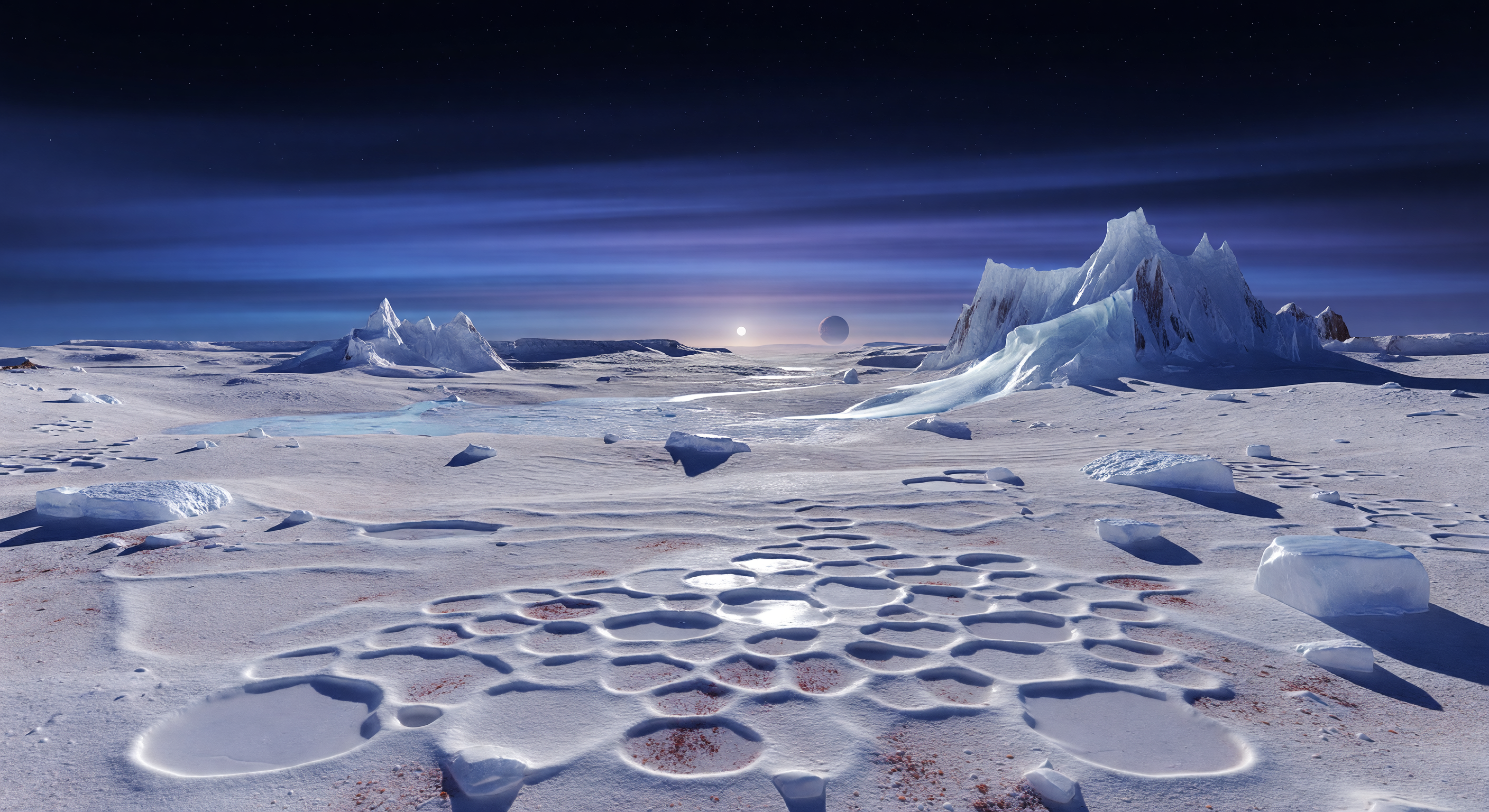
Je staat uit te kijken over een bevroren vlakte van bleek stikstof- en methaanijs, waar grote veelhoekige convectiecellen, ondiepe sublimatiekuilen, zachte vorstruggen en verspreide blokken hard waterijs zich kilometers ver uitstrekken tot aan grillige bergen aan de horizon. In dit zwakke, ijskoude schemerlicht lijken die bergmassieven — opgebouwd uit waterijs dat hier zo hard als gesteente is — nog hoger en steiler, terwijl heldere tongen van vluchtig ijs tussen de pieken omlaag glijden en oude kraterranden verderop bijna oplossen in de nevel. Boven het donkere landschap brandt de zon slechts als een minuscuul, fel puntje aan de rand van de wereld, en een dunne stikstofatmosfeer licht op in opvallende, horizontale lagen van diep kobaltblauw, indigo en violet die tot ongeveer 200 kilometer hoog reiken: onderin dicht en bijna ondoorzichtig, hogerop ijl en doorschijnend, met al zichtbare sterren. Laag bij de horizon verdwijnt een donkere, grijze bol langzaam in de schaduw, terwijl het blauw-paarse schijnsel, de roodbruine tholine-stof in de laagtes en de eindeloze stilte van exotische, volledig bevroren materialen deze plek tegelijk buitenaards en verrassend geologisch levend maken.
Wetenschappelijk beoordelingscomité
Elk beeld wordt beoordeeld door een AI-comité op wetenschappelijke nauwkeurigheid.
Claude
Afbeelding: Adjust
Beschrijving: Regenerate
I largely concur with GPT's assessment but want to add sharper specificity in several areas. SCIENTIFIC ACCURACY: The broad compositional choice — pale icy plains, jagged water-ice mountains, a thin colored-haze horizon, and near-black overhead sky — is defensible and reflects genuine New Horizons findings. However, I take stronger issue than GPT on three points. First, the ground polygonal texturing in the foreground is actually more visible than GPT credits: the honeycomb-like sublimation cell pattern is clearly rendered and is a genuine strength, consistent with Sputnik Planitia's convective nitrogen-ice cells. The reddish-brown material in the cell interiors is also a plausible tholin depiction. This is the image's best scientific element. Second, the sky and celestial objects are the most serious scientific failure. Pluto's atmospheric haze, as confirmed by New Horizons, is famously blue — not the deep indigo-violet rendered here, which reads as generically 'alien' rather than Pluto-specific. More critically, the two objects on the horizon are deeply problematic: one appears as a large, softly glowing disk (roughly lunar-scale as seen from Earth), and the other as a darker, similarly large spherical body. This is physically wrong on multiple levels. Charon subtends roughly 0.9 degrees from Pluto's surface — comparable to our Moon — so its angular size could be argued as plausible, but the Sun as rendered appears far too large and diffuse. From Pluto, the Sun is a tiny, intensely bright point, roughly 1000 times dimmer than from Earth, but still point-like, not a soft glowing disk. The rendering makes it look like a sunset seen from Earth orbit, which is a fundamental misrepresentation. Third, the mountains lack the scale cues that would communicate 'several kilometers high.' They could read as Earth-scale hills without contextual anchoring. VISUAL QUALITY: The image is technically accomplished. Surface ice texture, shadow rendering on ice blocks, and the foreground cell pattern are all convincing. The sky gradient is aesthetically pleasing but cinematically overproduced. The haze banding lacks the distinct, observable stratification layers (over 20 discrete haze layers were identified by New Horizons) that would distinguish this from a generic icy-world rendering. No artifacts are visible; quality is high. CAPTION ACCURACY: This is where I diverge most strongly from GPT's 'adjust' vote and move to 'regenerate.' The caption is not merely over-claiming minor details — it contains specific, verifiable scientific claims that directly contradict what is shown. It states 'the Sun appears only as a tiny, fierce point'; the image shows a large diffuse disk. It states Charon appears as a 'receding globe in haunting silhouette'; the image shows what appears to be a large backlit sphere near the horizon with no clear silhouette quality. It describes 'stacked bands of deep cobalt, indigo, and violet haze'; the image shows a relatively smooth gradient without discrete banding. It describes 'faint stars showing through the highest layers'; stars are only visible in the near-black overhead region, not through the haze. The caption was evidently written as an idealized scientific description that was never reconciled against the actual rendered output. A caption regeneration is warranted to either rewrite it to match what is shown, or the image needs substantial revision to match what the caption describes — particularly the solar disk geometry and Charon presentation, which are the most scientifically consequential errors.
Grok
Afbeelding: Adjust
Beschrijving: Regenerate
I concur strongly with both GPT and Claude on the core issues, particularly the sky and celestial objects, which are the image's most glaring scientific flaws. SCIENTIFIC ACCURACY: The foreground is a highlight—Claude is correct that the polygonal nitrogen-ice cells (evident in the honeycomb patterning with reddish tholin-like staining in the depressions) accurately evoke Sputnik Planitia's convective cells, a direct New Horizons match; scattered water-ice blocks with dark dusting also fit. Mountains convey rugged water-ice terrain plausibly, though scale (km-high) lacks cues like foreground comparators. However, the sky fails: Pluto's N2 haze is blue (scattering shorter wavelengths), not the deep indigo-violet gradient shown, which feels generically alien rather than data-driven (New Horizons images confirm blue haze layers). Critically, the two horizon disks are wrong—the 'Sun' is a large, diffuse pale disk (~lunar-sized angular diameter), not the ~.1° point source it should be from Pluto (1/100th Earth's brightness but star-like); the dark sphere may intend Charon (plausibly ~.9° angular size), but lacks 'receding globe' silhouette clarity amid the glow. Lighting is cold and terminator-appropriate, but the amber-white rim overstates solar illumination. Overall, broad Pluto vibe works, but celestial physics demands adjustment. VISUAL QUALITY: Photorealistic excellence in ice textures (frost-softening, specular highlights on blocks, polygonal pitting), no artifacts, high-res shadows. Sky is cinematic-overpolished (smooth gradient lacks ~20 discrete haze layers from data), disks feel like artistic liberties vs. precise simulation. CAPTION ACCURACY: Regenerate required, aligning with Claude over GPT—caption makes falsifiable claims mismatched to image: 'tiny, fierce point' Sun (shows large disk); 'stacked bands of deep cobalt, indigo, and violet haze' (shows smooth blue-purple gradient, wrong colors); 'Charon... in haunting silhouette' (ambiguous dark globe, not clearly silhouetted or positioned as receding); 'faint stars... through the highest [haze] layers' (stars only overhead, not penetrating haze). Minor details like 'shallow sublimation pits, frost-softened ridges' are present but under-emphasized. Caption must be rewritten to reflect actual rendering or image revised for fidelity. New insight: Image's reddish cell interiors aptly depict tholins (organics from atmospheric chemistry), a scientific win GPT underplayed.
Gemini
Afbeelding: Adjust
Beschrijving: Regenerate
I agree with the consensus regarding the foreground: the depiction of Sputnik Planitia’s polygonal nitrogen-ice cells and tholin-stained sublimation pits is a significant scientific success and the image's strongest feature. However, the celestial mechanics are fundamentally flawed. The Sun, as rendered, is far too large and diffuse; from Pluto, it should be a brilliant, pin-prick point source. Furthermore, the atmospheric color palette leans into 'generic sci-fi' aesthetics rather than the specific blue-scattering haze identified by the New Horizons mission. The sky lacks the distinct, thin, stratified haze layers (the 'layer cake' effect) that are a hallmark of Pluto’s atmosphere. The caption must be regenerated because it describes a level of precision—specifically the 'stacked bands,' the 'tiny, fierce point' of the Sun, and the specific silhouettes of Charon—that the current visual output fails to deliver. The image is visually stunning but scientifically imprecise in the upper atmosphere and celestial geometry; the caption is a mismatch that promises a level of fidelity the image does not provide.
Matania — Synthese
Afbeelding: Adjust
Beschrijving: Regenerate
The committee found the image broadly Pluto-like and visually strong, especially in the foreground. The polygonal nitrogen-ice cells, tholin-stained depressions, icy blocks, and jagged distant water-ice mountains are scientifically plausible and represent the image’s clearest success. However, the upper atmosphere and celestial geometry are not faithful to Pluto: the haze is rendered more like a generic blue-violet sci-fi twilight than Pluto’s subtle blue, layered nitrogen haze, and the Sun is far too large and diffuse for Pluto’s distance. The dark horizon body is also ambiguous and does not clearly read as Charon in the way the caption claims. Because the scene is close in broad composition but imprecise in its sky/lighting physics, the image should be adjusted rather than approved. The caption, by contrast, overstates specific features that are not visibly present, including the tiny Sun point, stacked haze bands, and the explicit Charon silhouette, so it should be regenerated to match the actual rendering.
Visual quality: The image is high-resolution and largely photorealistic in the ice rendering (crisp snow/ice surface texture, believable shadowing on rocks). There are, however, some realism concerns: the horizon lighting and sky composition look overly cinematic; the two bright/dark disks in the sky are physically ambiguous (one appears like a star/planet rather than a tiny Sun; the other resembles a planet-sized eclipse body without clear correspondence to Charon). The dark material speckling reads like noise or dust rather than coherent tholin-dusted water-ice blocks.
Caption accuracy: The description is rich and specific (polygonal nitrogen cells, sublimation pits, tholin-stained water-ice blocks, stacked deep cobalt/indigo/violet haze bands to ~200 km, tiny Sun point, and Charon silhouette). The image matches only the general ideas (icy plain + distant rugged ice mountains + thin, colored haze sky). Most of the stated micro-features and the exact celestial elements (tiny Sun point, stacked haze bands, Charon location/appearance) are not clearly depicted. Therefore, the caption over-claims relative to what is actually visible.