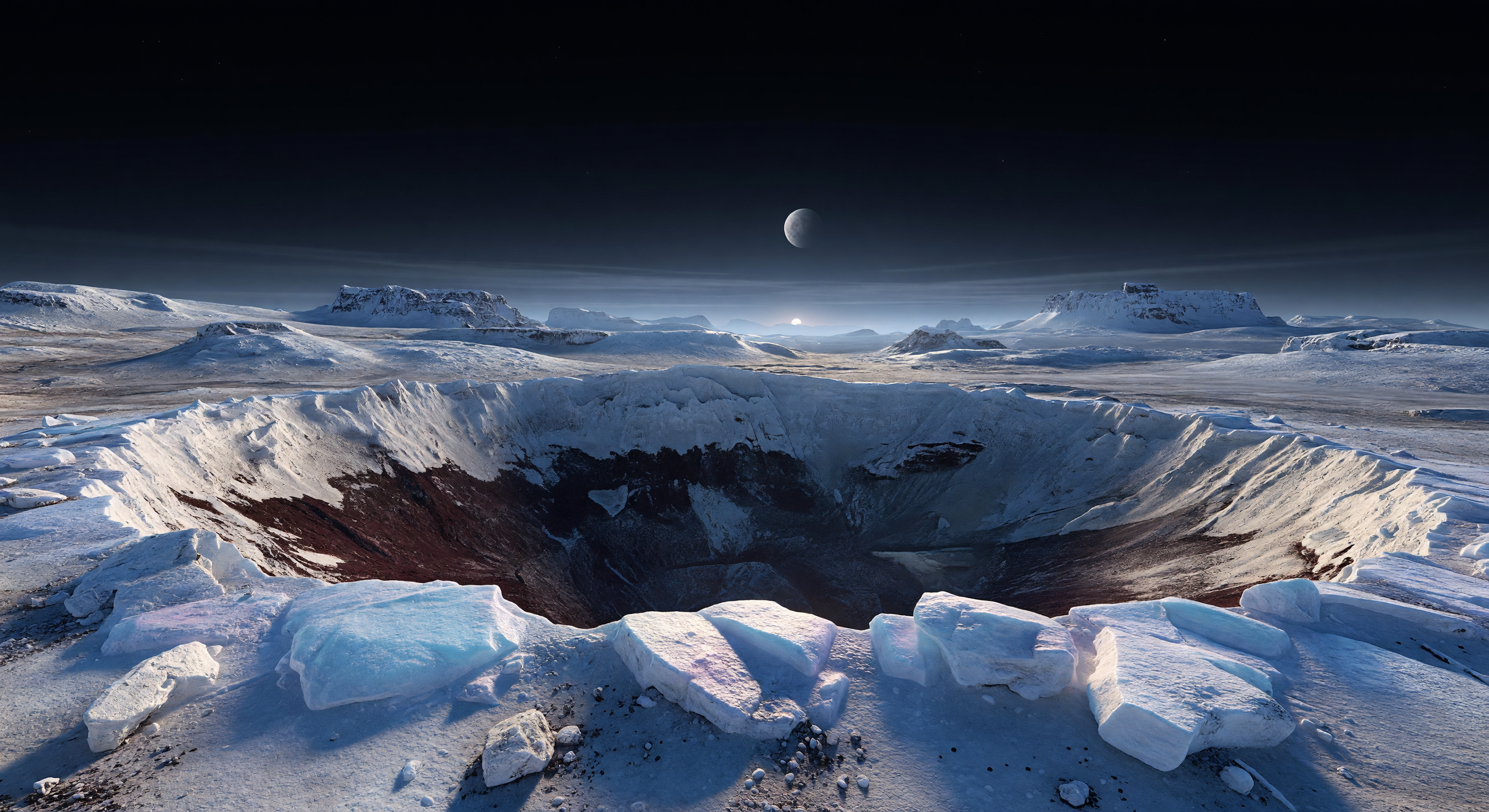
Aan de rand van een enorme inslagkrater glinstert een pantser van methaanrijp en stikstofijs in helder wit en ijl blauw, waar de laatste, zwakke stralen van de piepkleine zon onder een extreem lage hoek over scherp gebarsten waterijsrotsen strijken. Vlak voor je vallen de broze, met sublimatiekuiltjes getekende platen abrupt weg in een diepblauwe schaduw, waar donker roodbruine tot houtskoolkleurige tholinen zich ophopen op terrassen en langs instabiele hellingen — organische resten die zijn gevormd door straling en chemische reacties in een ijle stikstofatmosfeer. Aan de horizon liggen oude, zwaar bekraterde hooglanden en steile ijsbergen die door de geringe zwaartekracht onverwacht hoog oprijzen, terwijl boven hen een dunne, gelaagde nevel een koude blauwe schemering in de bijna zwarte hemel trekt. Hoog daarboven hangt Charon als een opvallend grote, grijswitte schijf, zodat het voelt alsof je staat op de rand van een bevroren afgrond in een stille, buitenaards heldere wereld waar ijs, organische stoffen en vacuüm samen het landschap vormen.
Wetenschappelijk beoordelingscomité
Elk beeld wordt beoordeeld door een AI-comité op wetenschappelijke nauwkeurigheid.
Claude
Afbeelding: Adjust
Beschrijving: Adjust
I largely concur with GPT's assessment but want to sharpen several points and add new observations. On scientific accuracy: the most glaring issue is Charon's appearance. In the image, the body in the sky is rendered as a thin crescent — essentially a 'moon phase' presentation consistent with Earth's Moon as seen from Earth. This is physically wrong for the Pluto-Charon system. Charon is tidally locked and orbits at roughly 19,600 km, subtending about 3.9 degrees as seen from Pluto — roughly 8x the angular diameter of our Moon from Earth. It should appear as a large, imposing disk, not a delicate crescent, and the caption correctly calls it 'a large, bright disk,' making this a direct image-caption contradiction and a scientific error. This alone nearly warrants 'regenerate,' but I am holding at 'adjust' because the rest of the scene has genuine merit. The sunlight directionality is plausible for Pluto's distance — diffuse, low-angle, and pale — though arguably still slightly too bright and warm-toned for a body receiving ~1/1000th of Earth's solar flux. The horizon haze band reads too optically thick; Pluto's atmosphere has a surface pressure of roughly 10 microbars, and while New Horizons confirmed beautiful multilayered photochemical haze, it would not produce the soft, luminous glow band visible here, which evokes Titan or early-morning Earth more than Pluto's limb haze as actually imaged. On tholin coloration: GPT correctly flags that the basin's darker material skews too gray-black rather than the characteristic reddish-brown seen in New Horizons imagery of Cthulhu Regio and similar tholin-rich terrains. The caption's claim of 'reddish-brown tholin deposits' is only weakly supported — the image shows what looks more like shadowed gray rock. The ice blocks in the foreground are visually compelling and the blue-white-lavender palette for frost-covered water-ice bedrock is broadly defensible, though the distinction between methane frost and nitrogen ice patches is not visually resolvable, as GPT noted. On visual quality: the rendering is technically accomplished — no obvious seam artifacts, coherent shadow directionality, and convincing parallax depth. The ice slab geometry in the foreground is the strongest element. Caption accuracy: the caption is well-written and scientifically informed in its prose, referencing sublimation, frost migration, tholin formation chemistry, and nitrogen haze correctly as concepts, but the image does not fully deliver on those specifics. Recommended adjustments in priority order: (1) Correct Charon to a large gibbous-to-full disk of appropriate angular size; (2) Warm and intensify the basin floor coloration toward reddish-brown to match tholin reality; (3) Reduce the atmospheric horizon glow to a subtler, more layered photochemical haze consistent with New Horizons observations; (4) Consider slightly reducing overall scene brightness to better reflect Pluto's actual illumination environment.
Grok
Afbeelding: Adjust
Beschrijving: Adjust
I concur with both GPT and Claude's assessments, with some refinements and additions. **Scientific accuracy (image: adjust)**: The foreground water-ice slabs with blue-white-cyan tonality are a strong match for Pluto's rugged icy terrains (e.g., Hitchhiker Mountains or Sputnik Planitia rims), and low-angle dusk lighting captures the pale, extended shadows seen in New Horizons images under ~1 km/s orbital velocity and 1/100 Earth insolation. Uplands and steep blocky mountains align with Pluto's low gravity (~.06g) enabling kilometer-scale cliffs. However, Charon is depicted as a small, thin crescent moon-like sliver near the horizon—gravely inaccurate, as Claude notes: at ~19,600 km separation, it subtends ~3.9° (8x Luna's .5° from Earth), demanding a large, dominant gibbous/full disk spanning 7-8x the image's apparent moon size, especially prominent at dusk. Tholin deposits in the crater basin show improved reddish-brown hues compared to prior gray-black critiques (visible as warm rusty tones on terraces/slopes), better evoking Cthulhu Regio's irradiated organics, but remain subdued vs. caption's 'reddish-brown' emphasis and lack clear 'terrace/lower-slope' sublimation patterns. Nitrogen/methane frost distinctions are still merged into generic blue-white ice without spectral specificity (methane absorbs red, yielding subtle blue; nitrogen is brighter pinkish in IR but near-neutral visible). Atmosphere haze is a thin blue band—progress from overly thick prior versions—but too uniform and luminous; Pluto's ~10 μbar N2 haze (New Horizons layers) is fainter, more discrete photochemical streaks, not a soft Earth-like gradient. Scale feels immense but lacks foreground-object cues (e.g., human-scale rover) for 'immense scale' emphasis. **Visual quality (image: approve leaning adjust)**: Photorealistic excellence—no artifacts, coherent parallax/shadows, high-res ice fracturing, and atmospheric depth. Minor nit: sky blackness is perfect, but starfield absent (Pluto skies show faint stars due to low albedo/atmosphere). **Caption accuracy (adjust)**: Prose is scientifically precise (tholin chemistry, frost migration, weak gravity), but image underdelivers on 'methane frost... pale cyan, faint lavender,' 'patches of nitrogen ice,' distinct 'tholin... along terraces,' and especially 'Charon as a large, bright disk'—direct mismatch. Broad scene aligns (crater rim, dusk, haze, Charon), so adjust caption to 'generalized frosts on water-ice' and 'large moon-like body (Charon)' or regenerate image. **Recommendations**: (1) Enlarge/phase-correct Charon to massive disk (priority); (2) Enhance tholin reds and add terrace striations; (3) Subtler, layered haze; (4) Infuse faint methane-cyan/lavender tints on select slabs; (5) Dim overall ~20% for truer flux. Strong potential—near approve with tweaks.
Gemini
Afbeelding: Regenerate
Beschrijving: Adjust
I agree with the previous committee members, but I am escalating the image vote to 'regenerate' due to the cumulative failure of key visual features to match the provided scientific description. The most critical failure is the depiction of Charon; presenting it as a thin crescent is a fundamental error in orbital mechanics for the Pluto-Charon system, where Charon should dominate the sky as a massive, near-static disk. Furthermore, the atmospheric haze remains visually reminiscent of an Earth-like scattering effect rather than the discrete, layered photochemical haze observed by New Horizons. While the foreground ice geometry is technically impressive, the failure to distinguish between nitrogen and methane frost compositions—and the lack of clearly defined tholin-rich terrace deposits—means the image fails to represent the specific geological features described in the caption. The caption itself is well-researched, but it should be adjusted to be slightly less specific about 'pale cyan and faint lavender' frost hues unless the rendering engine can explicitly map those spectral signatures to the ice patches.
Matania — Synthese
Afbeelding: Adjust
Beschrijving: Adjust
The committee found the scene broadly plausible as an icy Pluto crater-rim landscape at dusk, with strong photorealistic execution, coherent lighting, and convincing terrain structure. However, several scientific details are not well matched to the caption: Charon is depicted too small and crescent-like instead of a large dominant disk, the atmospheric haze is too Earth-like and prominent for Pluto, and the surface materials do not clearly distinguish methane frost, nitrogen ice, and reddish-brown tholin-rich deposits. The image is therefore close but scientifically under-specified, and the caption overstates features that the rendering does not clearly show.
Visual quality: The image is high-resolution, aesthetically realistic, and largely free of obvious rendering artifacts. Lighting and shadows are coherent, and the horizon/atmospheric perspective is convincing. The main visual concern is scientific interpretation: the color palette and material differentiation do not strongly match the caption’s specific methane vs. nitrogen vs. tholin claims, suggesting compositional overstatement rather than a technical flaw.
Caption accuracy: The description matches the broad concept (icy Pluto crater rim at dusk with Charon in the sky and a faint hazy atmosphere), but several specifics are not directly evidenced by the image—especially methane frost vs nitrogen ice distinctions and clearly reddish-brown tholin at terraces/lower slopes. Therefore the caption should be revised to reflect what is actually visible (dominantly water-ice-bright surfaces and darker organics/basin material, with generalized haze and Charon) or the image should be regenerated with stronger, more discriminable compositional/color cues for methane/nitrogen/tholin and a more physically Pluto-like haze intensity.