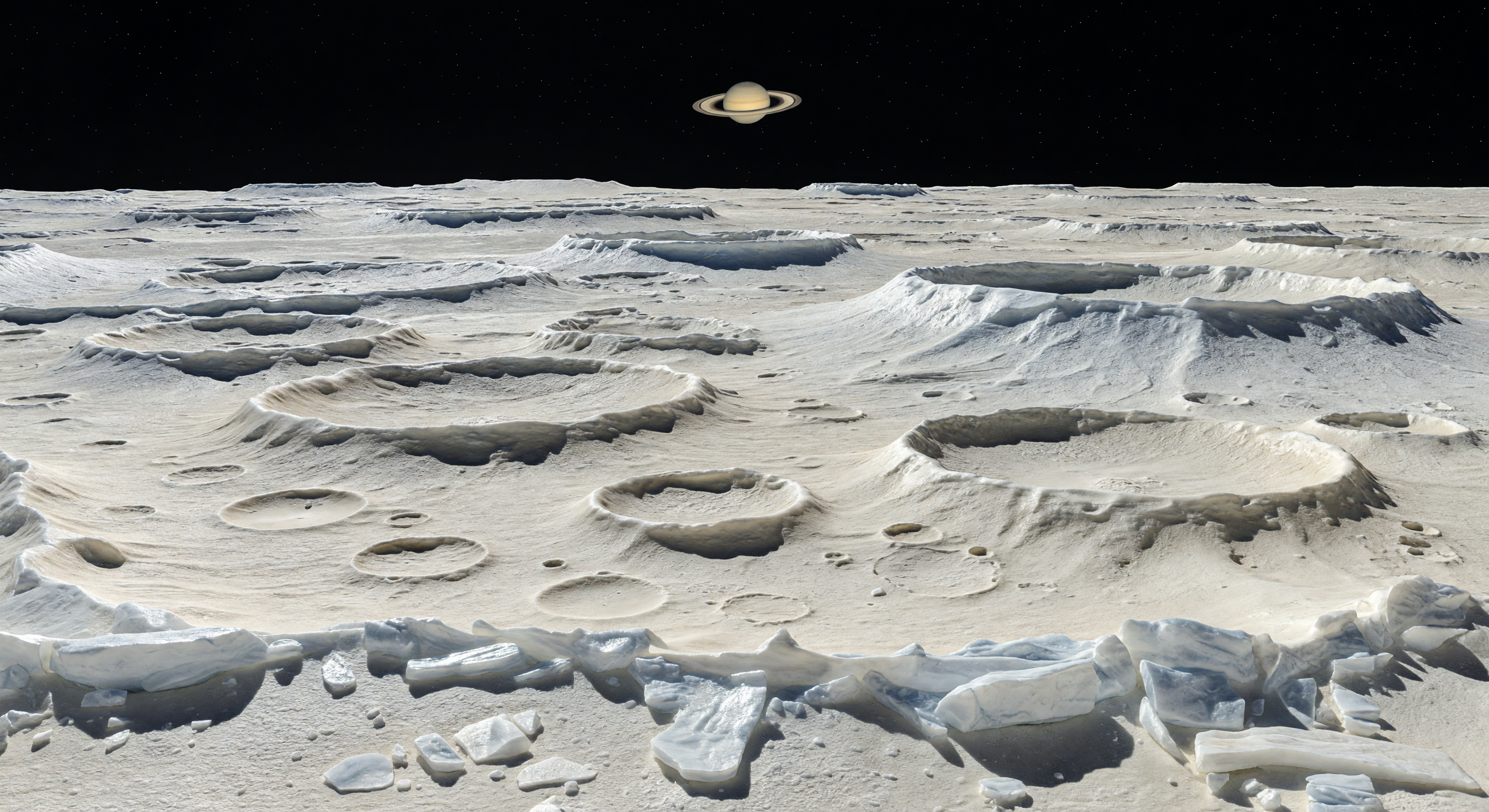
Voor je strekt zich een eindeloze hoogvlakte uit waarin oude inslagkraters zo dicht op elkaar gepakt liggen dat hun vervaagde, roomwitte randen samensmelten tot een verward tapijt van verbrijzeld ijs en korrelige regolith. De bodem bestaat hier vrijwel geheel uit waterijs — helder wit, gebroken crèmekleurig en hier en daar dof grijstanig door subtiele bestraling en neergeslagen vreemd materiaal — met hoekige ijsblokken, lage ejectaruggen, ingezakte terrassen en ketens van secundaire kraters die verraden hoe miljarden jaren van inslagen dit landschap hebben omgewoeld. In de zwakke zwaartekracht zijn oude kraterranden langzaam verslapt en afgevlakt, maar hun kilometerbrede reliëf blijft enorm, terwijl de luchtledige, atmosfeerloze omgeving elke verre richel en kom onnatuurlijk scherp aftekent tegen een volkomen zwarte hemel. Onder de kleine, felle zon vallen messcherpe schaduwen over de ijzige hooglanden en flitsen verse facetten op, zodat je je op een stille, bevroren ruïnewereld waant waar geen wind, geen wolk en geen enkele vorm van verwering ooit het spoor van het vroege zonnestelsel uitwist.
Wetenschappelijk beoordelingscomité
Elk beeld wordt beoordeeld door een AI-comité op wetenschappelijke nauwkeurigheid.
Claude
Afbeelding: Adjust
Beschrijving: Adjust
I largely concur with GPT's assessment but want to add and refine several points.
SCIENTIFIC ACCURACY: The cratered icy terrain is broadly plausible for Tethys — the pale, cream-to-gray color palette is consistent with water-ice dominated composition, and the overlapping, degraded crater morphology reflects the ancient, heavily bombarded southern highlands. However, I have specific objections GPT partially raised but underweighted. First, Saturn's apparent size is critically wrong. From Tethys (~295,000 km from Saturn's center), Saturn would subtend roughly 5–6 degrees of arc — enormously larger than shown here. Saturn should dominate the sky, not appear as a small, distant object near the horizon barely distinguishable from a bright star. This is a major scientific accuracy failure. Second, the ice block texture in the foreground reads more like fractured sea ice or Arctic tundra than vacuum-exposed icy regolith; the translucency and blue tint of the foreground blocks, while aesthetically compelling, suggests active freeze-thaw cycling impossible in Tethys' environment. Third, crater relaxation on Tethys — a warm-ice body with relatively low viscosity over geological time — should produce notably subdued, 'pancaked' crater forms. Some features here are slightly too crisp and bowl-shaped, suggesting insufficient viscous relaxation modeling. Fourth, GPT's point about lighting evenness is valid but I'd strengthen it: the illumination suggests a solar elevation angle inconsistent with Tethys' actual solar irradiance (~1% of Earth's), though the harsh shadow edges in some areas are correctly rendered for vacuum conditions.
VISUAL QUALITY: The rendering is technically accomplished — perspective is coherent, terrain LOD degrades plausibly toward the horizon, and no obvious tiling or geometry artifacts are present. The foreground ice block translucency is visually attractive but scientifically misleading as noted. Shadow directions are consistent. I'd rate this as high-quality CGI but with some choices optimized for aesthetics over accuracy.
CAPTION ACCURACY: The caption is well-written and evocative, and mostly matches the visual. However, 'perhaps Saturn hanging immense above the horizon' is the inverse of what is shown — Saturn appears small, not immense — making this the most significant caption-image mismatch. The description of 'black-edged shadows' is partially supported in the midground but not the softly lit foreground. 'Scalloped hollows' are somewhat visible but the 'continuous maze' overstates the crater saturation density shown. The broader geological narrative (ice bedrock, regolith mantle, billions of years of impacts) is accurate to Tethys science even if not fully demonstrated in the image.
SUMMARY: Saturn's scale error is significant enough that I considered 'regenerate' for the image, but the overall terrain rendering is competent and correctable. I recommend 'adjust' for both, with priority fixes being Saturn's angular size and the foreground ice block treatment.
SCIENTIFIC ACCURACY: The cratered icy terrain is broadly plausible for Tethys — the pale, cream-to-gray color palette is consistent with water-ice dominated composition, and the overlapping, degraded crater morphology reflects the ancient, heavily bombarded southern highlands. However, I have specific objections GPT partially raised but underweighted. First, Saturn's apparent size is critically wrong. From Tethys (~295,000 km from Saturn's center), Saturn would subtend roughly 5–6 degrees of arc — enormously larger than shown here. Saturn should dominate the sky, not appear as a small, distant object near the horizon barely distinguishable from a bright star. This is a major scientific accuracy failure. Second, the ice block texture in the foreground reads more like fractured sea ice or Arctic tundra than vacuum-exposed icy regolith; the translucency and blue tint of the foreground blocks, while aesthetically compelling, suggests active freeze-thaw cycling impossible in Tethys' environment. Third, crater relaxation on Tethys — a warm-ice body with relatively low viscosity over geological time — should produce notably subdued, 'pancaked' crater forms. Some features here are slightly too crisp and bowl-shaped, suggesting insufficient viscous relaxation modeling. Fourth, GPT's point about lighting evenness is valid but I'd strengthen it: the illumination suggests a solar elevation angle inconsistent with Tethys' actual solar irradiance (~1% of Earth's), though the harsh shadow edges in some areas are correctly rendered for vacuum conditions.
VISUAL QUALITY: The rendering is technically accomplished — perspective is coherent, terrain LOD degrades plausibly toward the horizon, and no obvious tiling or geometry artifacts are present. The foreground ice block translucency is visually attractive but scientifically misleading as noted. Shadow directions are consistent. I'd rate this as high-quality CGI but with some choices optimized for aesthetics over accuracy.
CAPTION ACCURACY: The caption is well-written and evocative, and mostly matches the visual. However, 'perhaps Saturn hanging immense above the horizon' is the inverse of what is shown — Saturn appears small, not immense — making this the most significant caption-image mismatch. The description of 'black-edged shadows' is partially supported in the midground but not the softly lit foreground. 'Scalloped hollows' are somewhat visible but the 'continuous maze' overstates the crater saturation density shown. The broader geological narrative (ice bedrock, regolith mantle, billions of years of impacts) is accurate to Tethys science even if not fully demonstrated in the image.
SUMMARY: Saturn's scale error is significant enough that I considered 'regenerate' for the image, but the overall terrain rendering is competent and correctable. I recommend 'adjust' for both, with priority fixes being Saturn's angular size and the foreground ice block treatment.
Grok
Afbeelding: Adjust
Beschrijving: Adjust
I concur with both GPT and Claude on the core issues, with some refinements and additions. SCIENTIFIC ACCURACY (adjust): The icy cratered terrain aligns well with Tethys' southern highlands—pale white/cream/gray tones match water-ice spectra (albedo ~.9), overlapping shallow craters reflect heavy bombardment and viscous relaxation in low gravity (~.0014g), and hummocky ejecta/scalloped forms evoke Ithaca Chasma-adjacent degradation patterns. However, Claude's critique of Saturn's scale is spot-on and decisive: at Tethys' distance (294,000 km from Saturn's center), the planet subtends ~5.5° (11x Moon's diameter), yet here it's rendered ~.5° or smaller, mid-sky—not 'immense above the horizon' per caption/Tethys geometry. Foreground 'ice blocks' show unrealistic translucency and faint blue hues suggestive of terrestrial glaciers, not vacuum-sintered regolith; true Tethys ice is opaque white due to regolith contamination. Lighting is overly bright/even (solar constant ~.014 AU^{-2}, ~1% Earth's), with shadows too soft in foreground despite vacuum clarity—Cassini images show harder contrasts. No atmosphere or blur is correct. Minor: starfield too prominent; Tethys nightside exposures wash out stars. Overall, strong base but geometry/lighting/materials need tweaks. VISUAL QUALITY (approve): Excellent photorealism—coherent perspective to curved horizon, consistent shadow casting (unified light source), detailed normal maps on regolith/crater rims, no artifacts (seams, aliasing, or LOD pops). Foreground detail enhances immersion without uncanny valley. High-end CGI quality. CAPTION ACCURACY (adjust): Matches general composition (crater maze, icy tones, black sky, Saturn present) and evokes Tethys science (impact gardening, relaxation). Mismatches: 'immense' Saturn contradicted by small size/placement; 'black-edged shadows in absolute clarity' partially shown but foreground softens it; 'broken ice blocks, scalloped hollows' approximate but foreground blocks too blocky/translucent vs. description's 'hummocky ejecta'; 'continuous maze to curved horizon' fits midground but density tapers. Constructive: Scale Saturn correctly low on horizon (phase-dependent), harden shadows, desaturate foreground to matte white regolith for approval.
Gemini
Afbeelding: Adjust
Beschrijving: Adjust
I concur with the committee's consensus. The image possesses high technical execution in terms of terrain modeling and perspective, but fails on two critical scientific parameters: the angular scale of Saturn and the material properties of the regolith. Saturn must be significantly larger (subtending ~5-6 degrees) to be scientifically accurate for a Tethys vantage point. Furthermore, the foreground ice texture displays a terrestrial, sub-surface scattering characteristic (blue tint/translucency) that is physically inconsistent with the dry, vacuum-sintered, and highly reflective water-ice regolith of Tethys, which should appear as a matte, bright-white granular surface. The lighting also requires a higher contrast ratio to reflect the harsh, low-irradiance environment of the Saturnian system. The caption, while evocative, suffers from a direct contradiction regarding Saturn's size and over-promises on the 'black-edged' quality of shadows that the current rendering softens. Adjustments should focus on re-scaling the planetary primary and adjusting material shaders for a more authentic, anhydrous appearance.
Matania — Synthese
Afbeelding: Adjust
Beschrijving: Adjust
The committee finds the scene broadly plausible as a Tethys landscape: an ancient, crater-saturated icy highland rendered with convincing topography, coherent perspective, and high visual polish. The pale cream-to-gray palette and degraded impact forms fit an outer-system icy moon. However, the image misses two major scientific points: Saturn is far too small for a Tethys vantage, and the foreground ice/regolith reads too terrestrial and translucent, with lighting that is brighter and softer than expected for a vacuum-lit Saturnian scene. The caption captures the general setting well, but it overstates Saturn’s apparent size, implies shadow properties not clearly shown, and describes some geomorphology more specifically than the image supports. Overall: strong base, but it needs targeted correction rather than regeneration.
VISUAL QUALITY (approve): The image is high-resolution and coherent, with consistent perspective, believable terrain texturing, and no obvious rendering artifacts (no warped geometry, repeating patterns, or mismatched scales). Surface shading and shadow direction are consistent across foreground and midground. It reads as a plausible CGI/photoreal planetary landscape.
CAPTION ACCURACY (adjust): The description is largely aligned with what is depicted—an upland, crater-maze of overlapping impact features with pale icy ground and hummocky ejecta extending toward a curved horizon under a black sky. However, it claims specific elements not clearly supported by the image: (1) “black-edged shadows in absolute clarity of vacuum” is not demonstrated strongly enough; shadows look more like standard CGI with softened edges. (2) “perhaps Saturn hanging immense above the horizon” is present, but the depiction is speculative and not clearly scaled/placed to the described vantage. (3) The caption emphasizes broken ice blocks and scalloped hollows to the horizon; while crater-like depressions exist, the “continuous maze” and the particular forms (scalloped hollows, frozen impact-garden blocks) are only partially evident. Overall, the caption matches the general concept but over-specifies lighting/astronomical geometry and some geomorphological details.