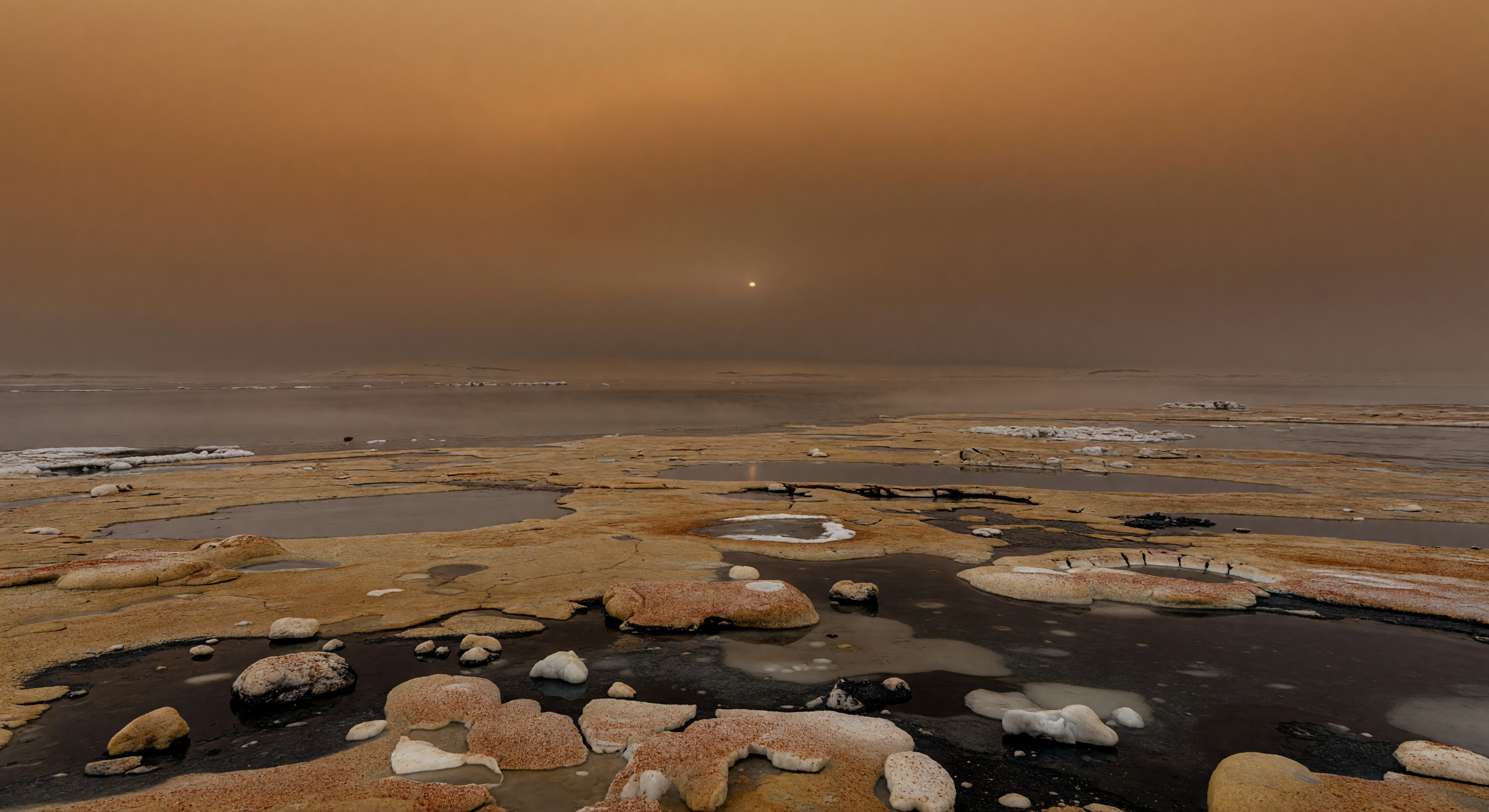
Hier sta je in een lage, bijna vlakke poolbekkenwereld waar harde keien en gebarsten platen van waterijs, bestoven met roestbruine organische neerslag, overgaan in ondiepe, bijna zwarte plasjes en meerrestjes van vloeibaar methaan en ethaan. Onder de dichte stikstofatmosfeer hangt een vrijwel gesloten winterkap van methaanwolken en fotochemische nevel, waardoor het oranjebruine hemelgewelf nog donkerder wordt en het zwakke daglicht zo sterk verstrooid raakt dat schaduwen vrijwel verdwijnen. De uitgestrekte vlakte toont subtiele polygonale scheuren, lage bulten, vage geultjes en oude ingezakte structuren, tekenen van een landschap waarin ijs zich als gesteente gedraagt en waarin neerslag, verdamping, afzetting en erosie door koolwaterstoffen het reliëf langzaam herschrijven. Aan de verre rand lost de horizon op in bruine mist, zodat schaal en afstand moeilijk te peilen zijn en de stille, koude duisternis aanvoelt alsof je op de bodem van een buitenaardse, bevroren zee van lucht en organische chemie staat.
Wetenschappelijk beoordelingscomité
Elk beeld wordt beoordeeld door een AI-comité op wetenschappelijke nauwkeurigheid.
Claude
Afbeelding: Adjust
Beschrijving: Adjust
I largely concur with GPT's assessment but want to add and refine several points. SCIENTIFIC ACCURACY: The dominant orange-brown photochemical haze is well-rendered and consistent with Cassini VIMS and ISS data on Titan's atmospheric opacity. The diffuse, nearly shadowless lighting is a genuine strength — this is one of the harder atmospheric effects to render convincingly and it mostly succeeds. The visible 'sun' as a small dim point rather than a fully diffuse glow is the most scientifically significant error: at Titan's poles under a winter hood, the solar disk would be utterly indistinguishable from the surrounding haze, not a discrete bright point. The liquid pools are tonally plausible (very dark, near-black) which is accurate for liquid hydrocarbons under haze-filtered light, but their margins show slightly too much specular reflectivity — Cassini RADAR data suggests Titan's hydrocarbon lakes have extremely smooth, low-reflectance surfaces. The white/frost-bright icy material on cobbles and plates is a notable concern: under Titan's haze, high-albedo water-ice surfaces would appear more muted amber than bright white, because the atmosphere filters and tints all incoming light heavily. These bright whites read as terrestrial frost or snow, not organic-dusted cryogenic substrate. The 'rusty organic fallout' coloration on rounded forms is actually one of the image's strongest features — that reddish-brown dusting on ice boulders is consistent with tholins settling from the atmosphere. VISUAL QUALITY: The image is technically accomplished with no obvious generation artifacts, good depth recession, and convincing terrain continuity. The haze gradient from ground to sky is smooth and naturalistic. My disagreement with GPT is minor here: I think the horizon dissolution is actually reasonably well-handled in the mid-ground, though the far background does become slightly too clear and structured rather than fully absorbed into murk. The scale reads as ambiguous — the cobbles and plates could be anywhere from 10cm to 10m, which is not necessarily a flaw but limits scientific grounding. CAPTION ACCURACY: The description is evocative and mostly consistent with the image's mood, but as GPT notes, it overclaims on specific features. 'Polygonal cracks' and 'shallow channels' are not clearly visible. More importantly, the caption states the Sun is reduced to 'little more than a weak diffuse glow' but the image shows a distinct bright point — this is a direct contradiction between text and image that needs resolution either by adjusting the image or softening the caption language. The 'horizonless brown' claim also doesn't fully hold: there is a discernible horizon with some structure. I would recommend adjusting the image to eliminate the discrete solar point (replace with broad diffuse brightening), muting the white-bright ice surfaces toward amber-tan, and slightly increasing far-field haze to better match the caption's 'dissolve into murky brown' claim. Caption should be adjusted to remove or soften the polygonal crack and channel references unless those features are made more explicit in a regenerated image.
Grok
Afbeelding: Adjust
Beschrijving: Adjust
I concur with both GPT and Claude on the core issues, with some refinements and additions. SCIENTIFIC ACCURACY: The orange-brown photochemical haze and diffuse, low-contrast lighting are spot-on for Titan's tholin-laden atmosphere (consistent with Cassini ISS and VIMS spectra, where haze scatters ~99% of UV/blue light, tinting everything amber). Dark, near-black hydrocarbon pools with muted margins align well with RADAR and near-IR observations of Ontario Lacus-style lakes, showing low specular reflectance due to surface tension and hydrocarbon viscosity. Rusty organic dusting on icy cobbles is excellent—matches DISR Huygens data on tholin precipitates. However, the discrete pale sunspot (☉-like glow) is a clear inaccuracy for polar winter: Titan's ~7 AU distance + dense haze (optical depth τ~5-10 at poles) renders the solar disk indistinguishable, per Polder model simulations—should be uniform diffuse glow only. Bright white ice patches (e.g., on fractured plates and cobbles) are too albedo-high; under haze, H2O-ice (albedo ~.4-.6 clean) appears desaturated tan/amber due to red-end light dominance, not stark white like fresh terrestrial snow. Polygonal cracks and channels are faintly hinted but too subdued for Titan's thermal contraction polygons (seen in RADAR at ~10-100m scales). Scale feels meter-scale cobbles, plausible but ambiguous. Overall, minor-to-moderate issues prevent full approval. VISUAL QUALITY: Photorealistic excellence—no artifacts, seamless textures, convincing depth via haze gradient, natural shadowlessness. Minor nit: far horizon retains too much structure (visible plate edges), not fully 'dissolving into murk'; sunspot is crisp-edged, breaking immersion. CAPTION ACCURACY: Strong mood match (twilight sea-world, hazy diffusion), but mismatches image on sun as 'weak diffuse glow' (image shows point source), absent/prominent polygons/channels/rims, and incomplete 'horizonless brown' (discernible relief persists). 'Heavy winter hood of methane cloud' implies stratiform clouds (per VIMS polar vortex data), but image shows uniform haze, no layered clouds. Adjust caption to reflect visible elements (e.g., 'faint polygonal hints' vs. assertive claims) or image to match (diffuse sun, muted whites, enhanced cracks/haze). No need to regenerate—targeted tweaks suffice for approval.
Gemini
Afbeelding: Adjust
Beschrijving: Adjust
I concur with the committee's consensus. The primary scientific failure is the presence of a discrete solar disk; at Titan's poles, the high optical depth of the atmospheric haze effectively acts as a diffuser, rendering the Sun as a uniform brightening rather than a visible light source. The 'bright white' ice is also a significant distraction; in the amber-dominant spectrum of Titan's surface, water ice should appear as muted ochre or tan, not stark white. Visually, the image is high-quality, but the lack of true 'horizon dissolution' prevents it from achieving the claustrophobic, alien atmosphere described in the caption. The caption itself is overly ambitious, claiming features like polygonal cracks and distinct channels that are either absent or too ambiguous to be identified as such. I recommend an adjustment to both: the image requires a softening of the light source and a color-grading shift toward the amber spectrum, while the caption should be revised to describe the 'subtle, suggestive textures' rather than definitive geological structures.
Matania — Synthese
Afbeelding: Adjust
Beschrijving: Adjust
The committee finds the image broadly Titan-like and scientifically promising, with strong photochemical haze, diffuse low-contrast lighting, dark hydrocarbon-like pools, and credible tholin-stained terrain. However, it falls short in a few key Titan polar winter details: the Sun appears as a discrete bright point instead of being fully diffused by the haze, the bright white ice patches read too terrestrial and high-albedo, and the far background retains slightly too much structure for the desired murky cloud-hood atmosphere. The caption matches the general mood but overstates several visible details, especially polygonal cracking, distinct channels/rims, and the degree of horizon dissolution. Overall, the image and caption are close in spirit but need targeted refinement rather than regeneration.
Visual quality: The image is high-resolution and visually coherent, with good terrain continuity and plausible atmospheric haze perspective. No obvious generation artifacts, warped geometry, or texturing errors are visible. Minor issues include the too-clear distant horizon/terrain dissolution and the presence of a small, crisp bright light source that undermines the “Sun erased to a weak diffuse glow” aspect.
Caption accuracy: The description matches the general mood (polar winter-like dim haze, low basin, dark liquid pools, icy fragments), but it overcommits to details that aren’t clearly evident: polygonal cracking, subtle rims/channels, and the near-horizonless murk are not strongly portrayed. The “heavy methane cloud hood” is also not distinctly shown as layered methane clouds over the ground; instead, it’s mostly a smooth haze with a clearer sky. Overall, the caption is close in spirit but needs adjustment to better match what is actually visible.