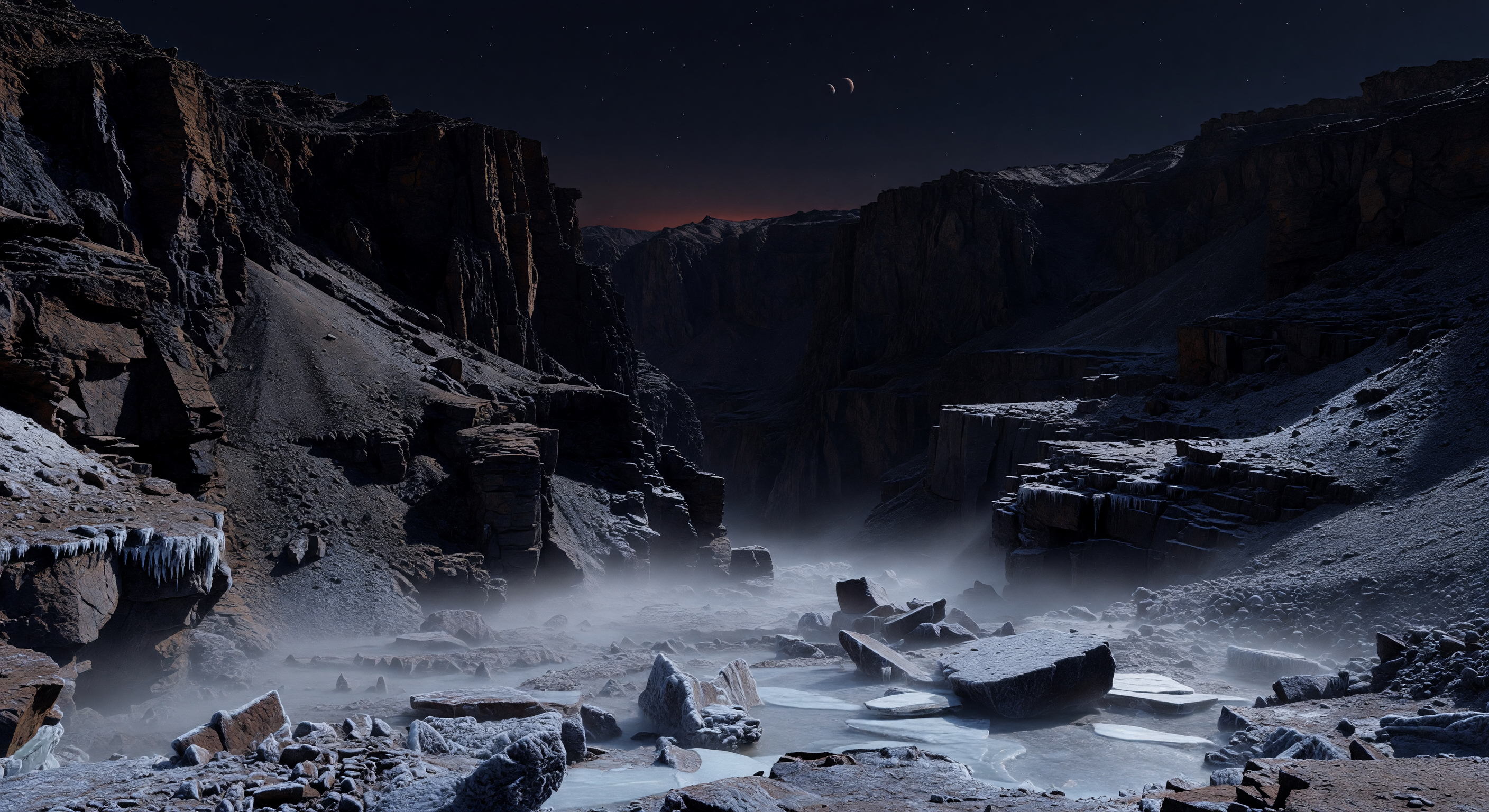
Je staat op de bodem van een immense kloof waar bijna zwarte basaltische en ultramafische silicaatwanden in gebroken richels, kolomvormige scheuren en oude aardverschuivingslittekens omhoog verdwijnen in de duisternis, terwijl onderaan een zee van dicht, wit vriesmist tussen puinvelden en rijpbedekte blokken ligt opgesloten. Het zwakke licht is natuurkundig spaarzaam: geen directe straling bereikt deze permanente nachtzijde, alleen een verre rood-oranje schemer boven de rand en een koude blauw-witte weerkaatsing van ijs, rijp en mist, waardoor elke steenrand glinstert en elke spleet zwart blijft. De canyonbodem toont broze korsten van rijp, doorschijnende platen grondijs en met vorst verkit puin, tekenen van een extreem koude omgeving waar water of vluchtige stoffen als ijs neerslaan en als cryomist in laagten kunnen samenstromen. Onder een bijna zwartblauwe hemel met enkele scherpe sterren voelt de schaal monumentaal en vreemd vertrouwd tegelijk: een bewoonbare-zone wereld rond een rustige rode dwerg, maar hier in eeuwige nacht teruggebracht tot stilte, steen en bevroren damp.
Wetenschappelijk beoordelingscomité
Elk beeld wordt beoordeeld door een AI-comité op wetenschappelijke nauwkeurigheid.
Claude
Afbeelding: Adjust
Beschrijving: Adjust
I largely concur with GPT's assessment but want to add precision and some pushback on certain points. SCIENTIFIC ACCURACY: The basaltic/ultramafic canyon morphology is genuinely well-executed — the columnar jointing, fractured ledge stacking, and talus slopes are consistent with mafic volcanic terrain undergoing freeze-thaw or impact-driven mechanical weathering. The frost accumulation on lower-lying rocks and the pooling of fog in the canyon floor are physically coherent with cold-trap dynamics on a tidally locked world where shadowed lowlands act as thermal sinks. These are genuine strengths. However, GPT is correct that the two celestial objects in the upper sky are problematic. They read as a crescent moon and a smaller companion body — neither is scientifically justified for TOI-700 d without explicit data supporting a large satellite system. More critically, they contribute ambient light that contradicts the 'almost black sky' premise. On the permanent night side of a tidally locked planet orbiting a dim M-dwarf at ~0.163 AU, scattered starlight would be negligible; the sky should be far darker and more featureless than shown. The reddish terminator gradient near the horizon is present but subtle — arguably undersold relative to the caption's description, though its softness is actually more physically realistic than a sharp glow would be. The fog's character is my additional concern beyond GPT's note: cryofog on such a world would likely be nitrogen or CO2 condensate rather than water ice, and its scattering properties could differ meaningfully from the rendered volumetric water-mist appearance. The bright white luminosity of the fog reads as slightly too warm and optically thick for an extremely cold, low-energy environment. VISUAL QUALITY: Photorealism is high. Rock textures are detailed and geologically coherent. Ice plate rendering on foreground rocks is convincing. No obvious geometric artifacts or structural impossibilities. The primary visual concern echoes GPT's: the fog has a cinematic polish that prioritizes legibility over physical plausibility — it's beautiful but slightly studio-lit rather than governed by faint thermal emission and weak atmospheric scattering as described. The overall scene lighting is too generous for a permanent night environment; surfaces are readable in ways that imply more ambient illumination than the scenario supports. CAPTION ACCURACY: The caption is descriptively rich and mostly honest about the speculative nature of the visualization. It accurately calls out frost, ice plates, cryofog pooling, dark cliffs, and the terminator smear. Where it misaligns with the image: it claims the terminator is the 'only hint' of stellar energy, but the image shows two distinct sky objects providing additional light. The caption's language about 'ghostly white only through faint atmospheric scattering and weak thermal reflection' sets a dimmer, more austere expectation than the rendered fog delivers. RECOMMENDATIONS: Remove or replace the crescent moon and companion object with a correctly rendered starfield appropriate to TOI-700's sky position. Darken overall scene illumination meaningfully to match permanent night-side conditions. Consider shifting fog coloration slightly toward blue-gray to suggest non-water condensate chemistry. The terminator glow could be modestly intensified to better match the caption's description since it is currently too subtle to read clearly. These are all adjustments rather than fundamental reconceptions — the core scene concept is sound and worth preserving.
Grok
Afbeelding: Adjust
Beschrijving: Adjust
I concur with both GPT and Claude on the core issues, adding some refinements based on the visible image. SCIENTIFIC ACCURACY: approve with caveats—the geological features are exemplary: fractured basaltic/ultramafic cliffs with columnar jointing, ledge scarring, landslide talus, and frost-rimed rubble convincingly evoke slow cryogenic weathering on a tidally locked rocky world like TOI-700 d (~1.1 Earth radii, potentially habitable zone but with extreme night-side cold traps). Cryofog pooling in the valley floor aligns with atmospheric transport of volatiles (likely N2/CO2 over H2O) into shadowed basins, and the subtle reddish terminator horizon glow aptly hints at the M2V dwarf's distant limb without direct illumination. However, the two prominent sky objects (crescent moon-like body and smaller orb) are unjustified—no data supports large moons for TOI-700 d, and they introduce unphysical scattered light, undermining the 'almost black sky' and 'stars sharp' premise amid negligible stellar flux (~.008% Earth's). Fog scattering is well-stratified but appears optically thick/white like water mist rather than dimmer blue-gray cryogenic particulates. Overall consistent with informed speculation, but celestial additions detract. VISUAL QUALITY: High photorealism—sharp rock/ice textures, coherent depth/scale (colossal canyon feels vast), no artifacts like warping or glow anomalies. Fog volumetric rendering is polished yet slightly cinematic (overly luminous foreground pooling implies stronger thermal emission than faint scattering supports). Lighting is moody but too ambiently lit by sky objects for true permanent night. CAPTION ACCURACY: Mostly accurate—captures canyon scale, frost/ice plates on rubble, dense low-lying cryofog glow, dark cliffs, and terminator 'smear.' Misaligns on sky: caption claims terminator as 'only hint' of star, but image's moon/planet orbs provide dominant light sources; fog 'ghostly white' matches visually but caption's 'faint' physics undersells the rendered brightness. RECOMMENDATIONS: Regenerate sky to remove moons, deepen to starfield-only blackness with sharper pinpoint stars; subtly blue-shift fog for non-aqueous cryogenics; preserve all geology/fog pooling as-is. These tweaks elevate an already strong concept without major overhaul.
Gemini
Afbeelding: Adjust
Beschrijving: Adjust
I concur with the committee's assessment regarding the celestial bodies. The inclusion of crescent moons introduces an unphysical light source that directly contradicts the 'permanent night' and 'almost black sky' constraints essential to the TOI-700 d model. Geologically, the image is excellent; the basaltic weathering and talus distribution are highly credible for an M-dwarf-orbiting world. However, the 'cinematic' lighting of the fog suggests a photostudio environment rather than the low-energy, high-contrast environment expected on a tidally locked night side. To reach approval, the sky must be purged of non-existent satellites and the fog's albedo needs to be reduced to reflect the scarcity of available light, shifting the color palette from warm white to a cooler, more alien blue-gray. The caption is well-written but must be updated if the celestial objects are removed, or it must explicitly acknowledge their presence if they are intended as speculative (though I recommend their removal for scientific consistency).
Matania — Synthese
Afbeelding: Adjust
Beschrijving: Adjust
The committee finds the landscape concept scientifically strong overall: the canyon geology is highly convincing, with basaltic-looking cliffs, fractured ledges, talus slopes, and frost-rimed rubble that plausibly evoke cryogenic weathering on TOI-700 d. The pooling fog in the canyon floor is also directionally correct for a cold-trap environment on a tidally locked world. However, the image’s sky contains crescent-moon-like bodies that are not justified by the prompt and introduce unrealistic ambient light, weakening the intended permanent-night, almost-black-sky setting. The fog is also rendered a bit too cinematically bright and Earthlike in appearance, reading more like generic mist than physically constrained cryofog. The caption is broadly aligned with the scene’s geology and low-lying fog, but it overstates the idea that the horizon smear is the only sky illumination, since the image shows additional celestial light sources; it also should better match the rendered fog’s appearance or the image should be changed to match the caption more closely.
VISUAL QUALITY: The image is high quality and convincing—crisp detail in rock textures, believable ice/frost highlights on protruding blocks, and strong depth cues. I do not see obvious AI artifacts (warped structures, impossible anatomy, or geometry discontinuities). The main visual concern is that the atmospheric fog has a slightly stylized/cinematic look—especially the lower-foreground “white” fog mass—rather than clearly governed by physically consistent scattering/thermal contrast. Also, the presence of a distinct crescent moon in a “planetary night-side” setting is an unrealistic specificity unless intentionally justified.
CAPTION ACCURACY: The caption’s core concepts (colossal canyon, permanent night, dark cliffs, frost/ice plates, dense freezing fog pooling in the valley, distant red terminator hint) are broadly consistent with what’s shown. But it over-specifies items that are not clearly supported: the caption emphasizes a “dim reddish smear” as the only hint of the star—whereas the image shows a noticeable crescent moon and a stronger, more Earthlike nocturnal sky illumination gradient. The “ghostly white” glow is present, yet the distribution and appearance of the fog read more like general mist than specifically cryofog confined by shadowed lowland processes.
Overall: Keep the general canyon + cryofog concept, but remove or justify the crescent moon/sky lighting and make the terminator/starlight contribution match the ‘almost black sky’ description more closely; also improve the fog’s stratification and scattering character to better convey “freezing fog pooling” rather than generic volumetric mist.