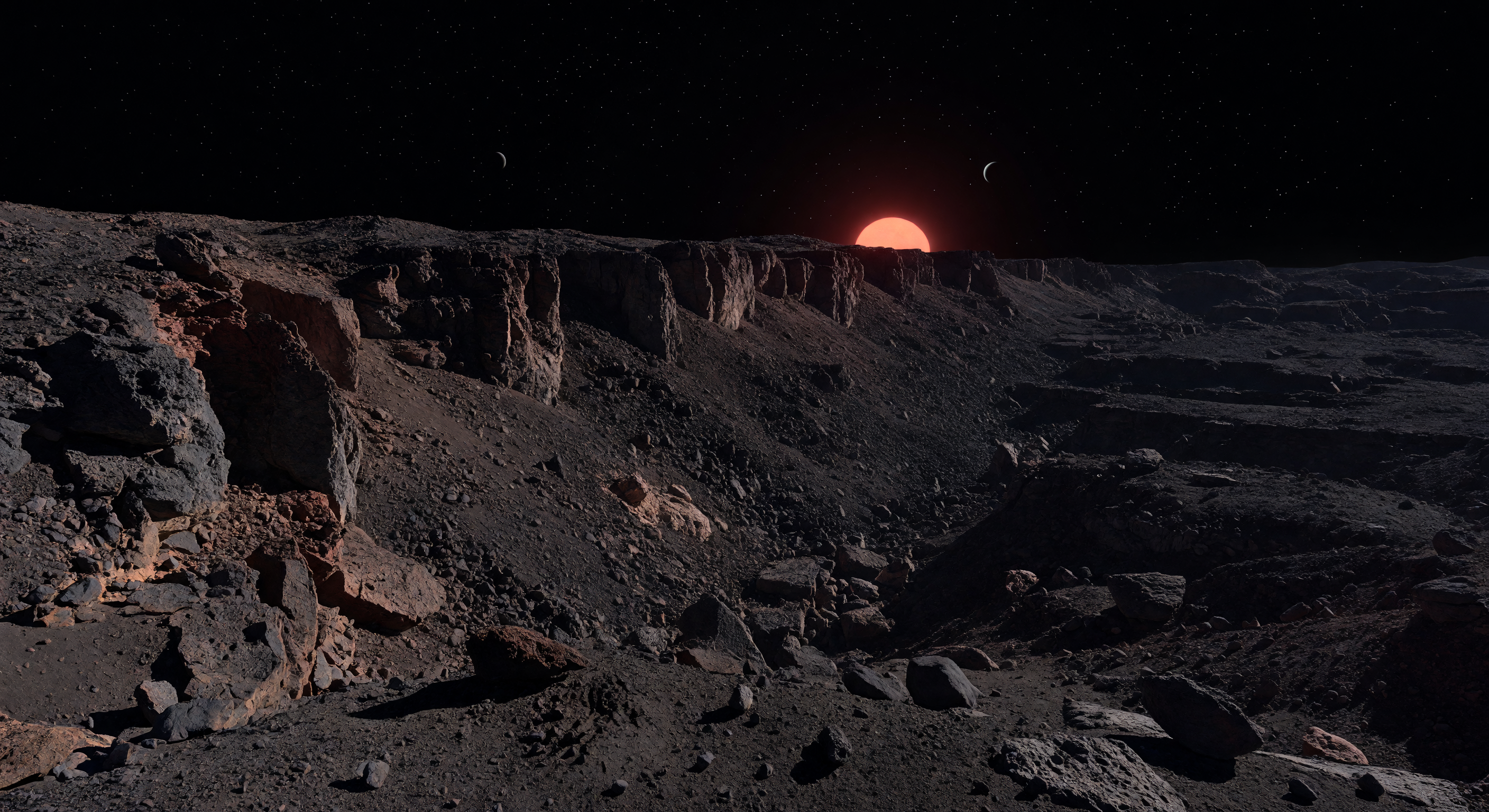
Aan de eeuwige schemergrens rijst een kilometerslange steilrand op uit een kale, luchtloze wereld: zwarte basaltische en ultramafische rotsen zijn door extreme temperatuurverschillen opengebarsten tot messcherpe kliffen, puinhellingen en terrassen vol hoekige blokken, breccie en gebarsten regoliet. Het dieprood-oranje licht van de ultrakoele dwergster, die half verzonken en onbeweeglijk aan de horizon hangt door getijdenvergrendeling, strijkt rakelings over het landschap en zet de verlichte wand in maroon en koperkleurige gloed, terwijl de andere zijde abrupt wegvalt in bijna absolute duisternis met haarscherpe vacuümschaduwen. Omdat er nauwelijks atmosfeer is, blijft de hemel zelfs aan de verlichte kant pikzwart en bezaaid met scherpe sterren, met hier en daar een heldere naburige wereld als kleine sikkel of bol. Tussen huisgrote keien in de voorgrond en de verre, verbrokkelde hooglanden voel je de enorme schaal en de meedogenloze fysica van een oppervlak zonder lucht, zonder water en zonder verzachting—alleen gesteente, straling en een permanente grens tussen hitte en nacht.
Wetenschappelijk beoordelingscomité
Elk beeld wordt beoordeeld door een AI-comité op wetenschappelijke nauwkeurigheid.
Claude
Afbeelding: Adjust
Beschrijving: Adjust
I largely concur with GPT's assessment but want to add several specific observations that sharpen the critique.
SCIENTIFIC ACCURACY: The core concept is sound — tidally locked body, no atmospheric scattering, hard-edged shadows, black sky with stars visible simultaneously with the stellar disk. These are all correct first-order behaviors for an airless tidally locked world. TRAPPIST-1 is an M8 red dwarf, and the rendered stellar color (deep red-orange) is a reasonable approximation of its ~2550K blackbody emission, which I'd call a genuine strength of the image. Where I diverge slightly from GPT: the angular size of the star on the horizon appears too small. TRAPPIST-1b orbits at roughly 0.011 AU, meaning TRAPPIST-1 would subtend approximately 4–5 degrees of arc as seen from the surface — dramatically larger than our Sun appears from Earth. The rendered disk looks Sun-sized or smaller, which is a meaningful scientific inaccuracy that should be flagged more strongly. The two crescent/disk objects in the sky are scientifically defensible in concept — TRAPPIST-1 hosts seven planets in very compact orbits, and neighboring planets would indeed be visible and potentially quite large in the sky. However, the sizes shown appear underscaled for the known orbital geometry; TRAPPIST-1c, for instance, could appear comparable to or larger than our Moon. The geology reads as generically plausible basaltic highland terrain but lacks differentiation — the caption's claims of vesicular lava texture and ultramafic variety are not visually distinguishable. Thermal fracturing patterns from extreme diurnal temperature gradients at the terminator could be more pronounced and directional.
VISUAL QUALITY: Render quality is high. Texturing on the rock faces is convincing, shadow directionality is internally consistent, and the star field is appropriately dense without looking artificial. One subtle issue: the lighting gradient across the escarpment mid-ground transitions too smoothly given the absence of an atmosphere — in reality, without Rayleigh scattering, the transition from illuminated to shadow should be even more abrupt. The ambient fill light in the deep shadows is slightly too generous, likely a rendering concession for visibility that slightly undermines the 'razor-edged darkness' the caption describes.
CAPTION ACCURACY: The caption is evocative and broadly matched but oversells specific geological detail not clearly rendered (vesicular slabs, ultramafic composition). The 'neighboring planet hanging like a distant ember' language implies a warm reddish hue to the secondary body, but both objects in the sky appear as neutral gray crescents, not ember-toned. The 'lightless abyss' below the escarpment reads more as a shadowed slope than a genuine vertical drop. These are adjustable issues, not regeneration-level failures. Overall: adjust on both counts, with the stellar angular size being the most scientifically correctable priority for a revision pass.
SCIENTIFIC ACCURACY: The core concept is sound — tidally locked body, no atmospheric scattering, hard-edged shadows, black sky with stars visible simultaneously with the stellar disk. These are all correct first-order behaviors for an airless tidally locked world. TRAPPIST-1 is an M8 red dwarf, and the rendered stellar color (deep red-orange) is a reasonable approximation of its ~2550K blackbody emission, which I'd call a genuine strength of the image. Where I diverge slightly from GPT: the angular size of the star on the horizon appears too small. TRAPPIST-1b orbits at roughly 0.011 AU, meaning TRAPPIST-1 would subtend approximately 4–5 degrees of arc as seen from the surface — dramatically larger than our Sun appears from Earth. The rendered disk looks Sun-sized or smaller, which is a meaningful scientific inaccuracy that should be flagged more strongly. The two crescent/disk objects in the sky are scientifically defensible in concept — TRAPPIST-1 hosts seven planets in very compact orbits, and neighboring planets would indeed be visible and potentially quite large in the sky. However, the sizes shown appear underscaled for the known orbital geometry; TRAPPIST-1c, for instance, could appear comparable to or larger than our Moon. The geology reads as generically plausible basaltic highland terrain but lacks differentiation — the caption's claims of vesicular lava texture and ultramafic variety are not visually distinguishable. Thermal fracturing patterns from extreme diurnal temperature gradients at the terminator could be more pronounced and directional.
VISUAL QUALITY: Render quality is high. Texturing on the rock faces is convincing, shadow directionality is internally consistent, and the star field is appropriately dense without looking artificial. One subtle issue: the lighting gradient across the escarpment mid-ground transitions too smoothly given the absence of an atmosphere — in reality, without Rayleigh scattering, the transition from illuminated to shadow should be even more abrupt. The ambient fill light in the deep shadows is slightly too generous, likely a rendering concession for visibility that slightly undermines the 'razor-edged darkness' the caption describes.
CAPTION ACCURACY: The caption is evocative and broadly matched but oversells specific geological detail not clearly rendered (vesicular slabs, ultramafic composition). The 'neighboring planet hanging like a distant ember' language implies a warm reddish hue to the secondary body, but both objects in the sky appear as neutral gray crescents, not ember-toned. The 'lightless abyss' below the escarpment reads more as a shadowed slope than a genuine vertical drop. These are adjustable issues, not regeneration-level failures. Overall: adjust on both counts, with the stellar angular size being the most scientifically correctable priority for a revision pass.
Grok
Afbeelding: Adjust
Beschrijving: Adjust
I concur with both GPT and Claude on the overall 'adjust' verdict for image and caption, with some refinements and additions based on close inspection of the provided image.
SCIENTIFIC ACCURACY: Core elements are strong and align well with TRAPPIST-1b as a tidally locked, likely airless rocky world: black star-filled sky, no atmospheric haze/clouds, hard shadows from unilateral red dwarf illumination, and terminator-like stark light/dark contrast from thermal extremes. The red-orange stellar hue accurately evokes TRAPPIST-1's ~255K temperature. However, as Claude notes, the star's angular diameter is undersized—should be ~4-5° (8-10 Sun widths) from .011 AU, appearing like a massive crimson disk half-buried in the horizon, not the small Sun-like orb shown. The two sky objects (likely TRAPPIST-1c/e analogs) are a scientific win for the compact system but underscaled and desaturated—neighboring planets could loom Moon-sized or larger with reflected reddish glows, not neutral gray crescents. Geology is plausible fractured basalt (evoking lunar highlands), but lacks caption-specific vesicular lava slabs or ultramafic differentiation; thermal stress fractures could be more linear/oriented toward the star. The 'abyss' appears as a shadowed valley, not a sheer kilometer-drop. Minor: no dust levitation or sublimation features expected near terminator despite low/no atmosphere.
VISUAL QUALITY: Excellent photorealism—sharp rock texturing, coherent specular highlights on lit faces, dense believable starfield, no artifacts/glitches. Shadows are convincingly sharp, though midground gradients have subtle fill light (as Claude flags) softening 'razor-edged darkness' slightly beyond pure specular reflection off rocks. Lighting boundary is appropriately hard-edged sans scattering. Scale feels epic via layered escarpments receding to horizon/void. High quality, just needs tweaks for angular sizes and shadow fidelity.
CAPTION ACCURACY: Matches broadly (escarpment tiers, black boulders/talus, crimson glow vs. darkness, black starry sky, neighboring 'ember' planet), but mismatches on details: no clear 'vesicular lava slabs' or 'ultramafic rock' variety (uniform dark basaltic tones); sky bodies lack 'ember' warmth (gray, not glowing); star not convincingly 'half-submerged' at current scale; 'lightless abyss' is a dark slope, not void-plunge. 'Maroon twilight' gradient is minimal. These are preciseable via prompt refinements, warranting 'adjust' not regenerate.
RECOMMENDATIONS: Enlarge star to 4-5° disk partially below horizon; scale/color sky planets as large reddish crescents; sharpen shadow cutoffs, add subtle geology variety (e.g., gas bubble textures, greenish ultramafics); emphasize vertical drop. Strong base image—minor regenerations could approve.
SCIENTIFIC ACCURACY: Core elements are strong and align well with TRAPPIST-1b as a tidally locked, likely airless rocky world: black star-filled sky, no atmospheric haze/clouds, hard shadows from unilateral red dwarf illumination, and terminator-like stark light/dark contrast from thermal extremes. The red-orange stellar hue accurately evokes TRAPPIST-1's ~255K temperature. However, as Claude notes, the star's angular diameter is undersized—should be ~4-5° (8-10 Sun widths) from .011 AU, appearing like a massive crimson disk half-buried in the horizon, not the small Sun-like orb shown. The two sky objects (likely TRAPPIST-1c/e analogs) are a scientific win for the compact system but underscaled and desaturated—neighboring planets could loom Moon-sized or larger with reflected reddish glows, not neutral gray crescents. Geology is plausible fractured basalt (evoking lunar highlands), but lacks caption-specific vesicular lava slabs or ultramafic differentiation; thermal stress fractures could be more linear/oriented toward the star. The 'abyss' appears as a shadowed valley, not a sheer kilometer-drop. Minor: no dust levitation or sublimation features expected near terminator despite low/no atmosphere.
VISUAL QUALITY: Excellent photorealism—sharp rock texturing, coherent specular highlights on lit faces, dense believable starfield, no artifacts/glitches. Shadows are convincingly sharp, though midground gradients have subtle fill light (as Claude flags) softening 'razor-edged darkness' slightly beyond pure specular reflection off rocks. Lighting boundary is appropriately hard-edged sans scattering. Scale feels epic via layered escarpments receding to horizon/void. High quality, just needs tweaks for angular sizes and shadow fidelity.
CAPTION ACCURACY: Matches broadly (escarpment tiers, black boulders/talus, crimson glow vs. darkness, black starry sky, neighboring 'ember' planet), but mismatches on details: no clear 'vesicular lava slabs' or 'ultramafic rock' variety (uniform dark basaltic tones); sky bodies lack 'ember' warmth (gray, not glowing); star not convincingly 'half-submerged' at current scale; 'lightless abyss' is a dark slope, not void-plunge. 'Maroon twilight' gradient is minimal. These are preciseable via prompt refinements, warranting 'adjust' not regenerate.
RECOMMENDATIONS: Enlarge star to 4-5° disk partially below horizon; scale/color sky planets as large reddish crescents; sharpen shadow cutoffs, add subtle geology variety (e.g., gas bubble textures, greenish ultramafics); emphasize vertical drop. Strong base image—minor regenerations could approve.
Gemini
Afbeelding: Adjust
Beschrijving: Adjust
I concur with the committee's consensus. The image succeeds in capturing the 'mood' of a tidally locked, airless world, but fails on the specific astrophysical scaling required for the TRAPPIST-1 system. Specifically, the angular diameter of the primary star is the most critical scientific error; at 0.011 AU, TRAPPIST-1 should dominate the horizon as a massive, brooding crimson disk, not a distant point-source. Furthermore, the 'neighboring planet' visual is too subtle; given the extreme orbital packing of the TRAPPIST-1 system, these bodies should appear as looming, crescent-lit giants, not minor background features. Geologically, while the basaltic textures are rendered with high visual quality, they lack the distinct 'vesicular' (pitted/bubbly) and 'ultramafic' (varied mineral hues) properties promised in the caption. The lighting, while sharp, suffers from 'fill light' artifacts in the shadows that defy the physics of a true vacuum, where light should be strictly directional or derived from local albedo only. The caption is overly descriptive of features that are not clearly represented in the render, particularly regarding the 'maroon twilight'—a color that implies atmospheric scattering which is physically impossible on this airless world. I recommend a revision that prioritizes the massive stellar scale and a more dramatic, vertical 'abyss' shadow-casting to better align with the description.
Matania — Synthese
Afbeelding: Adjust
Beschrijving: Adjust
The committee agrees the image is a strong atmospheric portrayal of TRAPPIST-1b’s terminator, with convincing hard shadows, a black airless sky, and plausible rocky escarpment textures. However, it falls short on key scientific scaling: TRAPPIST-1 should appear far larger from the surface, the neighboring sky bodies are too subtle and undersized for the compact TRAPPIST-1 system, and the shadow transition is a bit too softly filled for a vacuum world. The caption broadly matches the scene’s mood and structure, but it overstates or over-specifies details not clearly shown, including vesicular/ultramafic geology, a distinctly ember-like neighboring planet, and a true abyssal drop. Overall: a good base rendering that needs adjustment rather than regeneration.
Visual quality: Overall image quality is high (good contrast, coherent shadows, convincing rock texture, no obvious rendering glitches). The star field and lighting are plausible for a space-view. Minor concerns: the symmetry of lighting and the apparent “terminator” boundary are slightly hard-edged compared to what a real terminator would look like without any atmospheric scattering; also, any “near-terminator twilight maroon” is subtle—most of the sky is simply dark with minimal gradient.
Caption accuracy: The description broadly matches (terminator-like horizon glow, jagged cliffs, talus boulders, airless black sky, no clouds). But it over-specifies elements that are either not clearly shown or not reliably supported: (1) “half-submerged” star depiction is not strongly evidenced beyond an artistic placement; (2) “neighboring planet hanging like a distant ember” appears as a secondary small body, but its inclusion/justification for TRAPPIST-1b is not scientifically grounded; (3) “vesicular lava slabs” and “kilometers” scale are not verifiable from the image. These issues are more than purely stylistic, so a minor adjustment vote is appropriate rather than full approval.