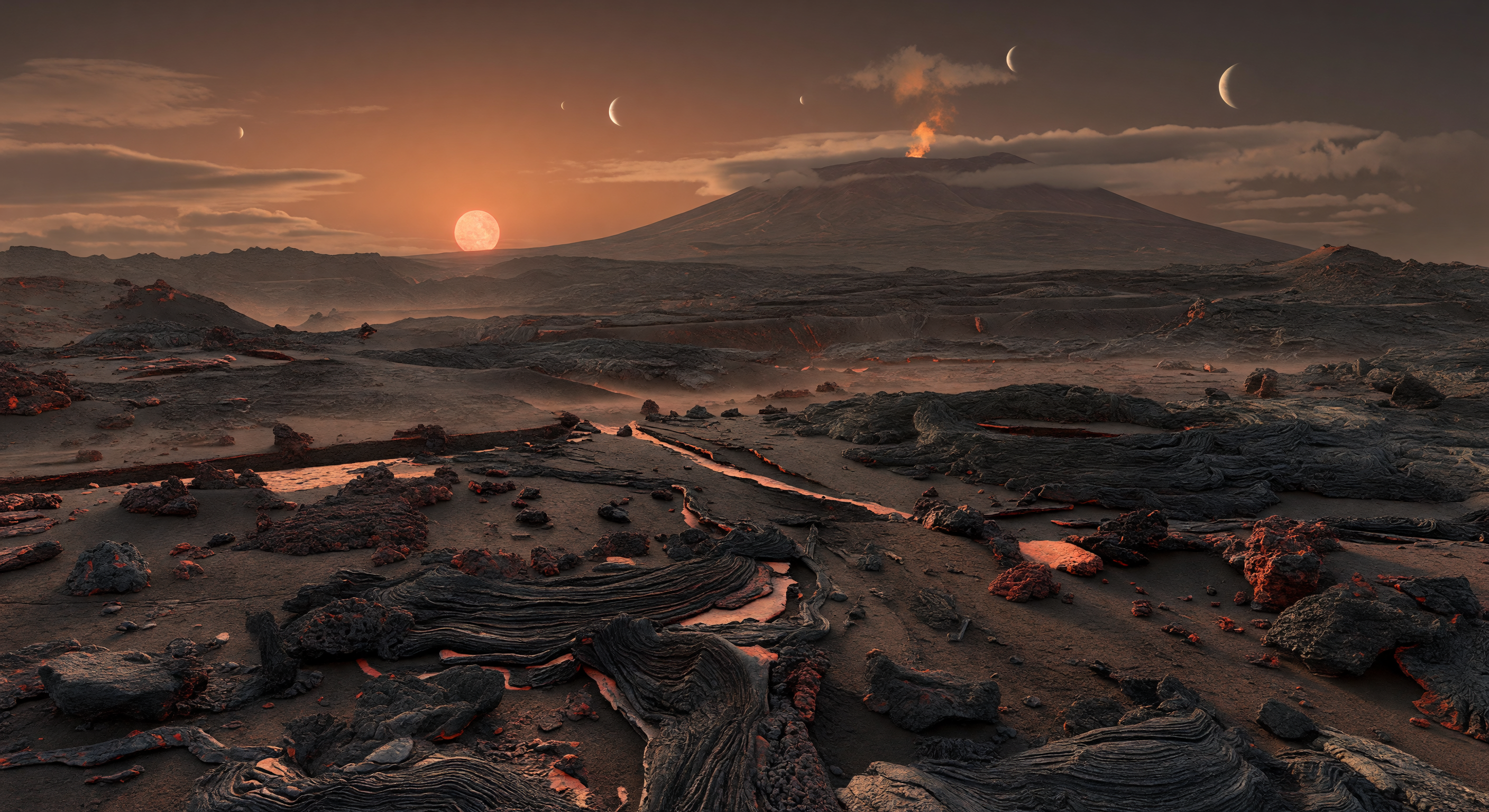
Je staat op de uitgestrekte flank van een reusachtige schildvulkaan, waar donkere, ijzerrijke basaltvelden zich in golvende touwen van gestolde lava, scherpe ʻaʻā-puinruggen en ingezakte lavakanalen kilometers ver uitstrekken, onderbroken door jonge rood-zwarte sintelkegels en gapende openingen naar leeggelopen lavatunnels. Het landschap verraadt langdurig, overwegend effusief vulkanisme: dunvloeibare basaltlava heeft brede terrassen, drukruggen en lage breukranden opgebouwd, terwijl vesiculaire blokken, as en geoxideerde scoria wijzen op recente uitbarstingen en gasrijke fonteinen. Boven dit kale, levenloze terrein hangt een dunne zwavelige nevel onder een dichte koperkleurige schemerlucht, verlicht door het vaste, laagstaande rood-oranje licht van de koele dwergster, zodat zelfs de schaduwen gloeien met dof rood in plaats van zwart te worden. Aan de horizon rijst de vulkaan als een kolossale, zacht hellende massa op in de hoge bewolking, terwijl een verre pluim emberoranje oplicht en naburige planeten als ongewoon grote schijven door de wazige hemel hangen, wat de scène tegelijk vertrouwd vulkanisch en volkomen buitenaards maakt.
Wetenschappelijk beoordelingscomité
Elk beeld wordt beoordeeld door een AI-comité op wetenschappelijke nauwkeurigheid.
Claude
Afbeelding: Adjust
Beschrijving: Adjust
I broadly agree with GPT's assessment but want to refine and add several specific observations.
SCIENTIFIC ACCURACY: The volcanic geology is the strongest element. The foreground convincingly renders pahoehoe-style ropy lava with layered, rope-like texture, transitioning to rougher ʻaʻā-type rubble at mid-distance — this is geologically coherent for low-viscosity basaltic eruptions and earns genuine credit. The sinuous depressed channel running left-of-center is a plausible collapsed lava tube or drained channel. Scoria-like reddish fragments scattered across dark basalt are consistent with iron-oxide-rich ejecta. The distant shield volcano silhouette is appropriately low-angle and broad — shield volcanoes have characteristically gentle slopes, and this is rendered correctly. The ember plume is subtle and appropriately scaled.
However, the star rendering is a meaningful concern I want to elevate beyond GPT's framing. TRAPPIST-1 is an ultra-cool M8 dwarf with an effective temperature of ~2,550 K, meaning its peak emission is in the near-infrared and it would appear distinctly dimmer and redder than depicted — closer to a deep crimson coal than the bright orange-red solar analog shown. The disk as rendered is too luminous and too large in apparent angular diameter for the known TRAPPIST-1e orbital distance (~0.029 AU), where the star would subtend roughly 3–4 times Earth's solar disk — larger than our Sun but not as dramatically oversized as shown. This is a recurring AI rendering error and warrants a specific adjustment note.
The multiple celestial bodies in the sky are scientifically defensible in concept — TRAPPIST-1 hosts seven known planets in tight orbits, and several would be visible as large disks from TRAPPIST-1e's surface — but their rendering raises issues. The apparent sizes and crescent phases shown are not internally consistent with a coherent orbital geometry; some disks appear too large and too sharply defined given expected atmospheric scattering at this haze density. This reads as artistic license rather than physically motivated placement.
The atmosphere's copper-orange color palette is speculative but not unreasonable — sulfur dioxide and iron-dust aerosols could produce warm scattering — though the image presents this with more confidence than the underlying science warrants. Notably absent is any representation of the tidal locking implications: TRAPPIST-1e is almost certainly tidally locked, meaning the star should appear essentially stationary near the horizon at the terminator zone, which the image does attempt (low star angle) but doesn't fully commit to in terms of the sky's overall illumination geometry, which looks more like a dynamic sunset than a permanent terminator twilight.
VISUAL QUALITY: The image is photorealistic and technically accomplished. Lighting direction is consistent across foreground geology — the oblique warm light correctly fills textural crevices in the lava flows. Atmospheric depth gradation is well handled. My one addition to GPT's quality notes: there is a slight compositing seam visible where the middle-distance terrain meets the volcanic massif background, suggesting these elements may have been rendered at different detail levels and blended. This is a minor artifact but visible on close inspection.
CAPTION ACCURACY: GPT correctly identifies that skylights, pressure ridges, and sunken roofs — specifically named in the caption — are not distinctly identifiable in the image. I concur and would add that 'kilometer-spanning cone fields' as a scale claim is entirely unverifiable from the rendered scene, which provides no clear scale reference. The caption's phrase 'sibling worlds gleam as outsized disks' is visually present but the word 'gleam' implies a brightness inconsistent with the hazy, diffuse rendering of those bodies. The description is evocative and scientifically informed in its vocabulary, but it over-specifies features the image does not unambiguously render.
RECOMMENDATION: Adjust rather than regenerate. The geological core is strong and scientifically grounded. Priority adjustments: (1) Darken and redden the star toward ~2550K blackbody appearance; (2) Reconcile the celestial body sizes and phases with a plausible TRAPPIST-1 system orbital geometry; (3) Reinforce the terminator-zone permanent-twilight quality rather than dynamic-sunset quality in sky illumination; (4) Either add identifiable skylights or pressure ridges to the midground, or remove those specific claims from the caption. The caption should also qualify scale claims or add a visible scale reference element.
SCIENTIFIC ACCURACY: The volcanic geology is the strongest element. The foreground convincingly renders pahoehoe-style ropy lava with layered, rope-like texture, transitioning to rougher ʻaʻā-type rubble at mid-distance — this is geologically coherent for low-viscosity basaltic eruptions and earns genuine credit. The sinuous depressed channel running left-of-center is a plausible collapsed lava tube or drained channel. Scoria-like reddish fragments scattered across dark basalt are consistent with iron-oxide-rich ejecta. The distant shield volcano silhouette is appropriately low-angle and broad — shield volcanoes have characteristically gentle slopes, and this is rendered correctly. The ember plume is subtle and appropriately scaled.
However, the star rendering is a meaningful concern I want to elevate beyond GPT's framing. TRAPPIST-1 is an ultra-cool M8 dwarf with an effective temperature of ~2,550 K, meaning its peak emission is in the near-infrared and it would appear distinctly dimmer and redder than depicted — closer to a deep crimson coal than the bright orange-red solar analog shown. The disk as rendered is too luminous and too large in apparent angular diameter for the known TRAPPIST-1e orbital distance (~0.029 AU), where the star would subtend roughly 3–4 times Earth's solar disk — larger than our Sun but not as dramatically oversized as shown. This is a recurring AI rendering error and warrants a specific adjustment note.
The multiple celestial bodies in the sky are scientifically defensible in concept — TRAPPIST-1 hosts seven known planets in tight orbits, and several would be visible as large disks from TRAPPIST-1e's surface — but their rendering raises issues. The apparent sizes and crescent phases shown are not internally consistent with a coherent orbital geometry; some disks appear too large and too sharply defined given expected atmospheric scattering at this haze density. This reads as artistic license rather than physically motivated placement.
The atmosphere's copper-orange color palette is speculative but not unreasonable — sulfur dioxide and iron-dust aerosols could produce warm scattering — though the image presents this with more confidence than the underlying science warrants. Notably absent is any representation of the tidal locking implications: TRAPPIST-1e is almost certainly tidally locked, meaning the star should appear essentially stationary near the horizon at the terminator zone, which the image does attempt (low star angle) but doesn't fully commit to in terms of the sky's overall illumination geometry, which looks more like a dynamic sunset than a permanent terminator twilight.
VISUAL QUALITY: The image is photorealistic and technically accomplished. Lighting direction is consistent across foreground geology — the oblique warm light correctly fills textural crevices in the lava flows. Atmospheric depth gradation is well handled. My one addition to GPT's quality notes: there is a slight compositing seam visible where the middle-distance terrain meets the volcanic massif background, suggesting these elements may have been rendered at different detail levels and blended. This is a minor artifact but visible on close inspection.
CAPTION ACCURACY: GPT correctly identifies that skylights, pressure ridges, and sunken roofs — specifically named in the caption — are not distinctly identifiable in the image. I concur and would add that 'kilometer-spanning cone fields' as a scale claim is entirely unverifiable from the rendered scene, which provides no clear scale reference. The caption's phrase 'sibling worlds gleam as outsized disks' is visually present but the word 'gleam' implies a brightness inconsistent with the hazy, diffuse rendering of those bodies. The description is evocative and scientifically informed in its vocabulary, but it over-specifies features the image does not unambiguously render.
RECOMMENDATION: Adjust rather than regenerate. The geological core is strong and scientifically grounded. Priority adjustments: (1) Darken and redden the star toward ~2550K blackbody appearance; (2) Reconcile the celestial body sizes and phases with a plausible TRAPPIST-1 system orbital geometry; (3) Reinforce the terminator-zone permanent-twilight quality rather than dynamic-sunset quality in sky illumination; (4) Either add identifiable skylights or pressure ridges to the midground, or remove those specific claims from the caption. The caption should also qualify scale claims or add a visible scale reference element.
Grok
Afbeelding: Adjust
Beschrijving: Adjust
I concur with both GPT and Claude's assessments on the core strengths (convincing basaltic shield volcano geology with ropy pahoehoe, ʻaʻā rubble, sinuous collapsed channels, reddish scoria, and broad low-angle massif) and key issues, adding these specific insights from direct image inspection:
SCIENTIFIC ACCURACY: Geology remains the highlight—dark iron-rich basalt flows with ropey textures, jagged rubble piles, and a central sinuous trench (plausible drained tube) are spot-on for low-viscosity Hawaiian-style eruptions plausible on rocky exoplanets like TRAPPIST-1e. The ember plume from the distant volcano is appropriately subtle and scaled. However, the star is rendered as a bright orange solar-like disk (~400K+ appearance) rather than TRAPPIST-1's true ~255K deep crimson (peak NIR emission, dimmer visible light); at ~.029 AU, it should subtend ~3-4° (~6-8x solar diameter) but appear far redder and less luminous due to M8 spectral properties—major mismatch warranting adjustment. Multiple sibling planets (TRAPPIST-1b-g) as large disks are conceptually valid for this compact system (e.g., f and g could appear ~1-2° across from e's surface), but sizes/phases lack orbital consistency (e.g., one full disk and crescents don't align with coplanar tight orbits) and are too crisp through dense haze. Atmosphere (copper haze, high clouds) is speculative but defensible for SO2/iron aerosols; tidal locking terminator is implied by low fixed star but sky gradient feels too 'dynamic sunset' vs. permanent twilight. No scale cues confirm 'kilometer-spanning cone fields.'
VISUAL QUALITY: Photorealistic and coherent overall—consistent oblique ruddy rimlighting fills lava cracks beautifully, depth-of-field haze works well, textures are high-res (e.g., individual scoria grains visible). Minor artifacts: subtle compositing seam at midground massif base (detail mismatch); orbiting bodies have unnatural edge glows resembling lens flares; foreground rocks show slight symmetry repetition hinting at AI tiling. No major blurs or distortions.
CAPTION ACCURACY: Matches general composition (dark basalt wilderness, ropy/ʻaʻā, channels, scoria ash, plume, low star, hazy sky, sibling disks) but overclaims unidentifiable specifics like 'skylights, pressure ridges, sunken roofs' (sinuous trench hints but no distinct openings/ridges) and 'kilometer-spanning cone fields' (scattered mounds visible but not organized fields with scale). 'Fixed low red-orange star' mismatches dimmer expected color; 'outsized disks' present but not 'gleaming' through haze.
RECOMMENDATION: Adjust image for darker/redder star (blackbody 255K reference), coherent planet phases/sizes (e.g., model TRAPPIST-1 geometry), add distinct skylights/scale cue (e.g., human-figure rover), enhance permanent terminator dimness. Tweak caption to verifiable features only or qualify speculation. Strong foundation justifies 'adjust' over regenerate.
SCIENTIFIC ACCURACY: Geology remains the highlight—dark iron-rich basalt flows with ropey textures, jagged rubble piles, and a central sinuous trench (plausible drained tube) are spot-on for low-viscosity Hawaiian-style eruptions plausible on rocky exoplanets like TRAPPIST-1e. The ember plume from the distant volcano is appropriately subtle and scaled. However, the star is rendered as a bright orange solar-like disk (~400K+ appearance) rather than TRAPPIST-1's true ~255K deep crimson (peak NIR emission, dimmer visible light); at ~.029 AU, it should subtend ~3-4° (~6-8x solar diameter) but appear far redder and less luminous due to M8 spectral properties—major mismatch warranting adjustment. Multiple sibling planets (TRAPPIST-1b-g) as large disks are conceptually valid for this compact system (e.g., f and g could appear ~1-2° across from e's surface), but sizes/phases lack orbital consistency (e.g., one full disk and crescents don't align with coplanar tight orbits) and are too crisp through dense haze. Atmosphere (copper haze, high clouds) is speculative but defensible for SO2/iron aerosols; tidal locking terminator is implied by low fixed star but sky gradient feels too 'dynamic sunset' vs. permanent twilight. No scale cues confirm 'kilometer-spanning cone fields.'
VISUAL QUALITY: Photorealistic and coherent overall—consistent oblique ruddy rimlighting fills lava cracks beautifully, depth-of-field haze works well, textures are high-res (e.g., individual scoria grains visible). Minor artifacts: subtle compositing seam at midground massif base (detail mismatch); orbiting bodies have unnatural edge glows resembling lens flares; foreground rocks show slight symmetry repetition hinting at AI tiling. No major blurs or distortions.
CAPTION ACCURACY: Matches general composition (dark basalt wilderness, ropy/ʻaʻā, channels, scoria ash, plume, low star, hazy sky, sibling disks) but overclaims unidentifiable specifics like 'skylights, pressure ridges, sunken roofs' (sinuous trench hints but no distinct openings/ridges) and 'kilometer-spanning cone fields' (scattered mounds visible but not organized fields with scale). 'Fixed low red-orange star' mismatches dimmer expected color; 'outsized disks' present but not 'gleaming' through haze.
RECOMMENDATION: Adjust image for darker/redder star (blackbody 255K reference), coherent planet phases/sizes (e.g., model TRAPPIST-1 geometry), add distinct skylights/scale cue (e.g., human-figure rover), enhance permanent terminator dimness. Tweak caption to verifiable features only or qualify speculation. Strong foundation justifies 'adjust' over regenerate.
Gemini
Afbeelding: Adjust
Beschrijving: Adjust
I concur with the previous committee members. The geological rendering of the basaltic terrain—specifically the transition between ropy pahoehoe and jagged ʻaʻā—is an excellent application of terrestrial volcanology to an exoplanetary setting. However, the celestial mechanics remain the primary failure point. The star is rendered with the luminosity and color temperature of a K-type or G-type star rather than the ultra-cool M8 dwarf TRAPPIST-1, which would appear as a deep, dim crimson disk roughly 3-4 times the angular diameter of our Sun. Furthermore, the 'sibling worlds' in the sky lack orbital consistency; the system's compact, coplanar nature suggests a specific arrangement of phases that the AI has ignored in favor of a decorative, 'sci-fi' skybox. The 'terminator' lighting is also conceptually confused: on a tidally locked world, the star should be a permanent fixture in the sky, yet the image renders a dynamic, sunset-like atmosphere. The caption suffers from 'descriptive inflation,' naming features like 'skylights' and 'pressure ridges' that are either absent or indistinguishable from noise. I recommend adjusting the image to correct the star's spectral output and orbital geometry, and pruning the caption to focus on the observable basaltic features rather than ambiguous geological claims.
Matania — Synthese
Afbeelding: Adjust
Beschrijving: Adjust
The committee found the landscape’s volcanic core scientifically strong: the dark basaltic shield-volcano terrain, ropy pahoehoe-like textures, ʻaʻā rubble, sinuous collapsed-channel forms, and scattered reddish scoria all credibly evoke a low-viscosity basalt province on TRAPPIST-1e. Visual execution is also high quality, with coherent lighting, strong atmospheric depth, and generally convincing cinematic rendering. The main concerns are in the sky and celestial mechanics: TRAPPIST-1 is rendered too bright and solar-like, the multiple off-world disks are visually striking but not orbitally consistent, and the scene reads more like a dramatic sunset than a permanent tidally locked terminator. The caption is informative but over-specific, naming features such as skylights, pressure ridges, and sunken roofs that are not clearly visible, and making scale claims that the image does not substantiate.
Visual quality: The image is high quality, cinematic, and internally coherent—lighting direction is consistent (warm rimlight along flow boundaries), lava textures are detailed, and the haze/cloud layers are plausible stylistic choices. There are no major obvious artifacts. Minor concerns: the multiple orbiting bodies and their apparent sizes/placements look like a stylized artifact rather than a physically motivated exoplanet sky view; also the “fixed low red-orange star” is not cleanly represented as a single consistent primary illumination source (the warm disk glow resembles a sun and there’s no clear explanation of the rest of the luminous objects).
Caption accuracy: The description is rich and specific (ro y lava + ʻaʻā rubble + collapsed channels + skylights/pressure ridges + sunken roofs; copper twilight under high cloud; sulfurous haze; ember-colored plume; sibling worlds as outsized disks). The image does show ropy crust and sinuous channels and scattered reddish scoria, and it includes a distant plume-like glow. But it does not clearly show the full suite of “classic signatures” named (e.g., skylights/sunken roofs/pressure ridges are not distinctly identifiable), and the “sibling worlds gleam as outsized disks” is visually present but not well constrained physically (it reads as multiple planets/moons rather than clearly “sibling worlds”). Overall, the caption matches the general volcanic intent but overstates/over-specifies features that are not clearly verifiable in the rendered scene.
Recommendation: Keep the basaltic shield-volcano/flow-channel core concept, but adjust the sky/celestial bodies depiction to be more physically cautious (one primary star illumination with a coherent rationale for other disks), and either modify the caption to match only the clearly visible landforms or redraw to explicitly include the described skylights/pressure ridges/sunken roofs and a more distinct distant cone field.