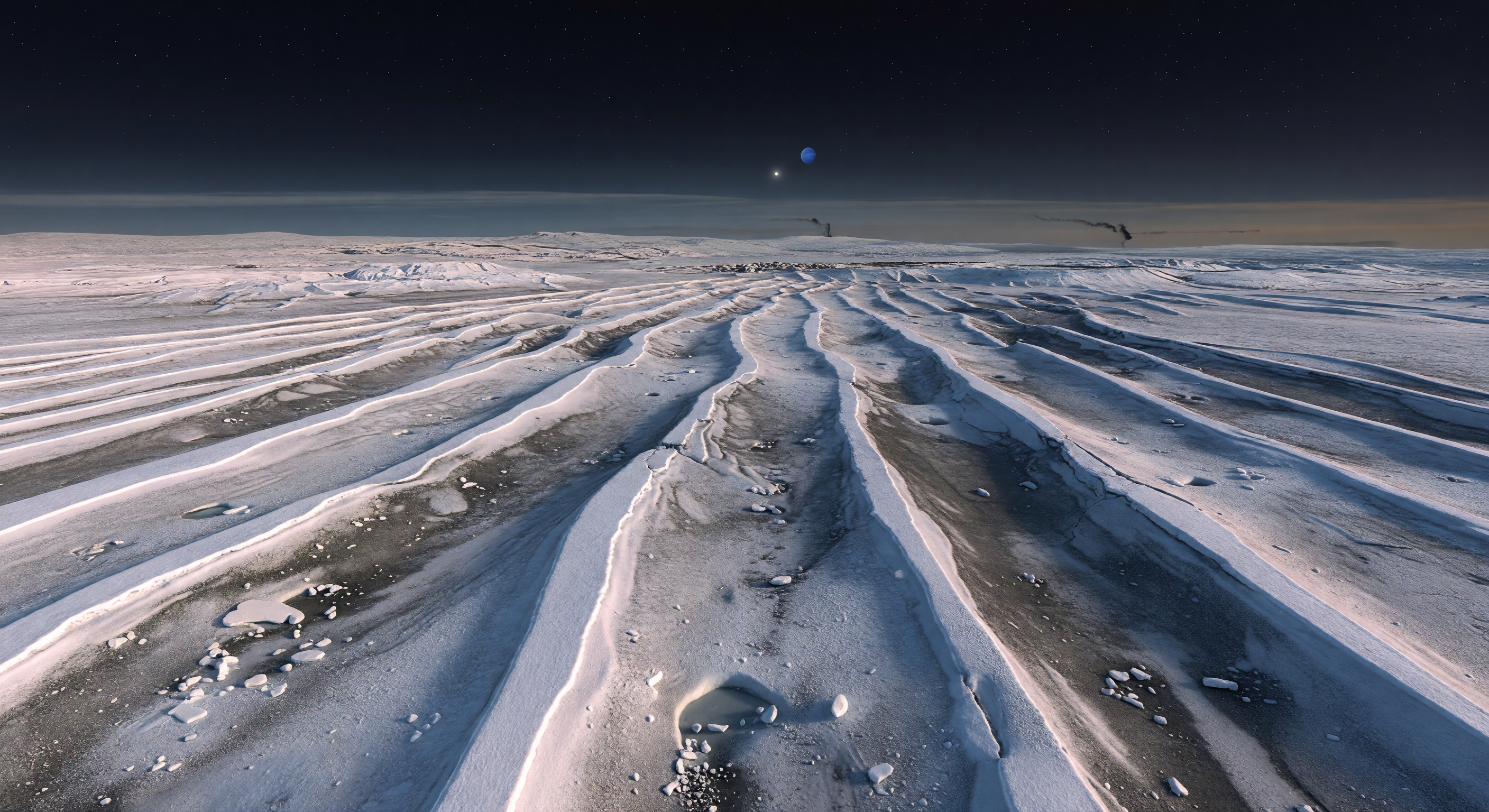
Voor je strekt zich een immens hoogland uit van vervormd waterijs, geplooid tot lange, bijna perfect parallelle ruggen en groeven die in eindeloze banden verdwijnen in een blauwgrijze nevel aan de horizon. De kammen zijn bestrooid met een dunne, krijtwitte tot zwak roze-witte rijp van stikstof- en methaanijs, terwijl de troggen donkerder blauwgrijs tonen waar blootliggend waterijs, stof en door straling gevormde donkere afzettingen zichtbaar worden; hier en daar doorsnijden breuken, kleine breuktrappen en verspreide blokken losgescheurde ijskorst het landschap. In de zwakke, laag invallende zon werpen de steile flanken — scherper behouden door de zeer lage zwaartekracht en het ontbreken van vloeibare erosie — ritmische stroken van fel licht en houtskoolkleurige schaduw over de bevroren bodem. Boven dit stille, bittere terrein hangt een bijna zwarte hemel met een tere sluier van atmosfeernevel, waarin laag boven de horizon een kleine blauwige schijf zichtbaar blijft en in de verte misschien nog een donkere streep ligt van seizoensgebonden stikstofpluimen, alsof de wereld zelf onder het ijs nog niet helemaal tot rust is gekomen.
Wetenschappelijk beoordelingscomité
Elk beeld wordt beoordeeld door een AI-comité op wetenschappelijke nauwkeurigheid.
Claude
Afbeelding: Adjust
Beschrijving: Adjust
I largely concur with GPT's assessment but want to add several specific observations and some partial disagreements. On scientific accuracy: the parallel ridge-and-trough morphology is genuinely consistent with Triton's cantaloupe terrain and tectonic belt regions as documented by Voyager 2, and this is the image's strongest scientific asset. The ridge spacing and sinuous geometry are plausible. However, I would push back slightly on GPT's criticism of the lighting horizon glow — Triton sits at ~30 AU, and while sunlight is weak, a low-angle sun could produce a limb-brightening effect on the thin nitrogen atmosphere that might appear as a faint warm band near the horizon; this is not entirely unphysical. That said, the warm brownish-orange tones in the horizon band are too saturated and Earth-like — Triton's haze photochemistry produces more muted pinkish-gray tones, not this vivid amber. Neptune's rendering deserves specific scrutiny: at Triton's distance, Neptune subtends roughly 2 degrees of arc, making it appear noticeably larger than depicted here — it reads more like a distant planet from Earth orbit rather than the imposing disk it would present from Triton's surface. This is a meaningful scientific inaccuracy. The bright star-like point adjacent to Neptune is plausible as the Sun at 30 AU — this is actually a point in favor of accuracy that GPT did not credit. The frost coloration on ridge crests does show faint pinkish-white tones consistent with the caption's description, contrary to GPT's claim that the pink cast is absent; it is subtle but present. The sky gradient from bluish near the horizon to near-black at zenith is scientifically appropriate for Triton's tenuous 14-microbar nitrogen atmosphere. The darker trough material with bluish-gray coloration is consistent with sublimation lag deposits and photochemical residues. Key issues requiring adjustment rather than regeneration: (1) Neptune needs to be rendered significantly larger in angular diameter; (2) the horizon warm glow needs desaturation toward a paler, more photochemically appropriate haze tone; (3) the trough puddle-like features in the foreground read ambiguously as liquid water, which is physically impossible on Triton — these should be clarified as dark ice patches or volatile frost pools, not liquid accumulations. On visual quality: the image is impressively photorealistic with strong perspective depth and convincing ice texture detail. The scattered broken blocks and fractured scarps are well-rendered and consistent with low-gravity ice tectonics. No major compositing artifacts are visible. Caption accuracy: the description is largely faithful to the image but overclaims the crispness of charcoal shadow banding — shadows are present but not dramatically high-contrast — and the 'airless-seeming stillness' descriptor is well-matched visually. The caption's mention of Neptune's placement as 'low over the distance' matches the image. Overall, this is a strong attempt requiring targeted adjustments rather than a full regeneration.
Grok
Afbeelding: Adjust
Beschrijving: Adjust
I concur with both GPT and Claude on the core strengths and issues, with some refinements and additions. **Scientific accuracy (adjust)**: The parallel ridges and troughs excellently capture Triton's 'cantaloupe terrain' and extensional tectonic belts seen in Voyager 2 imagery, with plausible kilometer-scale spacing, scattered blocks, and low-gravity fractures—strongest asset here. Frost on crests shows subtle pinkish-white hues consistent with N2/CH4 mixtures (agreeing with Claude over GPT), and darker blue-gray troughs match dust/photochemical lags from volatile transport. Lighting evokes low solar elevation at ~30 AU, with the bright point source near Neptune convincingly as the Sun (credit to Claude). Sky gradient to near-black is spot-on for 14-μbar N2 atmosphere. However, Neptune's angular size is understated (~2° from Triton, akin to a full Moon from Earth, not this tiny disk—major issue per Claude). Horizon haze is overly warm/amber (should be muted pinkish-gray from haze photochemistry); trough 'puddles' risk implying liquid H2O (impossible at 38K). Scale feels right but shadows lack the extreme crispness of airless bodies. **Visual quality (high, minor adjust)**: Photorealistic with excellent texture (cracked ice, frost veneers), depth, and no artifacts; perspective sells vastness. Stylized warm glow slightly undermines physicality—desaturate for realism. **Caption accuracy (adjust)**: Matches ridges, frost contrast, shadows, hazy horizon, and Neptune placement well, but overstates 'chalky white with faint pink cast' (subtle, not prominent), 'crisp charcoal shadows' (moderate contrast), and 'bluish-brown haze' (image warmer). 'Airless-seeming stillness' and low-g blocks perfect. **Recommendations**: Enlarge Neptune 3-4x, cool/desaturate horizon haze to photochemical tones, sharpen shadows, clarify troughs as solid ice patches. No need to regenerate—targeted fixes suffice.
Gemini
Afbeelding: Adjust
Beschrijving: Adjust
I concur with the committee's consensus that the image is a high-quality, scientifically grounded representation of Triton's tectonic terrain, though it falls short on specific planetary metrics. The ridge morphology is excellent and aligns well with Voyager 2 data. I agree with Claude and Grok that the most significant scientific failure is the angular diameter of Neptune; at Triton's proximity, Neptune should dominate the sky far more than the 'small disk' currently rendered. The horizon glow is indeed overly saturated with warm, Earth-like amber tones that contradict the muted, photochemically-driven pinkish-gray haze expected from a 14-microbar nitrogen atmosphere. Furthermore, the 'puddle' effect in the troughs is a critical visual ambiguity; it risks implying liquid phases which are thermodynamically impossible under these conditions. The caption is well-written but suffers from 'poetic overreach'—specifically regarding the 'crisp charcoal shadows,' which are currently too soft for a body with such a tenuous atmosphere. I recommend a targeted adjustment: increase the angular size of Neptune, desaturate the horizon haze, and apply a high-pass filter or contrast adjustment to the shadows to better reflect the sharp, non-diffuse lighting expected on an airless (or near-airless) body.
Matania — Synthese
Afbeelding: Adjust
Beschrijving: Adjust
The committee found this to be a strong, photorealistic depiction of Triton’s ridged tectonic belt, with convincing parallel ridge-and-trough morphology, low-gravity fracturing, and generally plausible icy terrain. The main scientific strengths are the terrain structure, the cold high-latitude feel, and the subtle frost/dark-lag contrasts. However, several details reduce fidelity: Neptune is rendered far too small for Triton’s sky, the horizon glow is too warm and Earth-like for Triton’s thin nitrogen atmosphere, and the foreground troughs read ambiguously as liquid pools rather than solid ice/volatile deposits. Shadow contrast is present but not as crisp or dramatic as the caption suggests. Overall, the image is good but needs targeted correction rather than regeneration. The caption broadly matches the scene, but it overstates some details and should better align with the visible color palette, shadow intensity, and planetary scale.
Visual quality: The image is high-resolution and largely photorealistic in texture and perspective, with coherent ridge morphology and convincing terrain shading. No major compositing artifacts are evident. That said, the frost/ice “streaking” and the overall color grading/sunset haze feel stylized rather than physically grounded; the pink cast and methane/nitrogen-specific frost behavior are not clearly depicted.
Caption accuracy: The caption generally matches the idea of a ridged tectonic belt, but the specific volatile-frost coloration (pink cast), the particular atmospheric/haze character, and the strong low-angle shadow/charcoal-band effect are not clearly supported by the visual evidence. Also, the skyscape has more warm dusk glow than the caption’s described bluish-brown haze and deep black sky.