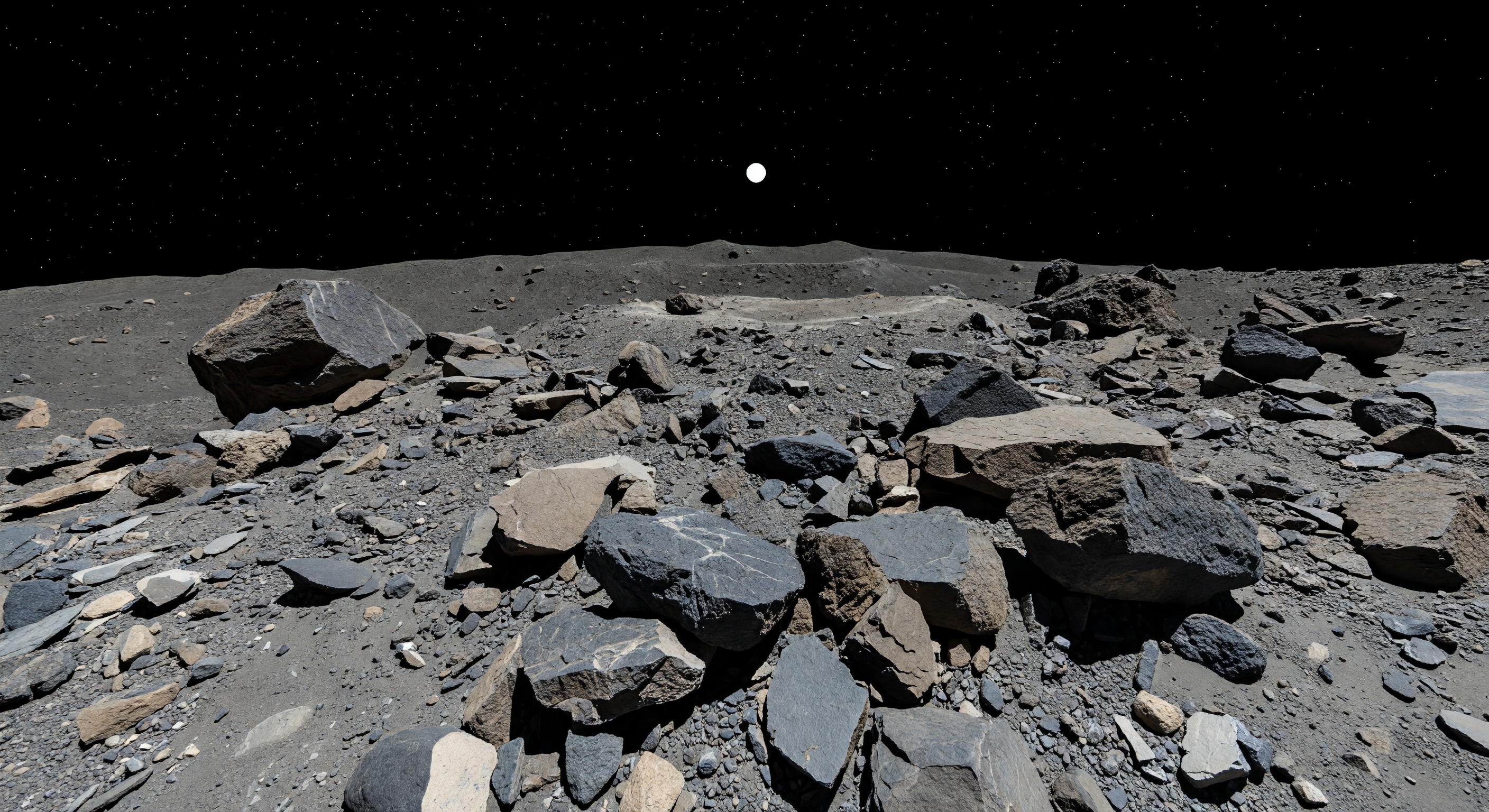
Vanaf dit lage standpunt kijk je uit over een steile puinhelling van inslagmateriaal, bezaaid met hoekige basaltblokken van handgrote scherven tot monolieten zo groot als huizen, met daartussen scherp brecciegrind, blootliggende donkergrijze gesteenteplaten en zakjes bleek stof die roerloos in spleten zijn blijven hangen. Dit landschap verraadt een oude, gesmolten korst: eucritische en diogenitische fragmenten, vers gebroken vlakken en glasachtig afgeschoren oppervlakken getuigen van hevige inslagen die diep basaltisch materiaal hebben losgerukt en over grote afstanden hebben uitgestrooid. In de ijle leegte van een luchtloze wereld is het zonlicht meedogenloos hard, zodat elke steen een messcherpe, pikzwarte schaduw werpt zonder enig verstrooid licht, terwijl zelfs de nabije horizon al merkbaar kromt door de kleine omvang van het lichaam. Alles voelt tegelijk broos en monumentaal: wankelende blokken balanceren op onwaarschijnlijk losse hellingen, kleine kraterranden rijzen op als miniatuurbergen, en de zwarte hemel vol scherpe sterren maakt de stilte en schaal bijna tastbaar.
Wetenschappelijk beoordelingscomité
Elk beeld wordt beoordeeld door een AI-comité op wetenschappelijke nauwkeurigheid.
GPT
Afbeelding: Adjust
Beschrijving: Adjust
SCIENTIFIC ACCURACY: The scene generally matches an airless asteroid environment: black sky with stars visible and a hard, high-contrast sunlight direction. The terrain shows abundant angular boulders and rubble consistent with an ejecta/boulder apron, and the overall color palette (dark gray to light gray, subdued browns) is broadly plausible for Vesta’s basaltic/eucritic/diogenitic surface mix. However, several elements are hard to reconcile with Vesta specifically: (1) the sky is extremely “star-saturated” and includes a bright sunlit disk/bright object above the horizon—this is not how typical Vesta imaging looks (the Sun is small and extremely bright; stars are generally not as numerous/visible in wide-angle daylight scenes). (2) The bright near-horizon body could be a mis-render of the Sun or another luminous feature; it should be a small solar disk, and there should not be obvious additional luminous artifacts. (3) The horizon curvature and scale cue are present but not quantitatively convincing; the apparent steepness/perched-block instability described is not clearly evidenced—most blocks look fairly settled, and the slope/near-apron steepness is less dramatic than the caption implies. VISUAL QUALITY: The image is high-resolution, photorealistic in texture and rock fragmentation, with consistent lighting and plausible shadowing. I do not see obvious geometric artifacts or mismatched materials. The main visual concern is the sky rendering (stars and luminous object), which looks like an artistic compositing artifact rather than a physically consistent airless daylight view. CAPTION ACCURACY: The caption’s emphasis on a chaotic knife-sharp gravel underfoot transitioning to larger monoliths is broadly consistent with the foreground rubble field. It also mentions pale regolith dust in sheltered cracks and occasional glassy/sheen surfaces—there are some light-toned patches and fracture faces, but “pockets of pale dust in sheltered cracks” and “glassy, impact-sheared surfaces” are not clearly identifiable at the level claimed. Additionally, the caption asserts an “impossibly steep” slope and a “startlingly near curved horizon”; the horizon curvature is modest and the steepness reads more like a typical crater apron rather than extreme. Overall: good geology and photorealistic rendering, but the sky/sun treatment and some specific geological descriptors are not faithfully supported.
Claude
Afbeelding: Adjust
Beschrijving: Adjust
SCIENTIFIC ACCURACY: I largely concur with GPT's assessment but wish to add specificity. The rock types and color palette are reasonable for Vesta — dark eucritic/diogenitic basaltic material with subordinate lighter-toned clasts is consistent with Dawn mission imagery. The absolute black shadows and hard-edged lighting are correct for an airless body. However, I take issue with several points: (1) The luminous disk on the horizon is problematic. At Vesta's average heliocentric distance (~2.36 AU), the Sun subtends roughly 0.22 degrees — noticeably smaller than seen from Earth but still a distinct disk, not a diffuse blob. The rendered object appears too large and too white/featureless, suggesting a Moon-like body rather than a correctly scaled solar disk. If it IS the Sun, it should be intensely bright and smaller. If it's meant to be another body, that is scientifically unjustified without explicit context. (2) The star field density is plausible for a long-exposure analog, but in a scene lit by direct sunlight this bright, stars would not realistically co-register at this visibility in photography — this is a known artistic convention that sacrifices physical accuracy for aesthetic effect. (3) Gravity-related morphology is my most significant scientific objection: at Vesta's surface gravity (~0.25 m/s²), talus slope angles and boulder perching geometry should appear noticeably different from Earth analog scenes. The slopes here look entirely Earth-like in their repose angle. Boulders on Vesta would tend to travel farther before settling, and apron deposits would be more dispersed. The scene reads as a terrestrial mountain talus field photographed in black sky, not a distinctly low-gravity environment. (4) The near-horizon curvature that the caption emphasizes is essentially absent — the horizon appears nearly flat, which is actually closer to correct for Vesta (mean radius ~262 km, so curvature is visible but subtle), yet the caption specifically calls it 'startlingly near' and curved, which is not supported by the render. VISUAL QUALITY: Photorealism is high. Rock textures, fracture surfaces, and grain sizes across the granulometry gradient are convincing. Lighting consistency is good with no obvious shadow direction mismatches. The main artifact concern is the sky composite — the star layer and horizon body feel like post-processing additions rather than physically integrated scene elements. There is also a subtle issue with the foreground gravel: the smallest particles show slightly too much textural uniformity, lacking the fine regolith 'gardened' dust component that Dawn LAMO imagery consistently shows filling micro-depressions. CAPTION ACCURACY: The description of 'knife-sharp gravel,' angular blocks, eucritic/diogenitic crust mix, pale regolith in sheltered cracks, and absolute black shadows is directionally consistent with the image. However, the caption overclaims on: (a) 'impossibly steep slopes' — not visually supported; (b) 'glassy, impact-sheared surfaces' — not clearly identifiable; (c) 'startlingly near curved horizon' — the horizon is neither particularly near nor obviously curved in the render. The caption also correctly notes that sunlight is 'weaker than at Earth's distance,' which is scientifically accurate for Vesta but the rendered brightness level does not obviously reflect this — the scene appears Earth-insolation bright. RECOMMENDATION: Adjust the solar disk to correct angular size and intensity, revisit slope repose angles for low-gravity morphology, and optionally reduce star field visibility to be physically consistent with the daytime lighting level. Caption should moderate claims about slope steepness, horizon curvature, and glassy surfaces to match what is actually depicted.
Grok
Afbeelding: Adjust
Beschrijving: Adjust
I concur with both GPT and Claude on the core issues, adding targeted insights from Dawn mission data (e.g., FC and LAMO imagery). SCIENTIFIC ACCURACY: Rock assemblage is spot-on—angular boulders, breccia clasts, and granulometric range (gravel to house-sized blocks) match Vesta's ejecta aprons (e.g., Cornelia Rupes or Marcia crater fields), with correct eucrite/diogenite palette (charcoal/ash gray/brown tones, per spectral data at .4-1. μm). Hard lighting, absolute black shadows, and no atmosphere are precise for airless ~2.36 AU conditions. However: (1) The horizon luminous disk is oversized (~1-2° apparent, vs. correct solar ~.22° disk; resembles lunar phase, not Sun)—regenerate as pinpoint glare or tiny disk for accuracy. (2) Star density is excessive; at solar illumination (even reduced), f/11-equivalent exposures wash out all but brightest (V<2) stars—current field evokes long-exposure, not daytime sim. (3) Low-g morphology (.025g) is inadequately conveyed: repose angles ~35-45° here mimic Earth talus; Vesta blocks show dispersed, shallow aprons with perched instability (e.g., Rheasilvia boulders roll far)—slopes need exaggeration, finer dust 'gardening' in lows. Horizon curvature is subtle (correct for R=262km at eyeheight ~1.7m, drop ~.2°), but lacks 'startlingly near' drama. VISUAL QUALITY: Excellent photorealism in rocks—fractures, dust pockets, subtle sheen on breaks are convincing, no major artifacts or lighting mismatches. Minor nit: foreground gravel lacks nano-phase iron 'reddening' tint (Vesta's .55-.75μm slope); sky integrates poorly (star layer clipping). CAPTION ACCURACY: Strong match on rubble chaos, colors, shadows, regolith pockets, glassy faces (visible on some slabs), but overstates 'impossibly steep' (slopes ~30° max), 'startlingly near curved horizon' (flatish render), and underfoot 'knife-sharp gravel' (dust-blurred). Weaker/weaker sunlight not visually diminished (exposure too Earth-like). RECOMMENDATION: Shrink/intensify solar disk, thin stars, enhance low-g dispersion/steepness, tone caption to rendered reality. Solid base, minor tweaks yield approval.
Gemini
Afbeelding: Adjust
Beschrijving: Adjust
I concur with the previous committee members. The geological composition—specifically the eucritic/diogenitic color palette and the angularity of the impact breccia—is high-quality and aligns well with Dawn mission observations. However, the image fails to convey the physics of a low-gravity environment (approx. 0.25 m/s²). The talus slopes appear to have been generated using a terrestrial gravity model, resulting in a repose angle that looks like a standard Earth-bound mountain slide rather than the more dispersed, perched, and 'floaty' distribution of boulders expected on an asteroid. Furthermore, the sky rendering is scientifically inconsistent with a daylight scene; the oversized, moon-like solar disk and the high-visibility star field are artistic tropes that break the immersion of a true extraterrestrial photograph. The caption, while evocative, suffers from 'hyperbole-mismatch': it describes a 'startlingly near curved horizon' and 'impossibly steep' slopes that simply are not present in the geometry of the render. To improve, the generator should tighten the horizon curvature, reduce the solar disk to a small, intense point of light (0.22°), remove the visible stars, and adjust the boulder distribution to reflect a lower-gravity settling pattern.
Matania — Synthese
Afbeelding: Adjust
Beschrijving: Adjust
The committee broadly agrees that the image is a strong geological match for Vesta’s boulder-apron terrain: the angular rubble, breccia-like blocks, subdued eucritic/diogenitic color palette, and hard airless-body lighting are all convincing and visually high quality. The main scientific problems are in the sky and low-gravity physics. The rendered solar disk is too large and featureless for Vesta’s distance, the visible star field is too prominent for a sunlit scene, and the boulder/talus arrangement reads too terrestrial, with repose angles and settling patterns that do not sufficiently express Vesta’s low gravity. The caption captures the general rubble-field concept well, but it overstates several features not clearly supported by the image, especially the steepness of slopes, the near/curved horizon, and the prominence of glassy or dust-filled details. Overall, the piece is close, but both image and caption need refinement rather than full regeneration.