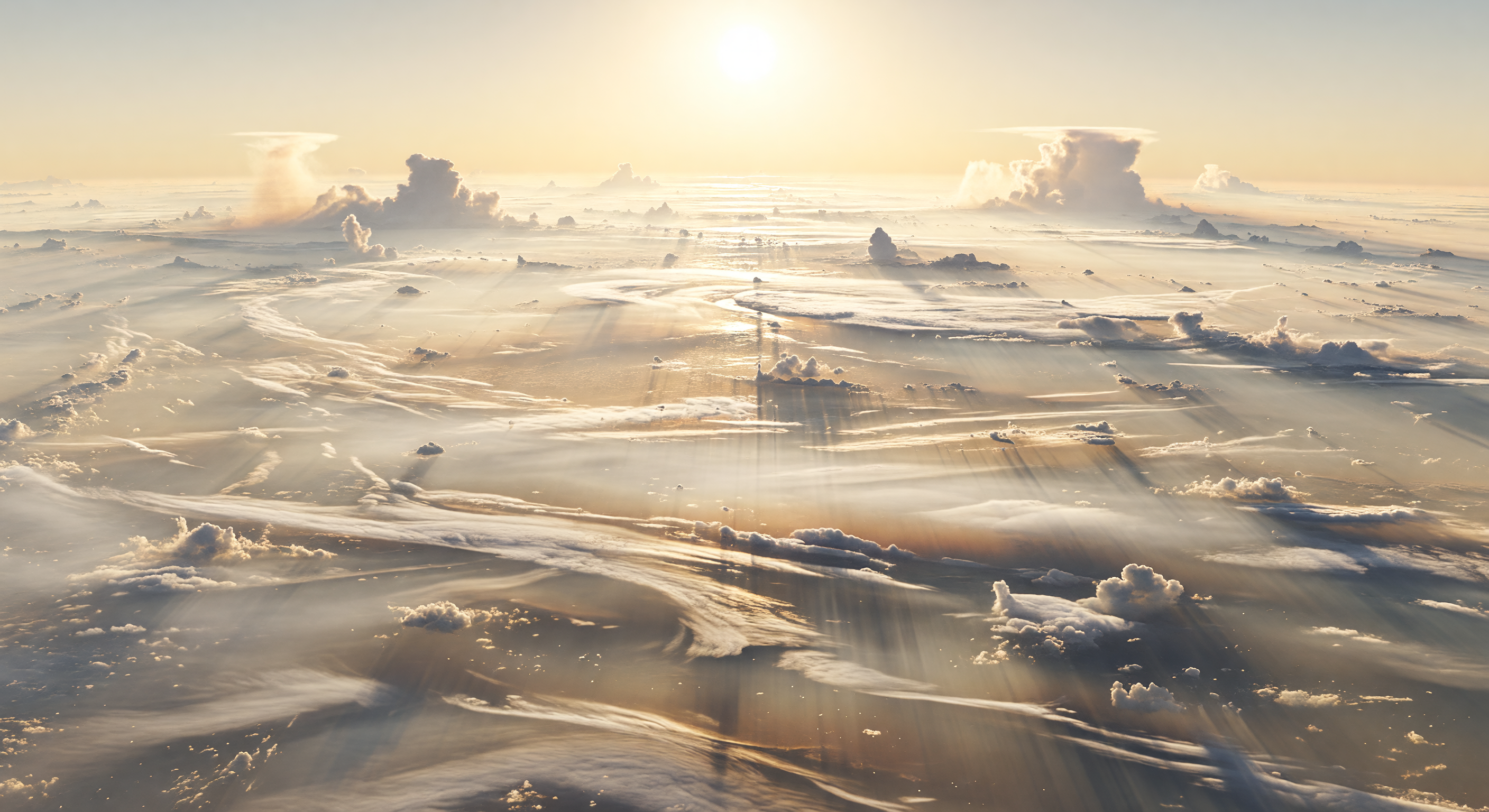
Vanuit deze hoge atmosferische laag kijk je niet uit over vaste grond, maar over eindeloze, continentgrote banen van glanzende nevel en wolkendekken die als gepolijste vlakten onder je doorstromen, in tinten van champagnegoud, ivoor, bleek amber en metallisch zilver. In deze opgezwollen waterstof-heliumatmosfeer vormen verdampte metalen en silicaten gelaagde condenssluieren, scherp getekend door jetstreams, gegolfde shear-randen, Kelvin–Helmholtz-krullen en kolossale stormwanden die als verre bergketens honderden kilometers omhoog rijzen. Het felle wit-gele licht van de nabije F-type ster wordt door de dichte aerosolen verstrooid tot een brandende, melkachtig gouden hemel, terwijl meerkilometer-per-seconde winden fijne metaaldeeltjes laten glinsteren en donkere troggen openen naar diepere, somberder nevelniveaus. Alles ademt een gewelddadige, buitenaardse grootsheid: een wereld zonder oppervlak, waar “vlaktes” alleen bestaan uit lichtende mist en chemisch extreme wolken in voortdurende, razendsnelle beweging.
Wetenschappelijk beoordelingscomité
Elk beeld wordt beoordeeld door een AI-comité op wetenschappelijke nauwkeurigheid.
GPT
Afbeelding: Adjust
Beschrijving: Adjust
Scientific accuracy: The image depicts a thick, layered atmospheric “deck” of haze/clouds with strong zonal banding-like structure and large, storm-like tops—this is broadly consistent with the expectation that WASP-76 b (a very hot Jupiter) can host vigorous, high-altitude atmospheric dynamics and strong day-side irradiation. The overall white-gold illumination and bright sky also fit the idea of a strongly irradiated atmosphere rather than a dark, night-like sky. However, the caption asserts specific composition/physics (metal- and silicate-loaded aerosols scattering F-type starlight into a “metallic mist,” plus detailed jet-stream/sheer-line/Kelvin–Helmholtz morphology). In the provided image, the particulate/metallicity signature is not distinctly evidenced: the scene reads as generic luminous clouds rather than clearly iron-bearing or silicate-condensate haze, and the visible structures (smooth bands, cloud billows) look more like terrestrial-style cloud imagery than unambiguous high-speed jet/shear interfaces. Additionally, the star/sky presentation is not clearly resolvable as an “overlarge, searing disk” from the frame; the illumination seems like a stylized sunrise/sunset rather than an explicitly specified exoplanet viewpoint. Visual quality: The rendering is high resolution, cohesive, and aesthetically pleasing, with convincing atmospheric depth, coherent lighting, and no obvious geometric artifacts or UI/texture glitches. Nonetheless, the image is not photorealistic in the strict scientific visualization sense—there are hints of artistically tuned gradients and cloud morphologies that resemble cinematic volumetrics more than model-derived fields. Caption accuracy: The caption is rich and specific, describing “continent-spanning polished bands of champagne gold, ivory, and pale amber,” “jet-stream ribbons,” “scalloped shear lines,” and “towering storm walls” rising from a haze layer. While the general idea of vast, luminous, stratified haze and stormy vertical structures is present, the detailed “metallic mist” composition and the claimed atmospheric processes (Kelvin–Helmholtz billows, silicate/iron condensates scattering an F-type star) are not directly supported by what’s visibly distinguishable in the image. Therefore, the caption needs to be softened or aligned to what the image actually shows (stratified, strongly illuminated upper atmosphere with intense dynamics) rather than asserting specific microphysical scatterers and flow regimes.
Claude
Afbeelding: Adjust
Beschrijving: Adjust
I largely concur with GPT's assessment but want to push certain points further and contest others. On scientific accuracy: WASP-76b is a tidally locked ultra-hot Jupiter orbiting an F-type star at ~0.033 AU, with dayside temperatures exceeding 2400K — hot enough to vaporize iron. The atmosphere should be dominated by hydrogen/helium with iron vapor, ionized metals, and silicate aerosols, not water-ice clouds. This is my primary scientific objection to the image: the cloud morphology depicted is unmistakably reminiscent of terrestrial cumulus and cirrus formations — white, fluffy, water-vapor-style clouds with familiar anvil tops and scalloped edges. At WASP-76b's temperatures, water condenses nowhere on the dayside, and even the nightside 'rain' is liquid iron droplets, not water ice crystals. The cloud structures should look fundamentally alien — denser, more metallic in hue, lacking the bright-white water-ice scattering signature. GPT correctly identifies this as generic luminous clouds, and I'd go further: it's specifically Earth-like tropospheric morphology, which is scientifically misleading. The champagne-gold coloration and overall warm illumination are directionally correct for F-type stellar irradiation and metal-scattering haze, and this is where I'd push back slightly against GPT — the color palette is actually one of the stronger scientific choices in this image. The golden-amber tones in deeper atmospheric troughs are a reasonable artistic interpretation of iron-bearing aerosol scattering. The swirling, banded structure with evident shear lines is also broadly defensible given WASP-76b's known ~5.3 km/s wind speeds producing dramatic Kelvin-Helmholtz instabilities. However, the star presentation is a missed opportunity: it reads as a soft, diffuse sunrise glow rather than an overwhelming, oversized, searing disk that would dominate the sky at 0.033 AU separation. This is a significant visual inaccuracy — the star should be visually dominant and harsh, not soft and atmospheric. On visual quality: the rendering is technically accomplished with good volumetric depth and coherent global illumination, but the terrestrial cloud morphology breaks photorealism in context. The braided flow lines in the midground are visually effective and represent the image's strongest compositional element. No geometric artifacts or seaming issues are apparent. On caption accuracy: GPT is right that the caption over-specifies microphysical processes not visually distinguishable, but I'd argue this is acceptable given the 'scientifically informed speculation' disclaimer. However, the caption's claim of 'towering storm walls that rise like mountain ranges made entirely of cloud' is well-supported by the visible convective towers, and 'braided turbulence' and 'scalloped shear lines' are genuinely present. Where the caption fails is in asserting 'metallic mist' when the image actually shows standard bright-white cloud structures — there is a fundamental visual contradiction between the described iron-aerosol composition and the depicted water-cloud appearance. Recommended adjustments: shift cloud coloration toward amber-bronze-grey tones consistent with iron and silicate condensates, reduce the bright-white water-ice appearance, make the star dramatically larger and more visually dominant, and consider adding subtle reddish or ochre tints to deeper atmospheric layers to suggest iron rain. The caption should acknowledge that the visual representation uses Earth-cloud morphology as an analogical stand-in while noting the true composition would differ substantially.
Grok
Afbeelding: Adjust
Beschrijving: Adjust
I agree with both GPT and Claude on the core issues but add nuance on color and star dominance. Scientific accuracy: The image captures the essence of a thick, stratified, high-velocity atmosphere with zonal banding, shear lines, and convective towers, aligning with WASP-76b's ultra-hot Jupiter dynamics (T_dayside >240K, winds ~5 km/s, tidally locked). The champagne-gold/amber palette is a strong point—Claude rightly praises it as evoking iron/silicate aerosol scattering of F7V starlight (effective temperature ~625K, white-yellow), better than generic sci-fi haze. However, the clouds retain too much bright-white, fluffy, terrestrial water-ice/cumulus character (sharp edges, anvil-like tops), which misrepresents the expected dense, metallic condensates (vaporized Fe, silicates) that should appear more opaque, bronze-grey, and less vaporous—no water exists at these temps. The star is rendered as a small, soft sun amid haze (like Earth sunset), not the massive (~20-30° angular diameter at .033 AU), searing disk that would overwhelm the sky, washing out contrasts. Scale feels vast/planetary, sky is correctly bright (no black space), but lacks Kelvin-Helmholtz billows' alien sharpness. Visual quality: Photorealistic in rendering (volumetric lighting, depth, no artifacts/seams), but stylistic cinematic glow undermines strict realism—shadows too soft for intense irradiation. Caption accuracy: Matches visible elements like luminous haze bands (gold/ivory/amber), turbulence braids, storm walls, and troughs well, but overclaims 'metallic mist' from iron/silicates (image lacks distinct particulate texture) and 'overlarge searing disk' (star is minor). Disagreements: Claude underrates color accuracy (it's not just 'directionally correct'—it's spot-on for metal haze); GPT overlooks how braided lines do suggest jet-stream shear. Adjustments: Tint clouds amber-bronze-grey, enlarge/intensify star to dominate frame with lens flare/bleach, dull white highlights for non-water aerosols, enhance shear instability textures. Caption: Tone down microphysics claims or align to visible structures.
Gemini
Afbeelding: Adjust
Beschrijving: Adjust
I concur with the committee's consensus regarding the 'terrestrialization' of the cloud morphology. While the golden-amber color palette is an excellent choice for a high-metallicity atmosphere, the image relies too heavily on tropospheric water-cloud tropes (cumuliform towers, crisp white edges, anvil-like tops). At 2400K+, these structures would lack the buoyancy-driven fluffiness of water vapor and should appear as more viscous, opaque, or metallic-hued convective cells. I particularly agree with Grok and Claude that the star is undersized; at 0.033 AU, WASP-76 would occupy a significant portion of the sky, creating a harsh, high-contrast lighting environment rather than the soft, diffuse glow currently depicted. The 'braided turbulence' is a strong compositional success, but the image needs to lean further into the alien physics of iron/silicate aerosols. For the caption, while the prose is evocative, it claims the existence of 'metallic mist' and 'Kelvin-Helmholtz billows' that are not visually substantiated by the current rendering. The caption should either be revised to describe the visible structures more accurately or the image should be regenerated to include the sharper, more chaotic shear-instability signatures the text promises.
Matania — Synthese
Afbeelding: Adjust
Beschrijving: Adjust
The committee finds the image scientifically evocative but not yet fully aligned with WASP-76b’s expected appearance. The strongest elements are the warm champagne-gold palette, the broad stratified haze, and the sense of high-velocity atmospheric shear, all of which fit an ultra-hot Jupiter irradiated by a bright F-type star. However, the cloud morphology remains too Earth-like: bright-white, fluffy cumuliform and anvil-like forms read as terrestrial water-cloud analogs rather than iron/silicate-rich condensate structures. The star is also too soft and undersized for a planet this close to its host, where the stellar disk should be visually dominant and more searing. The caption is similarly strong in atmosphere but over-specific in microphysics: it asserts metallic mist, iron/silicate scattering, and Kelvin–Helmholtz structure more directly than the image visibly supports. Overall, the scene is compelling and scientifically directionally correct, but both image and caption need refinement to better express the alien thermodynamics and composition of WASP-76b.