Scientific confidence: Medium
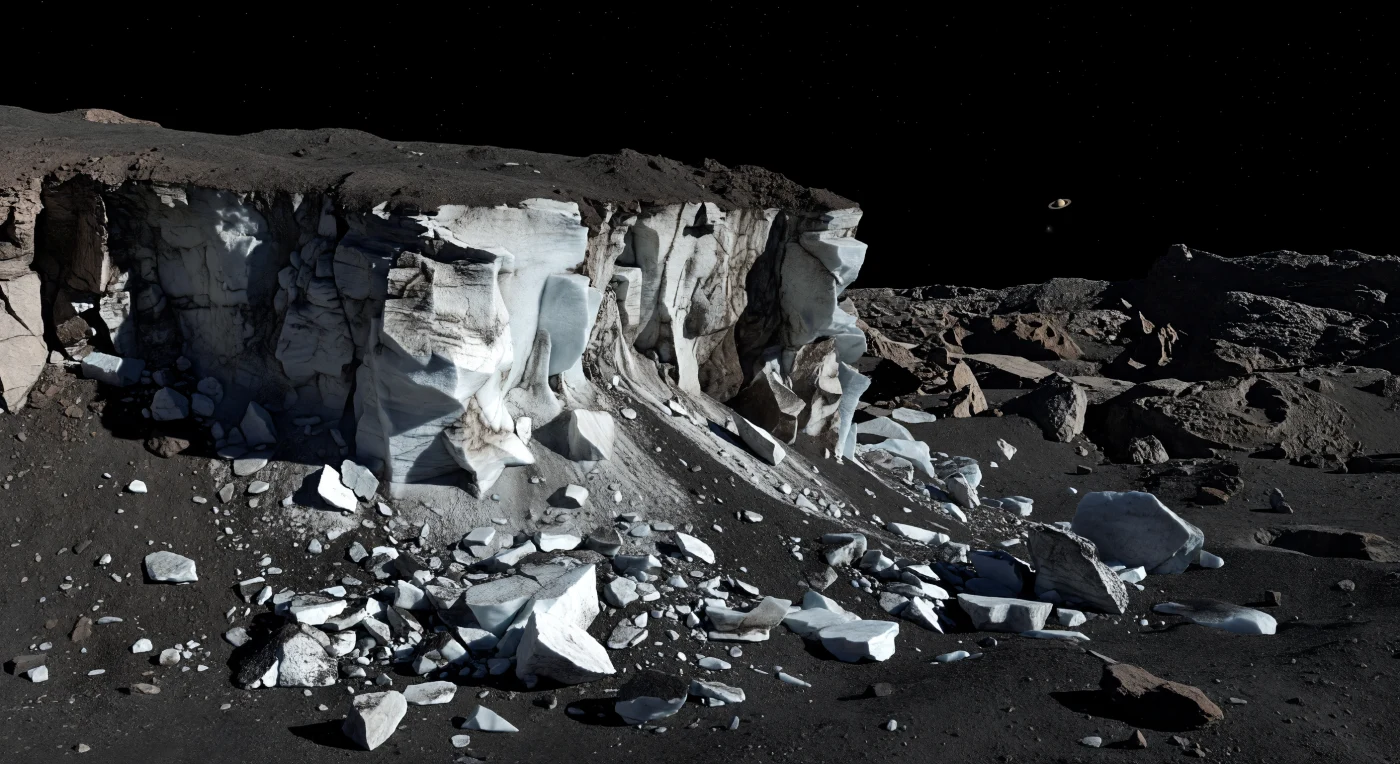
At the foot of a towering impact scarp, the ground is a jumbled carpet of sharp black regolith and angular fallen blocks, while above, a thin dark mantle of carbon-rich dust is sliced open to expose a brilliant ice-rich cliff face streaked with dirty white, pale gray, and faint bluish tones. In the hard, low-angle sunlight of an airless vacuum, every fracture, ledge, and shadowed crevice stands out with razor clarity, revealing a surface shaped by repeated impacts, mass wasting, and the preservation of unusually steep slopes under gravity so weak that debris can remain perched in precarious forms. The contrast between the soot-dark outer coating and the gleaming water-ice interior hints at a primitive body made of mixed rock and volatiles, likely little changed since the early Solar System except where collisions have torn it open. Beyond the cliff, broken crater rims and battered uplands fade into a black sky, where a tiny distant Sun casts a cold light over a landscape that feels both intimate and immense, as if you are standing inside the exposed anatomy of an ancient world.

You stand on a bleak, uneven plain of charcoal-black regolith and shattered ejecta, where angular boulders, fractured slabs, and faint frost-bright patches of freshly exposed ice litter the floor of an ancient basin immense enough to dominate this tiny, irregular world. All around, colossal terraced walls surge upward in stark relief, their cliffs and slump-scarred ledges striped with brilliant white to pale gray water-ice revealed beneath a darker, carbon-rich surface mantle, a vivid record of violent impacts and dry mass wasting in an airless vacuum. With gravity only a tiny fraction of Earth’s, steep scarps and kilometer-scale topography can persist here, and with no atmosphere, no liquid erosion, and no weather, the landscape is shaped almost entirely by crater excavation, brittle fracture, and the slow downslope creep of loose debris. Overhead, the sky is perfectly black and the distant Sun burns small and hard, casting knife-edged shadows that make the basin feel at once frozen, silent, and impossibly vast.

From this ground-level vantage, the horizon is a tangle of intersecting crater rims and saddle-backed uplands, where fractured charcoal-black bedrock, blocky ejecta, and loose talus rise in steep, angular forms that survive because gravity here is extraordinarily weak. The surface is mantled by very dark, carbon-rich regolith mixed with dirty water ice, and where fresh impacts or collapses have sliced into that coating, narrow white to faintly bluish scar lines gleam from exposed ice in stark contrast to the matte black terrain. In the airless vacuum, every ridge and distant crater crest remains unnervingly crisp against the black sky, with no haze to soften the view, while the tiny Sun casts razor-edged shadows into gullies and alcoves and a small, pale Saturn hangs far away like a delicate marker of scale. Standing here, you would feel the paradox of a small captured world made monumental by impacts—an ancient, frozen highland landscape whose battered relief preserves clues to primitive outer Solar System materials.
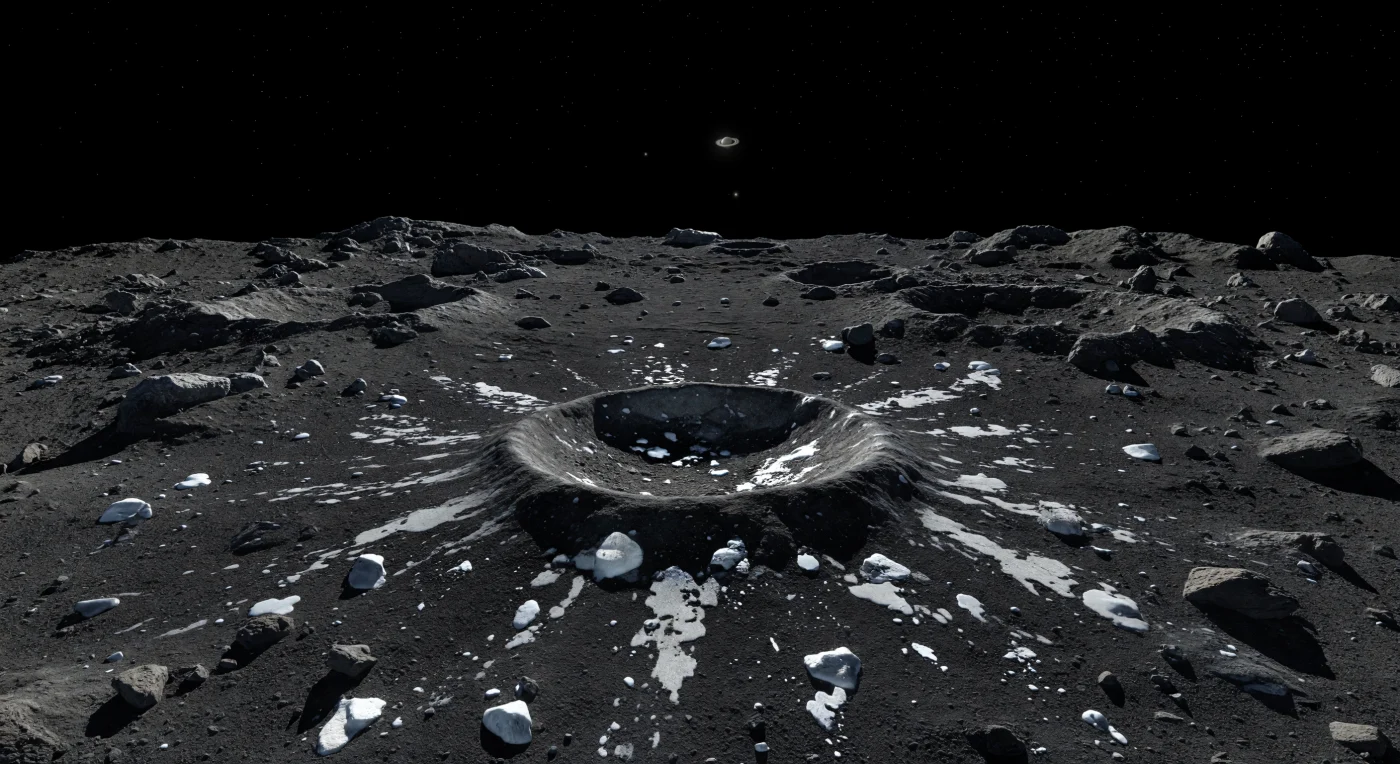
Across a charcoal-black plain pitted by countless ancient microcraters, a small fresh impact crater opens suddenly in the gloom, its razor-sharp rim and steep inner walls standing out under hard sunlight from a tiny distant Sun. The blast has thrown a mottled halo of debris across the old regolith: dirty-white icy clasts, brighter frostlike fragments, and dark carbon-rich powder radiate over the battered surface, revealing that beneath the moon’s low-albedo mantle lies a mixture of water ice and rock. In this airless, frigid environment, with gravity so weak that steep slopes and crisp ejecta patterns can persist and some impact debris can even escape entirely, every shadow falls long and knife-edged across boulders, hummocks, and overlapping crater rims. The result is a landscape that feels both frozen in time and violently excavated—an exposed relic of the outer Solar System, where ancient darkness has been freshly torn open to expose pale material below.

You stand on a stark polar plain where nearly horizontal sunlight skims over charcoal-dark regolith, coarse impact breccia, and scattered angular boulders, pulling razor-sharp shadows for kilometers across a horizon so tightly curved it betrays the tiny size of this battered world. Pale frost and dirty-white ice cling to microdepressions and the shaded rims of small craters, preserved in the deep cold and flashing faint bluish highlights against a surface darkened by carbon-rich debris. Everywhere the landscape is ruled by impacts—overlapping bowl-shaped craters, hummocky ejecta, fractured scarps, and raised rims that look exaggerated in the moon’s feeble gravity, where steep relief can survive for eons. Above it all hangs a perfectly black, airless sky with no haze or twilight, the distant Sun reduced to a hard, brilliant point of light that makes the wasteland feel both frozen in time and exposed to the raw emptiness of the outer Solar System.

From this ground-level vantage, an ancient plain of overlapping, degraded craters rolls away in broad dark swells, the surface mantled in compacted charcoal-black regolith strewn with angular boulders and half-buried crater rims softened by eons of impact gardening. Here and there, mottled bright patches and pale streaks flash from scarps and inner slopes where fresher impacts have punched through the dark, carbon-rich mantle to expose cleaner water ice beneath, revealing the mixed rock-and-ice makeup of this primitive captured body. Under a tiny, fiercely bright Sun and a perfectly black vacuum sky, every stone throws a razor-edged shadow, while the extremely low gravity allows unusually steep rims and rugged relief to persist across a landscape shaped almost entirely by relentless bombardment. The result is a silent, starkly alien world where kilometer-scale crater chains fade toward the horizon, and even a few small foreground rocks make you feel the vast age, emptiness, and fragility of this battered outer Solar System terrain.
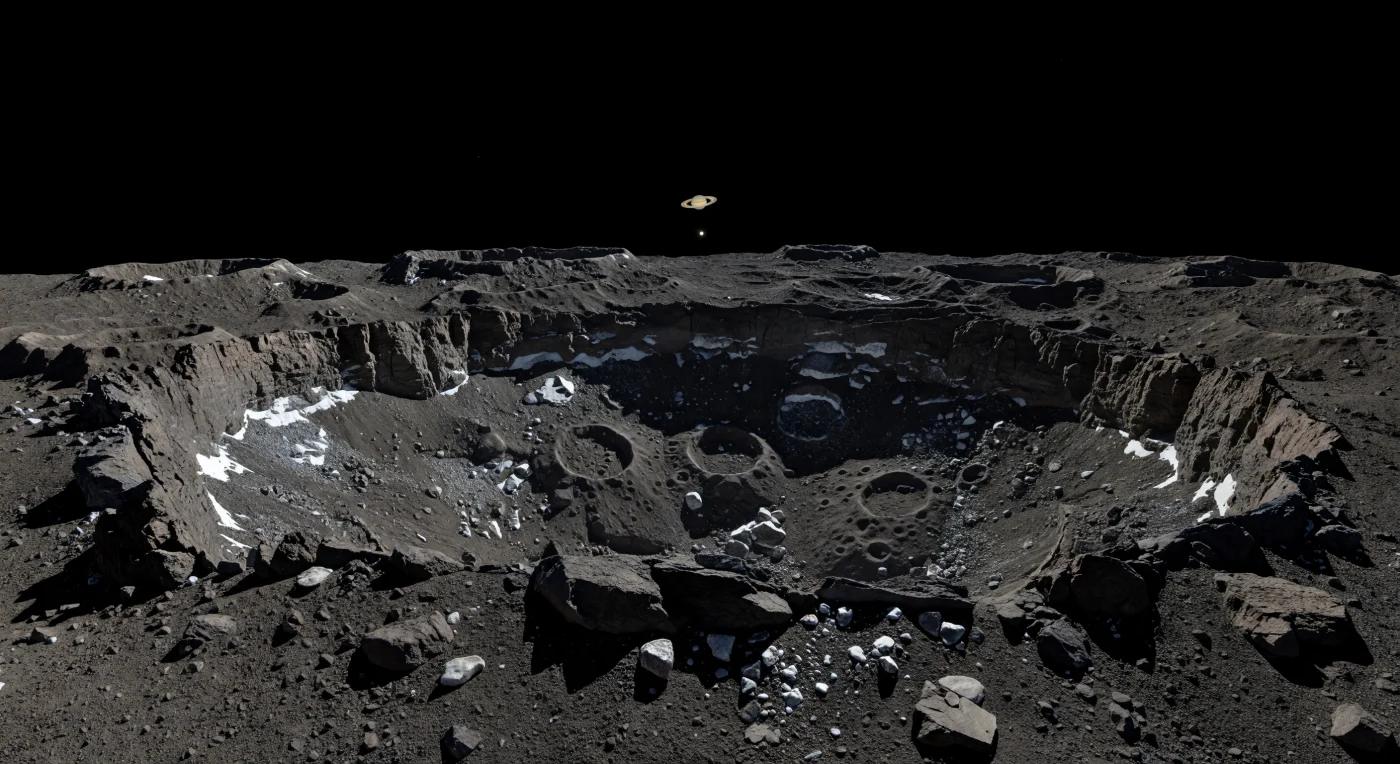
From this knife-edged crater rim, the ground is a harsh mosaic of charcoal-dark dust, shattered breccia blocks, and a few bright shards of exposed water ice catching the weak sunlight, while steep rubble slopes fall away into a labyrinth of overlapping craters and battered uplands. The landscape preserves impact damage with extraordinary clarity because there is no air, liquid, or active erosion here—only cold, carbon-rich regolith, fractured rock, and ice-rich scarps left bare by collisions on a tiny world whose gravity is so feeble that block fields and sharp relief can endure for eons. Above the serrated horizon, the sky is perfectly black, and Saturn hangs low as a small, delicate ringed disk, visibly distant compared with the grand views from the inner system. Under the Sun’s hard point-source light, every boulder throws a jet-black shadow, making the terrain feel both frozen in time and immense, as if you are standing on the broken skin of a captured relic from the outer Solar System.

At the bottom of this deep impact basin, you stand in a cold trap where sunlight never directly reaches, and the landscape is almost swallowed by darkness: a flat, subtly rumpled floor of charcoal-black regolith, angular ejecta blocks, and carbon-rich dust stretches into black, towering crater walls. Only a faint wash of reflected light from a distant sunlit rim high above reveals texture in the impact-gardened escarpments and catches a few bluish-white glints where water ice lies exposed along fractures, sheltered pockets, and bright streaks on the cliffs. This stark contrast reflects the moon’s unusual makeup—a primitive mix of dark rocky material and ice, likely preserved from the outer Solar System—while the tiny gravity allows steep, jagged relief and house-sized boulders to remain strewn across the basin. Under an airless black sky, with perhaps only a pin-small Sun beyond the rim, the scene feels less like a crater than a frozen natural vault: silent, ancient, and so light-absorbing that the darkness itself seems geological.

At ground level, the landscape is a stark field of charcoal-black regolith, its coarse grains, pebbly ejecta, and countless tiny impact pits etched with startling precision by the hard light of a very small, distant Sun. Here, every sharp-edged craterlet and loose fragment tells the story of relentless impact gardening on an airless world, where dark primitive, carbon-rich debris is mixed with crushed rock and ice, and fresh breaks occasionally flash silver-gray where water-ice-rich material has been excavated from beneath the darker mantle. The weak gravity leaves slopes crisp and rubble only loosely settled, so even low ridges and shallow rims feel exaggerated against the plain as it rises toward rugged cratered uplands and angular outcrops. Overhead, the sky is absolute black, without haze or weather, and the razor-sharp shadows beneath each pebble make the frozen stillness feel immense, ancient, and profoundly otherworldly.

You stand on a steep, broken staircase carved into a crater wall, where dark charcoal regolith and shattered black-brown debris spill over sharp ledges while pale gray to dirty-white streaks of freshly exposed ice-rich material gleam from fractured scarps. Meter-scale blocks, coarse breccia, and angular talus litter every bench, and in the tiny gravity the oversteepened terraces remain unnervingly crisp, their geometry sharpened by a small, distant Sun that throws hard-edged shadows into lightless bands of black. These contrasting layers record a surface mantled by carbon-rich, low-albedo material that has slumped and fractured to uncover a brighter mixture of water ice and rock beneath, exposing the internal makeup of a primitive, heavily battered body from the outer Solar System. Beyond the descending steps, jagged crater rims, overlapping impacts, and hummocky ejecta rise and fall across an irregular horizon under a sky of absolute black, making the landscape feel at once miniature in world size and immense in local relief.
