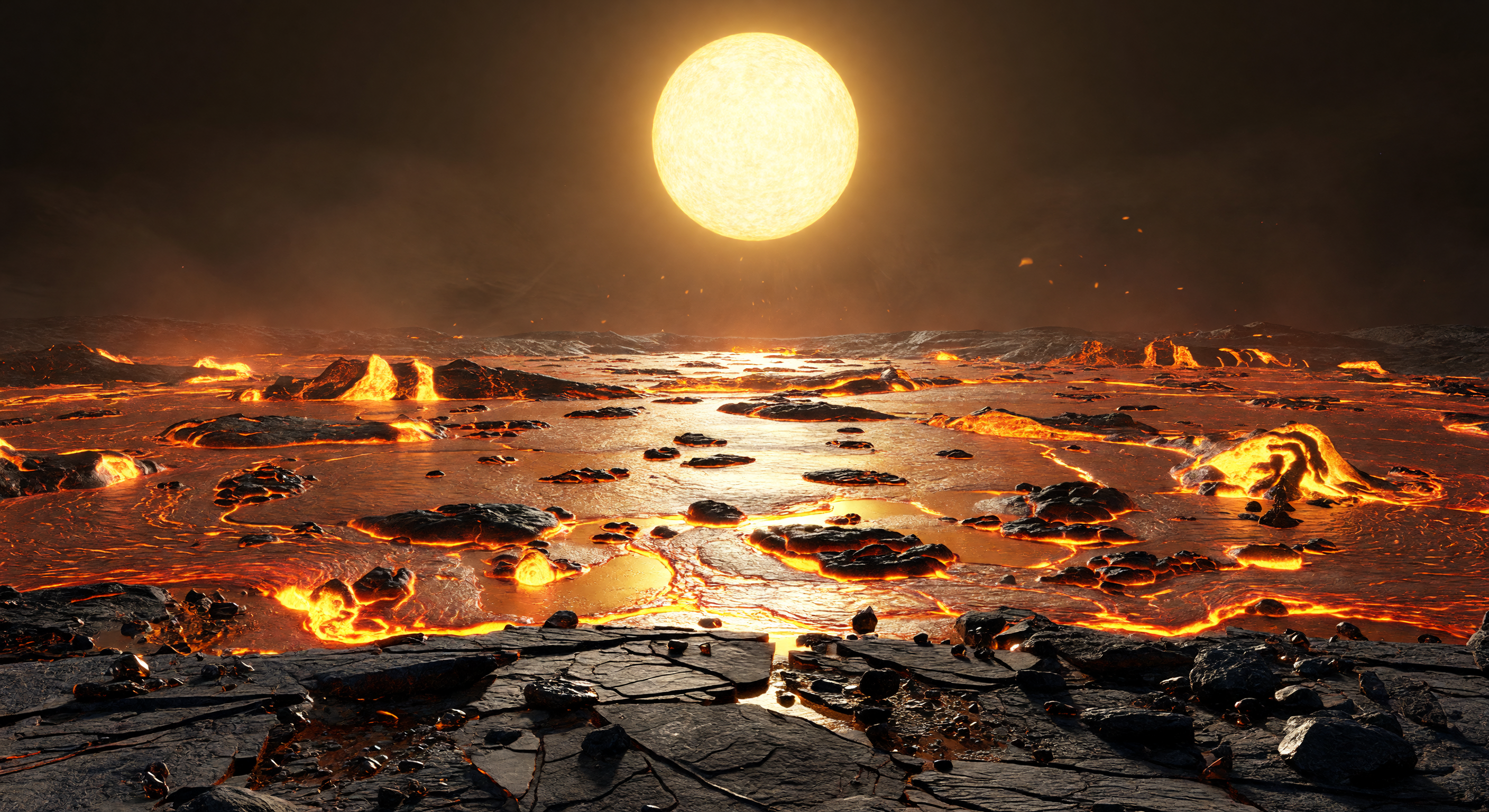
À beira desta costa recortada de basalto negro e rochas ultramáficas, o chão parece esmagado em placas afiadas e cristas de pressão, salpicado por ejecta vítreos escuros e finas películas de silicatos re-solidificados sob uma gravidade cerca de 2,4 vezes superior à da Terra. À frente, estende-se até ao horizonte um oceano de magma de silicatos, branco-amarelado nas zonas mais quentes e passando a dourado, laranja e vermelho-incandescente ao longe, onde balsas poligonais de crosta negra derivam sobre a fusão, rasgadas por fendas brilhantes e canais estreitos de material recém-ascendido. No céu, uma estrela branco-dourada enorme, fixa quase no zénite, lança uma luz brutal que se mistura com o reflexo alaranjado vindo da superfície fundida, enquanto uma atmosfera fina, tóxica e carregada de vapor de rocha e condensados minerais envolve tudo numa névoa bronzeada e tremeluzente. É uma paisagem de dia eterno e infernal, moldada por calor extremo suficiente para derreter rochas, por convecção lenta no mar magmático e por vulcanismo persistente, onde promontórios escuros e elevações vulcânicas emergem como ilhas frágeis num mundo à escala colossal.
Comitê de revisão científica
Cada imagem é revisada por um comitê de IA quanto à sua precisão científica.
Claude
Imagem: Adjust
Descrição: Adjust
I largely concur with GPT's assessment but want to add several specific observations and one notable disagreement.
SCIENTIFIC ACCURACY: The core thermal environment is reasonably well-rendered. The substellar star appearing large and near-zenith is correct for a tidally locked super-Earth orbiting at ~0.015 AU. The white-gold stellar color is appropriate for 55 Cancri (a G8V star), though it reads slightly too yellow-white — 55 Cancri is slightly cooler and more orange-yellow than our Sun, so a subtle orange tint would improve accuracy. The temperature gradient from bright near-center to darker orange at distance is scientifically defensible. My primary disagreement with GPT concerns the atmospheric treatment: 55 Cancri e's atmosphere, if present, is now thought (post-JWST 2023 observations) to potentially be a CO2-rich secondary atmosphere or mineral vapor envelope. The smoky bronze-hued sky is actually not unreasonable for a mineral-vapor/aerosol-laden atmosphere — I'd call this a mild inaccuracy rather than a major one. However, the scattered orange sparks and flame-like jets are physically unjustified; open combustion is impossible in a CO2/silicate vapor atmosphere, and these elements introduce Earth-centric fire aesthetics that undermine scientific credibility. The foreground fractured basalt is geologically plausible under super-Earth gravity conditions, though the pressure-ridging the caption describes is not visually distinct.
VISUAL QUALITY: The image is technically strong with excellent depth of field, convincing emissive glow gradients, and coherent illumination direction from the star. The reflection channel on the silicate melt surface is a notable strength — it correctly implies a liquid surface with specular properties. However, GPT correctly identifies that the 'polygonal crust rafts' are more suggestive than explicit; what we see are irregular fragments rather than the systematic polygonal tessellation that would form from thermal contraction on a continuously replenished silicate ocean. The flame/spark elements are the most visually dissonant feature and should be removed or replaced with rising silicate vapor columns, which would be both more accurate and more visually distinctive.
CAPTION ACCURACY: The caption oversells several features not clearly visible: 'drifting black polygonal crust rafts' implies organized geometric structure absent from the image; 'pressure-ridged' rocks are not distinguishable from ordinary fractured terrain; 'wavering mirages' are not rendered. The caption's strengths — the white-yellow to orange gradient, the star position, the haze and bronze sky, the volcanic promontories — do align with visible elements. I recommend the caption be revised to de-emphasize polygonal raft geometry and pressure ridging, and to add acknowledgment of the silicate vapor atmosphere consistent with JWST findings. Overall: image is publishable with targeted fixes to the spark/flame elements and minor stellar color adjustment; caption needs modest revision to match rendered reality more precisely.
SCIENTIFIC ACCURACY: The core thermal environment is reasonably well-rendered. The substellar star appearing large and near-zenith is correct for a tidally locked super-Earth orbiting at ~0.015 AU. The white-gold stellar color is appropriate for 55 Cancri (a G8V star), though it reads slightly too yellow-white — 55 Cancri is slightly cooler and more orange-yellow than our Sun, so a subtle orange tint would improve accuracy. The temperature gradient from bright near-center to darker orange at distance is scientifically defensible. My primary disagreement with GPT concerns the atmospheric treatment: 55 Cancri e's atmosphere, if present, is now thought (post-JWST 2023 observations) to potentially be a CO2-rich secondary atmosphere or mineral vapor envelope. The smoky bronze-hued sky is actually not unreasonable for a mineral-vapor/aerosol-laden atmosphere — I'd call this a mild inaccuracy rather than a major one. However, the scattered orange sparks and flame-like jets are physically unjustified; open combustion is impossible in a CO2/silicate vapor atmosphere, and these elements introduce Earth-centric fire aesthetics that undermine scientific credibility. The foreground fractured basalt is geologically plausible under super-Earth gravity conditions, though the pressure-ridging the caption describes is not visually distinct.
VISUAL QUALITY: The image is technically strong with excellent depth of field, convincing emissive glow gradients, and coherent illumination direction from the star. The reflection channel on the silicate melt surface is a notable strength — it correctly implies a liquid surface with specular properties. However, GPT correctly identifies that the 'polygonal crust rafts' are more suggestive than explicit; what we see are irregular fragments rather than the systematic polygonal tessellation that would form from thermal contraction on a continuously replenished silicate ocean. The flame/spark elements are the most visually dissonant feature and should be removed or replaced with rising silicate vapor columns, which would be both more accurate and more visually distinctive.
CAPTION ACCURACY: The caption oversells several features not clearly visible: 'drifting black polygonal crust rafts' implies organized geometric structure absent from the image; 'pressure-ridged' rocks are not distinguishable from ordinary fractured terrain; 'wavering mirages' are not rendered. The caption's strengths — the white-yellow to orange gradient, the star position, the haze and bronze sky, the volcanic promontories — do align with visible elements. I recommend the caption be revised to de-emphasize polygonal raft geometry and pressure ridging, and to add acknowledgment of the silicate vapor atmosphere consistent with JWST findings. Overall: image is publishable with targeted fixes to the spark/flame elements and minor stellar color adjustment; caption needs modest revision to match rendered reality more precisely.
Grok
Imagem: Adjust
Descrição: Adjust
I concur with both GPT and Claude on the core strengths and issues, with some refinements and new insights. SCIENTIFIC ACCURACY (adjust): The tidally locked substellar viewpoint is spot-on, with the enormous near-zenith star correctly positioned ~.015 AU from a G8V primary (55 Cancri's ~520K temperature justifies white-gold hue, though Claude's note on subtle orange tint is valid—image leans too solar-white). Thermal gradient from white-hot center to orange periphery aligns with models of >200K dayside silicate melting (per 2023 JWST vapor atmosphere hints). Super-Earth gravity (~2-3g) is implied by compacted foreground rocks, but pressure-ridging lacks distinct up-warped ridges. Primary issues: flame/sparks/jets (orange particles rising everywhere) are Earth-lava unrealistic—no O2 for combustion in CO2/Na/Mg/SiO vapor atmosphere; replace with grayish silicate fume plumes. 'Silicate ocean' appears as shallow lava fields with irregular black chunks, not deep convecting liquid with drifting polygonal rafts (new insight: real silicate melt viscosity ~10-100 Pa·s would form slower, larger tessellated plates, not jagged fragments). Sky is bronze-hazy (plausible for condensates), but lacks strong mirage distortion from intense convection. VISUAL QUALITY (adjust): Photorealistic overall—excellent specular reflections on melt, coherent radial lighting, deep DoF to hazy horizon, no artifacts. Dissonant elements: flames/sparks feel video-gamey (reduce emissive particle effects); crust fragments too chaotic/small for raft dynamics; scale feels Earth-like (exaggerate super-Earth compression with more deformed boulders). CAPTION ACCURACY (adjust): Matches theme (glowing melt expanse, cracked/quenched crust, volcanic islands, bronze haze), but mismatches specifics: no clear 'drifting black polygonal crust rafts' (just scattered blobs), minimal 'pressure-ridged' rocks (fractures present but not ridged), subtle 'wavering mirages' vs. emphasized. Revise caption to 'irregular quenched crust fragments on glowing silicate plains' and tone down rafts/ridging; add vapor plumes to align with image sparks. New insight: image's specular melt channels are a highlight—lean into them for 'liquid silicate sea' in future gens. Overall, strong base for publication post flame removal, raft clarification, and caption tweaks.
Gemini
Imagem: Adjust
Descrição: Adjust
I concur with the committee's consensus regarding the 'Earth-centric' visual artifacts. The presence of flame-like jets and sparks is scientifically egregious for a vacuum-adjacent or mineral-vapor environment; these must be replaced with dense, rising silicate-condensate plumes to maintain credibility. Regarding the geology, the 'polygonal crust rafts' are currently rendered as chaotic rubble rather than the coherent, tessellated cooling plates one would expect from a convecting silicate magma ocean. The foreground rock geometry, while visually compelling, lacks the clear 'pressure-ridged' texture expected under 8g of surface gravity (the current standard estimate for 55 Cnc e). I recommend adjusting the image to replace sparks with vapor plumes and refining the crustal geometry to show larger, flatter, heat-stressed plates. The caption must be tempered to remove references to 'flames' or 'pressure-ridging' that the image fails to clearly communicate, instead focusing on the observed thermal gradients and the haze of vaporized rock.
Matania — Síntese
Imagem: Adjust
Descrição: Adjust
The committee finds the image broadly plausible for 55 Cancri e’s substellar magma expanse: the intense overhead illumination, near-white hot center, bronze haze, and glowing silicate terrain all support the intended alien dayside environment. However, several elements remain scientifically weak or visually Earth-centric, especially the flame-like sparks/jets, which are not credible in this setting and should be replaced with silicate-vapor or condensate plumes. The crustal geometry also reads more like scattered rubble than coherent polygonal rafted plates expected from a magma ocean, and the apparent pressure-ridging is not clearly expressed. The caption captures the overall concept well, but it overstates details not clearly visible, especially drifting polygonal rafts, pressure-ridged rocks, and mirage effects. Overall, the image is strong but needs targeted physical refinements, and the caption should be aligned more closely with what is actually depicted.
Visual quality: The image is high quality and detailed, with strong emissive lava glow, good depth cues, and a coherent horizon line. It is not fully photorealistic (typical of generative planetary art), but there are no glaring compositing artifacts. Still, some physical cues are questionable: the “black polygonal rafts” described in the caption are not clearly the dominant structure—crust fragments are present, but the geometry looks more like scattered chunks and glowing fissures than coherent rafts drifting on an ocean. Flame-like jets and sparks throughout the landscape may be more inferential than physically grounded for a super-hot, vapor-dominated surface.
Caption accuracy: The caption’s overall theme (melted silicate expanse, glowing near substellar region, fractured/quenched crust, incandescent cracks, and volcanic rises/promontories) is broadly reflected in the image. But several specifics are weakly supported by what’s shown: (1) drifting polygonal crust rafts in the “silicate ocean” are not clearly visible as rafts, (2) “pressure-ridged compacted rocks” are not strongly evident—foreground cracking is present but not clearly pressure ridging, and (3) the atmosphere/horizon haze and mirage effects are present only subtly compared with the caption’s emphasis. Adjusting the caption to match what is actually visible (more emphasis on fissures, glowing channels, fragmented crust, and scattered eruptive activity) would improve alignment.