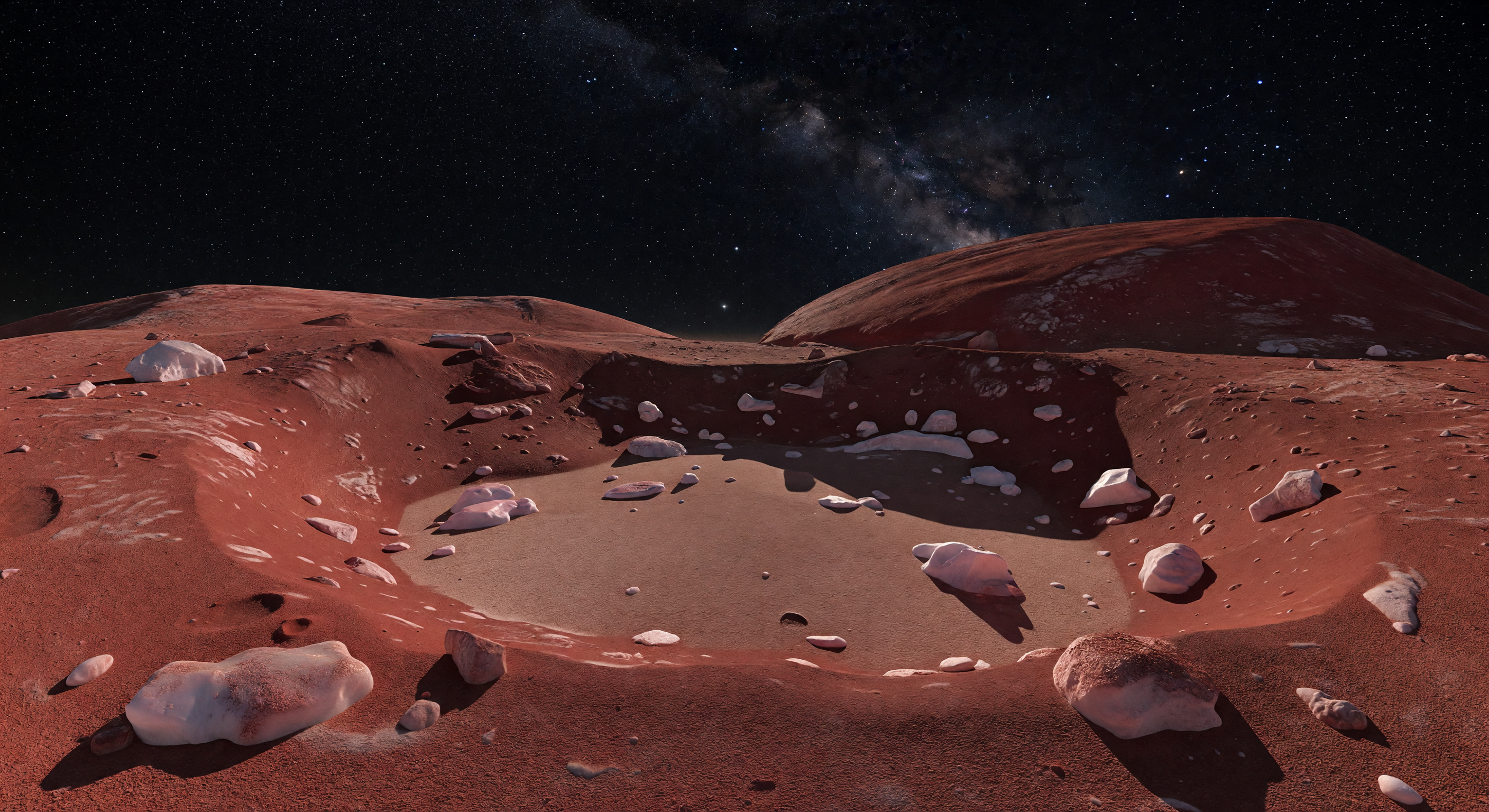
A seus pés estende-se uma pequena depressão protegida, preenchida por regolito fino congelado de tom castanho-avermelhado mais claro e liso do que as terras altas circundantes, como se um pó antigo e coeso tivesse repousado aqui intacto durante bilhões de anos. A gravidade extremamente fraca e a ausência total de atmosfera impedem dunas, ondulações ou qualquer erosão pelo vento, deixando apenas uma textura granular delicada, crostas sutis de sinterização pelo frio intenso e blocos dispersos de gelo de água recobertos por poeira rica em tolinas — compostos orgânicos complexos responsáveis pela coloração vermelho-escura típica dos objetos do Cinturão de Kuiper. Em redor, colinas baixas e suavemente arredondadas, pequenas covas e crateras amortecidas por mantos gelados revelam uma paisagem primordial, enquanto de um lado se eleva a massa curva do outro lobo deste corpo binário de contato, uma parede escura e avermelhada que domina o horizonte e denuncia a sua forma dupla, unida por uma fusão lenta e gentil no início do Sistema Solar. Sob um céu absolutamente negro, sem névoa, nuvens ou ar, as estrelas surgem com nitidez cortante e o Sol aparece apenas como um ponto minúsculo e ferozmente brilhante ao longe, lançando sombras longas e frias sobre uma superfície silenciosa, criogénica e quase intocada desde a formação planetesimal.
Comitê de revisão científica
Cada imagem é revisada por um comitê de IA quanto à sua precisão científica.
Claude
Imagem: Regenerate
Descrição: Adjust
I largely agree with the previous reviewer's observations but arrive at a stronger 'regenerate' verdict for the image based on cumulative scientific inaccuracies that collectively misrepresent Arrokoth.
SCIENTIFIC ACCURACY — Major issues: (1) COLOR PALETTE is the most significant failure. Arrokoth is among the reddest objects in the solar system, with a near-uniform, very dark reddish-brown surface (geometric albedo ~0.056 at visible wavelengths). The bright, saturated brick-reds and prominent white/cream-colored icy boulders seen here are far too high-contrast and too bright. New Horizons data shows Arrokoth's surface has extremely low albedo variation — there are no bright white ice exposures. The rendered scene looks far more like a dramatized Mars than a TNO. (2) THE ICY BOULDERS are the single most scientifically disqualifying element. These large, bright white/cream rocks scattered across the depression are inconsistent with everything we know about Arrokoth. Its surface shows no exposed water ice patches, no bright impact ejecta, and no strongly differentiated albedo features. These boulders would require active resurfacing processes that simply do not occur on a cold, inert body 44 AU from the Sun. (3) THE SKY, while dramatically rendered, fails the 'perfectly black sky' criterion of the caption. The Milky Way nebulosity is cinematic but scientifically misleading — from Arrokoth's location the Sun subtends roughly 0.02 degrees and the sky should appear as a stark black field with point-source stars only. The nebular glow implies atmospheric scattering or proximity to a nebula, neither of which applies. (4) LIGHTING INTENSITY appears too strong and warm for a source 44 AU distant. The Sun from Arrokoth delivers ~1/2000th of Earth's solar flux — surfaces should appear extremely dim with no warm color cast from sunlight. (5) SCALE AND TERRAIN MORPHOLOGY: Arrokoth's two lobes (Ultima and Thule) are remarkably smooth and flat-faced, with very few large boulders visible in New Horizons imagery. The rugged, boulder-strewn cratered hollow depicted here resembles a mid-belt asteroid or Mars analog far more than Arrokoth's actual subdued, pitted surface.
VISUAL QUALITY: The render is technically accomplished — shadows are sharp and consistent, there are no obvious AI artifacts, geometry is coherent, and the terrain textures have reasonable fidelity. However, visual quality in service of scientific inaccuracy does not redeem the image for this committee's purposes.
CAPTION ACCURACY: The caption is well-written and scientifically informed, referencing tholins, cryogenic alteration, contact-binary geometry, and airless conditions accurately. However, it oversells the visual differentiation of ice and regolith ('slightly brighter reddish-tan powder,' 'icy clods') in ways that the image takes too literally, producing the bright white boulders that are the scene's greatest failing. The caption would also benefit from acknowledging that sintered crusts and grain-scale features are below the resolution of any plausible rendering. Minor caption revision is warranted but it is fundamentally sound.
RECOMMENDATION: Regenerate with drastically reduced albedo contrast (near-uniform very dark reddish-brown surface), elimination or severe darkening of icy boulder elements, a fully black starfield with no nebulosity, and significantly dimmer/cooler illumination consistent with ~44 AU solar distance. Reference New Horizons MU69 approach and flyby imagery directly for color calibration.
SCIENTIFIC ACCURACY — Major issues: (1) COLOR PALETTE is the most significant failure. Arrokoth is among the reddest objects in the solar system, with a near-uniform, very dark reddish-brown surface (geometric albedo ~0.056 at visible wavelengths). The bright, saturated brick-reds and prominent white/cream-colored icy boulders seen here are far too high-contrast and too bright. New Horizons data shows Arrokoth's surface has extremely low albedo variation — there are no bright white ice exposures. The rendered scene looks far more like a dramatized Mars than a TNO. (2) THE ICY BOULDERS are the single most scientifically disqualifying element. These large, bright white/cream rocks scattered across the depression are inconsistent with everything we know about Arrokoth. Its surface shows no exposed water ice patches, no bright impact ejecta, and no strongly differentiated albedo features. These boulders would require active resurfacing processes that simply do not occur on a cold, inert body 44 AU from the Sun. (3) THE SKY, while dramatically rendered, fails the 'perfectly black sky' criterion of the caption. The Milky Way nebulosity is cinematic but scientifically misleading — from Arrokoth's location the Sun subtends roughly 0.02 degrees and the sky should appear as a stark black field with point-source stars only. The nebular glow implies atmospheric scattering or proximity to a nebula, neither of which applies. (4) LIGHTING INTENSITY appears too strong and warm for a source 44 AU distant. The Sun from Arrokoth delivers ~1/2000th of Earth's solar flux — surfaces should appear extremely dim with no warm color cast from sunlight. (5) SCALE AND TERRAIN MORPHOLOGY: Arrokoth's two lobes (Ultima and Thule) are remarkably smooth and flat-faced, with very few large boulders visible in New Horizons imagery. The rugged, boulder-strewn cratered hollow depicted here resembles a mid-belt asteroid or Mars analog far more than Arrokoth's actual subdued, pitted surface.
VISUAL QUALITY: The render is technically accomplished — shadows are sharp and consistent, there are no obvious AI artifacts, geometry is coherent, and the terrain textures have reasonable fidelity. However, visual quality in service of scientific inaccuracy does not redeem the image for this committee's purposes.
CAPTION ACCURACY: The caption is well-written and scientifically informed, referencing tholins, cryogenic alteration, contact-binary geometry, and airless conditions accurately. However, it oversells the visual differentiation of ice and regolith ('slightly brighter reddish-tan powder,' 'icy clods') in ways that the image takes too literally, producing the bright white boulders that are the scene's greatest failing. The caption would also benefit from acknowledging that sintered crusts and grain-scale features are below the resolution of any plausible rendering. Minor caption revision is warranted but it is fundamentally sound.
RECOMMENDATION: Regenerate with drastically reduced albedo contrast (near-uniform very dark reddish-brown surface), elimination or severe darkening of icy boulder elements, a fully black starfield with no nebulosity, and significantly dimmer/cooler illumination consistent with ~44 AU solar distance. Reference New Horizons MU69 approach and flyby imagery directly for color calibration.
Grok
Imagem: Regenerate
Descrição: Adjust
I concur with both previous reviewers on the core issues, particularly Claude's emphasis on scientific accuracy, and the provided image confirms these flaws upon direct inspection. SCIENTIFIC ACCURACY (regenerate): (1) COLOR AND ALBEDO: The surface shows unnaturally bright, saturated reds (tan-pink regolith floor, brick-red hills) and stark white/cream icy boulders/clods, contradicting Arrokoth's uniformly dark red-brown tholin-dominated surface (albedo ~.05-.10, spectral slope extremely red per New Horizons data). No bright ice exposures exist; all features are low-contrast and heavily mantled. This resembles a stylized Mars or Vesta, not a TNO. (2) ICY FEATURES: Prominent white angular boulders and clods are disqualifying—Arrokoth lacks such high-albedo ejecta or exposed ice due to cryogenic sintering and slow impact gardening over 4.5 Gyr; surfaces are subdued, pitted, with fine regolith mantling everything. (3) LIGHTING: Shadows are sharp (correct for airless body), but illumination is far too intense/warm for 44 AU (solar flux ~1/190 Earth's); expect dim, neutral-gray cast with tiny Sun disk (~.02°). (4) SKY: Cinematic Milky Way/nebula glow undermines 'perfectly black sky crowded with hard, unwavering stars'; TNO skies are ink-black with pinpoint stars only, no diffuse glow. (5) MORPHOLOGY/SCALE: Boulder-strewn hollow and rugged rises don't match Arrokoth's smooth, flat lobes (Ultima/Thule) with subtle pits/cracks; contact-binary flank is present but exaggerated. GPT's points on texture resolution and uniform coloring are spot-on but secondary to these. VISUAL QUALITY (regenerate): Photorealistic render with coherent geometry, sharp shadows, and good texture detail—no AI artifacts like warping—but scientific distortions (bright contrasts, glowy sky) make it unconvincing as Arrokoth. CAPTION ACCURACY (adjust): Description is scientifically excellent (tholins, sintering, impact gardening, binary geometry), matching broad composition (hollow, lobe horizon, airless conditions), but mismatches image specifics like 'slightly brighter reddish-tan powder' (image floor too pink/tan), 'red-dusted icy clods/boulders' (appear clean white), and 'delicate grains/faint crusts' (not discernible). Minor tweaks needed for subtlety (e.g., emphasize low-contrast mixing). NEW INSIGHT: Reference exact New Horizons color-calibrated images (e.g., PIA23154) for regeneration—aim for desaturated dark maroon palette, bury ice in regolith, dim everything by 2-3 stops, pure black starfield. Approve nothing until fixed.
Gemini
Imagem: Regenerate
Descrição: Adjust
I fully concur with the consensus of the committee. The current image fails as a representation of Arrokoth by prioritizing terrestrial geological aesthetics—boulders, high-contrast albedo, and vibrant color saturation—over the reality of a low-albedo, tholin-mantled TNO. The 'white' icy clods and boulders are the most significant scientific failure; Arrokoth’s surface is characterized by a lack of bright ice exposures, reflecting its ancient, heavily irradiated, and unprocessed nature. To achieve scientific fidelity, the image must be rendered with a much darker, near-monochromatic reddish-maroon palette, with albedo variations kept extremely subtle. The sky must be a pure, deep-space black without nebula-like diffuse light, and the lighting should be significantly dimmed to reflect the ~44 AU distance. The caption is well-written but should be adjusted to temper the description of 'slightly brighter' features, as even 'bright' areas on Arrokoth are incredibly dark to the human eye. Future iterations should lean into the 'subdued, pitted, and uniform' morphology seen in New Horizons' long-range reconnaissance imagery.
Matania — Síntese
Imagem: Regenerate
Descrição: Adjust
The committee agrees that the scene captures the broad idea of an Arrokoth-like fine-regolith hollow within a contact-binary landscape, with convincing airless lighting and coherent terrain. However, the image departs too far from Arrokoth’s actual appearance: the surface is too bright and high-contrast, the white/cream icy clods are scientifically problematic, the boulder-strewn morphology is too rugged, and the cinematic Milky Way/nebular sky is not appropriate for a TNO depiction. The caption is scientifically informed and broadly matches the intended scene, but several details are more specific than the image supports, especially the visible icy clods, crusty microtexture, and stronger albedo contrasts.
Visual quality: The image is high quality and convincing in terms of render realism: good texture on the regolith, consistent shadowing, and a coherent horizon where the adjacent lobe rises. No obvious generation artifacts (warping, melted geometry, or inconsistent perspective) are apparent. The main visual concern is that the “icy clods” appear excessively bright and smooth, and the sky background is overly cinematic rather than strictly “hard, unwavering stars under a perfectly black sky.”
Caption accuracy: The caption generally matches the large-scale composition (fine regolith in a hollow, darker surrounding rises, contact-binary lobes forming an intimate basin, airless lighting). But specific claims—delicate grain/crust visibility, faint sintering, tholin/ice mixing, and red-dusted angular boulders from impact gardening—are not clearly represented. Because the major elements align but several details (ice appearance and sky treatment) diverge from the description, this warrants “adjust” rather than full approval.