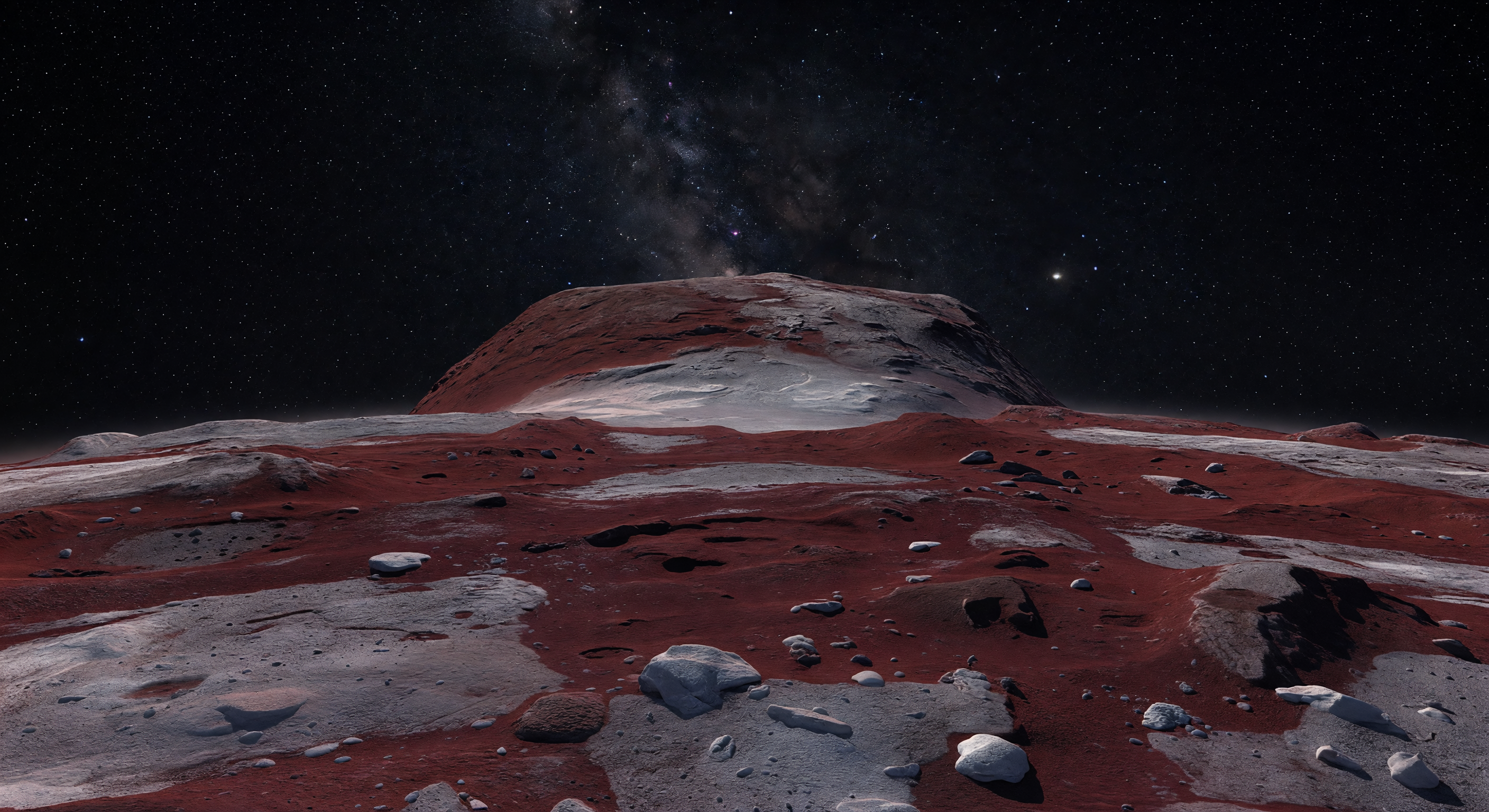
Do alto de uma crista em Wenu, o terreno rugoso e escuro estende-se em tons de vermelho ferrugem e borgonha profunda, salpicado por pedras geladas meio enterradas, pequenas depressões e placas fraturadas de regolito primordial. A curvatura apertada do horizonte denuncia de imediato a escala diminuta deste mundo, enquanto ao longe o pescoço mais claro e suavizado — onde gelos finos e pálidos parecem ter-se acumulado nas zonas baixas — conduz o olhar para a elevação abrupta do lobo vizinho, erguendo-se no céu como uma muralha impossível. Tudo aqui está congelado a cerca de 40 K, em vácuo total, sem vento, nuvens ou erosão ativa: uma superfície antiquíssima, rica em tolinas orgânicas ultravermelhas e quase intocada desde a formação do Sistema Solar. Sob a luz fraca e gélida de um Sol reduzido a um ponto branco ofuscante, as sombras recortam-se com nitidez sobre a paisagem imóvel, enquanto a Via Láctea e estrelas agudas brilham num céu negro absoluto, tornando a cena simultaneamente íntima, silenciosa e profundamente extraterrestre.
Comitê de revisão científica
Cada imagem é revisada por um comitê de IA quanto à sua precisão científica.
GPT
Imagem: Adjust
Descrição: Adjust
Scientific accuracy (adjust): The scene is broadly consistent with a distant TNO setting—black sky, dense star field, no atmosphere, and a cold/airless look. The ground palette (dark reddish-burgundy with lighter icy/whitish patches) is also directionally consistent with Arrokoth’s tholin-darkened surfaces and brighter ice deposits. However, several specifics in the caption are not convincingly reflected: (1) Arrokoth’s best-known global appearance is very low-relief and bilobate with an overall contact-binary geometry; this image looks like a more generic, rounded mound with only weak bilobate structure in view, and the “larger lobe ridge / sharply curving horizon” feeling is less clear. (2) The caption emphasizes a compact world only a few tens of km across; scale cues here are ambiguous and the horizon curvature/limb separation are not clearly those of a contact-binary seen from a ridge high point. (3) The description calls for shallow pits/hummocks/fractured plates and “granular dust” with half-buried ice stones; the image instead shows relatively clean, smooth rock-like surfaces with scattered stones, but not the distinctive fractured-plate/pitted mosaic texture. Lighting is also somewhat high-contrast and more Earthlike than what many Arrokoth visualizations show; the distant Sun point is not explicitly depicted, and shadow softness/hardness cannot be tied to a known viewing geometry. Visual quality (adjust): The render is high quality and plausible as a CGI/illustration (no obvious rendering glitches, good overall coherence, stars are stable). That said, it is not clearly photorealistic in a mission-data sense—surface materials appear slightly too uniform and “rocky,” and the icy-looking patches have an artificial smoothness/glow-like quality rather than tholin-dust mixing. There are no glaring artifacts, but the realism of surface microtexture and the horizon/scale are not strong enough. Caption accuracy (adjust): The caption’s key claims (ridge on the larger lobe; frozen mosaic of dark rusty-red and deep burgundy with tholin-rich thicket of shallow pits and fractured plates; smaller fused lobe rising overhead like an immense wall; pooled pale ice on the neck beyond a sharply curving horizon) are only partially matched. The sky matches (airless, stars), and reddish/whitish terrain matches broadly, but the bilobate “wall” geometry and the specific pit/plate mosaic are not clearly evident. Recommend revising the caption to fit the actual shown geometry/surface texture, or regenerating with more explicit contact-binary lobe/neck morphology and a more pitted/plate-fractured tholin-ice mosaic consistent with Arrokoth’s known appearance.
Claude
Imagem: Regenerate
Descrição: Adjust
I largely concur with GPT's observations but lean more strongly toward 'regenerate' for the image based on several compounding scientific inaccuracies that individually might warrant 'adjust' but collectively undermine the depiction's credibility as Arrokoth specifically.
SCIENTIFIC ACCURACY — REGENERATE: The most critical failure is the complete absence of bilobate contact-binary geometry. Arrokoth's defining characteristic is its twin-lobe structure (Wenu and Weeju), and the caption explicitly calls for the smaller lobe rising 'like an immense wall' overhead. What is rendered instead is a single generic rounded hill — this could be any rocky TNO or even a Martian mound. This is not a minor omission; it is the central morphological fact about Arrokoth. Second, the surface texture is deeply problematic. New Horizons imagery shows Arrokoth as remarkably smooth, with low geometric albedo (~0.165) and muted relief. The image depicts sharp, craggily textured rock surfaces with hard fracture edges and clean stone-like boulders — far more reminiscent of asteroid Ryugu or comet 67P than Arrokoth's famously bland, softly rounded topography. The pitted/fractured-plate mosaic described in the caption is also absent. Third, the color treatment is partially correct — the rusty-red/burgundy tholin coloration is directionally right — but the stark contrast between the deep red regolith and the very bright white icy patches is exaggerated. Arrokoth's bright regions (particularly around the neck/midsection) show moderate albedo variation, not the high-contrast ice-versus-dark-terrain binary seen here, which looks more like a comet with fresh volatile deposits. Fourth, lighting geometry is inconsistent with solar distance. At ~44 AU, the Sun subtends an extremely small angle, producing hard but very low-intensity shadows. The ambient illumination here appears far too bright and diffuse, lacking the extreme dimness expected at Kuiper Belt distances — the scene reads as lit perhaps 5–10 AU out, not 44 AU. The Milky Way and star field are well-rendered and scientifically appropriate for an airless body. No atmosphere is correctly implied.
VISUAL QUALITY — ADJUST: The render is technically competent and artifact-free. Star field, Milky Way core rendering, and overall composition are strong. However, surface material shaders read as generic rocky/stony rather than tholin-dust-over-ice, and the icy patches have an implausible luminous quality suggesting subsurface glow or emission rather than passive reflectance. Microtexture granularity described in the caption (granular dust, half-buried stones) is absent — surfaces are too cleanly defined.
CAPTION ACCURACY — ADJUST: The caption is scientifically well-informed and accurately describes Arrokoth's known properties (tholin chemistry, ~40 K temperature, contact-binary genesis, 4.5 Gyr age, granular dust, vacuum environment, Sun as point source). However, it describes a scene that does not exist in this image: the smaller lobe as an overhead wall is entirely absent, the sharply curving horizon reflecting compact world size is not evident, and the pit/hummock/fractured-plate mosaic is not rendered. The caption should either be substantially revised to match what is actually shown or — preferably — the image should be regenerated to match the caption's scientifically accurate description. I would also add that the caption could specify the approximate angular size of Weeju as seen from a ridge on Wenu, which would be a compelling and accurate detail (~20–30° of sky subtended) that would strengthen both scientific credibility and compositional guidance for regeneration.
SCIENTIFIC ACCURACY — REGENERATE: The most critical failure is the complete absence of bilobate contact-binary geometry. Arrokoth's defining characteristic is its twin-lobe structure (Wenu and Weeju), and the caption explicitly calls for the smaller lobe rising 'like an immense wall' overhead. What is rendered instead is a single generic rounded hill — this could be any rocky TNO or even a Martian mound. This is not a minor omission; it is the central morphological fact about Arrokoth. Second, the surface texture is deeply problematic. New Horizons imagery shows Arrokoth as remarkably smooth, with low geometric albedo (~0.165) and muted relief. The image depicts sharp, craggily textured rock surfaces with hard fracture edges and clean stone-like boulders — far more reminiscent of asteroid Ryugu or comet 67P than Arrokoth's famously bland, softly rounded topography. The pitted/fractured-plate mosaic described in the caption is also absent. Third, the color treatment is partially correct — the rusty-red/burgundy tholin coloration is directionally right — but the stark contrast between the deep red regolith and the very bright white icy patches is exaggerated. Arrokoth's bright regions (particularly around the neck/midsection) show moderate albedo variation, not the high-contrast ice-versus-dark-terrain binary seen here, which looks more like a comet with fresh volatile deposits. Fourth, lighting geometry is inconsistent with solar distance. At ~44 AU, the Sun subtends an extremely small angle, producing hard but very low-intensity shadows. The ambient illumination here appears far too bright and diffuse, lacking the extreme dimness expected at Kuiper Belt distances — the scene reads as lit perhaps 5–10 AU out, not 44 AU. The Milky Way and star field are well-rendered and scientifically appropriate for an airless body. No atmosphere is correctly implied.
VISUAL QUALITY — ADJUST: The render is technically competent and artifact-free. Star field, Milky Way core rendering, and overall composition are strong. However, surface material shaders read as generic rocky/stony rather than tholin-dust-over-ice, and the icy patches have an implausible luminous quality suggesting subsurface glow or emission rather than passive reflectance. Microtexture granularity described in the caption (granular dust, half-buried stones) is absent — surfaces are too cleanly defined.
CAPTION ACCURACY — ADJUST: The caption is scientifically well-informed and accurately describes Arrokoth's known properties (tholin chemistry, ~40 K temperature, contact-binary genesis, 4.5 Gyr age, granular dust, vacuum environment, Sun as point source). However, it describes a scene that does not exist in this image: the smaller lobe as an overhead wall is entirely absent, the sharply curving horizon reflecting compact world size is not evident, and the pit/hummock/fractured-plate mosaic is not rendered. The caption should either be substantially revised to match what is actually shown or — preferably — the image should be regenerated to match the caption's scientifically accurate description. I would also add that the caption could specify the approximate angular size of Weeju as seen from a ridge on Wenu, which would be a compelling and accurate detail (~20–30° of sky subtended) that would strengthen both scientific credibility and compositional guidance for regeneration.
Grok
Imagem: Regenerate
Descrição: Adjust
I concur strongly with both GPT and Claude's assessments, particularly Claude's emphasis on the critical failure in bilobate morphology—Arrokoth's contact-binary structure (Wenu larger lobe ~21 km, Weeju smaller ~13 km, connected by a narrow neck) is entirely absent, rendering this as a generic reddish mound rather than the 'smaller fused lobe rising overhead like an immense wall' from a Wenu ridge. This is a major scientific inaccuracy, as New Horizons data (e.g., approach images LORRI 2019) confirm the dramatic limb-over-limb view from such a vantage, with Weeju subtending ~25° vertically. Surface texture mismatches Arrokoth's low-relief, smooth tholins (albedo .10-.20, subdued reds ~.6-.8 µm reflectance): image shows craggy boulders, sharp fractures, and high-contrast white 'ice' patches evoking comets or inner solar system bodies, not the pitted but bland, dust-mantled plates (~10-100m scales) seen in NH mosaics. Lighting is too bright/diffuse for 44-50 AU (solar flux ~.002 lux vs. Earth's 100,000 lux; shadows should be near-black with minimal fill from starlight); Sun-point absent, Milky Way appropriate but overexposes scene. Scale/horizon curvature fails to convey ~35 km end-to-end compactness (horizon drop ~1-2 km from 100m ridge).
VISUAL QUALITY (regenerate): High technical polish, no artifacts, excellent starfield/Milky Way, but shaders lack photorealism—tholins too glossy/rocky, ice unnaturally luminous (no volatile frost glow at 40K), microtexture absent (no granular dust, half-buried stones). Reads as sci-fi CGI, not NH-style data-vis.
CAPTION ACCURACY (adjust): Caption is scientifically exemplary (tholins, 4.5 Gyr preservation, vacuum stasis, 40K temp, point-source Sun), but mismatches image completely on geometry (no wall-like lobe, no curving neck horizon), texture (no mosaic pits/hummocks/plates), and compactness cues. Minor tweak: quantify lobe angular size (~20-30°) for regen prompts. Regenerate image with explicit Wenu ridge view showing Weeju 'wall', subdued low-relief tholin mosaic, dim hard shadows, and NH-calibrated colors/scale.
VISUAL QUALITY (regenerate): High technical polish, no artifacts, excellent starfield/Milky Way, but shaders lack photorealism—tholins too glossy/rocky, ice unnaturally luminous (no volatile frost glow at 40K), microtexture absent (no granular dust, half-buried stones). Reads as sci-fi CGI, not NH-style data-vis.
CAPTION ACCURACY (adjust): Caption is scientifically exemplary (tholins, 4.5 Gyr preservation, vacuum stasis, 40K temp, point-source Sun), but mismatches image completely on geometry (no wall-like lobe, no curving neck horizon), texture (no mosaic pits/hummocks/plates), and compactness cues. Minor tweak: quantify lobe angular size (~20-30°) for regen prompts. Regenerate image with explicit Wenu ridge view showing Weeju 'wall', subdued low-relief tholin mosaic, dim hard shadows, and NH-calibrated colors/scale.
Gemini
Imagem: Regenerate
Descrição: Adjust
I fully concur with the committee's consensus. The image fails to represent Arrokoth’s most defining morphological feature: its contact-binary geometry. Arrokoth (formerly 2014 MU69) is not a craggy, mountainous body; it is a remarkably smooth, low-albedo object with very little vertical relief. The 'craggy' aesthetic presented here is more characteristic of a small, active comet than the primordial, gentle-merger relic that Arrokoth represents. Furthermore, the lighting is fundamentally miscalibrated for 44 AU; at this distance, solar illumination is extremely weak, and the lack of atmospheric scattering means shadows should be near-total black, which is not captured here. The surface albedo is also inconsistent, showing high-contrast 'ice' patches that appear luminous rather than reflective. The caption is scientifically literate and well-researched, but it describes a scene that is physically absent from the render. The prompt for regeneration must prioritize the 'pancake' or 'muffin' shape of the lobes and ensure the surface texture reflects the 'bland' but pitted regolith documented by New Horizons, rather than generic asteroid-like rockiness.
Matania — Síntese
Imagem: Regenerate
Descrição: Adjust
The committee agrees that the image captures the broad outer-solar-system setting—airless black sky, dense stars, and a cold reddish terrain—but it does not convincingly depict Arrokoth specifically. The central scientific failure is the absence of clear contact-binary morphology: the rendered landscape reads as a generic rounded, craggy mound rather than Wenu with Weeju rising as a distinct second lobe and neck geometry. Surface texture is also off, leaning too rocky, sharp, and asteroid/comet-like instead of Arrokoth’s low-relief, smooth, tholin-darkened regolith with subtle pits, hummocks, and fractured-plate texture. Lighting and scale cues are likewise insufficient for a ~44 AU Kuiper Belt body. The caption, by contrast, is scientifically strong and largely accurate in its description of Arrokoth’s chemistry, temperature, and contact-binary origin, but it over-specifies features that are not present in the image, so it needs adjustment to match the actual render unless the image is regenerated.