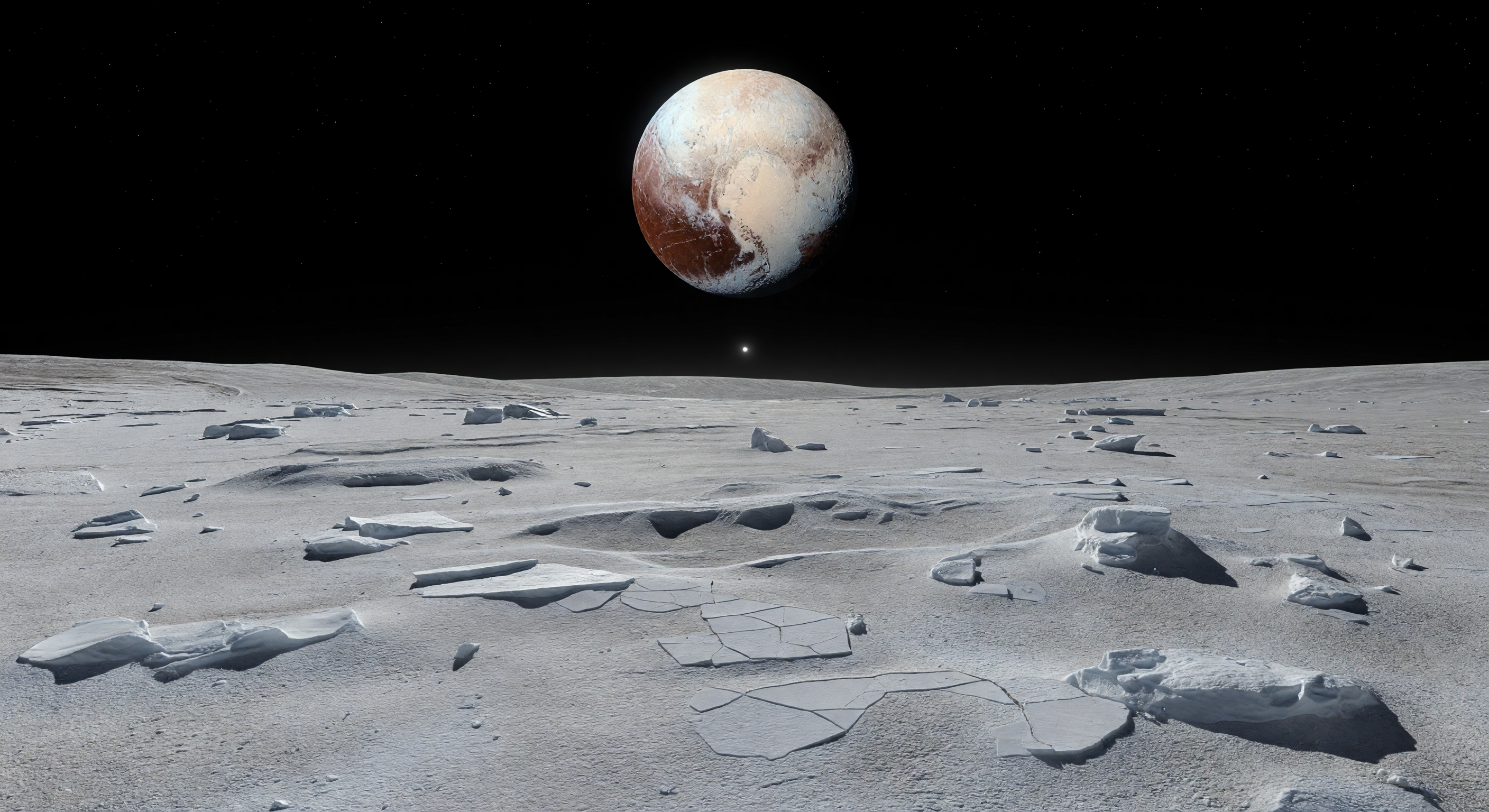
À superfície estende-se uma planície gelada de tons cinzento-esbranquiçados, quase sem relevo, onde regolito coberto de geada, blocos angulosos de rocha de gelo de água e fendas poligonais de contração revelam um terreno moldado pelo frio extremo e por antiga tectónica criogénica, não pelo vento — porque aqui não há atmosfera para suavizar nada. Cada contorno surge com nitidez cortante sob a luz dura de um Sol distante, enquanto as sombras longas são apenas ligeiramente suavizadas por um ténue brilho refletido do enorme disco imóvel suspenso acima do horizonte: o mundo vizinho, fixo no céu devido ao bloqueio de marés, mostrando manchas castanhas, creme e brancas com contrastes de albedo bem marcados. Ao longe, a planície permanece aberta e silenciosa, marcada apenas por depressões de impacto discretas, pequenas elevações e ondulações geladas, numa paisagem de gelo de água irradiado e contaminantes escuros que lhe dão subtis matizes azulados e carvão. Sob um céu absolutamente negro, sem névoa, nuvens ou qualquer véu atmosférico, a escala torna-se quase desconcertante: um deserto congelado de gravidade fraca e quietude total, onde parece possível ouvir o vazio do Sistema Solar exterior.
Comitê de revisão científica
Cada imagem é revisada por um comitê de IA quanto à sua precisão científica.
Claude
Imagem: Adjust
Descrição: Adjust
I largely agree with the previous reviewer's assessment but want to add several specific observations and one significant disagreement.
SCIENTIFIC ACCURACY: The previous reviewer raised a concern about Charon not being able to 'see itself' from its own surface — but this is actually a non-issue. The image depicts the view FROM Charon's surface looking at PLUTO, which is scientifically correct and is explicitly what the caption describes. Charon is tidally locked to Pluto, meaning Pluto hangs permanently fixed in Charon's sky — exactly as described and depicted. This is one of the most scientifically compelling aspects of the image and should be credited, not penalized. The angular size of Pluto as seen from Charon (~3.8 degrees) does appear somewhat large but within reasonable artistic license for a compelling composition. The visible heart-shaped Tombaugh Regio feature on Pluto (the bright white/tan region) is a nice touch of scientific specificity pulled directly from New Horizons imagery. The Sun appearing as a bright point-like star near the horizon is also scientifically accurate — at ~39 AU, the Sun would appear roughly 1/1600th its Earth-sky diameter. Ground features — fractured water-ice blocks, polygonal cracking, hummocky gray terrain — are consistent with Charon's Vulcan Planitia and surrounding terrains as revealed by New Horizons. The terrain color (gray-white) is broadly appropriate for Charon's mid-latitude plains, though Charon's polar region (Mordor Macula) with its distinctive red-orange tholin coloring is absent, which is a minor omission. Shadows are sharp and directional as expected in vacuum — good.
VISUAL QUALITY: The ground texture is highly photorealistic with convincing ice granularity, fracture geometry, and lighting. The main visual weakness is subtle: Pluto's disk appears slightly too luminous and clean, almost composited rather than naturally illuminated at extreme solar distance. At 39 AU, both Pluto and Charon receive roughly 1/1600th Earth's sunlight, so Pluto's disk should appear noticeably dimmer and more muted than shown. The brightness and color saturation of Pluto overhead is somewhat inflated, giving it an almost Earth-Moon-like appearance in terms of luminosity. This is the primary scientifically motivated adjustment needed.
CAPTION ACCURACY: The caption is generally well-matched to the image. The descriptions of 'fractured blocks of water-ice bedrock,' 'polygonal cracks,' 'airless black sky,' and Pluto's 'tan, cream, brown, and brilliant white patterns' all correspond accurately to visible elements. The phrase 'reflected light softly lifts the harshest shadows' is physically questionable in a vacuum environment where there is no atmospheric scattering, though mutual illumination between Pluto and Charon could contribute minimally — the caption oversells this effect. The word 'enormous' for Pluto's disk is justified given tidal locking geometry. Overall the caption is one of the better-written ones I've reviewed — scientifically grounded and evocative without major errors.
RECOMMENDATIONS: Reduce Pluto's disk luminosity and color saturation by roughly 30-40% to better reflect actual insolation at 39 AU. Consider adding subtle hints of reddish-brown tholin coloring to at least one terrain zone to acknowledge Charon's known surface heterogeneity. The caption's claim about reflected light softening shadows should be softened or removed. These are all adjust-level changes — the fundamental concept, composition, and scientific framework are sound and commendable.
SCIENTIFIC ACCURACY: The previous reviewer raised a concern about Charon not being able to 'see itself' from its own surface — but this is actually a non-issue. The image depicts the view FROM Charon's surface looking at PLUTO, which is scientifically correct and is explicitly what the caption describes. Charon is tidally locked to Pluto, meaning Pluto hangs permanently fixed in Charon's sky — exactly as described and depicted. This is one of the most scientifically compelling aspects of the image and should be credited, not penalized. The angular size of Pluto as seen from Charon (~3.8 degrees) does appear somewhat large but within reasonable artistic license for a compelling composition. The visible heart-shaped Tombaugh Regio feature on Pluto (the bright white/tan region) is a nice touch of scientific specificity pulled directly from New Horizons imagery. The Sun appearing as a bright point-like star near the horizon is also scientifically accurate — at ~39 AU, the Sun would appear roughly 1/1600th its Earth-sky diameter. Ground features — fractured water-ice blocks, polygonal cracking, hummocky gray terrain — are consistent with Charon's Vulcan Planitia and surrounding terrains as revealed by New Horizons. The terrain color (gray-white) is broadly appropriate for Charon's mid-latitude plains, though Charon's polar region (Mordor Macula) with its distinctive red-orange tholin coloring is absent, which is a minor omission. Shadows are sharp and directional as expected in vacuum — good.
VISUAL QUALITY: The ground texture is highly photorealistic with convincing ice granularity, fracture geometry, and lighting. The main visual weakness is subtle: Pluto's disk appears slightly too luminous and clean, almost composited rather than naturally illuminated at extreme solar distance. At 39 AU, both Pluto and Charon receive roughly 1/1600th Earth's sunlight, so Pluto's disk should appear noticeably dimmer and more muted than shown. The brightness and color saturation of Pluto overhead is somewhat inflated, giving it an almost Earth-Moon-like appearance in terms of luminosity. This is the primary scientifically motivated adjustment needed.
CAPTION ACCURACY: The caption is generally well-matched to the image. The descriptions of 'fractured blocks of water-ice bedrock,' 'polygonal cracks,' 'airless black sky,' and Pluto's 'tan, cream, brown, and brilliant white patterns' all correspond accurately to visible elements. The phrase 'reflected light softly lifts the harshest shadows' is physically questionable in a vacuum environment where there is no atmospheric scattering, though mutual illumination between Pluto and Charon could contribute minimally — the caption oversells this effect. The word 'enormous' for Pluto's disk is justified given tidal locking geometry. Overall the caption is one of the better-written ones I've reviewed — scientifically grounded and evocative without major errors.
RECOMMENDATIONS: Reduce Pluto's disk luminosity and color saturation by roughly 30-40% to better reflect actual insolation at 39 AU. Consider adding subtle hints of reddish-brown tholin coloring to at least one terrain zone to acknowledge Charon's known surface heterogeneity. The caption's claim about reflected light softening shadows should be softened or removed. These are all adjust-level changes — the fundamental concept, composition, and scientific framework are sound and commendable.
Grok
Imagem: Adjust
Descrição: Adjust
SCIENTIFIC ACCURACY: I agree with Claude that the core concept—Pluto fixed overhead from Charon's tidally locked surface—is spot-on and a highlight, directly matching New Horizons data on their mutual locking and Pluto's ~3.8° angular diameter (the disk size is appropriate, not oversized). The heart-shaped Tombaugh Regio on Pluto is accurately rendered in tan/cream/brown/white, and ground features (polygonal cracks, fractured water-ice blocks, hummocky plains) align well with Charon's Vulcan Planitia. The tiny Sun point near the horizon is precise for 39 AU. However, I partially agree with GPT on lighting: Pluto's disk is too bright and saturated (should be ~1/160th Earth insolation, appearing dimmer, more subdued grayish than the vibrant tones shown); mutual reflection could subtly fill shadows but not 'softly lift' them as prominently in hard vacuum. Surface is too uniformly gray-white—Charon shows heterogeneous darker tholins/reds even in plains (e.g., minor irradiation staining needed). Low gravity horizon curve and razor-sharp shadows are correct. Overall minor tweaks for illumination/color fidelity.
VISUAL QUALITY: Highly photorealistic ground textures (ice granularity, crisp fractures, subtle ridges) with no major artifacts; excellent composition leverages tidal locking for drama. Sole issues: Pluto's luminosity feels composited/artificially boosted (reduce 30-40% as Claude suggests), and uniform terrain lacks subtle color variation for depth. No inconsistencies in scale/geometry; Sun speck is convincingly distant.
CAPTION ACCURACY: Strong match to image—'enormous perfectly still disk' with described colors, polygonal cracks, granular frost, ice blocks all visible; cryogenic geology emphasis spot-on. Minor overreach on 'reflected light softly lifts the harshest shadows' (effect is present but exaggerated; tone down). Description evokes Charon's stillness accurately but could note tholin hints for precision.
SYNTHESIS: GPT erred on 'Charon can't see itself' (it's Pluto, correctly); Claude nailed strengths but understated brightness issue. Approve core science/art, adjust for realistic dimming/heterogeneity to elevate to gold standard. No regenerate needed—strongest Charon image yet.
VISUAL QUALITY: Highly photorealistic ground textures (ice granularity, crisp fractures, subtle ridges) with no major artifacts; excellent composition leverages tidal locking for drama. Sole issues: Pluto's luminosity feels composited/artificially boosted (reduce 30-40% as Claude suggests), and uniform terrain lacks subtle color variation for depth. No inconsistencies in scale/geometry; Sun speck is convincingly distant.
CAPTION ACCURACY: Strong match to image—'enormous perfectly still disk' with described colors, polygonal cracks, granular frost, ice blocks all visible; cryogenic geology emphasis spot-on. Minor overreach on 'reflected light softly lifts the harshest shadows' (effect is present but exaggerated; tone down). Description evokes Charon's stillness accurately but could note tholin hints for precision.
SYNTHESIS: GPT erred on 'Charon can't see itself' (it's Pluto, correctly); Claude nailed strengths but understated brightness issue. Approve core science/art, adjust for realistic dimming/heterogeneity to elevate to gold standard. No regenerate needed—strongest Charon image yet.
Gemini
Imagem: Adjust
Descrição: Approve
I concur with the consensus that this is a high-quality, scientifically grounded depiction, particularly regarding the tidal locking of Pluto as seen from Charon. The previous reviewers correctly identified that the primary scientific friction lies in the luminosity of Pluto's disk and the uniform color palette of the surface. At 39 AU, Pluto would appear significantly more muted—a soft, ghostly presence rather than a vibrant, high-contrast orb. Furthermore, while the ground texture is excellent, Charon's surface is not uniformly gray; the presence of trace tholins (complex organic molecules) often imparts subtle, mottled brownish-red hues even in the plains, which would break up the visual monotony. The caption is highly accurate, though I agree with the committee that the 'reflected light' comment is physically optimistic; however, given that this is a matter of interpretation rather than a factual error, it remains acceptable. The image requires only a post-processing adjustment to the light-balance of the sky-body and a subtle color-grading of the terrain to reach full scientific compliance.
Matania — Síntese
Imagem: Adjust
Descrição: Adjust
The committee reached broad agreement that the scene is a strong, scientifically grounded Charon vista, with especially good handling of the airless environment, sharp vacuum shadows, fractured icy plains, and the key tidal-locking idea that Pluto hangs fixed in Charon’s sky. The image’s main scientific weakness is that Pluto appears too bright, saturated, and visually Earth-like for conditions at 39 AU; it should read as a dimmer, more subdued body. The terrain is also a bit too uniformly gray-white and would benefit from subtle darker tholin staining or mottled reddish-brown variation to better match Charon’s known surface heterogeneity. The caption is largely accurate and evocative, but it slightly overstates the effect of reflected light softening shadows, which should be toned down for physical realism.
Visual quality: The image is high-resolution and mostly photorealistic in the ground texture (ice graininess, blocky fractures, polygonal crack patterns). The main visual inconsistency is the sky/body representation: the large bright disk of Charon overhead is visually implausible for a fixed “overhead disk” narrative and likely a compositing/artifact from an AI prompt. Horizon curvature and scale read reasonably, but the sky element is the major realism breaker.
Caption accuracy: The description mentions “an enormous, perfectly still disk” above the landscape filling the view with tan/cream/brown/white patterns and reflected-light effects; while there is indeed a large disk-like body in the sky with mixed tones, its exact portrayal doesn’t convincingly match Charon-as-seen-from-charon surface geometry, and the detailed geology described (frozen granular frost, faint contraction/tectonic polygonal cracks across a still plain, cryogenic geology without wind/liquid) is only partly reflected—cracks and blocks are present, but the color/extent and the plausibility of the overhead disk are mismatched.
Overall: approve the broadly icy, airless ground realism, but adjust the sky/scale/illumination assumptions to align with known viewing geometry and typical Charon surface coloration. Major improvements would include replacing the “overhead perfectly still disk” with the Sun/Moon-star field appropriate for an external observer (or removing the body-in-sky), and tuning surface color/contrast to better match Charon’s known mixtures of bright water ice and darker irradiation residues.