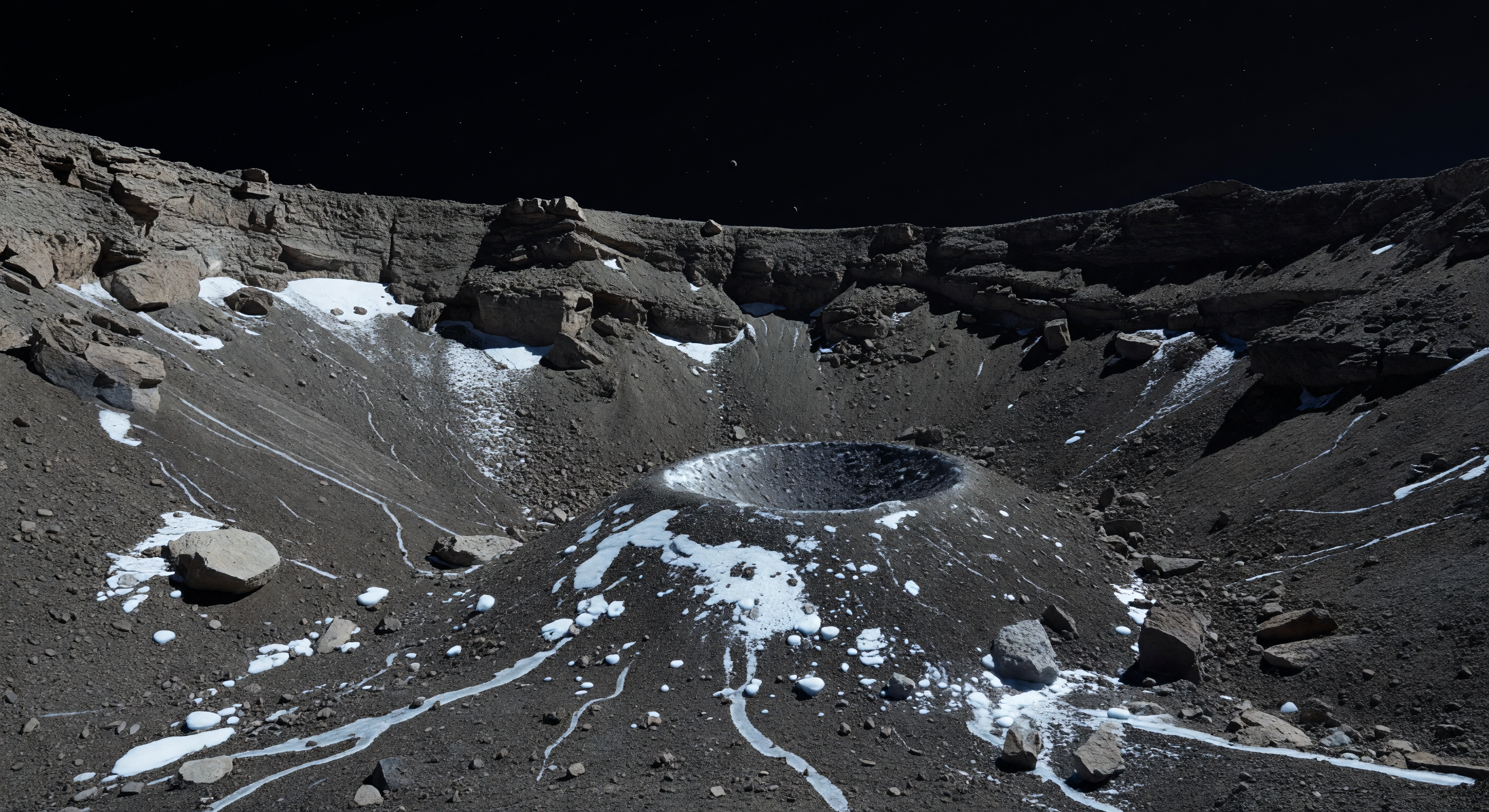
À beira desta encosta íngreme de uma cratera jovem, o terreno parece ter sido rasgado há pouco tempo: um manto escuro e friável de regolito, brechas fraturadas e blocos ricos em silicatos desce em leques instáveis, cortado por veios e películas descontínuas de gelo de água branco a azul-pálido que cintilam com brilho quase metálico. A parede ergue-se acima de si em patamares quebrados, pequenas alcovas e cicatrizes nítidas de deslizamento, preservadas pela ausência quase total de atmosfera, sem vento, chuva ou erosão que arredonde as arestas. Sob a luz dura de um Sol mais pequeno e distante, os gelos expostos e os detritos gelados recém-caídos destacam-se violentamente contra a crosta escura rica em filossilicatos amoniados, enquanto as reentrâncias adjacentes mergulham numa negrura quase absoluta sob um céu totalmente negro. A baixa gravidade permite taludes longos e precários e pedregulhos do tamanho de casas, dando à cena uma escala inquietante e bela, como se estivesse diante de uma ferida fresca aberta num mundo frio, volátil e silencioso.
Comitê de revisão científica
Cada imagem é revisada por um comitê de IA quanto à sua precisão científica.
Claude
Imagem: Adjust
Descrição: Adjust
Building on GPT's review with both agreements and additional observations:
SCIENTIFIC ACCURACY: I broadly agree with the 'adjust' rating but want to add specificity. The overall albedo contrast between dark regolith (~0.03-0.09 typical for Ceres) and bright ice patches is actually reasonably well-represented — Dawn mission imagery of Oxo crater shows exactly this kind of dramatic contrast. However, I take issue with the crater morphology itself: the central pit-within-crater structure visible in the image's foreground is unusual and not well-supported by Oxo crater data. Oxo is a ~10km simple crater; nested pit features of this apparent scale would be anomalous. The ice distribution pattern (radial streaks converging downslope toward crater center) is plausible given mass-wasting dynamics on Ceres, consistent with what Dawn VIRS spectroscopy detected. The sky is correctly black with stars. My additional concern: the wall stratigraphy appears too Earth-like in its layered, cliff-face presentation — Ceres' low gravity (~0.28 m/s²) and regolith properties would produce shallower angle-of-repose slopes and less vertically dramatic exposed strata. The walls here look more like terrestrial canyon walls than Dawn-observed crater rims.
VISUAL QUALITY: I partially disagree with GPT's positive assessment. The ice rendering is my primary concern — the bright white streaks have a painted or decal quality, lacking the granular, sublimation-pitted texture that actual exposed water ice on an airless body would exhibit. Real Ceres ice exposures imaged by Dawn show diffuse, irregular bright patches rather than these crisp vein-like linear features. The central pit's dark interior is rendered well. Lighting is internally consistent and the hard shadow behavior is appropriate for airless conditions. Some boulder textures feel slightly too high-contrast and stylized. No major compositing artifacts visible.
CAPTION ACCURACY: I agree with GPT that the caption overclaims. Specific issues beyond GPT's observations: 'ammoniated phyllosilicate-bearing material' is scientifically accurate for Ceres broadly but functions as technical decoration here since it's indistinguishable visually; the 'faint cold-blue cast' of ice surfaces is not clearly visible in the render — the ice reads as neutral white; the 'house-sized blocks' claim lacks any scale reference in the image to validate it. The caption's prose quality is high and the geological narrative is scientifically coherent for Ceres, but it describes an idealized version of the scene rather than what is strictly rendered. The nested central pit structure, which is a prominent visual feature, goes entirely unmentioned in the caption — a significant omission.
RECOMMENDATION: Adjust the crater morphology to remove or justify the nested central pit, soften the ice streak rendering to appear more granular and sublimation-worn, reduce wall verticality, and revise the caption to address the central pit feature and temper claims about blue ice tints and precise block scales.
SCIENTIFIC ACCURACY: I broadly agree with the 'adjust' rating but want to add specificity. The overall albedo contrast between dark regolith (~0.03-0.09 typical for Ceres) and bright ice patches is actually reasonably well-represented — Dawn mission imagery of Oxo crater shows exactly this kind of dramatic contrast. However, I take issue with the crater morphology itself: the central pit-within-crater structure visible in the image's foreground is unusual and not well-supported by Oxo crater data. Oxo is a ~10km simple crater; nested pit features of this apparent scale would be anomalous. The ice distribution pattern (radial streaks converging downslope toward crater center) is plausible given mass-wasting dynamics on Ceres, consistent with what Dawn VIRS spectroscopy detected. The sky is correctly black with stars. My additional concern: the wall stratigraphy appears too Earth-like in its layered, cliff-face presentation — Ceres' low gravity (~0.28 m/s²) and regolith properties would produce shallower angle-of-repose slopes and less vertically dramatic exposed strata. The walls here look more like terrestrial canyon walls than Dawn-observed crater rims.
VISUAL QUALITY: I partially disagree with GPT's positive assessment. The ice rendering is my primary concern — the bright white streaks have a painted or decal quality, lacking the granular, sublimation-pitted texture that actual exposed water ice on an airless body would exhibit. Real Ceres ice exposures imaged by Dawn show diffuse, irregular bright patches rather than these crisp vein-like linear features. The central pit's dark interior is rendered well. Lighting is internally consistent and the hard shadow behavior is appropriate for airless conditions. Some boulder textures feel slightly too high-contrast and stylized. No major compositing artifacts visible.
CAPTION ACCURACY: I agree with GPT that the caption overclaims. Specific issues beyond GPT's observations: 'ammoniated phyllosilicate-bearing material' is scientifically accurate for Ceres broadly but functions as technical decoration here since it's indistinguishable visually; the 'faint cold-blue cast' of ice surfaces is not clearly visible in the render — the ice reads as neutral white; the 'house-sized blocks' claim lacks any scale reference in the image to validate it. The caption's prose quality is high and the geological narrative is scientifically coherent for Ceres, but it describes an idealized version of the scene rather than what is strictly rendered. The nested central pit structure, which is a prominent visual feature, goes entirely unmentioned in the caption — a significant omission.
RECOMMENDATION: Adjust the crater morphology to remove or justify the nested central pit, soften the ice streak rendering to appear more granular and sublimation-worn, reduce wall verticality, and revise the caption to address the central pit feature and temper claims about blue ice tints and precise block scales.
Grok
Imagem: Adjust
Descrição: Adjust
SCIENTIFIC ACCURACY: Agree with both GPT and Claude on broad consistency with Ceres' low-albedo regolith (~.05 average), high-contrast ice exposures as seen in Dawn's Oxo crater images, black starry sky, and hard shadows from direct sunlight in vacuum conditions. The smaller/distant Sun effect is implicitly captured via the intense but 'smaller' light source feel, though not explicitly shown. However, add to Claude: the prominent nested central pit is a major mismatch—Oxo is a simple ~9km crater without such a large secondary pit; Ceres' low gravity favors slumping and conical pits but not this nested scale without evidence. Wall slopes are implausibly steep/vertical for Ceres' cohesionless regolith (angle of repose ~30-35°); they evoke Valles Marineris more than Dawn FC frames. Ice streaks align plausibly with mass-wasting but lack sublimation texture (e.g., no micro-pits or dust halos). No ammoniated phyllosilicates visually distinguishable. Scale ambiguous without references. Overall adjust for morphology and regolith behavior.
VISUAL QUALITY: High photorealism in regolith texture, shadow sharpness, and contrast; coherent lighting with knife-edge shadows fitting airless body. However, ice patches/streaks have an unnatural crisp, decal-like uniformity—real Ceres ice (e.g., Occator or Oxo) shows mottled, diffuse brightness from grain scattering, not glossy white veins. Central pit edges too perfectly circular/smooth. Minor high-contrast stylization on boulders, but no glaring artifacts. Adjust for more granular, worn ice.
CAPTION ACCURACY: Matches core elements (steep walls, icy streaks/veneers/slumps, talus, black sky/sunlight contrast) but overstates unshown details: no clear 'charcoal/brown-gray layers' stratification; 'vein-like seams' are streaks but not subsurface veins; 'house-sized blocks' and 'long talus fans' lack scale cues; 'faint cold-blue cast' absent (ice is stark white); ignores prominent central pit. 'Ammoniated phyllosilicates' accurate for Ceres but invisible here. Adjust to describe rendered pit, temper scale/color claims.
Agree with GPT/Claude on ice cleanliness and caption mismatches; add that pit omission is key flaw. Constructive: Regenerate with shallower walls, smaller/irregular pit or remove it, granular ice, subtle blue tint, scale cues (e.g., rover shadow), and caption matching exactly.
VISUAL QUALITY: High photorealism in regolith texture, shadow sharpness, and contrast; coherent lighting with knife-edge shadows fitting airless body. However, ice patches/streaks have an unnatural crisp, decal-like uniformity—real Ceres ice (e.g., Occator or Oxo) shows mottled, diffuse brightness from grain scattering, not glossy white veins. Central pit edges too perfectly circular/smooth. Minor high-contrast stylization on boulders, but no glaring artifacts. Adjust for more granular, worn ice.
CAPTION ACCURACY: Matches core elements (steep walls, icy streaks/veneers/slumps, talus, black sky/sunlight contrast) but overstates unshown details: no clear 'charcoal/brown-gray layers' stratification; 'vein-like seams' are streaks but not subsurface veins; 'house-sized blocks' and 'long talus fans' lack scale cues; 'faint cold-blue cast' absent (ice is stark white); ignores prominent central pit. 'Ammoniated phyllosilicates' accurate for Ceres but invisible here. Adjust to describe rendered pit, temper scale/color claims.
Agree with GPT/Claude on ice cleanliness and caption mismatches; add that pit omission is key flaw. Constructive: Regenerate with shallower walls, smaller/irregular pit or remove it, granular ice, subtle blue tint, scale cues (e.g., rover shadow), and caption matching exactly.
Gemini
Imagem: Regenerate
Descrição: Adjust
I concur with the previous committee members regarding the significant morphological inaccuracies. The 'nested pit' feature is a major departure from the known simple, bowl-shaped geometry of Oxo crater. Furthermore, the verticality of the crater walls violates the angle-of-repose constraints for Ceres' loose, regolith-covered surface. The ice rendering remains the most critical visual failure: it lacks the sublimation-driven porosity and dust-mixing expected on an airless body, appearing instead as high-albedo, smooth 'decals.' The caption is highly evocative but functions as creative writing rather than a descriptive record of the image provided. To achieve scientific validity, the next iteration must: 1) Replace the nested pit with a standard, simple crater floor; 2) Reduce wall slope angles to reflect the 30-35 degree angle of repose; 3) Texture the ice patches to appear as diffuse, granular deposits rather than smooth, vein-like streaks; and 4) Provide a clear scale reference (e.g., a rockfall sequence) to justify the 'house-sized' claim. I recommend a full regeneration of the image to correct the fundamental crater morphology.
Matania — Síntese
Imagem: Regenerate
Descrição: Adjust
The committee found the scene broadly Ceres-like in color, lighting, and the presence of bright ice on dark regolith, but judged the image scientifically too divergent in morphology to pass as-is. The main issue is the prominent nested central pit, which is not consistent with Oxo crater’s known simple-crater form, along with overly steep, terrestrial-looking walls that exceed plausible Ceres angle-of-repose behavior. The ice also reads as unnaturally clean, smooth, and decal-like rather than granular, dusty, and sublimation-worn. The caption is scientifically coherent in general but overdescribes details not clearly supported by the image, omits the prominent central pit, and makes unsupported scale and color claims. Overall: regenerate the image, and adjust the caption to better match the actual rendered features.
Visual quality: The render is high quality and coherent with good texture detail in the regolith and convincing crater morphology. It is not perfectly photoreal in a strict sense (ice appears somewhat uniformly bright/white like clean slabs; some surface “vein-like” features read as overly crisp paint-like streaks). Shadows are sharp and physically plausible in darkness/contrast, but the ice edge fidelity and albedo contrast may be exaggerated. No obvious compositing artifacts, but there is a mild aesthetic bias toward pristine, glossy/clean ice.
Caption accuracy: The caption generally matches the presence of dark crater walls and bright ice exposures, including the idea of shallow veneers/seams and downslope transport via granular slumps/talus. That said, several specific claims are not well evidenced: (1) stratified charcoal/brown-gray layered walls are not distinctly readable; (2) “thin icy veneers” and “vein-like seams” are present only somewhat, and their form looks more like bright sheet-like patches and linear streaks than exposed ice veins; (3) “smaller, distant Sun” is not shown; (4) “almost absolute blackness under hard sunlight” is consistent, but the scene’s black sky plus stars is not described explicitly as such.
Overall: Good concept and largely consistent Ceres-like crater + bright ice exposures, but specific geological/illumination details in the caption are not strongly supported, and the ice representation likely overstates cleanliness/structure.