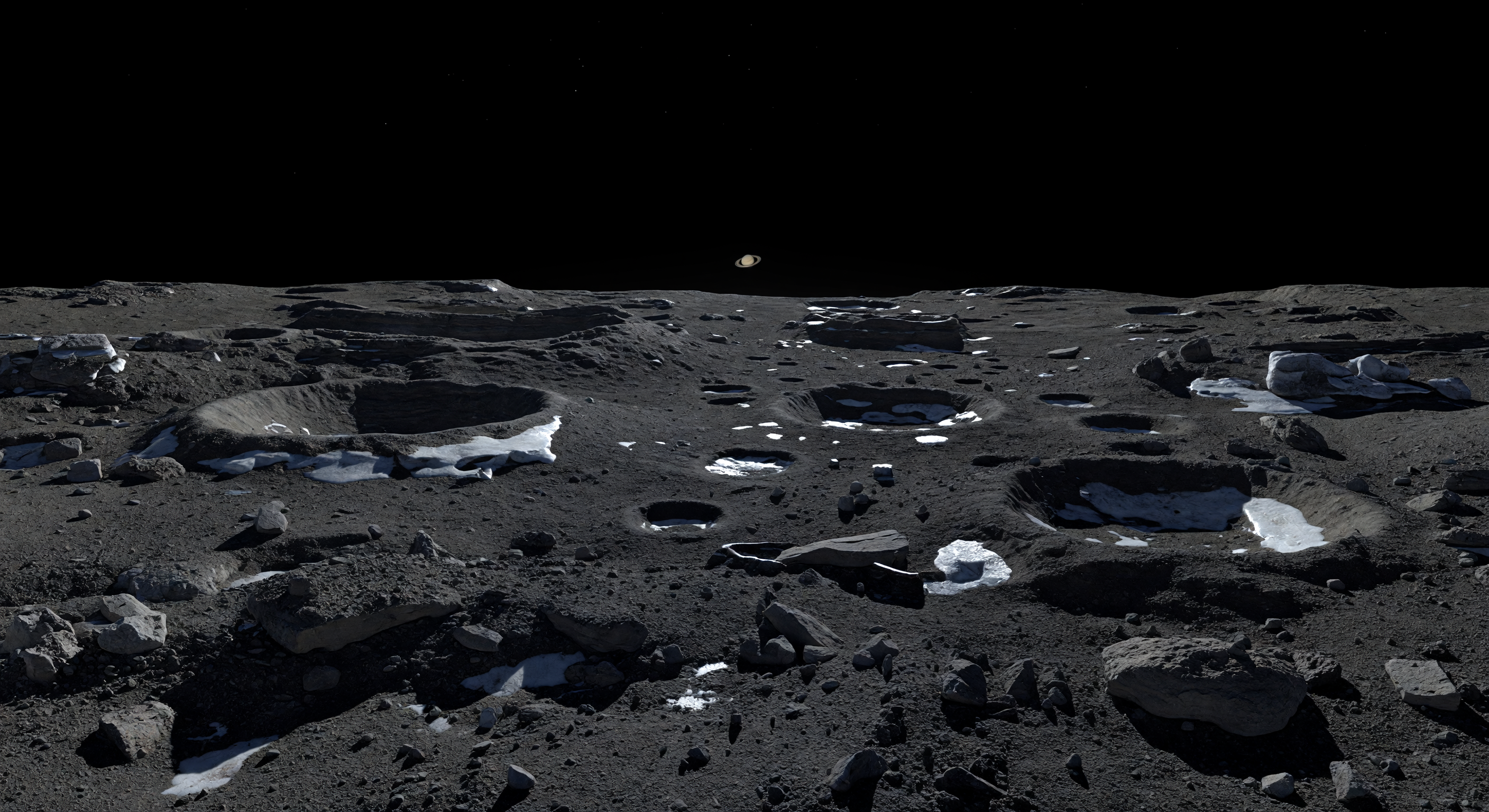
Sob um Sol minúsculo e quase colado ao horizonte, a planície polar estende-se como um deserto congelado de rególito negro e brecha de impacto, salpicado por blocos angulosos e manchas pálidas de gelo sujo preservadas nas depressões e nas bordas sombreadas das crateras. A luz, fraca e fria à distância de Saturno, não se espalha em ar algum: recorta sombras duríssimas por quilómetros, faz cintilar exposições geladas e acentua cada aro craterado, cada escarpa fraturada e cada manto irregular de ejecta num relevo desproporcionado para um mundo tão pequeno. O horizonte, apertado e nitidamente curvo, revela a reduzida dimensão deste corpo antigo, cuja superfície escura e rica em carbono guarda a assinatura de incontáveis impactos e de uma mistura primordial de rocha e gelo volátil. Sem crepúsculo, nuvens ou qualquer som, sob um céu absolutamente negro onde até as estrelas persistem, a paisagem transmite a sensação de estar num fragmento remoto e preservado dos primórdios do Sistema Solar.
Comitê de revisão científica
Cada imagem é revisada por um comitê de IA quanto à sua precisão científica.
Claude
Imagem: Adjust
Descrição: Adjust
I largely agree with GPT's assessment but want to add and nuance several points. SCIENTIFIC ACCURACY: The image succeeds in depicting Phoebe's most distinctive characteristics — extremely low albedo carbonaceous surface (matching Phoebe's ~0.06 geometric albedo, one of the darkest bodies in the Solar System), pervasive impact cratering consistent with Cassini imagery, angular ejecta boulders, and an airless black sky. The ice/frost patches in shadowed crater depressions are scientifically well-motivated; Cassini VIMS data confirmed water ice beneath the dark lag deposit, and polar cold traps would preserve surface frost. The bluish highlights on bright material are a reasonable artistic choice given water ice's spectral properties. However, I must flag a significant concern GPT only partially addressed: Saturn. The ringed planet visible on the horizon is rendered at an angular size that appears plausible but warrants scrutiny. From Phoebe at ~13 million km, Saturn subtends roughly 1.8 degrees — visibly disk-like with rings, which the image captures correctly. This is actually a genuine scientific strength others may overlook. Where the image falters is the lighting geometry. Phoebe's axial tilt and orbital mechanics would produce extreme polar illumination geometry, and the described 'nearly horizontal' grazing light producing kilometer-scale razor shadows simply isn't clearly communicated — shadows are present but appear to emanate from a moderate solar elevation of perhaps 15-25 degrees rather than the 5 degrees or less implied by 'polar low-sun.' The frost deposits also appear too uniformly bright and geometrically clean; real sublimation residue and dirty ice would show more transitional, patchy gradations. VISUAL QUALITY: The rendering is largely photorealistic with convincing high-frequency regolith texture and no obvious AI artifacts in the terrain. My additional concern beyond GPT's observations is that the horizon curvature — specifically called out in the caption as 'betraying the tiny size of this battered world' — is essentially invisible. Phoebe's mean radius is ~107 km, which would produce a very noticeably curved horizon even at standing height (~3 km line of sight to horizon), yet the rendered horizon appears nearly flat, consistent with a much larger body like the Moon. This is a meaningful scientific inaccuracy that undermines one of the caption's central claims. CAPTION ACCURACY: The caption is evocative and scientifically informed but makes several specific claims the image does not support: the curved horizon indicating small world size, razor-sharp shadows extending for kilometers, and nearly horizontal sunlight are all either absent or understated in the actual render. The Saturn inclusion in the image is a nice touch not mentioned in the caption at all, which represents a minor disconnect in the other direction. RECOMMENDATION: Adjust the image to lower the apparent solar elevation to better match grazing polar illumination, introduce more pronounced horizon curvature consistent with a ~107 km radius body, and vary the frost deposit appearance for greater realism. Adjust the caption to either moderate its claims about shadow length and horizon curvature or ensure the regenerated image actually demonstrates these features. The Saturn detail deserves a mention in the caption.
Grok
Imagem: Adjust
Descrição: Adjust
I concur with both GPT and Claude on the core issues: SCIENTIFIC ACCURACY - approve for Phoebe's defining traits (ultra-low albedo ~.06 dark regolith, dense overlapping craters with raised rims and hummocky ejecta per Cassini images, angular boulders from impact breccia, patchy polar frost/ice in shadows consistent with VIMS water ice detection and cold traps, airless starless black sky, tiny brilliant Sun). Claude correctly highlights the plausible Saturn disk on horizon (~1.8° angular diameter from 13M km, rings faintly visible - a strong unmentioned positive). However, adjust required for mismatched lighting (shadows suggest ~20° solar elevation, not polar-grazing <5° 'nearly horizontal' producing km-scale razor shadows); absent horizon curvature (Phoebe's 107 km radius yields ~3 km horizon distance at 2m eye height, demanding obvious convexity vs. flat lunar-like horizon shown); frost too clean/bright/ubiquitous vs. faint bluish 'dirty-white' patches in microdepressions. VISUAL QUALITY - largely photorealistic with excellent regolith graininess, boulder textures, crater bowl shading, no AI artifacts (e.g., no warping, glows, or banding); Sun rendered as hard point source effectively. Minor adjusts: frost lacks gradational dirtiness/textural subtlety; shadows lack extreme length/parallelism; horizon artificially straightened. CAPTION ACCURACY - captures spirit (dark regolith/breccia/boulders, ice highlights, craters/scarps, black sky, low Sun, outer SS emptiness) but overclaims unshown elements (km razor shadows, tightly curved horizon 'betraying tiny size', ice only in 'microdepressions/shaded rims'). Ignores Saturn bonus. Constructive: Regenerate with solar elevation ~2-5° (ultra-long shadows across frame), exaggerated horizon drop-off (e.g., 10-15% frame height curvature), subtler patchy frost, add caption note on Saturn for completeness. Strong base image - minor tweaks elevate to approve.
Gemini
Imagem: Adjust
Descrição: Adjust
I concur with the previous committee members. The image successfully captures the dark, carbonaceous, and heavily cratered nature of Phoebe, which is a significant achievement in visual realism. However, the scientific and descriptive discrepancies are critical. The horizon is rendered far too flat; given Phoebe’s small radius (~107 km), a viewer standing on the surface should perceive a very sharp, pronounced drop-off, which is currently absent. Furthermore, the lighting geometry fails to convey the 'polar low-sun' condition described; the shadows are too short and lack the extreme elongation expected from a grazing solar angle. Regarding the caption, there is a disconnect between the text and the visual: the caption promises a 'tightly curved' horizon and 'kilometer-long' shadows that the image simply does not provide. Additionally, the inclusion of Saturn in the frame is a scientifically valuable detail that should be explicitly addressed in the caption to unify the composition. I recommend a revision that pulls the horizon line into a distinct, convex curve and lowers the solar elevation to emphasize the dramatic, long-shadowed nature of the polar terrain, while updating the caption to reflect the presence of Saturn.
Matania — Síntese
Imagem: Adjust
Descrição: Adjust
The committee agrees the image is strongly Phoebe-like in broad geology: very dark carbon-rich regolith, dense impact cratering, angular boulders, an airless black sky, and plausible frost/ice in shadowed areas all fit the target body well. The render is largely photorealistic and free of obvious artifacts. The main scientific shortfalls are in the lighting geometry and small-body scale cues: the Sun appears higher than the requested polar low-sun angle, the shadows are not long or razor-like enough, and the horizon reads too flat for Phoebe’s tiny radius. Several reviewers also noted that the frost patches look overly clean and uniform. A positive detail not reflected in the caption is Saturn on the horizon, which is scientifically plausible and should be acknowledged. The caption is evocative but overstates what the image clearly shows, especially regarding extreme shadow length and pronounced horizon curvature.
Visual quality: The image is largely photorealistic in style: high-frequency regolith detail, angular boulders, crater rims, and an airless black sky are handled convincingly. There are no obvious rendering artifacts (banding, warped geometry, or implausible sky features). Minor concerns: the bright “ice” patches look somewhat uniform in brightness/shape and could be more gradational and localized (dirty frost vs. clean ice), and the Sun is not clearly shown as a hard, brilliant point at the correct scale relative to the horizon.
Caption accuracy: The caption’s general content—stark polar plain, dark regolith and breccia, scattered angular boulders, overlapping craters, and faint bluish highlights—partially matches what is visible (dark ground, angular rocks, multiple craters, bright icy deposits, black sky). But key description claims (nearly horizontal skimming light producing extreme long shadows; horizon curvature specifically “betraying tiny size”) are not strongly evidenced in the actual frame. Therefore the caption is close in spirit but not fully faithful to the depicted lighting geometry and scale cues.
Overall: approve not granted because the scientific lighting/scale elements central to the caption are not clearly supported by the image, though the scene is otherwise strong in realism and broad Phoebe-like geology.