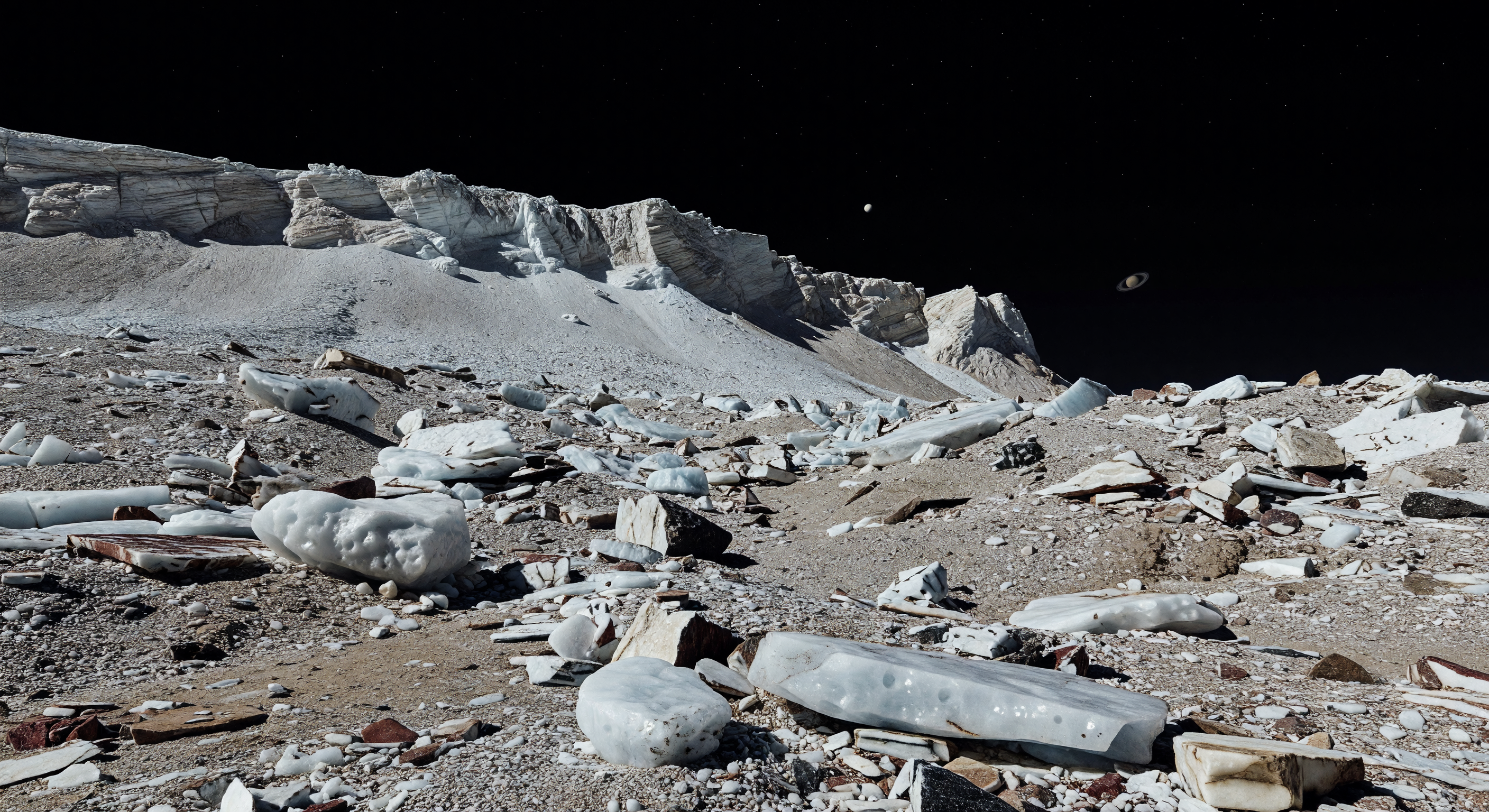
Ao pé da grande crista equatorial, o terreno ergue-se numa parede de gelo de água fraturado que domina o horizonte, enquanto vastos leques de avalanche descem em línguas de cascalho e blocos angulosos, uns do tamanho de automóveis, outros reduzidos a grânulos secos de regolito. A luz solar, pequena e distante, incide de lado através do vácuo e recorta cada aresta com sombras negras e duríssimas, fazendo cintilar o gelo mais limpo em branco e cinzento pálido, ao lado de depósitos escuros castanho-avermelhados ricos em material carbonáceo, característicos da região de baixo albedo. Em gravidade muito fraca e sem ar para suavizar nada, a paisagem mantém um relevo brutalmente nítido: lascas brilhantes, superfícies ligeiramente arredondadas pela sublimação e blocos partidos por impactos acumulam-se em mantos de tálus sobrepostos sob escarpas quilométricas. Sob um céu absolutamente negro, onde as estrelas mal se insinuam, a escala parece ao mesmo tempo íntima e colossal, como se estivéssemos encostados à base de uma montanha impossível num mundo gelado, árido e silencioso.
Comitê de revisão científica
Cada imagem é revisada por um comitê de IA quanto à sua precisão científica.
Claude
Imagem: Adjust
Descrição: Adjust
I largely concur with GPT's assessment but want to add several specific observations that refine the evaluation.
SCIENTIFIC ACCURACY: The airless rendering is commendable — knife-edged shadows, black sky, no atmospheric scattering, all physically correct for an atmosphere-free body at ~9.5 AU. The stratified layering visible in the upper scarp wall is a genuinely thoughtful detail consistent with proposed icy crustal stratigraphy on Iapetus. Talus morphology with angular slabs and gravel-dominated regolith is plausible under low gravity (0.223 m/s²). However, I must flag a critical Iapetus-specific failure: the color palette is almost entirely in the bright-terrain (Roncevaux Terra) register. Iapetus is famous above all other Solar System bodies for its extreme albedo dichotomy — Cassini Regio's leading hemisphere approaches albedo ~0.03–0.05 (near coal-black), while trailing terrain reaches ~0.5–0.6. The equatorial ridge transects BOTH terrains. A talus field at the ridge base should show pronounced dark reddish-brown lag deposits coating lower faces of boulders, infilling between clasts, and mantling the regolith in the carbon/tholins-rich signature. The image shows only token dark material on a handful of rocks. This is the single largest scientific deficiency. I also note the two celestial objects in the sky: the ringed planet (Saturn) and what appears to be a moon are both correctly included and appropriately sized for distance, which is a nice accurate touch GPT did not credit.
VISUAL QUALITY: Photorealism of ice and rock textures is strong. The translucent quality of the foreground ice blocks — showing subsurface scattering effects — is visually appealing but arguably too pronounced for heavily space-weathered, sublimation-processed surface ice, which should appear more matte and microcracked. Scale is convincing. No geometric artifacts detected. The transition between talus field and cliff face is rendered with reasonable geological coherence.
CAPTION ACCURACY: The caption's most specific and evocative claim — 'dirty-white water-ice boulders, reddish-black coated blocks' and 'carbon-rich lag deposits absorb the light' — is the central unfulfilled promise of the image. The image is predominantly a clean-ice scene. The caption also claims the ridge reads as a 'planetary spine' with 'jagged escarpments,' but the upper wall, while dramatic, looks more like a generic glacial or sedimentary scarp than Iapetus's peculiar ~20 km tall, nearly circumferential equatorial ridge. Recommend either darkening significant portions of the terrain to reflect realistic Iapetus albedo contrast or adjusting the caption to specify this is a bright-terrain (trailing hemisphere) section of the ridge where lag deposits are less developed — which would be a scientifically defensible framing that rescues both the image and caption from regeneration.
SCIENTIFIC ACCURACY: The airless rendering is commendable — knife-edged shadows, black sky, no atmospheric scattering, all physically correct for an atmosphere-free body at ~9.5 AU. The stratified layering visible in the upper scarp wall is a genuinely thoughtful detail consistent with proposed icy crustal stratigraphy on Iapetus. Talus morphology with angular slabs and gravel-dominated regolith is plausible under low gravity (0.223 m/s²). However, I must flag a critical Iapetus-specific failure: the color palette is almost entirely in the bright-terrain (Roncevaux Terra) register. Iapetus is famous above all other Solar System bodies for its extreme albedo dichotomy — Cassini Regio's leading hemisphere approaches albedo ~0.03–0.05 (near coal-black), while trailing terrain reaches ~0.5–0.6. The equatorial ridge transects BOTH terrains. A talus field at the ridge base should show pronounced dark reddish-brown lag deposits coating lower faces of boulders, infilling between clasts, and mantling the regolith in the carbon/tholins-rich signature. The image shows only token dark material on a handful of rocks. This is the single largest scientific deficiency. I also note the two celestial objects in the sky: the ringed planet (Saturn) and what appears to be a moon are both correctly included and appropriately sized for distance, which is a nice accurate touch GPT did not credit.
VISUAL QUALITY: Photorealism of ice and rock textures is strong. The translucent quality of the foreground ice blocks — showing subsurface scattering effects — is visually appealing but arguably too pronounced for heavily space-weathered, sublimation-processed surface ice, which should appear more matte and microcracked. Scale is convincing. No geometric artifacts detected. The transition between talus field and cliff face is rendered with reasonable geological coherence.
CAPTION ACCURACY: The caption's most specific and evocative claim — 'dirty-white water-ice boulders, reddish-black coated blocks' and 'carbon-rich lag deposits absorb the light' — is the central unfulfilled promise of the image. The image is predominantly a clean-ice scene. The caption also claims the ridge reads as a 'planetary spine' with 'jagged escarpments,' but the upper wall, while dramatic, looks more like a generic glacial or sedimentary scarp than Iapetus's peculiar ~20 km tall, nearly circumferential equatorial ridge. Recommend either darkening significant portions of the terrain to reflect realistic Iapetus albedo contrast or adjusting the caption to specify this is a bright-terrain (trailing hemisphere) section of the ridge where lag deposits are less developed — which would be a scientifically defensible framing that rescues both the image and caption from regeneration.
Grok
Imagem: Adjust
Descrição: Adjust
I concur with both GPT and Claude on the core issues: the image's overwhelming bright-ice dominance fails to capture Iapetus's hallmark albedo dichotomy, with insufficient reddish-black tholin-coated blocks, dark carbon-rich lag deposits, and shadowed absorption areas that should dominate a talus field at the equatorial ridge base (where both bright and dark terrains meet). Cassini imagery shows dark material (albedo ~.05) extensively mantling such slopes, not just token patches as here. The ridge scarp evokes height but lacks the sinuous, circumferential 'spine-like' morphology—appearing more like a generic icy cliff than Iapetus's ~20 km tall, enigmatic feature. Positively, Claude rightly credits the accurate sky elements: faint Saturn and a small moon (likely Rhea or Dione) at realistic angular sizes (~9.5 AU distance, low solar elevation implied by long shadows). Lighting is exemplary—brutal, airless clarity with knife-edge shadows, no scatter, weak insolation gradient. Low-g talus angularity and scale (car-sized blocks) are spot-on (g=.223 m/s² favors blocky debris over fines). Visual quality is photorealistic excellence: subsurface ice scattering is a subtle win for clean ice, textures show sublimation pitting/microcracks, no artifacts, coherent stratigraphy in scarp. Minor nit: foreground regolith could use more dust cohesion realism. Caption overpromises specific contrasts ('reddish-black coated blocks,' 'carbon-rich lag') not shown, and 'planetary spine' is interpretive overreach for the generic wall. Adjust image by boosting dark lag coverage (30-50% of talus) and ridge curvature; or tweak caption to 'bright-terrain section with minor darkening' for approval. No need to regenerate—strong foundation.
Gemini
Imagem: Adjust
Descrição: Adjust
I concur with the committee's consensus regarding the albedo discrepancy. The image displays a 'clean ice' aesthetic that lacks the pervasive, dark, reddish-brown carbonaceous lag (tholins) that characterizes the equatorial ridge's interaction with the Cassini Regio material. While the 'brutal' lighting and low-gravity angularity of the talus are well-executed, the failure to integrate the dark, light-absorbing regolith—which should be intermixed with the ice blocks rather than relegated to minor, isolated patches—undermines the scientific legitimacy of an Iapetus-specific landscape. Furthermore, the ridge lacks the distinct, massive, and often monolithic character of the equatorial spine, appearing more like a localized cliff face. To reach 'approve' status, the image requires a significant increase in dark, dust-mantled surface area to reflect the moon's unique hemispheric contrast. The caption is currently an 'overpromise'; it describes a high-contrast environment that the visual data fails to support. I recommend either modifying the image to include the pervasive dark lag or adjusting the caption to explicitly frame the scene as a specific, rare exposure of 'trailing-side' bright terrain to reconcile the discrepancy.
Matania — Síntese
Imagem: Adjust
Descrição: Adjust
The committee agrees the scene is visually strong and scientifically plausible in broad terms: it convincingly depicts an airless, low-gravity talus field with angular ice-rock debris, a fractured scarp, and harsh solar shadowing appropriate for Iapetus. The main issue is Iapetus specificity. The image reads too much like a clean, bright icy landscape and does not sufficiently express the moon’s defining albedo dichotomy, especially the dark reddish-brown carbon-rich lag deposits and tholin-coated material expected near the equatorial ridge/Cassini Regio interface. The ridge itself also appears more like a generic cliff than Iapetus’s distinctive circumferential equatorial spine. The caption likewise overstates these missing features, describing dark coated blocks and pronounced lag deposits that are not clearly present in the image. Overall: strong rendering and good physics, but it needs stronger Iapetus-specific morphology and material contrast to align image and caption.
Visual quality: The image is high-resolution and convincingly rendered with strong photorealistic textures on ice and fractured rock, good scale cues from block sizes relative to the ground, and no obvious geometric artifacts. There is no clear evidence of non-physical elements (e.g., atmosphere, clouds, or smeared geometry). Minor concern: the color grading is slightly uniform toward light icy tones, which reduces the realism of Iapetus’s strong dark-lag distribution, but this is more a scientific-matching issue than an imaging artifact.
Caption accuracy: The caption describes an immense talus fan cascading from a towering fractured wall, and the image indeed shows a sloping debris field with large ice/rock blocks and a wall/scarp behind it. The mention of “weak sunlight so far from the Sun” and an airless, brutally clear shadowing style is broadly consistent. However, key caption specifics are not clearly visible: reddish-black coated blocks and carbon-rich lag deposits absorbing light are minimal/unclear, and the “equatorial ridge / planetary spine” interpretation is not explicit in the visible topography. Therefore, the caption is directionally correct but needs adjustment to match what’s actually shown.