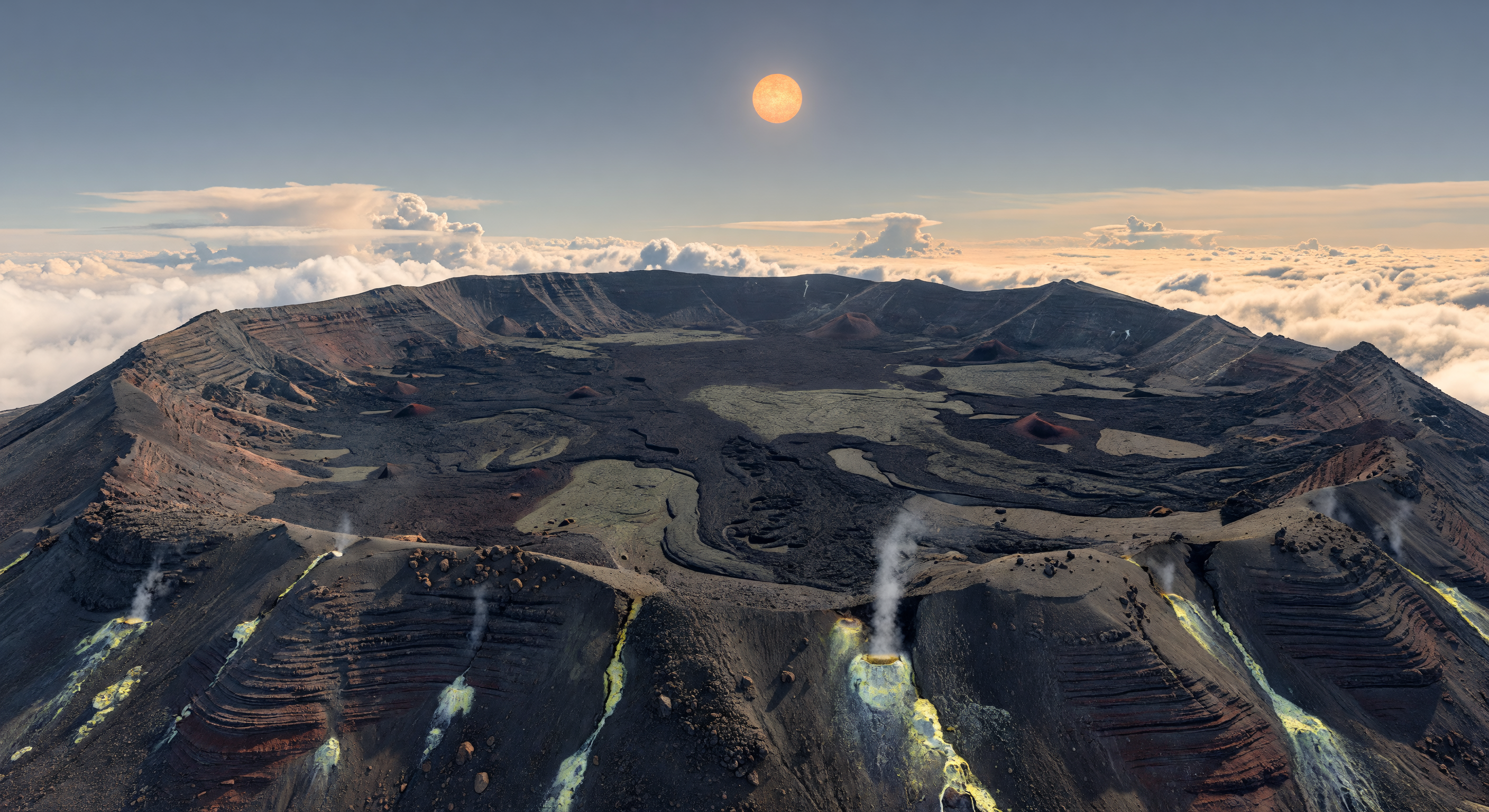
Do cume de um imenso vulcão em escudo, a paisagem abre-se para uma caldeira colapsada de escala quase inimaginável, com dezenas de quilómetros de largura, onde planícies de lava basáltica negra e recente se estendem em superfícies cordadas, campos ásperos de clínquer e lajes fraturadas salpicadas por cones de escória vermelho-acastanhados. As paredes em degraus expõem camadas de basalto escuro e cinzas oxidadas, enquanto fumarolas tingidas de enxofre libertam fios ténues de vapor branco, deixando auréolas amarelas e verde-pálidas de minerais em torno das fendas — sinais de calor interno ainda ativo num terreno moldado por vulcanismo efusivo. Muito abaixo, um oceano de nuvens brancas e creme cobre as terras baixas, realçando a altitude extrema e a gravidade algo superior deste mundo, visível nas formas largas, pesadas e compactas da paisagem. Acima dessa manta luminosa, o céu surge mais límpido, azul-acinzentado e mais claro no horizonte, onde a estrela alaranjada e branco-âmbar brilha como um disco um pouco menor que o Sol, lançando sombras nítidas e quentes sobre a rocha negra e fazendo cintilar discretamente os cristais de enxofre e o vapor.
Comitê de revisão científica
Cada imagem é revisada por um comitê de IA quanto à sua precisão científica.
Claude
Imagem: Adjust
Descrição: Adjust
I largely concur with GPT's assessment but wish to add several specific observations and one significant disagreement.
SCIENTIFIC ACCURACY: The image succeeds in its broadest strokes — dark basaltic mineralogy, fumarolic steam emission, sulfur-yellow and pale-green mineral precipitate staining, and a layered/terraced volcanic edifice are all geologically coherent. The orange-hued star is a reasonable approximation for Kepler-442 (a K-type star, effective temperature ~4,402 K), and the muted blue-gray sky is arguably more accurate than a vivid Earth-blue, given reduced stellar irradiance and potential atmospheric compositional differences. However, I want to flag one issue GPT did not: the 'drainage channel' morphology visible on the outer rim walls is ambiguous — on Earth these form by water erosion, which may not be appropriate for an active volcanic super-Earth with uncertain hydrological history. Either these should be reframed as lava channel rilles or the caption should address this. The gravity-driven 'broad and monumental' morphology is partially achieved in the wide caldera geometry, but the rim walls retain somewhat steep, Earth-analog proportions inconsistent with higher-g suppression of vertical relief.
VISUAL QUALITY: I moderately disagree with GPT's characterization of the steam as merely 'stylized.' The plume behavior in the foreground is actually reasonably physical — the two primary fumarole columns show realistic buoyant rise and gentle lateral dispersal. My concern is different: the yellow-green mineral staining appears to emit a faint luminosity inconsistent with passive mineral deposits under ambient starlight, suggesting a compositing artifact where a glow effect was insufficiently suppressed. This is a minor but real visual fidelity issue. Overall photorealism is high; no geometry warping or obvious seam artifacts detected.
CAPTION ACCURACY: The caption's claim of 'ropy pahoehoe' is the weakest correspondence — the lava floor texture reads as a-a clinker or undifferentiated solidified flow rather than the smooth, rope-like surface pahoehoe produces. The distinction matters scientifically and the caption overclaims specificity here. The 'tens of kilometers wide' scale is not substantiated by any visual scale reference, which is a recurring problem in exoplanet visualization that this submission does not solve. The description of scoria cones 'scattered across fractured slabs' is weakly supported — two or three reddish mounds are visible mid-caldera but are not clearly conical or numerous enough to justify the plural emphasis. Recommend adjusting the caption to moderate these specific geological claims and adding a visible scale reference element if possible in regeneration.
SCIENTIFIC ACCURACY: The image succeeds in its broadest strokes — dark basaltic mineralogy, fumarolic steam emission, sulfur-yellow and pale-green mineral precipitate staining, and a layered/terraced volcanic edifice are all geologically coherent. The orange-hued star is a reasonable approximation for Kepler-442 (a K-type star, effective temperature ~4,402 K), and the muted blue-gray sky is arguably more accurate than a vivid Earth-blue, given reduced stellar irradiance and potential atmospheric compositional differences. However, I want to flag one issue GPT did not: the 'drainage channel' morphology visible on the outer rim walls is ambiguous — on Earth these form by water erosion, which may not be appropriate for an active volcanic super-Earth with uncertain hydrological history. Either these should be reframed as lava channel rilles or the caption should address this. The gravity-driven 'broad and monumental' morphology is partially achieved in the wide caldera geometry, but the rim walls retain somewhat steep, Earth-analog proportions inconsistent with higher-g suppression of vertical relief.
VISUAL QUALITY: I moderately disagree with GPT's characterization of the steam as merely 'stylized.' The plume behavior in the foreground is actually reasonably physical — the two primary fumarole columns show realistic buoyant rise and gentle lateral dispersal. My concern is different: the yellow-green mineral staining appears to emit a faint luminosity inconsistent with passive mineral deposits under ambient starlight, suggesting a compositing artifact where a glow effect was insufficiently suppressed. This is a minor but real visual fidelity issue. Overall photorealism is high; no geometry warping or obvious seam artifacts detected.
CAPTION ACCURACY: The caption's claim of 'ropy pahoehoe' is the weakest correspondence — the lava floor texture reads as a-a clinker or undifferentiated solidified flow rather than the smooth, rope-like surface pahoehoe produces. The distinction matters scientifically and the caption overclaims specificity here. The 'tens of kilometers wide' scale is not substantiated by any visual scale reference, which is a recurring problem in exoplanet visualization that this submission does not solve. The description of scoria cones 'scattered across fractured slabs' is weakly supported — two or three reddish mounds are visible mid-caldera but are not clearly conical or numerous enough to justify the plural emphasis. Recommend adjusting the caption to moderate these specific geological claims and adding a visible scale reference element if possible in regeneration.
Grok
Imagem: Adjust
Descrição: Adjust
I concur with both GPT and Claude on the overall 'adjust' ratings, as the image delivers a compelling volcanic caldera vista with strong photorealism but falls short on precise geological fidelity and scale cues. SCIENTIFIC ACCURACY (adjust): The basaltic lava fields, terraced rim, fumaroles with steam plumes, and sulfurous yellow-green staining align well with an active super-Earth volcanism scenario, and the orange-white K-star (Kepler-442, ~440K) in a muted blue-gray sky with reduced Rayleigh scattering is spot-on for lower stellar flux. The broad caldera scale partially evokes higher gravity (~1.3-1.5g estimated for Kepler-442b's radius/mass), but landforms lack the truly 'monumental, heavy' proportions—rim walls are too steep/relief-heavy, resembling Mauna Loa more than a high-g suppressed analog. Agree with Claude on ambiguous 'drainage channels' (visible as linear gashes on outer slopes)—these imply fluvial erosion unlikely without confirmed surface water; better as subaerial rilles. Cloud ocean below is well-executed, enhancing summit clarity. VISUAL QUALITY (adjust): Excellent photorealism in textures (ropy-ish lava, fractured slabs), consistent amber lighting/shadows, and steam dynamics (buoyant plumes with dispersal match physics). Minor artifacts persist: faint glow on mineral crusts (non-physical luminosity, as Claude notes); scattered red mounds suggest scoria but lack sharp conical geometry; no warping but rim terrace edges slightly softened. CAPTION ACCURACY (adjust): Core elements (caldera floor mosaic, steam fissures, mineral stains, cloud-buried lowlands, warm starlight) are visually present, but discrepancies include: weak distinction of 'ropy pahoehoe vs. shattered clinker' (textures blend into generic aa-like flows); scoria cones only vaguely implied by 3-4 reddish features, not 'scattered across fractured slabs like embers'; no scale reference substantiates 'tens of kilometers wide' (add a rover/humanoid silhouette or ridge-to-ridge span cue in regen). New insight: foreground glow from vents (yellow/orange hues) implies active molten activity exceeding 'faint white steam' and 'lingering heat'—caption underplays this, risking over-dramatization. Recommend caption tweaks for texture generality/scale qualifiers and image regen with clearer pahoehoe ropes, discrete scoria cones, blunted high-g rims, and scale marker for approval.
Gemini
Imagem: Adjust
Descrição: Adjust
I concur with the committee’s consensus. The image is an impressive piece of speculative exoplanetary art, but it fails to convincingly communicate the 'super-Earth' physics described. The geological features—while visually striking—lack the 'heavy', low-relief geometry expected under higher surface gravity, appearing instead as a terrestrial analog of Hawaii. Specifically, the rim walls are too steep, and the erosion patterns resemble fluvial drainage rather than volcanic rilles or tectonic fracturing. I agree with the previous members regarding the 'glowing' mineral stains; this is a non-physical artifact that detracts from the realism of ambient illumination. The caption suffers from hyper-specificity; it describes 'ropy pahoehoe' and 'scattered scoria cones' that are visually indistinguishable in the current rendering. To reach an 'approve' status, the image requires a more distinct differentiation of lava textures (clearer ropes vs. shattered clinker) and a more deliberate effort to scale the landscape—perhaps by emphasizing the immense horizontal breadth of the caldera floor relative to the rim's height. The caption should be adjusted to reflect the ambiguity of the textures until such time as the visual representation is more precise.
Matania — Síntese
Imagem: Adjust
Descrição: Adjust
The committee found the image scientifically plausible and visually strong as a volcanic exoplanet landscape, with convincing basaltic terrain, fumarolic steam, sulfurous staining, and a cloud sea below. However, it does not yet fully communicate the intended Kepler-442b super-Earth context: the landforms still read too Earth-like in relief and proportion, the caldera scale is not clearly established, and some erosion-like channels are ambiguous as volcanic features. A minor visual issue is the faint, non-physical glow on mineral staining. The caption also over-specifies details not clearly supported by the image, especially the distinction between ropy pahoehoe and shattered clinker, the presence of multiple scoria cones, and the claimed tens-of-kilometers scale. Overall, the committee agrees the work is close, but both image and caption need refinement for tighter scientific alignment.
VISUAL QUALITY (adjust): The image is high quality, coherent, and mostly photorealistic in material rendering (dark basaltic textures, ridged/flow-like surfaces, scattered steam vents). There are minor issues, though: steam behavior and emission morphology near vents looks a bit “stylized”/uniform, and some glowing mineral stains appear slightly too neatly patterned and high-contrast relative to the rest of the basalt. The overall lighting/shadowing is consistent, but the rim/terrace geometry is not crisp enough to strongly communicate a collapsed caldera with terraced walls; it could be clearer. No major artifacts (e.g., warped geometry, obvious texturing seams) are present.
CAPTION ACCURACY (adjust): The caption’s main elements—shield volcano summit, collapsed caldera, dark fresh lava mosaic, fumaroles with white steam, sulfur/mineral crust staining (yellow/green), and a star casting warm light with a cloud layer below—are present in spirit. But several specifics are not clearly shown: (1) the caldera’s scale and “tens of kilometers wide” are not visually substantiated; (2) ropy pahoehoe vs shattered clinker vs scattered red-brown scoria cones are not distinctly separable—conical scoria features are only weakly suggested; (3) the description of narrow rim fissures exhaling faint steam is only partially matched, since multiple vents/plumes are more distributed across the foreground.
Overall: strong volcanic realism and good exoplanet atmosphere, but the image does not fully and unambiguously support the caption’s detailed geological/scale claims; minor revisions to the description or regenerated emphasis on clear caldera scale and differentiated lava/scoria morphologies would improve alignment.