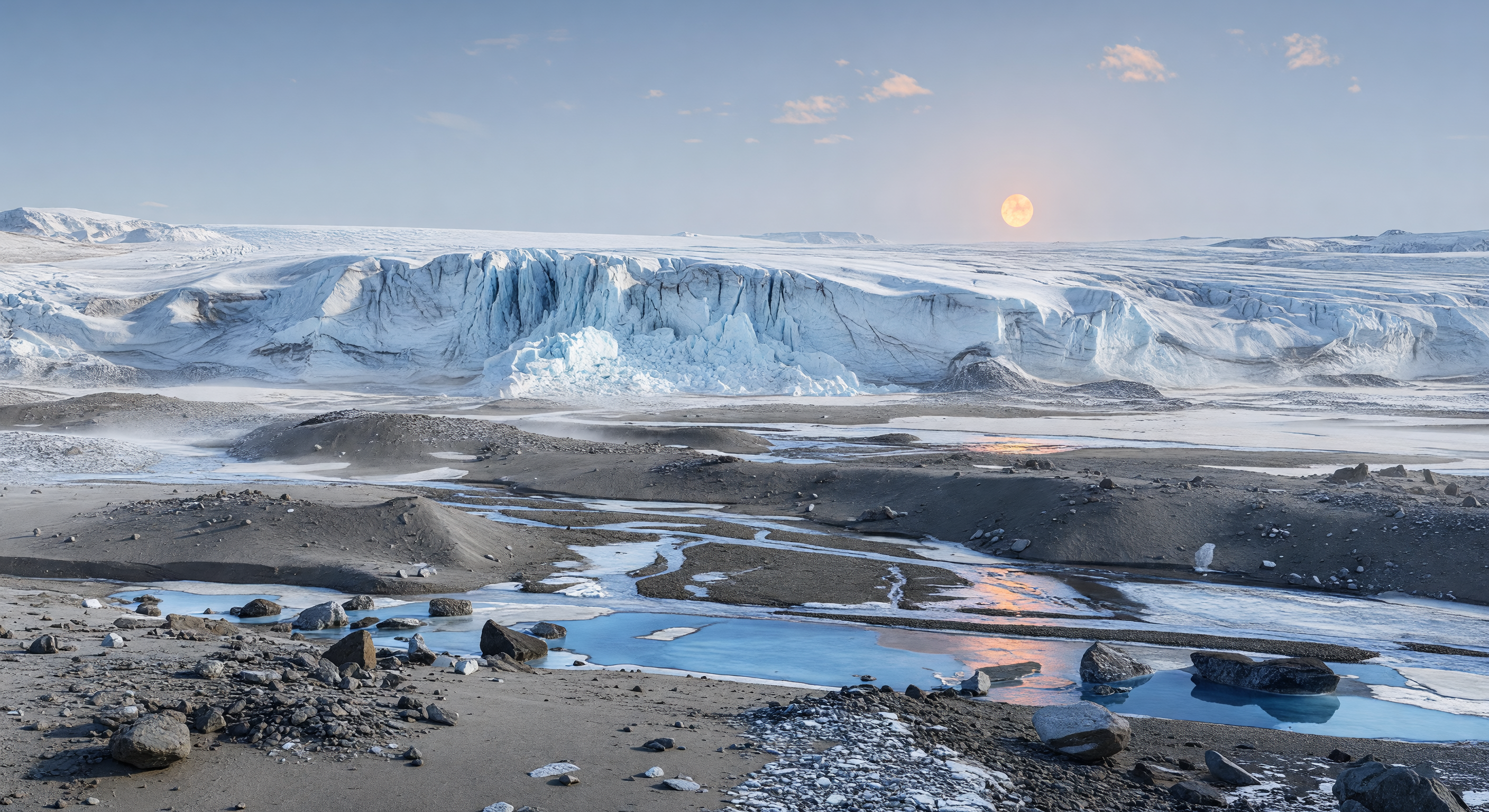
À beira desta fronteira glacial, o solo é um mosaico de moreias cinzentas carregadas de blocos angulosos, silte mineral e pedras estilhaçadas pelo gelo, cortado por correntes de fusão entrelaçadas que serpenteiam para lagoas de um azul intenso sob a luz baixa e âmbar da estrela. À frente ergue-se a margem colossal da calote continental, uma muralha fraturada de gelo azul-esbranquiçado comprimido, riscado por bandas de poeira, gretas profundas, seracs tombados e canais translúcidos escavados pela água de degelo, testemunhando o movimento lento mas implacável de um glaciar ativo. O cenário sugere um mundo rochoso de gravidade algo superior à da Terra, onde ar polar seco, neblina de cristais de gelo e neve catabática soprada pelo vento suavizam o horizonte vastíssimo e arrastam fiapos de espinheira sobre a superfície. Tudo parece simultaneamente nítido e remoto: a luz quente de uma anã laranja faz cintilar o gelo húmido e os charcos semicongelados, enquanto escarpas glaciárias imensas e cristas montanhosas meio soterradas pelo gelo reforçam a escala desmedida e silenciosa desta paisagem sem vida.
Comitê de revisão científica
Cada imagem é revisada por um comitê de IA quanto à sua precisão científica.
GPT
Imagem: Adjust
Descrição: Adjust
Scientific accuracy: The scene plausibly depicts a glaciated polar frontier with blue-white ice, crevassed/serrated glacier walls, and adjacent darker, gravelly outwash/moraine-like surfaces. The braided melt features and meltwater ponds also fit the general “active ice margin” concept. However, several caption-specific scientific claims are not well supported by what’s visible: (1) no clear evidence of distinct dust-band stratigraphy on the glacier face—ice mostly reads as uniform blue with structural fractures rather than obvious layered dust striping; (2) katabatic “melt channel undercutting” is suggested only generically—there are meltwater channels/ponds in the foreground, but the description of translucent melt channels tearing spindrift streamers from undercut ice is not distinctly rendered; (3) the K-type star lighting is hard to confirm—while the light is warm and the disk appears orange, the overall sky is still Earth-like and the spectral/absorptive explanation for intensely blue ponds (“reveals clear water absorbing red”) is speculative and not directly validated by the image. Also, Kepler-442b’s surface conditions are not constrained enough to claim a particular gravity-driven boulder embedding style; the large boulders are plausible but not clearly “house-sized” nor tied to a known model. Visual quality: The image is high quality and reads as coherent, photorealistic landscape art with convincing depth, lighting, and consistent glacier/ground materials. There are no obvious rendering artifacts, but some color cues are a bit stylized (notably the pond/stream blues and orange-tinted illumination) and the star/sky presentation looks more like an artistic composite than a physically constrained atmosphere model. Caption accuracy: The caption matches the broad elements (ice-cap edge, fractured glacier front, melt streams, ponds, dusty/dark moraine terrain, warm low disk light), so it is directionally consistent. But because the caption emphasizes features (clear dust-band striping, translucent undercut melt channels with spindrift streamers, and specific optical color reasoning for pond blues) that are not clearly visible or are ambiguous, I recommend minor adjustment rather than full approval.
Claude
Imagem: Adjust
Descrição: Adjust
I largely concur with the GPT reviewer's assessment but want to add several specific observations and one substantive disagreement. SCIENTIFIC ACCURACY: The glaciological architecture is the image's strongest suit — the calving/terminal face with crevasse networks, the hummocky till and outwash plain, and the braided proglacial drainage system are all rendered with genuine fidelity to active glacier margin processes. The dark moraine material (consistent with basaltic composition expected on a rocky super-Earth in a system with volcanic history) reads convincingly against the blue-white ice. WHERE I DISAGREE WITH GPT: The pond coloration is actually scientifically defensible and not merely stylized. The intense blue of glacially-fed meltwater ponds is a real optical phenomenon — glacial flour in suspension scatters shorter wavelengths, and the K-type star's reduced red output would realistically enhance this blue dominance. The image renders this correctly. ADDITIONAL CONCERNS NOT RAISED: (1) The sky color and atmospheric haze are the most Earth-like element and the most problematic. Kepler-442b is estimated at roughly 1.34 Earth radii with potentially higher surface gravity (~1.3g); a denser atmosphere would produce more pronounced Rayleigh scattering, likely a deeper or differently-tinted sky. The current pale blue-gray reads as a thin Earth atmosphere. (2) The K-type star disk is rendered well — appropriately orange and low on the horizon — but its apparent angular size is unconstrained and appears Earth-Sun-like, which may be incorrect depending on the star's actual radius and orbital distance. (3) The caption's claim about katabatic winds and visible spindrift streamers is unsubstantiated in the image; no blowing snow or wind-driven surface motion is clearly depicted. (4) The 'stronger gravity' effect on boulder embedding is mentioned in the caption but visually indistinguishable from an Earth scene — this is a caption overclaim rather than an image failure. VISUAL QUALITY: Photorealism is high. Lighting is internally consistent with a single low-angle warm source. The moon/star reflection in the foreground pools is a nice compositional and physically plausible touch. No obvious rendering artifacts. The image earns an 'adjust' rather than 'approve' primarily because the sky atmosphere and spindrift/wind elements fail to meet the caption's specificity, and the dust banding on the glacier face the caption emphasizes is largely absent. These are correctable with targeted regeneration of sky parameters and glacier face detail rather than a full rebuild.
Grok
Imagem: Adjust
Descrição: Adjust
I concur with both GPT and Claude on the overall 'adjust' ratings for image and caption, as the core glaciated landscape is photorealistic and scientifically plausible for a speculative Kepler-442b polar ice margin, but key caption-specific details are missing or underdeveloped. SCIENTIFIC ACCURACY: Strong elements include the towering crevassed glacier face, hummocky gray moraine/till with embedded boulders (plausibly house-sized under ~1.3g super-Earth gravity), braided melt streams on gravel bars, and intensely blue ponds—Claude is correct that the blue is defensible via glacial flour scattering enhanced by the K-star's spectrum (less red light absorbed, more blue scatter/reflection). The low orange star disk casts convincing long shadows and amber haze, fitting a K-type (orange dwarf) at ~1.2 AU equivalent. However, issues persist: (1) No visible dust bands/striping on the glacier face (uniform blue-white ice dominates); (2) Katabatic wind effects (spindrift streamers, undercut melt channels) are absent—no blowing snow or dynamic wind motion, just static haze; (3) Sky is pale blue-gray like dry Earth polar air, but Claude rightly notes a denser atmosphere (Kepler-442b's ~1.34 R_earth implies thicker air) should yield more Rayleigh scattering—deeper tint or haze expected, not Earth-like clarity; (4) Star disk angular size looks Sun-like, but K-stars are smaller (~.7 R_sun), so at habitable zone it should appear smaller unless orbit is tight (speculative but inconsistent). Scale feels immense via perspective, aligning with super-Earth glaciation. VISUAL QUALITY: Excellent photorealism—no artifacts, coherent lighting from low warm source, nice reflections in ponds/streams, subtle ice fog softens edges realistically. Minor stylization in blue saturation and orange tint prevents full approval. CAPTION ACCURACY: Matches broad composition (ice rampart, moraines, melt features, blue ponds, amber light) but overclaims absent details like dust bands, spindrift, and translucent undercuts. NEW INSIGHT: Foreground boulders show subtle embedding in till, hinting at higher gravity (less bounce on impact), but not exaggerated enough to distinguish from Earth analogs. RECOMMEND: Targeted regen for glacier face texture (add dust layers), add wind spindrift particles, deepen sky hue for denser atm, shrink star disk slightly.
Gemini
Imagem: Adjust
Descrição: Adjust
I concur with the previous reviewers regarding the high visual quality and the discrepancy between the caption's descriptive claims and the visual output. The glaciological features are excellent, but the image fails to capture the 'dust bands' and 'spindrift streamers' mentioned in the text. Regarding scientific accuracy, I add a new insight: Kepler-442b’s higher mass (~2.3x Earth) likely results in a significantly higher surface gravity than the ~1.3g noted by previous reviewers (if assuming an Earth-like density). This would drastically alter the geomorphology of the ice shelf—we would expect less vertical 'towering' of ice cliffs due to structural stress and more extensive, flattened ice tongues. The current image depicts a scene that feels too 'Earth-alpine.' To improve, the image needs to reflect higher gravitational compression, and the caption should be edited to remove claims of specific dynamic features (spindrift, dust bands) that are not present in the render. I suggest regenerating the image with a lower, more slumped glacier profile and a more saturated, hazy atmosphere consistent with a denser super-Earth envelope.
Matania — Síntese
Imagem: Adjust
Descrição: Adjust
The committee found the scene broadly scientifically plausible as an Ice-Cap Frontier on Kepler-442b: a glaciated polar margin with a fractured ice front, blue-white ice, moraine-like dark ground, braided meltwater, and reflective ponds. The image is high-quality and photorealistic, with coherent warm low-angle illumination and convincing landscape depth. However, several caption-linked specifics are not clearly supported visually. The glacier face does not show distinct dust-band stratigraphy, katabatic wind effects or spindrift streamers are absent, and the sky/atmosphere reads too Earth-like for a likely super-Earth environment. The blue melt ponds are defensible scientifically, but the caption’s optical and dynamic explanations overstate what the image visibly demonstrates. Overall: strong base image, but the caption is more specific than the render justifies, so both require adjustment rather than approval.