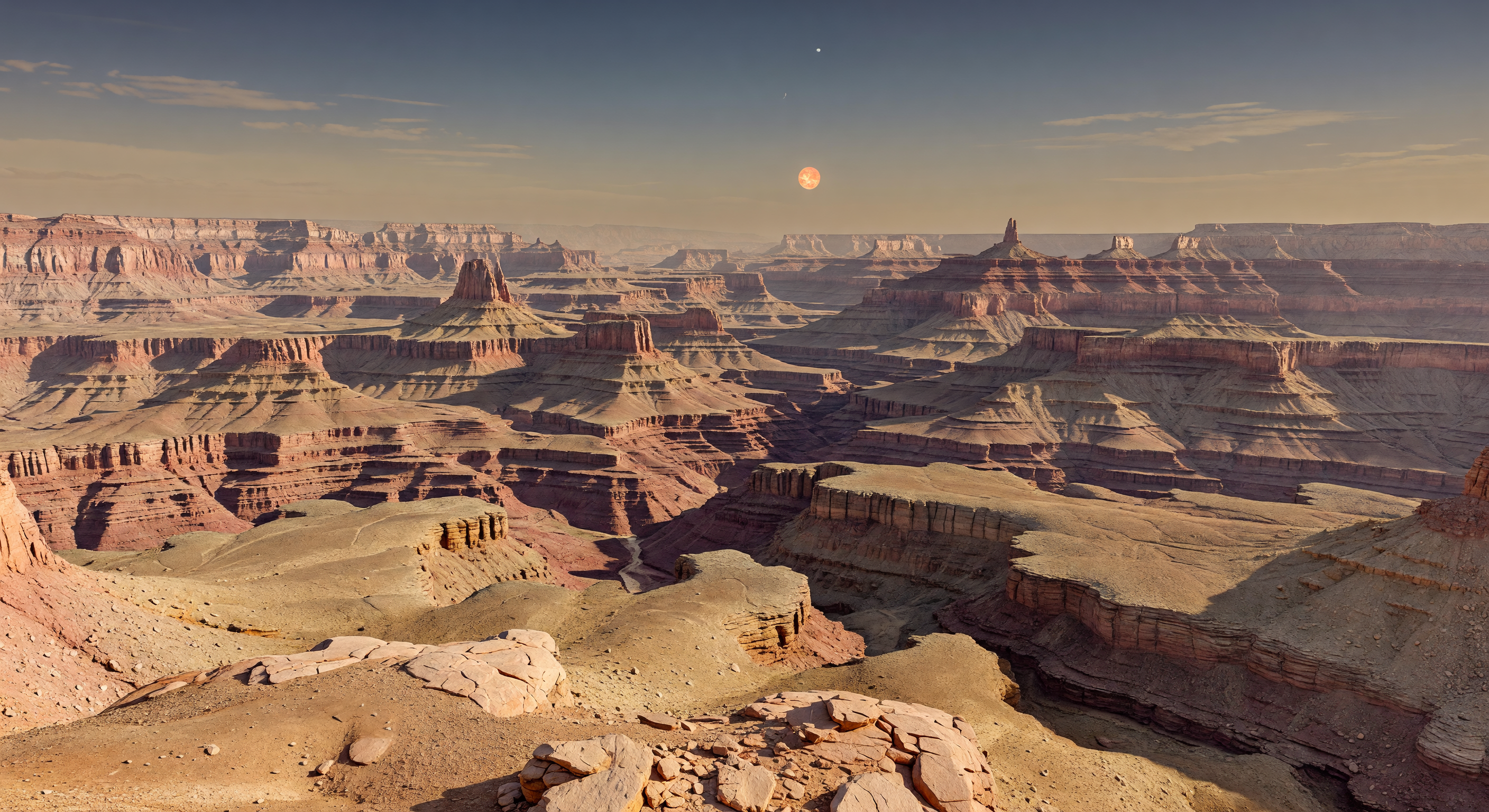
À altura dos olhos, abre-se um labirinto colossal de desfiladeiros escavados em espessas camadas sedimentares de tons bege, salmão, ocre e umber, onde arribas estriadas, mesas isoladas, buttes, arcos naturais e cones aluviais se sucedem até se perderem em planaltos distantes. O solo, coberto por lajes fraturadas, cascalho varrido pelo vento, blocos angulosos e ondulações finas de poeira, sugere uma paisagem antiga e árida, moldada durante eras por erosão, abatimentos de vertente e soerguimento tectónico, com manchas minerais escuras a sublinhar a história química das rochas. Sob um céu azul seco que se dissolve numa névoa quente junto ao horizonte, a luz baixa e âmbar da estrela lança sombras longas em tons malva e violeta-acastanhado, revelando uma atmosfera plausivelmente densa mas poeirenta e uma gravidade um pouco superior à da Terra na imponência compacta das escarpas. Sem água visível, sem vegetação e sem qualquer sinal de presença humana, a vastidão pedregosa transmite a sensação de estar à beira de um mundo mais pesado e silencioso, onde cada ravina e cada parede em faixas parecem talhadas numa escala quase impossível.
Comitê de revisão científica
Cada imagem é revisada por um comitê de IA quanto à sua precisão científica.
Claude
Imagem: Adjust
Descrição: Adjust
I largely concur with GPT's assessment but wish to add several distinct observations and one significant disagreement.
SCIENTIFIC ACCURACY: The sedimentary layering is geologically coherent and the erosional morphology (terraces, buttes, escarpments) is consistent with a rocky world with a history of fluvial and aeolian erosion. Kepler-442b is estimated at ~1.34 Earth radii with a likely rocky composition and an equilibrium temperature of ~233K — crucially, this is a COLD world by default, yet the image presents a warm desert. This is not necessarily disqualifying under speculative visualization rules, but it represents a significant interpretive leap that the caption does not adequately flag. The stronger gravity implied (~1.3g estimated) would plausibly produce more compressed, broader canyon profiles with less dramatic vertical relief — the image actually shows very tall, sheer cliffs, which may be slightly inconsistent with higher-gravity erosional dynamics producing more slumped, talus-heavy slopes. I disagree with GPT's mild treatment of the sky color: for a K-type orange dwarf (Kepler-442 is K5V), the sky should show a noticeably more amber-to-orange tint at low sun angles, with potentially stronger Rayleigh scattering producing a deeper blue-violet zenith. The sky here is close to Earth-normal, which is a meaningful inaccuracy. The moon or second body visible as a reddish disk near the horizon is an unexplained addition — Kepler-442b has no confirmed moons, and its presence should either be justified in the caption or removed.
VISUAL QUALITY: Photorealism is high. Atmospheric haze recedes convincingly into the distance. Stratification is sharp and internally consistent. I do note the foreground rock textures transition slightly unnaturally from smooth slabs to gravel fields, and the mid-ground canyon floor is unusually flat and featureless compared to the dramatic relief above — a minor but noticeable inconsistency. No major generation artifacts detected.
CAPTION ACCURACY: The caption claims 'mauve shadows deep into slot chasms' — the shadows visible are neutral brownish-purple at best, and genuine slot chasms (narrow, deep, parallel-walled) are not visible from this vantage. The scene reads more as a Grand Canyon-style open amphitheater than a labyrinth. The orange dwarf star is referenced in the caption but the image's lighting character does not meaningfully differentiate from a G-type solar analog. The unidentified reddish celestial body in the sky is entirely absent from the caption, which is a notable omission. Recommend: explicitly acknowledge the moon/body or remove it, adjust sky chromaticity toward K-dwarf character, add a caption note on the cold-world interpretive assumption, and either deliver tighter slot-chasm geometry or revise the 'labyrinth' descriptor to better match the open canyon panorama actually depicted.
SCIENTIFIC ACCURACY: The sedimentary layering is geologically coherent and the erosional morphology (terraces, buttes, escarpments) is consistent with a rocky world with a history of fluvial and aeolian erosion. Kepler-442b is estimated at ~1.34 Earth radii with a likely rocky composition and an equilibrium temperature of ~233K — crucially, this is a COLD world by default, yet the image presents a warm desert. This is not necessarily disqualifying under speculative visualization rules, but it represents a significant interpretive leap that the caption does not adequately flag. The stronger gravity implied (~1.3g estimated) would plausibly produce more compressed, broader canyon profiles with less dramatic vertical relief — the image actually shows very tall, sheer cliffs, which may be slightly inconsistent with higher-gravity erosional dynamics producing more slumped, talus-heavy slopes. I disagree with GPT's mild treatment of the sky color: for a K-type orange dwarf (Kepler-442 is K5V), the sky should show a noticeably more amber-to-orange tint at low sun angles, with potentially stronger Rayleigh scattering producing a deeper blue-violet zenith. The sky here is close to Earth-normal, which is a meaningful inaccuracy. The moon or second body visible as a reddish disk near the horizon is an unexplained addition — Kepler-442b has no confirmed moons, and its presence should either be justified in the caption or removed.
VISUAL QUALITY: Photorealism is high. Atmospheric haze recedes convincingly into the distance. Stratification is sharp and internally consistent. I do note the foreground rock textures transition slightly unnaturally from smooth slabs to gravel fields, and the mid-ground canyon floor is unusually flat and featureless compared to the dramatic relief above — a minor but noticeable inconsistency. No major generation artifacts detected.
CAPTION ACCURACY: The caption claims 'mauve shadows deep into slot chasms' — the shadows visible are neutral brownish-purple at best, and genuine slot chasms (narrow, deep, parallel-walled) are not visible from this vantage. The scene reads more as a Grand Canyon-style open amphitheater than a labyrinth. The orange dwarf star is referenced in the caption but the image's lighting character does not meaningfully differentiate from a G-type solar analog. The unidentified reddish celestial body in the sky is entirely absent from the caption, which is a notable omission. Recommend: explicitly acknowledge the moon/body or remove it, adjust sky chromaticity toward K-dwarf character, add a caption note on the cold-world interpretive assumption, and either deliver tighter slot-chasm geometry or revise the 'labyrinth' descriptor to better match the open canyon panorama actually depicted.
Grok
Imagem: Adjust
Descrição: Adjust
I concur with both GPT and Claude on the core issues while adding targeted insights. SCIENTIFIC ACCURACY (adjust): The layered sedimentary strata (tan/salmon/ochre/rust/umber) and erosional features (terraces, buttes, escarpments, talus slopes, alluvial fans) are geologically plausible for a rocky super-Earth like Kepler-442b (~1.34 R⊕, ~1.3g, equilibrium T~233K), but the image's warm desert presentation speculatively assumes a thicker greenhouse atmosphere overriding the cold baseline—acceptable for visualization but warrants caution. Higher gravity should favor broader, slumped profiles over the depicted sheer cliffs, which appear too vertically exaggerated (disagree mildly with GPT's 'plausible scale'; Claude's gravity-erosion point is spot-on). Lighting from the K5V orange dwarf is warm amber (sun visible as small orange disk), but shadows are neutral brown-purple rather than distinctly mauve/purple-biased as per K-star spectral shift (partial agreement with both reviewers). Sky is muted blue-beige with haze, vaguely supporting a 'substantial dry atmosphere,' but lacks the expected amber-orange tint or enhanced violet scattering at zenith for a K-dwarf world (stronger disagreement with GPT; Claude correct). The reddish celestial body (likely intended moon) near horizon is a speculative addition without Kepler-442b data support and feels Earth-Mars analogic. VISUAL QUALITY (approve, contra GPT/Claude minor quibbles): Photorealistic excellence—no artifacts, consistent lighting/perspective, sharp textures, coherent depth via haze; foreground gravel-talus transition is natural, canyon floors have subtle undulations. Saturation is vibrant but not excessively so for specular lighting. CAPTION ACCURACY (adjust): Strong match on colors, geology, low amber light, and vast scale, but mismatches on 'slot chasms/natural arches' (image shows open Grand Canyon-style amphitheater, not tight maze), 'mauve shadows' (not evident), and omission of the reddish body. 'Labyrinth' overstates the visible topology. RECOMMENDATION: Tune sky/shadows to K-dwarf palette (more violet zenith, purple-mauve shadows), slump cliffs slightly for 1.3g, either add tight slots/arches or revise caption to 'open canyon system,' remove/justify reddish body, and flag cold-world speculation.
Gemini
Imagem: Adjust
Descrição: Adjust
I concur with the committee's assessment regarding the discrepancy between the K-type stellar illumination and the generic terrestrial shadow palette. While the geological textures are high-quality, the 'labyrinth' descriptor is a significant misnomer for the open, amphitheater-style landscape provided. Furthermore, the committee correctly identifies the 'gravity paradox': sheer, vertical cliffs are geologically unlikely on a 1.3g world, which would favor more slumped, debris-heavy slopes. I add that the atmospheric composition (described as 'substantial') is visually inconsistent with the sharp, high-contrast edges of the distant buttes; a denser, dust-laden atmosphere should exhibit more pronounced scattering and lower edge-acuity at distance. The presence of the unmentioned celestial body is a major consistency error. Recommendation: Adjust the geometry to include tighter, narrow-aperture slot canyons to fulfill the 'labyrinth' prompt, replace the reddish body with a more scientifically grounded atmospheric feature (or justify its presence), and shift the color grading to emphasize the violet/amber spectral signature of a K5V dwarf star.
Matania — Síntese
Imagem: Adjust
Descrição: Adjust
The committee agrees the image is a high-quality, scientifically coherent speculative canyon scene, with convincing layered sedimentary geology, erosion features, and strong overall rendering. However, it does not fully satisfy the Kepler-442b framing: the landscape reads more like an Earth-like open desert amphitheater than a true layered canyon labyrinth, the sheer cliff geometry is a bit too vertical for the planet’s likely higher gravity, and the lighting/sky palette is not distinct enough for a K5V orange-dwarf world. The prominent reddish celestial body is also unsupported and unaddressed in the caption. Overall, the image is strong but needs better alignment with the stated exoplanet constraints and topographic intent.
Visual quality: The image is high quality and convincingly rendered: consistent perspective, coherent geology, and no obvious generation artifacts (no warped edges, repeating textures, or lighting discontinuities). Terrain detail is sharp, stratification reads clearly, and atmospheric perspective is used reasonably. Minor concern: the geology feels a bit too “Earth canyon”-generic and the color palette is somewhat saturated, which can slightly undermine the realism of an unfamiliar exoplanet surface (though this is within acceptable speculative visualization for a landscape concept).
Caption accuracy: The caption’s general match to what’s shown is good: layered sedimentary cliffs, canyon labyrinth topology, arid basin floors, and warm orange lighting are all present. The mismatch is mainly on specifics: (1) the caption emphasizes slot chasms, natural arches, and isolated buttes—arches are not clearly identifiable, and the labyrinth is more open and wide than “slot-chasm maze” from this viewpoint. (2) The claimed “mauve shadows” and stronger canyon depth in narrow chasms are only partially supported. (3) The description of talus/fractured slabs/alluvial fans is present only to a limited extent in the visible foreground/background.
Recommendation: Keep the overall concept, but adjust emphasis toward a tighter labyrinth/slot-chasm geometry (and visible arches if mentioned), and tune the lighting/atmospheric color more distinctly to an orange-dwarf-star illumination while reducing generic saturation. If the image is not intended to be Kepler-442b–constrained beyond being “speculative rocky desert,” then the caption should be toned to avoid over-precision about atmosphere and mauve shadow character.