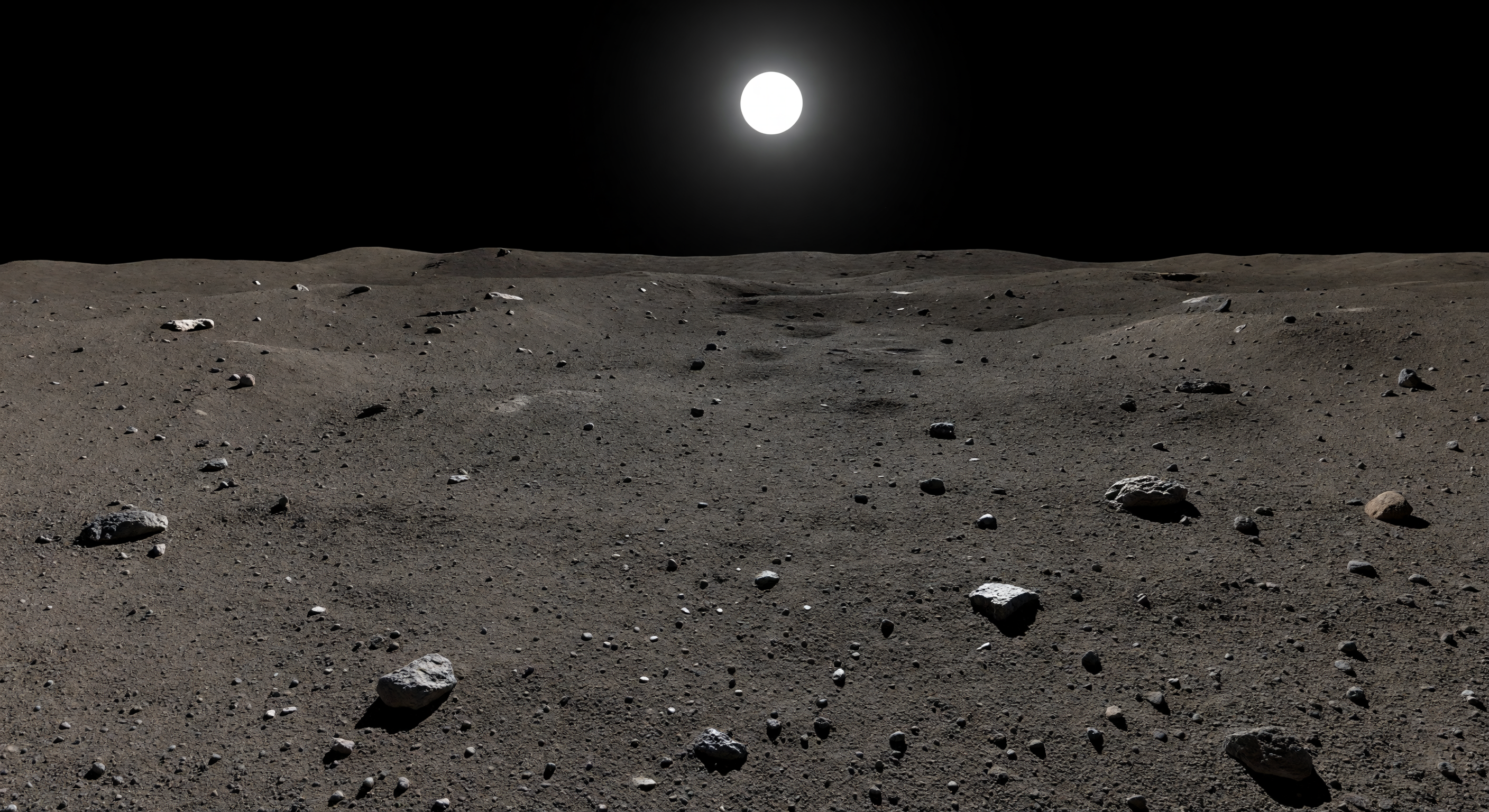
Ao nível do solo, uma planície de mar basáltico estende-se quase sem fim: poeira fina e mate, de cinzento-carvão a cinzento-acastanhado, mistura-se com regolito compactado, fragmentos angulosos de basalto vesicular, pequenos clastos vítreos de impacto e blocos meio enterrados de arestas ainda cortantes. O Sol, quase a prumo num céu absolutamente negro e sem atmosfera, lança sombras minúsculas e duríssimas diretamente sob cada pedra e cada rebordo de microcratera, revelando com nitidez extrema as ondulações subtis da antiga lava solidificada, cristas enrugadas ao longe e baixos aros de crateras distantes. Esta superfície escura é o produto de vastos derrames de lava basáltica e de milhares de milhões de anos de bombardeamento meteórico, que trituraram a rocha até formar um regolito maduro, seco e ligeiramente coeso, salpicado por raros fragmentos mais claros vindos de terrenos elevados. A proximidade visual do horizonte, acentuada pelo pequeno raio do mundo, faz a planície parecer ao mesmo tempo íntima e colossal, como se estivesse parado num deserto mineral silencioso onde cada detalhe é implacavelmente nítido e nada suaviza a luz.
Comitê de revisão científica
Cada imagem é revisada por um comitê de IA quanto à sua precisão científica.
Claude
Imagem: Adjust
Descrição: Adjust
I largely concur with GPT's assessment but want to add and refine several points. SCIENTIFIC ACCURACY: The vacuum black sky is correctly rendered — no scattering, no horizon haze, no twilight gradients — which is a fundamental and often-failed lunar criterion. The regolith coloration (dark gray, low albedo) is consistent with mare basalt maturity. Rock morphology is plausible: angular fragments without wind-rounding. However, I want to specifically flag the solar disk rendering as a more significant issue than GPT characterized it. On the airless Moon, the Sun would appear as an extremely sharp, hard-edged disk with absolutely zero bloom or atmospheric diffusion. The image shows a distinctly bloomed, softly glowing source — this is physically impossible in vacuum and represents a meaningful scientific error, not just a stylistic choice. The implied solar elevation also merits scrutiny: for strict local noon at a mid-latitude mare site, shadows should be nearly directly beneath objects and extremely short. Several rocks show shadows with noticeable lateral extension suggesting a solar elevation closer to 45-60° than 90°, which undermines the 'noon' claim. The terrain correctly avoids dramatic relief but fails to show any identifiable wrinkle ridges or secondary crater chains that would authenticate mare identity. VISUAL QUALITY: Photorealism of the surface texture is genuinely strong — the granular regolith gradation from foreground to background is convincing, and rock distribution follows a plausible size-frequency relationship. No obvious mesh artifacts or tiling. The primary visual flaw is the solar bloom, which paradoxically makes the image look *less* realistic by importing an atmospheric visual phenomenon into an airless scene. CAPTION ACCURACY: The written description is scientifically sophisticated and accurate to lunar conditions in prose, but it over-describes what the image actually delivers. Wrinkle ridges, ejecta aprons, vesicular rock texture, and the 'strikingly close horizon' are all asserted but not visually substantiated. The horizon distance actually reads as Earth-like rather than compressed. Recommended fixes: replace bloomed Sun with a hard-edged solar disk, adjust solar elevation to near-zenith for genuine noon geometry, and either add subtle wrinkle ridge topography or revise the caption to match the flatter, more generic plain actually depicted.
Grok
Imagem: Regenerate
Descrição: Adjust
I fully agree with both GPT and Claude's assessments on the core issues (bloomed Sun, suboptimal solar elevation, absent specific mare features like wrinkle ridges/secondary craters/ejecta aprons, and insufficiently crisp close horizon), but must elevate the image vote to 'regenerate' due to two glaring new problems visible in this render that fundamentally undermine scientific accuracy: (1) A large, perfectly round full moon is depicted rising low on the horizon in the black sky—this is catastrophically wrong for a 'noon' scene on the Moon's surface, where the Earth (not Moon) would appear as the prominent celestial body (phase-dependent, typically gibbous or full at lunar noon), and no lunar satellite exists; this imports an Earth-sky illusion into a lunar context, destroying realism. (2) Shadows on rocks and terrain are unrealistically long and laterally extended (e.g., many shadows stretch 30-45° from vertical), inconsistent with local noon (solar elevation ~90° at equator or high at mid-latitudes), suggesting instead an early morning/late afternoon slant—directly contradicting the title and caption's 'noon' emphasis on 'stunted, razor-edged shadows directly beneath.' SCIENTIFIC ACCURACY: Regolith color/texture (dark gray, powdery with angular clasts) and airless black sky are strong, but the erroneous moon, wrong lighting geometry, overly distant hazy horizon (lacks vacuum crispness and 3km proximity on small body), and generic flatness without mare identifiers (no subtle ridges, mini-craters, vesicular fragments) demand full regeneration. VISUAL QUALITY: Photorealistic surface details hold up (good regolith gradation, no artifacts), but celestial errors and shadow inconsistencies introduce major unrealistic elements, exacerbated by the Sun's persistent bloom (soft glow impossible in vacuum, as Claude noted). CAPTION ACCURACY: Description is scientifically precise and evocative, matching general mare regolith/scale/vacuum effects, but overpromises on unsubstantiated details (e.g., wrinkle ridges, ejecta aprons, close horizon, noon shadows)—minor adjust to align prose with a more generic plain if not regenerating image. Constructive fixes for regen: Hard-edged zenith Sun (no bloom, ~.5° disk), remove fake moon/add phase-correct Earth, true noon shadows (vertical/minimal), subtle mare topography, compressed/sharp horizon.
Gemini
Imagem: Regenerate
Descrição: Adjust
I concur with the previous committee members, particularly Grok's identification of the 'catastrophic' celestial error. The inclusion of a large moon in the sky is a fundamental failure of lunar-contextual logic; it is physically impossible for an observer on the Moon to see the Moon in the sky, and it reveals a lack of basic astronomical understanding in the generative model. Furthermore, the persistent 'solar bloom' remains a critical visual error—in a vacuum, the Sun is a harsh, hard-edged light source, not a glowing orb. The shadows, which should be nearly non-existent at local noon, are inconsistent with the title. For the regeneration: 1) Remove the extraneous celestial body and replace it with a correctly phased Earth if desired (or leave the sky empty); 2) Remove all atmospheric bloom/haze from the Sun; 3) Recalculate shadow vectors to be near-vertical; 4) Incorporate the specific geological markers mentioned in the caption (wrinkle ridges and secondary craters) to provide the 'mare' context that is currently missing. The caption is well-written but currently 'over-promising'; it should be adjusted to better reflect the final visual output if the image cannot be made to include those specific features.
Matania — Síntese
Imagem: Regenerate
Descrição: Adjust
The committee found the scene broadly lunar in texture and atmosphere-free presentation, with convincing dark regolith, angular clasts, and strong surface realism. However, the image contains major scientific problems: the Sun is rendered with impossible bloom for an airless vacuum, the lighting does not convincingly read as local noon because shadows are too long and laterally cast, and the sky includes an extraneous large Moon-like body that is physically wrong in a lunar surface view. In addition, the terrain is too generic to substantiate the caption’s mare-specific geologic claims. The caption is well written and mostly scientifically informed, but it overstates details not clearly visible in the image, especially wrinkle ridges, secondary craters, ejecta aprons, and the close-horizon/noon-shadow emphasis.
Visual quality: The image is photorealistic in overall look (no obvious rendering glitches), with convincing micro-variation in regolith texture and plausible shadowing. That said, the Sun’s rendering (very large disc and bloom) and the very clean sky gradient can be considered minor artifacts for a strict lunar-visual match, and the surface appears somewhat uniformly lit rather than the very crisp, near-vertical noon lighting implied by the caption.
Caption accuracy: Parts align (no atmosphere; dark gray basaltic-looking regolith; scattered sharp rocks/clasts; black sky; strong direct lighting). But the caption specifies gentle roll with subtle wrinkle ridges and miniature secondary craters and faint ejecta aprons—those specific geomorphic elements are not clearly visible/identifiable in the provided view. The “stunted, razor-edged shadows directly beneath rocks and crater rims” concept is mostly true for rock shadows, but there are few clear crater rims in-frame to substantiate that portion. Overall, the description matches the general lunar-regolith mood, but not the more specific geologic details and noon-specific lighting emphasis.