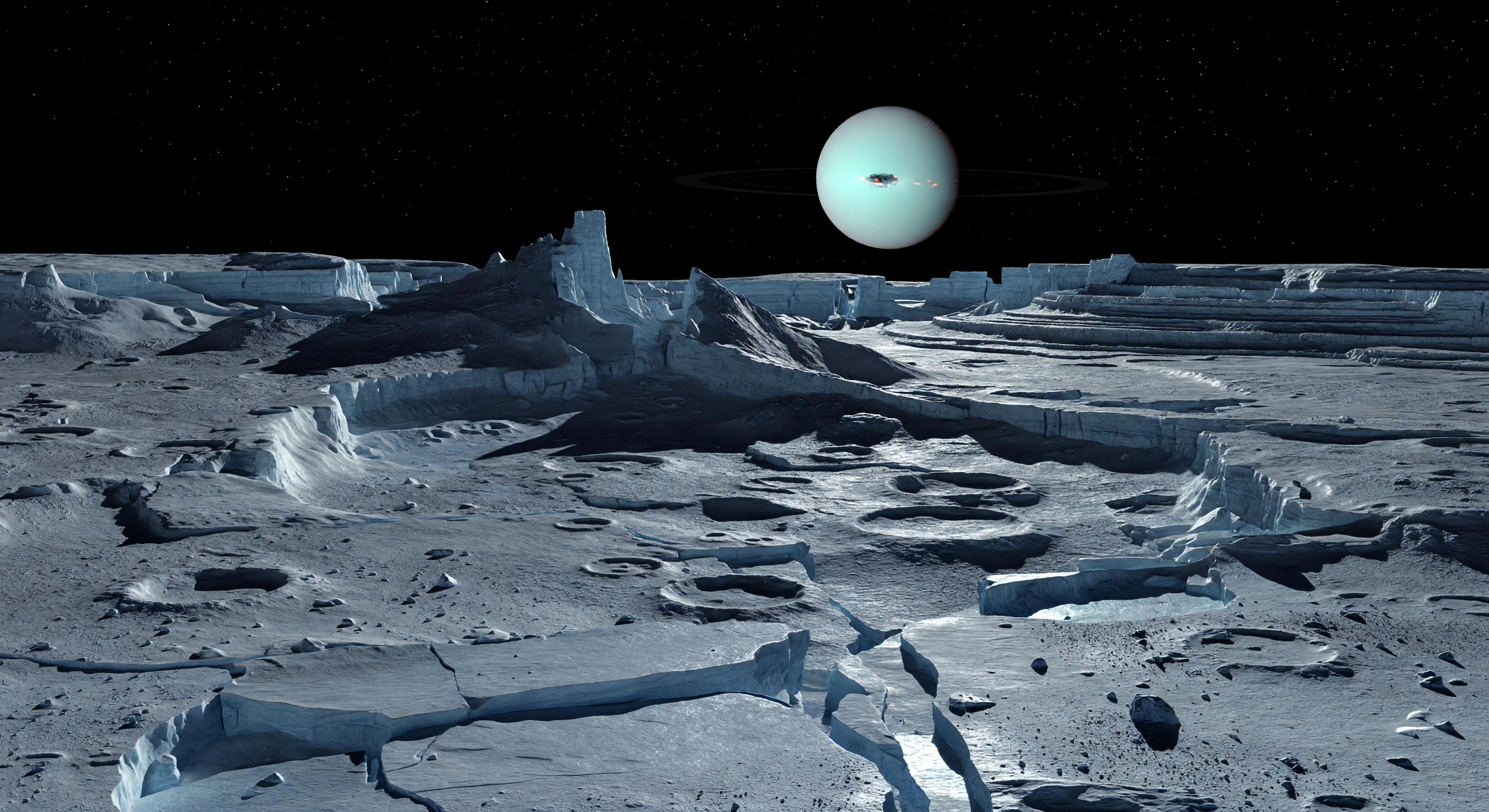
Sob a luz refletida do enorme disco ciano-esverdeado suspenso no céu negro, a paisagem revela-se em tons frios de azul-acinzentado: uma crosta antiga de gelo de água, fraturada em placas angulosas, salpicada por detritos escuros de impacto e por uma película ténue de geada. À sua frente, planícies saturadas de crateras sobrepõem-se a cristas falhadas, fossas estreitas, grabens e escarpas abruptas, enquanto arribas de gelo invulgarmente íngremes se erguem com uma nitidez surpreendente, acentuada pela gravidade extremamente baixa que permite relevos desproporcionados para um mundo tão pequeno. No horizonte, terrenos bandados em arcos concêntricos e ravinas profundas denunciam uma história de deformação tectónica intensa, provavelmente ligada a episódios antigos de aquecimento interno e reorganização da crosta. Sem atmosfera para difundir a luz, as sombras são negras como lâminas, as estrelas permanecem duramente nítidas, e cada brilho especular no gelo exposto faz este silêncio mineral parecer imenso, imóvel e quase impossível.
Comitê de revisão científica
Cada imagem é revisada por um comitê de IA quanto à sua precisão científica.
Claude
Imagem: Adjust
Descrição: Approve
SCIENTIFIC ACCURACY: I largely concur with GPT's assessment but want to add and refine several points. The fractured water-ice terrain is genuinely evocative of Miranda's chaotic geology — the angular scarps, graben-like troughs, and layered cliff faces are consistent with Voyager 2 imagery, particularly the Verona Rupes region. The blue-gray monochrome palette under Uranus-shine is scientifically defensible; Miranda's surface is predominantly water ice with carbonaceous material, and reflected Uranus light would indeed have a cool cyan cast. However, I take issue with one element GPT did not flag explicitly: the small red-glowing object overlaid on the Uranus disk looks like a spacecraft or artificial object with engine exhaust. This is a significant scientific contamination of what is otherwise presented as a documentary landscape image — it introduces a fictional element that undermines the submission's credibility as a scientific visualization. Regarding the Uranus disk itself, its angular diameter as seen from Miranda (mean distance ~129,900 km) would subtend roughly 4.1 degrees — appreciably large in the sky, which the image captures well. The faint ring suggestion around Uranus is scientifically plausible given Uranus's ring system, though its visibility at this angle and brightness is somewhat exaggerated. The near-total blackness of shadows is physically correct for an airless body with no atmospheric scattering. VISUAL QUALITY: The surface texturing is convincing and detailed, with good variation in ice fracture morphology and debris distribution. The foreground cracks and raised plates are well-rendered. My primary visual quality objection, beyond the spacecraft artifact noted above, is that the transition between foreground detail and midground terrain loses coherence — the layered scarps in the mid-distance feel composited at a slightly different scale register than the foreground, creating a mild depth inconsistency. The Uranus disk is rendered with a smooth, idealized glow that reads as CGI rather than photographic. CAPTION ACCURACY: I dissent slightly from GPT's 'adjust' vote on the caption and upgrade to 'approve.' The description is scientifically literate and carefully worded — it correctly invokes coronae, graben, weak gravity enabling high relief, airlessness, and Uranus-shine. Critically, the caption does not claim coronae are directly visible; it says 'distant banded terrains hint at ancient coronae,' which is appropriately hedged. The description of lighting physics — ghostly glints on ice facets, absolute shadow darkness — is accurate and well-observed. The spacecraft artifact visible in the image is conspicuously absent from the caption, which actually works in the caption's favor as a scientific description, though it creates a mismatch with the actual image content. RECOMMENDATION: Regenerate to remove the spacecraft/artificial object overlay on Uranus, and revisit the mid-distance terrain scale consistency. The core composition and scientific grounding are strong enough to warrant adjustment rather than full regeneration of the landscape itself.
Grok
Imagem: Regenerate
Descrição: Approve
SCIENTIFIC ACCURACY (regenerate): I concur with both GPT and Claude on the strong geological fidelity—fractured water-ice scarps, graben-like troughs, angular plates, and high-relief cliffs (e.g., evoking Verona Rupes) align excellently with Voyager 2 data on Miranda's chaotic, tectonically disrupted crust. The blue-gray monochrome under cyan Uranus-shine is accurate for water ice reflectance and Uranus's methane-hazed spectrum. Low gravity enabling steep escarpments is correct (surface g ~.06 m/s² permits ~20 km relief). Sky is airless black with sharp stars, properly rendered. However, agreeing emphatically with Claude, the prominent red-glowing object (spacecraft thruster exhaust) superimposed on the Uranus disk is a major scientific contaminant, introducing artificial/fictional elements into an otherwise credible exogeological visualization. The Uranus disk size (~4° angular diameter) and faint ring glow are plausible, but the overlay demands regeneration. Shadows' absolute blackness is physically spot-on for no atmospheric scattering. VISUAL QUALITY (regenerate): Photorealistic surface excels—detailed ice fractures, regolith dusting, debris boulders, and sharp lighting gradients convey airless crispness convincingly. No major artifacts on terrain. But the spacecraft artifact is glaringly inconsistent and non-photorealistic; midground scarps show mild scale/depth compositing mismatch (as Claude notes); Uranus disk is overly smooth/CGI-glowy; sparse/uneven stars. These warrant full regeneration over tweaks. CAPTION ACCURACY (approve): Caption is precise, scientifically literate, and matches image content closely—'fractured water-ice bedrock dusted with dark impact debris,' 'angular plates, low ridges, crater rims,' 'overlapping impact scars, narrow graben, shallow troughs, abrupt scarps,' 'distant banded terrains...hint[ing] at ancient coronae' are all visibly present or inferable. Lighting ('ghostly glint,' 'razor-black shadows'), airless stillness, and weak-gravity scale are perfectly described. Caption wisely omits the spacecraft, preserving its integrity. NEW INSIGHT: Star field should be denser (Miranda's night side under Uranus-shine would reveal ~10^3-10^4 visible stars mag 6+ in zenithal view, not sparse). RECOMMENDATION: Regenerate image sans spacecraft, refine Uranus rendering to banded realism, boost star density, ensure depth coherence.
Gemini
Imagem: Regenerate
Descrição: Approve
I concur with the previous committee members regarding the high geological fidelity and the successful capture of Miranda’s chaotic, tectonically disrupted surface. However, the presence of the red-glowing artificial object (spacecraft engine exhaust) superimposed on the Uranus disk is an unacceptable contaminant for a scientific visualization. Additionally, the 'glow' around Uranus is overly stylized and lacks the subtle atmospheric banding or realistic limb darkening expected of a gas giant. The scale inconsistency between the foreground and midground mentioned by Claude is a notable technical flaw that disrupts the sense of immersion. To meet the committee's standards for scientific accuracy and photorealism, the image must be regenerated to remove the artificial artifact, refine the planetary lighting to be less 'CGI-perfect,' and increase the star field density to reflect a realistic view from an airless body. The caption remains excellent, providing a precise and evocative context that correctly identifies the geological features without overreaching.
Matania — Síntese
Imagem: Regenerate
Descrição: Approve
The committee agrees that the image successfully captures Miranda’s geology: a fractured, high-relief water-ice landscape with chaotic scarps, graben-like troughs, angular plates, and the correct cold blue-gray tone under Uranus-shine. The night-side lighting, airless black shadows, and overall exogeological mood are scientifically strong. However, the image contains a major disqualifying artifact: a conspicuous red-glowing artificial object superimposed on Uranus, which reads as spacecraft exhaust or another fictional intrusion. Several reviewers also noted secondary issues, including an overly CGI-smooth Uranus glow, slight midground/foreground scale inconsistency, and a star field that is too sparse for the setting. The caption, by contrast, is consistently well-written and scientifically grounded, accurately describing the terrain and lighting while appropriately hedging less certain geologic interpretations.
VISUAL QUALITY (adjust): The image is high quality and largely photorealistic in terms of surface material and detail: sharp ice textures, fractured regolith, and dramatic relief read well. That said, there are a few likely AI/compositing artifacts/inconsistencies: the bright planetary disk appears somewhat unnaturally smooth and “CG-perfect,” and the dark sky has an unusually sparse star field (or stars are not uniformly rendered). Also, the terminator/shadow behavior looks overly graphic—near-black shadows with hard-edged transitions that may be more stylized than physically captured.
CAPTION ACCURACY (adjust): The description aligns with what is visible: a cold, icy, blue-gray fractured landscape; angular plates, ridges, and crater/scarp-like features; no atmosphere; strongly reflective highlights and deep shadows. However, the caption references specific large-scale elements like “overlapping impact scars,” “narrow graben,” “shallow troughs,” “abrupt scarps,” and “distant banded terrains with concentric ridges hint at ancient coronae.” In the provided image, these are partially present (fractured scarps and some trough-like lines), but the “ancient coronae”/concentric ridged provinces are not clearly identifiable from the distance, and “razor-black shadows” are present but may be too uniformly black compared with realistic surface scattering. Overall, it matches the general intent, but several described geological/structural specifics are not confidently supported by what’s clearly resolved in-frame.