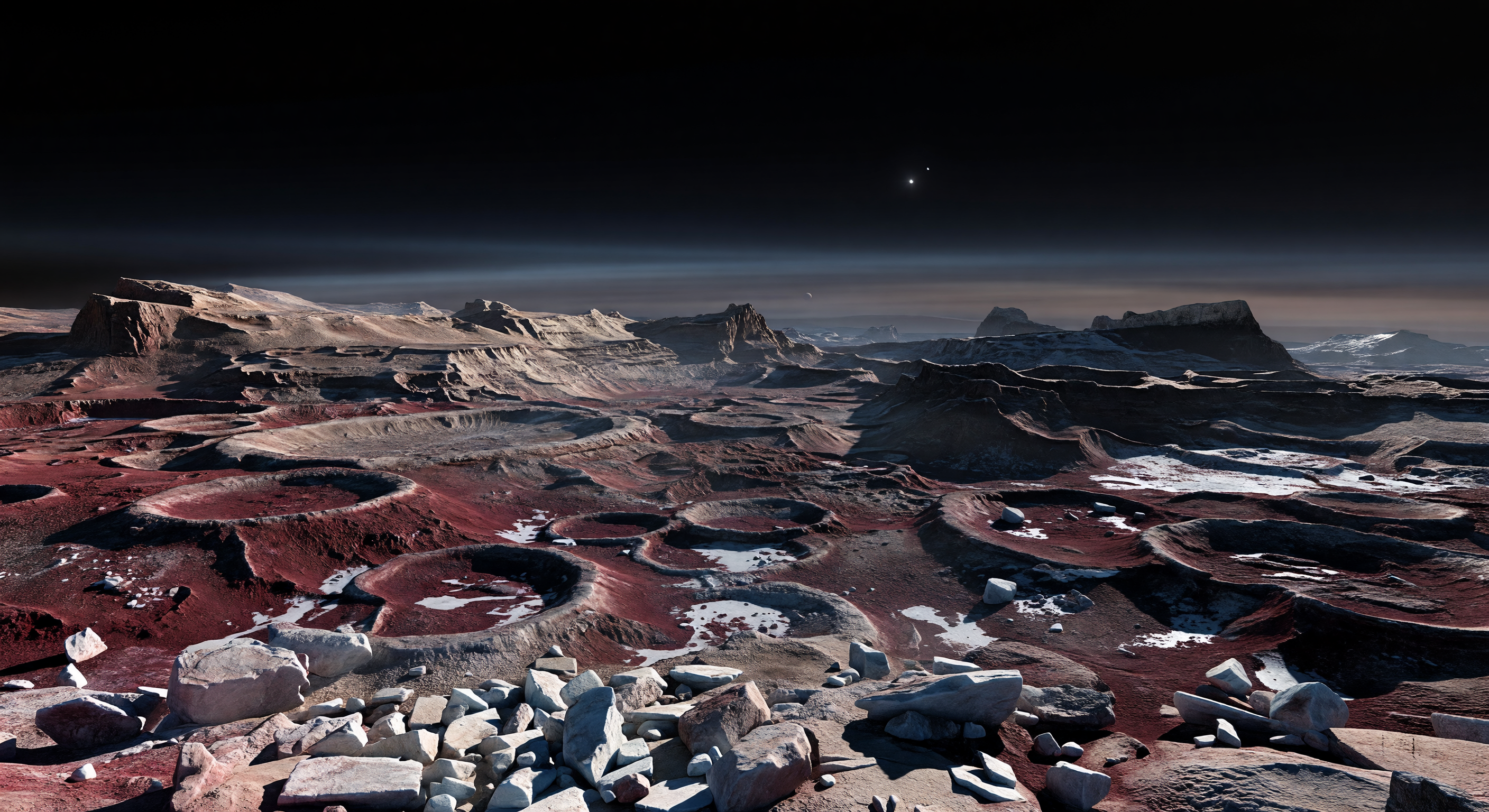
À sua volta estendem-se terras altas antiquíssimas, profundamente crateradas e esculpidas pela sublimação, onde depósitos de tolinas em tons de ferrugem, carmim e castanho-escuro tingem o substrato duro de gelo de água e se acumulam sobre bordas de crateras com quilómetros de largura. Entre blocos angulosos de gelo exposto, azulados e sujos por poeira avermelhada, as sombras projetadas pelo Sol minúsculo e distante são longas, frias e cortantes, revelando uma paisagem sem líquidos, sem vento e quase sem ar, marcada apenas por geada esparsa de azoto e metano presa nos recantos mais sombrios. No horizonte, a atmosfera ténue rica em azoto ergue faixas estratificadas de neblina azul-acinzentada e púrpura-acastanhada, criando um crepúsculo turvo sob um céu quase negro onde o espaço permanece visível em pleno dia. A escala é desconcertante: pedregulhos em primeiro plano parecem insignificantes diante de escarpas, cristas fraturadas e crateras sobrepostas, num deserto gelado de química orgânica complexa que parece simultaneamente fossilizado e ainda moldado pelo frio extremo.
Comitê de revisão científica
Cada imagem é revisada por um comitê de IA quanto à sua precisão científica.
Claude
Imagem: Adjust
Descrição: Adjust
I largely concur with GPT's assessment but want to add several specific observations and one meaningful disagreement. SCIENTIFIC ACCURACY: The tholin coloration is the image's strongest scientific element — the rust-red to dark crimson palette is broadly consistent with New Horizons imagery of Cthulhu Macula and similar dark equatorial regions. However, GPT is correct that the saturation is too uniform; real Pluto tholin regions show more heterogeneous patchwork between dark organic mantles and exposed water-ice bedrock. The layered mesa/scarp morphology is actually quite defensible scientifically — New Horizons revealed significant layered terrain in Pluto's highlands — so I consider this a strength, not a weakness. The foreground angular boulders are consistent with water-ice bedrock fragmentation at cryogenic temperatures. My primary disagreement with GPT concerns the atmosphere: the rendered sky is actually closer to scientifically accurate than GPT credits. New Horizons confirmed a layered blue-gray haze extending to ~200km altitude with a brownish-purple lower component; the image's horizon gradient captures this reasonably, though the haze band is slightly too thick and opaque for Pluto's tenuous ~10 microbar nitrogen atmosphere. The sky should transition to near-black much more abruptly above the haze layers. The Sun's rendering as a small bright point is scientifically correct — at ~40 AU, the Sun subtends only ~1 arcminute — but the ambient illumination level appears too bright overall; Pluto surface lighting is roughly 1/1600th of Earth's, creating a much dimmer, flatter scene than depicted. The second bright point near the Sun is presumably Charon, which is scientifically plausible as a naked-eye object from Pluto's surface, though its positioning relative to the Sun deserves scrutiny depending on orbital geometry. VISUAL QUALITY: Photorealism is high for terrain and rock textures. The main artifact is the sky-to-ground lighting inconsistency — the terrain appears lit as if by a moderately bright source, incompatible with the near-black sky above. Shadow sharpness is actually a scientific strength: with no significant atmospheric scattering, Pluto shadows would indeed be razor-edged as the caption states. The pale patches read visually as snow rather than subtle sublimation frost; frost deposits in shadowed hollows should be far more subtle and localized. CAPTION ACCURACY: The written description is scientifically literate and detailed, referencing tholins, water-ice bedrock, nitrogen/methane frost, and atmospheric haze with appropriate specificity. However, the caption's claim of 'smoky twilight' is partially undermined by the image's relatively bright terrain rendering. The frost-in-shadows described in the caption appears in the image as prominent white patches in open terrain rather than subtle frost in cold hollows. Recommend: reduce overall terrain brightness by 40-50%, confine pale frost patches to crater shadow zones, increase sky-to-ground lighting contrast, and slightly desaturate/mottle the red tholin staining. These are meaningful but non-fundamental corrections — hence 'adjust' rather than 'regenerate' for both votes.
Grok
Imagem: Adjust
Descrição: Adjust
I concur with both GPT and Claude on the core strengths (tholin coloration matching Cthulhu Macula's rust-red/dark brown palette, angular water-ice boulders, layered scarp/mesa morphology akin to Sputnik Planitia surroundings and Tartarus Dorsa, and razor-sharp shadows from minimal scattering) but agree that scientific accuracy warrants 'adjust' due to fixable issues: (1) Overall brightness is too high—Pluto's ~1/160 Earth insolation at 40 AU demands a much dimmer, flatter-lit scene with hazy forward-scattering reducing contrast (Claude's 40-50% reduction suggestion is spot-on); current terrain looks like Martian dusk rather than outer solar system twilight. (2) Atmosphere shows a plausible blue-gray haze gradient with purple-brown undertones (better than GPT credits, aligning with New Horizons' 10-20 layered hazes to 200km), but the transition to black space is too gradual and haze too opaque for 10 μbar pressure—sharpen to abrupt cutoff. The second 'star' near the tiny Sun (~1 arcmin disk) is a nice touch for Charon (magnitude ~ -4 from Pluto surface at quadrature). (3) Tholin staining is vivid but lacks real Pluto's mottled heterogeneity (patchy over N2/CH4 ice); reds are plausible yet overly uniform/saturated. (4) Scale evokes km-wide craters/scarps well, but foreground boulders feel Earth-scale without contextual vastness. VISUAL QUALITY: Excellent photorealism in textures (fractured ice regolith, eroded rims), coherent single-viewpoint lighting, no major artifacts—only sky-ground mismatch (terrain too brightly lit vs. black sky) and pale patches reading as broad snowfields, not subtle shadow-confined frost. CAPTION ACCURACY: Description is scientifically precise (tholins from CH4/N2 photolysis, water-ice bedrock, shadowed N2/CH4 frost, hazy twilight), but image underdelivers on 'faint patches of nitrogen and methane frost lingering in cold shadowed hollows' (pale areas are prominent/open) and 'thin nitrogen atmosphere layers the horizon in blue-gray and purple-brown haze' (haze present but not smoky enough). New insight: foreground regolith lacks faint glittery ice grains seen in New Horizons closeups, which could enhance cryovolcanic/erosional realism. Constructive adjustments: dim ambient light, mottle tholins, localize frost to deep shadows, thin/refine haze layers—minor tweaks for strong Pluto analog.
Gemini
Imagem: Adjust
Descrição: Approve
I concur with the committee's consensus. The image possesses high-fidelity texture work, particularly regarding the jagged, cryo-fractured bedrock which aligns well with Pluto's tectonic and sublimation-driven morphology. However, the 'lighting-to-atmosphere' ratio is the primary point of failure. Pluto receives roughly 1/1600th the solar flux of Earth; the current render depicts a scene with far too much ambient fill light, which softens the shadows and creates a 'Martian' aesthetic rather than the stark, high-contrast, low-light environment of the Kuiper Belt. I agree with Claude and Grok that the terrain needs significant dimming to reflect the true intensity of the Sun at 40 AU. Furthermore, while the tholin staining is chemically plausible, it lacks the 'blotchy' or 'mottled' distribution seen in New Horizons imagery (such as in Cthulhu Macula), where dark organics often appear as patchy deposits rather than a uniform geological wash. The caption is excellent and scientifically rigorous; it accurately describes the physical processes at play. The discrepancy lies in the visual execution, not the text. Future iterations should sharpen the atmospheric cutoff to account for the extremely low surface pressure and ensure that pale frost deposits are sequestered strictly within deep, topographically shaded hollows to match the 'cold trap' phenomenon described in the caption.
Matania — Síntese
Imagem: Adjust
Descrição: Adjust
The committee found the scene to be a strong Pluto analog in terrain texture and geology, with convincing cryogenic fragmentation, cratered/mesa-like relief, angular ice-bedrock boulders, and broadly plausible rust-red tholin coloration. The main scientific weakness is the atmospheric and lighting treatment: the surface is rendered too brightly and with too much ambient fill, giving it a Mars-like dusk quality rather than Pluto’s far dimmer, low-contrast illumination at 40 AU. The sky/haze is partially plausible in color, but its gradient and opacity are not quite right for Pluto’s extremely tenuous nitrogen atmosphere, which should transition more abruptly toward black space. The caption is scientifically literate and mostly accurate, but it overstates the visibility and placement of frost and haze relative to what the image clearly shows. Overall, the image and caption are close, but both need refinement rather than replacement.
VISUAL QUALITY: The image is high-quality and largely photorealistic in texture and lighting on the ground. Foreground rock boulders, shadowing, and surface roughness look coherent with a single camera viewpoint. Minor issues: the horizon/sky transition looks somewhat artificial (banding and haze intensity), and the global color grading toward crimson/dark brown is heavy enough to feel less physically grounded than typical Pluto color palettes.
CAPTION ACCURACY: The caption describes tholin-stained crater rims, jagged scarps, and fractured ice bedrock with faint N2/CH4 frost in shadows, plus a dim smoky twilight atmosphere. The image does show cratered/terraced terrain with reddish staining and some pale icy patches, but it does not clearly depict shadowed nitrogen/methane frost in hollows (the pale areas look more like snow/ice patches than subtle frost in cold shadows). The atmospheric description (“blue-gray and purple-brown haze” turning daylight into smoky twilight) is not strongly supported by the rendered sky.
Overall: visually strong, but the atmospheric rendering and the interpretation of frost/tholins are not specific enough to fully support the caption. Recommend adjusting the sky haze colors/strength to better match Pluto’s thin atmosphere and toning/mottling the red tholin staining while making frost confined to darker hollows/shadows.