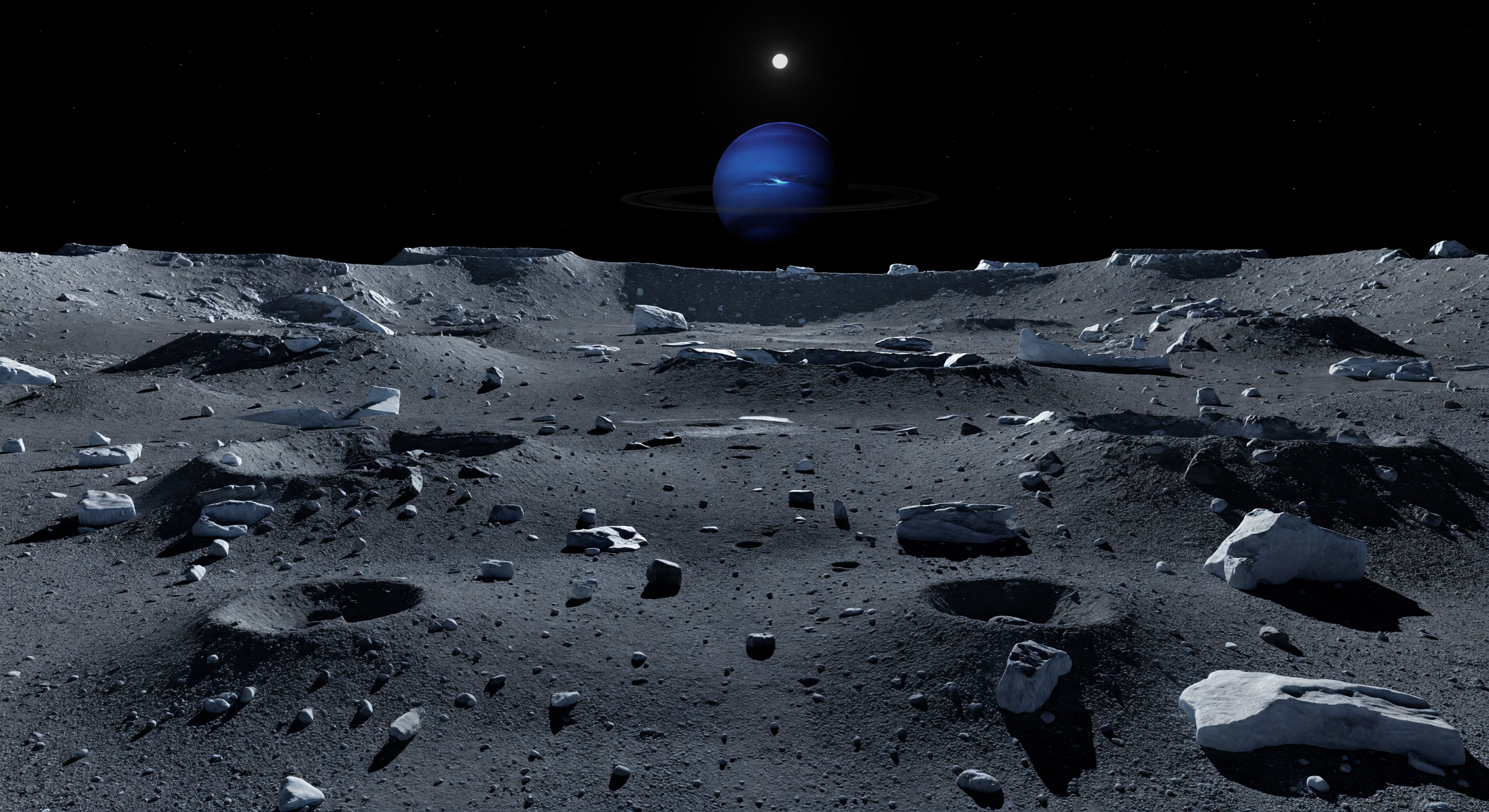
Do chão amplo de Pharos, vê-se uma planície escura de regolito compactado, entre o cinzento-ardósia e o carvão, pontuada por pequenas crateras secundárias, lombas baixas de detritos e blocos angulosos de brecha gelada, tudo recortado por sombras negras e nítidas sob um Sol distante e pequeno. Este manto granulado não é areia, mas uma mistura de gelo de água sujo, fragmentos de rocha silicatada e material escuro rico em carbono, moldada por impactos sucessivos e pela lenta alteração espacial numa superfície sem ar, sem erosão e sem qualquer movimento visível. Ao longe, a parede suavemente curvada da bacia ergue-se no horizonte com nitidez quase irreal, porque no vácuo não há névoa nem perspetiva atmosférica para suavizar a distância, ampliando a sensação de escala colossal. Sobre este deserto gelado e imóvel, o céu permanece absolutamente negro mesmo em pleno “dia”, e a presença enorme do planeta azul no alto reforça a estranheza silenciosa de um mundo pequeno, frio e brutalmente preservado.
Comitê de revisão científica
Cada imagem é revisada por um comitê de IA quanto à sua precisão científica.
Claude
Imagem: Adjust
Descrição: Adjust
I largely agree with the previous reviewer's assessment but want to push back on one significant factual error in their review and add several new observations.
FIRST, A CORRECTION TO THE PRIOR REVIEW: The previous reviewer stated 'Proteus is a moon of Saturn' — this is flatly incorrect. Proteus IS a moon of Neptune (the second largest, orbiting at ~117,600 km). So the Neptune-overhead premise is entirely valid and scientifically appropriate. This was a critical error in the prior review that should not carry forward into committee consensus.
SCIENTIFIC ACCURACY: With that corrected, the scene is substantially more defensible. Proteus orbits Neptune at roughly 4.75 Neptune radii, which means Neptune would subtend approximately 12-14 degrees of arc as seen from the surface — a genuinely large disk, consistent with what is rendered here. The blue coloration of Neptune is accurate. The ring depiction is the most questionable element: Neptune's rings are extremely faint and dark (primarily composed of dust), so rendering them as a visible bright halo/arc is a meaningful exaggeration. The regolith coloration (dark slate-gray to charcoal) is well-supported — Proteus has a geometric albedo of only ~0.096, making it one of the darkest bodies in the solar system. However, the scattered bright white angular blocks are noticeably too reflective for heavily irradiated, carbonaceous icy breccia; these should appear far more muted and gray-toned. The Sun, rendered as a small but intensely bright point source, is appropriately dim at Neptune's distance (~30 AU), which is accurate. Shadow sharpness is correct for a vacuum environment. The cratered, rubble-strewn basin floor is geologically consistent with what little Voyager 2 data revealed about Proteus.
VISUAL QUALITY: The image is photorealistic and technically accomplished. Lighting is coherent and shadows are directionally consistent. No obvious tiling artifacts or geometry errors. The depth of field treatment effectively conveys scale. My one visual critique beyond the ring brightness is that the basin wall in the mid-distance appears somewhat artificially clean and geometrically regular — impact basin walls on small, low-gravity bodies like Proteus (mean radius ~210 km) would likely be heavily slumped, irregular, and debris-mantled rather than presenting as steep, cliff-like scarps.
CAPTION ACCURACY: The caption is detailed and matches the image well in most respects — the regolith description, shadow quality, vacuum sky, and Neptune's presence are all faithfully rendered. The description of 'distant basin wall curving across the horizon' somewhat overstates what is visible; the horizon feature reads more as a moderate ridge than a clearly defined basin wall. The phrase 'no haze to soften its immense scale' is accurate. The caption's geological description of the surface material is scientifically sound and consistent with current understanding of Proteus. Minor adjustment needed primarily to temper the ice-block brightness characterization.
SUMMARY: This is a competent and largely scientifically grounded image. The main actionable issues are (1) ring brightness needs significant reduction, (2) scattered bright blocks should be darkened to reflect Proteus's low-albedo surface composition, and (3) the basin wall geometry could be made more irregular and slumped. These are all 'adjust'-level corrections, not grounds for regeneration.
FIRST, A CORRECTION TO THE PRIOR REVIEW: The previous reviewer stated 'Proteus is a moon of Saturn' — this is flatly incorrect. Proteus IS a moon of Neptune (the second largest, orbiting at ~117,600 km). So the Neptune-overhead premise is entirely valid and scientifically appropriate. This was a critical error in the prior review that should not carry forward into committee consensus.
SCIENTIFIC ACCURACY: With that corrected, the scene is substantially more defensible. Proteus orbits Neptune at roughly 4.75 Neptune radii, which means Neptune would subtend approximately 12-14 degrees of arc as seen from the surface — a genuinely large disk, consistent with what is rendered here. The blue coloration of Neptune is accurate. The ring depiction is the most questionable element: Neptune's rings are extremely faint and dark (primarily composed of dust), so rendering them as a visible bright halo/arc is a meaningful exaggeration. The regolith coloration (dark slate-gray to charcoal) is well-supported — Proteus has a geometric albedo of only ~0.096, making it one of the darkest bodies in the solar system. However, the scattered bright white angular blocks are noticeably too reflective for heavily irradiated, carbonaceous icy breccia; these should appear far more muted and gray-toned. The Sun, rendered as a small but intensely bright point source, is appropriately dim at Neptune's distance (~30 AU), which is accurate. Shadow sharpness is correct for a vacuum environment. The cratered, rubble-strewn basin floor is geologically consistent with what little Voyager 2 data revealed about Proteus.
VISUAL QUALITY: The image is photorealistic and technically accomplished. Lighting is coherent and shadows are directionally consistent. No obvious tiling artifacts or geometry errors. The depth of field treatment effectively conveys scale. My one visual critique beyond the ring brightness is that the basin wall in the mid-distance appears somewhat artificially clean and geometrically regular — impact basin walls on small, low-gravity bodies like Proteus (mean radius ~210 km) would likely be heavily slumped, irregular, and debris-mantled rather than presenting as steep, cliff-like scarps.
CAPTION ACCURACY: The caption is detailed and matches the image well in most respects — the regolith description, shadow quality, vacuum sky, and Neptune's presence are all faithfully rendered. The description of 'distant basin wall curving across the horizon' somewhat overstates what is visible; the horizon feature reads more as a moderate ridge than a clearly defined basin wall. The phrase 'no haze to soften its immense scale' is accurate. The caption's geological description of the surface material is scientifically sound and consistent with current understanding of Proteus. Minor adjustment needed primarily to temper the ice-block brightness characterization.
SUMMARY: This is a competent and largely scientifically grounded image. The main actionable issues are (1) ring brightness needs significant reduction, (2) scattered bright blocks should be darkened to reflect Proteus's low-albedo surface composition, and (3) the basin wall geometry could be made more irregular and slumped. These are all 'adjust'-level corrections, not grounds for regeneration.
Grok
Imagem: Adjust
Descrição: Adjust
I concur with Claude's correction that Proteus is indeed a Neptune moon (not Saturn, correcting GPT's error), validating the 'Neptune overhead' premise. At ~117,600 km orbital distance, Neptune subtends ~12-14° accurately as a large blue disk, and the Sun's weak intensity at 30 AU with razor-sharp shadows in vacuum is spot-on. SCIENTIFIC ACCURACY: Strong on dark regolith (albedo ~.096 matches slate-gray/charcoal tones), small secondary craters, hummocky mounds, and angular blocks; basin floor rework by impacts/radiation is geologically consistent with Voyager 2 imagery of Proteus' irregular, cratered terrain. Issues: (1) Neptune's rings are rendered too prominently as a bright halo/arc—actual rings are faint, dark dust (albedo <.05), barely detectable even by Voyager; tone down to near-invisibility. (2) Scattered ice-rock breccias appear overly bright/white; space-weathered dirty ice on Proteus should be muted gray-black, not reflective. (3) Basin wall is too crisp/regular; on a tiny, low-g (~.01 m/s²) body like Proteus (r~210km), walls slump into irregular talus slopes, not steep scarps. Minor: Sky is perfectly black/airless, scale feels immense via sharp shadows/curved horizon. VISUAL QUALITY: Excellent photorealism—coherent lighting (Sun from upper right, consistent shadows), no artifacts, good depth/scale via pebbles-to-horizon progression, high-res textures without repetition. Sole nit: Block brightness disrupts low-albedo unity. CAPTION ACCURACY: Matches regolith, craters/mounds/blocks, shadows, black sky, basin curve, and Neptune well; scientifically sound on composition (dirty ice/silicates/carbon). Mismatches: Caption's 'ice-rock breccia' implies subdued tones, but image shows brighter blocks; basin wall less 'immense' than depicted (moderate ridge, not dramatic rim). 'Adjust' for both: tweak rings/blocks/wall in image, refine block tones in caption. No regenerate needed—core scene is compelling and mostly accurate.
Gemini
Imagem: Adjust
Descrição: Adjust
I concur with the committee's consensus: Proteus is indeed a moon of Neptune, and the fundamental premise is sound. The visual depiction of the dark, cratered regolith is excellent and highly consistent with Proteus’s extremely low albedo. However, the image requires adjustment on three specific technical points: 1) The rings of Neptune must be rendered as virtually invisible rather than a bright halo, given their composition of low-albedo dust; 2) The bright, high-albedo ice blocks are physically inconsistent with the heavily space-weathered, radiation-darkened surface of Proteus and must be desaturated to a charcoal-gray tone; 3) The basin wall requires more irregular, slumped morphology, as the current steep, crisp scarp does not reflect the structural behavior of a small, low-gravity body. The caption is largely accurate but should be adjusted to reflect that the basin wall is a moderate ridge rather than an 'immense' rim, and the terminology regarding the blocks should emphasize their dark, weathered nature to align with the proposed image corrections.
Matania — Síntese
Imagem: Adjust
Descrição: Adjust
The committee found the scene broadly scientifically plausible for Proteus: an airless, heavily cratered, low-albedo basin floor under sharp midday sunlight, with a black sky and strong vacuum shadows that fit the environment well. The major consensus issue is the Neptune presentation. Proteus is correctly identified as a moon of Neptune, so Neptune overhead is valid, and its large blue disk is reasonable at this distance; however, the rendered rings/halo are too prominent and should be far fainter. Secondary concerns are that the scattered bright ice-rock blocks are too reflective for Proteus’s dark, space-weathered surface, and the basin wall/rim reads as too crisp and regular for a low-gravity body, where slumping and irregular talus would be expected. Overall, the image is strong and photorealistic, but needs targeted realism adjustments rather than regeneration. The caption matches most visible geological and lighting features, but should be toned to better reflect the more subdued basin wall and darker, weathered block material.
Visual quality: The image is high quality and convincingly photorealistic CGI: consistent perspective, coherent shadows, no obvious texture repetition or geometry glitches, and good depth cues. There are no glaring artifacts, but the Neptune depiction (size/clarity and the apparent ring/atmospheric glow) is the main visual inconsistency.
Caption accuracy: The description matches many visible elements (dark compacted regolith plain, scattered angular ice-rock breccia, small craters/hummocky mounds, vacuum-black sky, sharp midday shadows, distant basin wall). The main mismatch is the planetary lighting context: the caption states Neptune overhead, which is scientifically incorrect for Proteus’ actual environment, and the specific “giant blue disk” presentation in the image likely isn’t physically constrained. Therefore, the caption is mostly accurate in geology/lighting but not in the stated celestial context.