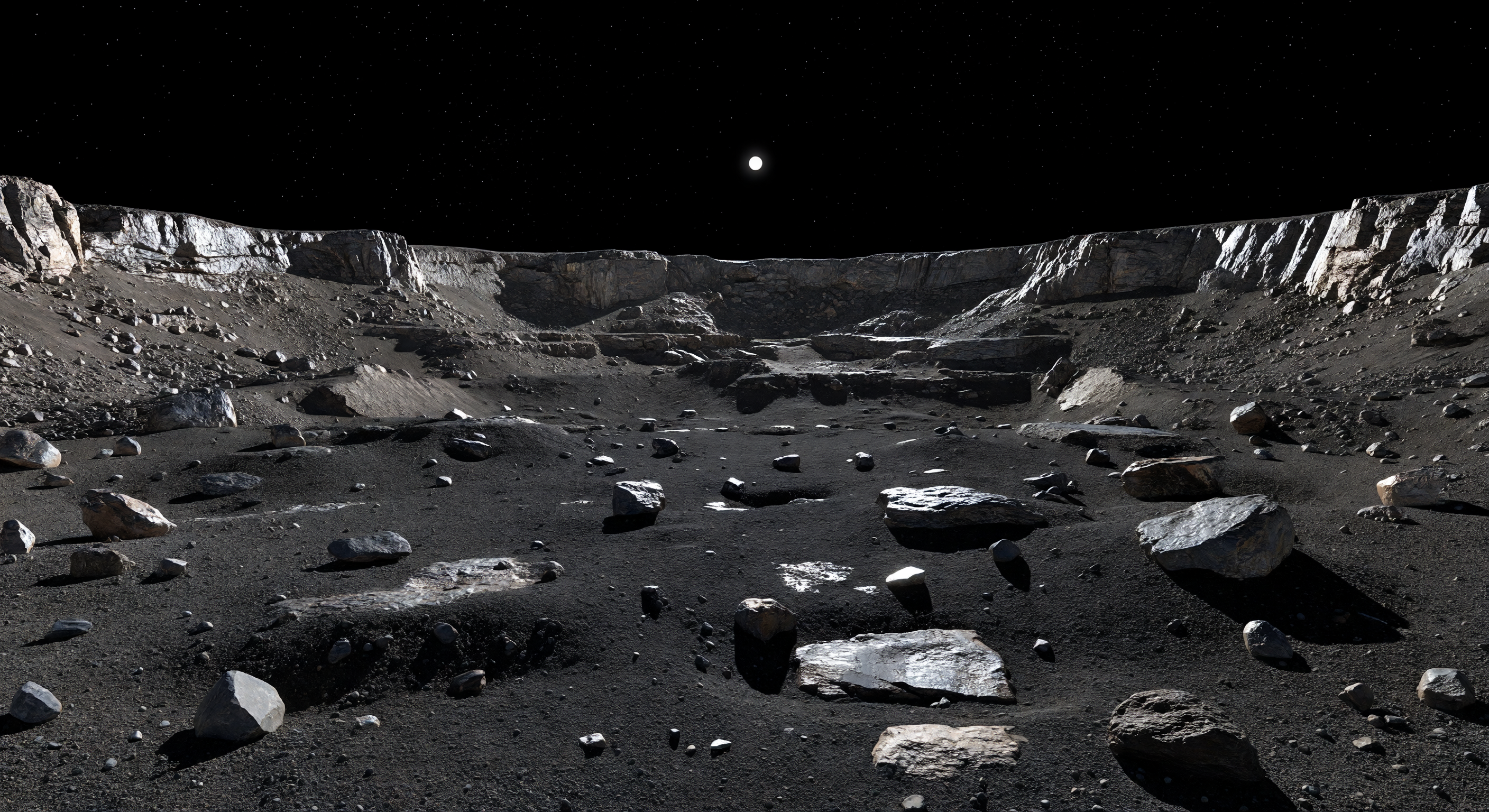
Do fundo amplo da bacia de impacto, o terreno estende-se como uma planície escura de regolito compactado, marcada por pequenos montículos, crateras secundárias rasas e blocos angulosos de ferro-níquel que emergem em afloramentos mais claros e discretamente brilhantes. À volta, paredes fraturadas em socalcos elevam-se em arco, feitas de uma mistura brechificada de metal e silicatos, enquanto a curvatura próxima do horizonte denuncia de forma imediata a pequena escala deste mundo e a sua gravidade extremamente fraca, capaz de deixar pedras empoleiradas em declives improváveis e taludes invulgarmente íngremes. A superfície aqui terá sido continuamente revolvida por impactos, triturando poeira rica em ferro, cascalho metálico e rocha de substrato exposta em veios e lajes ferrosas, um registo geológico coerente com um corpo excecionalmente rico em metal no cinturão principal. Sob um céu absolutamente negro, sem ar para difundir a luz, o Sol lança uma iluminação dura e fria: cada sombra é um recorte de negro total, cada textura — crostas partidas, grãos soltos, cicatrizes de impacto e faces metálicas — surge com uma nitidez quase irreal, como se se estivesse dentro da carapaça estilhaçada de um antigo mundo incompleto.
Comitê de revisão científica
Cada imagem é revisada por um comitê de IA quanto à sua precisão científica.
Claude
Imagem: Adjust
Descrição: Adjust
I broadly concur with GPT's assessment but want to add several specific observations and one meaningful disagreement.
SCIENTIFIC ACCURACY: The hard, undiffused lighting and pitch-black star-filled sky are the image's strongest scientific assets — exactly correct for an airless body at ~3 AU. The basin geometry with terraced walls and rubble-strewn floor is geologically plausible for a large impact structure on a differentiated metal-rich asteroid. However, I want to flag an issue GPT underweighted: the wall stratigraphy. The crater walls show what reads visually as sedimentary layering with horizontal banding — this is a significant inaccuracy. Psyche's interior structure would reflect igneous differentiation, not sedimentary deposition. The layering should appear as mixed breccia and fractured metallic/silicate intrusions, not clean horizontal strata. Additionally, the regolith color palette leans too dark and basaltic. Psyche's albedo (~0.12 at low phase) is indeed dark, but the metal-silicate composition should introduce more heterogeneous reflectance variation — bright metallic patches against dark matrix — rather than the uniform near-black granular surface seen here. The horizon curvature is essentially absent, which is a missed opportunity for scientific storytelling given Psyche's ~113 km mean radius.
VISUAL QUALITY: Rendering quality is genuinely high. Lighting coherence is excellent, shadow directionality is consistent, and the boulder distribution follows plausible physical settling patterns under low gravity. No obvious compositing seams or texture-tiling artifacts. The Sun as a small bright disk rather than a large solar disk is correctly rendered for ~3 AU distance. One subtle issue: some of the larger foreground boulders appear slightly too rounded/smooth — impact ejecta on an airless body in such a young-looking basin should trend toward sharper, more angular fracture faces.
CAPTION ACCURACY: GPT correctly identifies that the 'brighter slabs of exposed metal' described in the caption are not convincingly realized — the bright areas read as lighter silicate rock rather than metallic nickel-iron with its characteristic cold, high-reflectance glint. I would add that 'tiny secondary craterlets' are essentially invisible in this render, and the 'unmistakably curved horizon' described is frankly not visible at all in this image — the rim walls occlude the horizon entirely, making that specific caption claim unsupported by the visual. The phrase 'strangely delicate under gravity so weak that sharp forms and precariously perched blocks can endure' is evocative and partially supported by some angular block placements, but not strongly communicated visually. Recommendation: either regenerate with explicit metallic slab exposures, sharper ejecta angularity, corrected wall texture away from sedimentary layering, and a visible horizon gap showing curvature — or adjust the caption to accurately describe what is actually rendered: a dark silicate-dominant basin floor with mixed lighter clasts and fractured walls showing rough breccia rather than metal-rich exposures.
SCIENTIFIC ACCURACY: The hard, undiffused lighting and pitch-black star-filled sky are the image's strongest scientific assets — exactly correct for an airless body at ~3 AU. The basin geometry with terraced walls and rubble-strewn floor is geologically plausible for a large impact structure on a differentiated metal-rich asteroid. However, I want to flag an issue GPT underweighted: the wall stratigraphy. The crater walls show what reads visually as sedimentary layering with horizontal banding — this is a significant inaccuracy. Psyche's interior structure would reflect igneous differentiation, not sedimentary deposition. The layering should appear as mixed breccia and fractured metallic/silicate intrusions, not clean horizontal strata. Additionally, the regolith color palette leans too dark and basaltic. Psyche's albedo (~0.12 at low phase) is indeed dark, but the metal-silicate composition should introduce more heterogeneous reflectance variation — bright metallic patches against dark matrix — rather than the uniform near-black granular surface seen here. The horizon curvature is essentially absent, which is a missed opportunity for scientific storytelling given Psyche's ~113 km mean radius.
VISUAL QUALITY: Rendering quality is genuinely high. Lighting coherence is excellent, shadow directionality is consistent, and the boulder distribution follows plausible physical settling patterns under low gravity. No obvious compositing seams or texture-tiling artifacts. The Sun as a small bright disk rather than a large solar disk is correctly rendered for ~3 AU distance. One subtle issue: some of the larger foreground boulders appear slightly too rounded/smooth — impact ejecta on an airless body in such a young-looking basin should trend toward sharper, more angular fracture faces.
CAPTION ACCURACY: GPT correctly identifies that the 'brighter slabs of exposed metal' described in the caption are not convincingly realized — the bright areas read as lighter silicate rock rather than metallic nickel-iron with its characteristic cold, high-reflectance glint. I would add that 'tiny secondary craterlets' are essentially invisible in this render, and the 'unmistakably curved horizon' described is frankly not visible at all in this image — the rim walls occlude the horizon entirely, making that specific caption claim unsupported by the visual. The phrase 'strangely delicate under gravity so weak that sharp forms and precariously perched blocks can endure' is evocative and partially supported by some angular block placements, but not strongly communicated visually. Recommendation: either regenerate with explicit metallic slab exposures, sharper ejecta angularity, corrected wall texture away from sedimentary layering, and a visible horizon gap showing curvature — or adjust the caption to accurately describe what is actually rendered: a dark silicate-dominant basin floor with mixed lighter clasts and fractured walls showing rough breccia rather than metal-rich exposures.
Grok
Imagem: Adjust
Descrição: Adjust
I concur with both GPT and Claude on the core issues, with some refinements and additions. SCIENTIFIC ACCURACY (adjust): Strong assets include the pitch-black star-filled sky, visible stars in daylight, hard undiffused sunlight with sharp black shadows (correct for no atmosphere at ~3 AU), and basin morphology with terraced/fractured walls and rubble floor—plausible for a large impact basin on Psyche's low-gravity (~.02 m/s²), metal-rich surface. The small Sun disk is accurate. However, metallic features are underwhelming: no distinct bright nickel-iron slabs or veins with 'cold, restrained glints'; bright patches read as generic light silicate clasts amid dark regolith, not iron-rich/metal-dominant (Psyche's ~.12 albedo expects heterogeneous metal-silicate reflectance). Claude rightly flags apparent horizontal sedimentary layering on walls—inaccurate for Psyche's differentiated igneous core/mantle structure; should show chaotic breccia, fractures, or metallic intrusions. Horizon curvature is absent (rim walls fill the view, no gap to reveal ~113 km radius scale), undermining the 'small world' drama. Boulders are somewhat angular but not sharply fractured/precariously perched enough for low-g stability. Colors skew too uniformly dark/basaltic vs. Psyche's expected metallic sheen. VISUAL QUALITY (approve): Photorealistic render with excellent lighting coherence, consistent shadow casting, natural boulder/regolith distribution (plausible low-g settling), no artifacts, tiling, or seams; starfield and Sun disk are cleanly integrated. Minor nit: some boulders slightly too rounded for fresh ejecta. CAPTION ACCURACY (adjust): Matches dark regolith plain, angular fragments, basin walls/terraces, hard light/shadows, black sky. Mismatches on 'brighter slabs of exposed metal' (not metallic-glinting), 'tiny secondary craterlets' (none visible), 'unmistakably curved horizon' (occluded), and low-g 'delicate' sharp forms (present but subtle). Recommendation: Minor regenerate for metallic slabs, chaotic wall breccia (no layering), visible horizon curve, secondary craters, sharper blocks—or adjust caption to 'dark silicate-metal regolith with light clasts, no prominent metal exposures, subtle scale cues'.
Gemini
Imagem: Regenerate
Descrição: Adjust
I concur with the previous committee members regarding the failure of the image to represent the metallic nature of Psyche. The current render depicts a generic lunar-like or basaltic environment. To achieve scientific accuracy for a body composed of nickel-iron, the materials must exhibit higher specular reflectance and a distinct metallic luster—not just lighter-colored rock. The 'sedimentary' layering noted by Claude is a critical geological error; the internal structure of a differentiated M-type asteroid should show chaotic, fractured, and intrusive patterns. Furthermore, the lack of an visible horizon curve is a missed opportunity to emphasize the 'small world' scale. I recommend regeneration to prioritize: 1) metallic material shaders that provide a cold, silvery, high-contrast glint; 2) chaotic, jagged wall stratigraphy free of horizontal sedimentary bedding; 3) a wider composition that allows the horizon to curve noticeably; and 4) increased angularity in ejecta boulders, as low gravity preserves sharp, unweathered fracture edges. The caption should be adjusted to be less aspirational if the visual elements are not definitively present.
Matania — Síntese
Imagem: Adjust
Descrição: Adjust
The committee finds the scene broadly plausible for Psyche’s Panthia Basin in terms of lighting and general impact-basin morphology: the black sky, visible stars, hard sunlight, sharp shadows, and rubble-strewn terraced walls all suit an airless small body. Visual execution is strong and coherent, with no major rendering artifacts. However, the image underrepresents Psyche’s defining metal-rich character: the surface reads more like dark basaltic rock or generic regolith than nickel-iron-rich material, with only weak bright glints and no convincing exposed metal slabs. Several reviewers also noted wall textures that resemble sedimentary layering, which is scientifically inconsistent for Psyche and should instead suggest chaotic breccia, fractured intrusions, or mixed metallic/silicate material. The caption likewise overclaims details not clearly present in the image, especially prominent metallic slabs, tiny secondary craterlets, and a visibly curved horizon. Overall, the image is good but scientifically under-specific, and the caption should be tightened to match the visual evidence.
2) VISUAL QUALITY (approve): The image is convincing and coherent: consistent lighting direction, no obvious compositing artifacts, stable perspective, and plausible regolith/boulder distribution. The star field and extremely dark sky are clean and believable for a space/airless body render. Minor realism issues exist only in the material characterization (metal vs rock), not in rendering quality.
3) CAPTION ACCURACY (adjust): Many elements match: dark, dusty ground; angular boulders; crater/basin interior with fractured walls and rubble; no atmosphere; hard shadows; black sky with visible stars in a sunlit scene. But the caption’s specific details—iron-rich dust/compacted regolith, nickel-iron bedrock, brighter exposed metal slabs with prominent glints—are not clearly represented. The bright areas appear to be lighter rock patches rather than clearly metallic exposures, and the “tiny secondary craterlets” and “low hummocks” are only partially evident. Update the caption to better match what is actually visible (rocky breccia regolith with lighter clasts) or regenerate with stronger, distinct metallic reflectance/slab exposures and more explicit secondary craterlets.