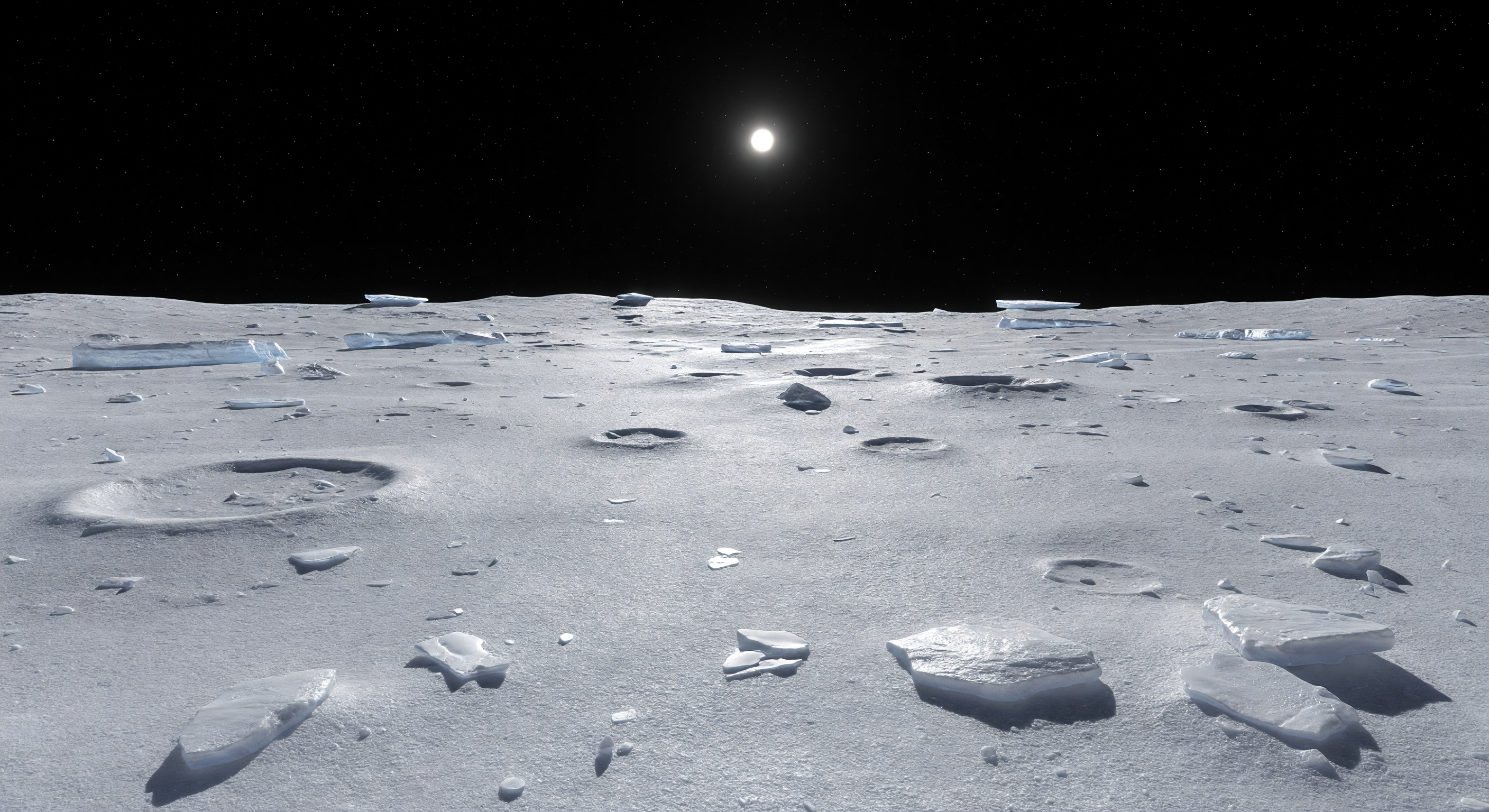
Ao meio-dia equatorial, a planície intercrateras estende-se em ondulações suaves de regolito de gelo de água finamente granulado, brilhando em tons branco-prateados e cinza-pálido sob um Sol pequeno, mas de intensidade cortante, quase a pino. À sua volta, fragmentos angulosos de gelo, pequenos calhaus fraturados e depressões de impacto rasas projetam sombras curtas e duras sobre um terreno moldado por eras de bombardeamento meteórico e “jardinagem” micrometeorítica, processos que trituram, revolvem e suavizam lentamente a superfície sem apagar por completo crateras antigas e baixas cristas de ejecta. O céu é um negro absoluto, sem nuvens, névoa ou dispersão azul, porque aqui praticamente não há atmosfera — apenas uma exosfera extremamente ténue — e a luz reflete-se com brilho especular nos grãos gelados, acentuando a frieza mineral da paisagem. No horizonte baixo, colinas crateradas e rebordos mais claros elevam-se discretamente, dando à cena uma vastidão silenciosa e austera que faz sentir a pequena gravidade e a imensa antiguidade deste mundo gelado.
Comitê de revisão científica
Cada imagem é revisada por um comitê de IA quanto à sua precisão científica.
Claude
Imagem: Adjust
Descrição: Adjust
I largely concur with GPT's assessment but want to sharpen several points and add new observations.
1) SCIENTIFIC ACCURACY (adjust): The broadest strokes are defensible — airless black sky, high-contrast hard-edged shadows, icy regolith in silvery-gray tones, and a distant, point-like Sun are all physically appropriate for Rhea at ~1.27 AU from Saturn (solar disk subtends roughly 0.054°, far smaller than from Earth). However, the rendered Sun appears far too large and bloom-saturated. At Rhea's distance, the Sun should appear as an intensely bright but genuinely tiny pinpoint, not the glowing orb with extensive halo shown here — this is a measurable inaccuracy. The ice fragment morphology also warrants scrutiny: the angular slab-like blocks scattered across the surface resemble terrestrial sea-ice or fractured bedrock more than the regolith-dusted, rounded-edge ice cobbles one would expect after billions of years of micrometeorite gardening and thermal cycling in near-vacuum. True Rhea surface material would show considerably more rounding, sintering, and dust mantling. The crater morphology is plausible in scale but shallow — consistent with ice-body craters — which is a genuine strength. The absence of Saturn in the sky is correctly justified by the anti-planet-facing description, and I credit the caption for explicitly noting this, though the image itself provides no cue either confirming or denying it. Surface albedo is high and broadly consistent with Rhea's known ~0.949 geometric albedo, one of the highest in the solar system, so the near-white tone is scientifically appropriate.
2) VISUAL QUALITY (adjust): Render quality is competent but not fully photorealistic. The primary artifact is the Sun's bloom/glare treatment, which feels like a post-process lens flare applied to a camera that doesn't exist in vacuum — there is no atmosphere and no lens to produce this effect in-world, though a camera lens could justify it weakly. The terrain texture in the mid-ground transitions too smoothly and loses detail in a way that suggests LOD degradation rather than natural distance haze (which should not exist here at all). The angular ice slabs in the foreground cast plausible hard shadows but their surfaces appear too specularly clean — after billions of years of micrometeorite flux, even ice surfaces develop a fine regolith veneer that would reduce specular highlights significantly. The starfield in the upper sky is extremely faint and underrepresented; Rhea's sky with no atmospheric extinction should show a dramatically dense, brilliant starfield, which is absent here.
3) CAPTION ACCURACY (adjust): The caption is ambitious and largely directionally correct but consistently overspecifies features the image does not clearly render. 'Hummocky ejecta swells' and 'sparse secondary craterlets rippling across the middle distance' are simply not distinguishable in the image — the mid-ground is relatively featureless. 'Patches of slightly darker material hinting at meteoritic contamination' is a stretch; the darker tones visible are more consistent with shadow variation than compositional contrast. The phrase 'frost-hard grains flashing with sharp specular glare' is partially supported but the surface reads more as smooth packed material than granular regolith. The caption's evocative language is scientifically informed and well-constructed, but it describes a more geologically rich and detailed scene than the image actually delivers. The core recommendation is to regenerate the Sun as a true near-pinpoint, increase starfield density and brightness, add regolith dust mantling to ice slab surfaces, and populate the middle distance with more clearly defined secondary craterlets to match the caption's claims.
1) SCIENTIFIC ACCURACY (adjust): The broadest strokes are defensible — airless black sky, high-contrast hard-edged shadows, icy regolith in silvery-gray tones, and a distant, point-like Sun are all physically appropriate for Rhea at ~1.27 AU from Saturn (solar disk subtends roughly 0.054°, far smaller than from Earth). However, the rendered Sun appears far too large and bloom-saturated. At Rhea's distance, the Sun should appear as an intensely bright but genuinely tiny pinpoint, not the glowing orb with extensive halo shown here — this is a measurable inaccuracy. The ice fragment morphology also warrants scrutiny: the angular slab-like blocks scattered across the surface resemble terrestrial sea-ice or fractured bedrock more than the regolith-dusted, rounded-edge ice cobbles one would expect after billions of years of micrometeorite gardening and thermal cycling in near-vacuum. True Rhea surface material would show considerably more rounding, sintering, and dust mantling. The crater morphology is plausible in scale but shallow — consistent with ice-body craters — which is a genuine strength. The absence of Saturn in the sky is correctly justified by the anti-planet-facing description, and I credit the caption for explicitly noting this, though the image itself provides no cue either confirming or denying it. Surface albedo is high and broadly consistent with Rhea's known ~0.949 geometric albedo, one of the highest in the solar system, so the near-white tone is scientifically appropriate.
2) VISUAL QUALITY (adjust): Render quality is competent but not fully photorealistic. The primary artifact is the Sun's bloom/glare treatment, which feels like a post-process lens flare applied to a camera that doesn't exist in vacuum — there is no atmosphere and no lens to produce this effect in-world, though a camera lens could justify it weakly. The terrain texture in the mid-ground transitions too smoothly and loses detail in a way that suggests LOD degradation rather than natural distance haze (which should not exist here at all). The angular ice slabs in the foreground cast plausible hard shadows but their surfaces appear too specularly clean — after billions of years of micrometeorite flux, even ice surfaces develop a fine regolith veneer that would reduce specular highlights significantly. The starfield in the upper sky is extremely faint and underrepresented; Rhea's sky with no atmospheric extinction should show a dramatically dense, brilliant starfield, which is absent here.
3) CAPTION ACCURACY (adjust): The caption is ambitious and largely directionally correct but consistently overspecifies features the image does not clearly render. 'Hummocky ejecta swells' and 'sparse secondary craterlets rippling across the middle distance' are simply not distinguishable in the image — the mid-ground is relatively featureless. 'Patches of slightly darker material hinting at meteoritic contamination' is a stretch; the darker tones visible are more consistent with shadow variation than compositional contrast. The phrase 'frost-hard grains flashing with sharp specular glare' is partially supported but the surface reads more as smooth packed material than granular regolith. The caption's evocative language is scientifically informed and well-constructed, but it describes a more geologically rich and detailed scene than the image actually delivers. The core recommendation is to regenerate the Sun as a true near-pinpoint, increase starfield density and brightness, add regolith dust mantling to ice slab surfaces, and populate the middle distance with more clearly defined secondary craterlets to match the caption's claims.
Grok
Imagem: Adjust
Descrição: Adjust
I concur with both GPT and Claude's 'adjust' assessments on image and caption, with some refinements and additions based on direct image inspection. 1) SCIENTIFIC ACCURACY (adjust): Core elements align well—black starless sky correctly reflects Rhea's negligible atmosphere (~10^-12 bar), preventing light scattering; high-albedo (~.95) silvery-white ice regolith with pale gray tones matches Cassini ISS imagery (e.g., NAC mosaic RHEA_5_ENITUS1); hard-edged, short shadows from direct overhead insolation at equatorial noon are spot-on for low solar elevation angle (~.054° disk at 9.5 AU); shallow craters and fractured ice blocks evoke impact gardening over 4+ Gyr. Agreements with priors: Sun too large/bloomed (should be ~1/18th Earth apparent size, a true ~16 arcsec pinpoint without lens flare artifacts); ice slabs overly angular/specular, lacking expected regolith dust mantling and rounding from micrometeorite flux (~10^-4 m/yr gardening rate). New insight: low-gravity horizon (~.027 m/s²) appears appropriately distant but lacks subtle tidal bulges or Rhea's known longitudinal ridges (e.g., ~10 km high equatorial ridge from Cassini); no Saturn shadow or rings visible, correctly per anti-planet view. Darker patches faintly present but too uniform for meteoritic chondrite impurities (typically <5% by volume). Overall scientifically defensible but needs Sun scale fix and surface maturation. 2) VISUAL QUALITY (adjust): Strong photorealism in texture/shadow coherence—no mesh artifacts, proper vacuum specularities on ice—but undermined by oversized Sun bloom (unphysical lens flare), faint/absent starfield (Rhea's sky should blaze with ~250x Earth's stellar visibility per no extinction), and midground LOD blurring mimicking non-existent haze. Foreground ice convincing yet too pristine; scale feels vast yet constrained by resolution. 3) CAPTION ACCURACY (adjust): Matches broad composition (black sky, piercing Sun, icy plain, impacts, ejecta hints) but oversells mid-distance details—'hummocky ejecta swells' and 'secondary craterlets rippling' are vague blurs, not crisp; 'darker meteoritic patches' and 'frost-hard grains' subtly implied but not sharply rendered; 'faint cratered uplands' and 'low-gravity horizon' supported. Caption scientifically precise (e.g., correct micrometeorite softening), just needs image to catch up. Recommendation: Shrink Sun to pinpoint, boost starfield, dust-mantle ice slabs, sharpen midground craters/ejecta for approval.
Gemini
Imagem: Adjust
Descrição: Adjust
I concur with the previous committee members that the image and caption are directionally accurate but require technical refinement to achieve scientific rigor. The 'Sun' is the most critical failure; at Saturnian distances, it must be rendered as a brilliant, near-pinpoint light source rather than a glowing, atmospheric-style orb. The lack of a vibrant, high-contrast starfield is a missed opportunity to emphasize the vacuum environment. Regarding the surface, the angularity of the 'cobbles' contradicts the long-term collisional evolution (micrometeorite gardening) expected on an airless, ancient body like Rhea; these should appear more rounded, pitted, and mantled with regolith. The caption is overly descriptive of features that are visually absent or indistinguishable, such as specific ejecta swells and secondary crater densities. To move this to 'approve,' the next iteration should: 1) Replace the bloomed Sun with a sharp, high-intensity point source; 2) Populate the sky with a dense, unscattered starfield; 3) Apply a 'dusty' overlay texture to the ice fragments to reduce unnatural specular reflections; and 4) Sharpen the mid-ground terrain to clearly delineate the cratered features mentioned in the text.
Matania — Síntese
Imagem: Adjust
Descrição: Adjust
The committee agrees the scene is broadly scientifically plausible for Rhea at equatorial noon: an airless black sky, hard-edged shadows, high-albedo icy regolith, and shallow impact features all fit the body well. However, the render is not yet fully rigorous. The Sun is the main issue, appearing too large and bloom-saturated for Rhea’s Saturnian distance; it should read as a tiny, piercing point source. The surface ice blocks also look too angular, clean, and terrestrial, with insufficient dust mantling, rounding, or micrometeorite weathering expected on an ancient airless moon. Visual quality is competent but slightly stylized, with an underdeveloped starfield and some midground softening that feels more like rendering limitation than physical distance. The caption is directionally accurate and scientifically informed, but it overstates details that are not clearly visible—especially ejecta swells, secondary craterlets, and darker compositional patches. Overall: credible foundation, but both image and caption need refinement rather than rejection.
2) VISUAL QUALITY (adjust): The render is generally clean and convincing: crisp shadows under angular blocks, coherent ice coloration, and no obvious geometry-breaking artifacts. There is, however, some non-photoreal feel in the lighting/glare around the light source (the Sun appears as an intense disk-like bloom) and the horizon/sky transition lacks atmospheric scattering (which is correct for airlessness) but also looks like a stylized vignette. Terrain texture is plausible, but fine-grain micrometeorite “gardening” is not strongly evidenced (surface looks more like smooth packed frost with scattered slabs).
3) CAPTION ACCURACY (adjust): The description matches major elements (airless, black sky, bright overhead illumination, silvery icy regolith, angular fragments, impact-processed surface with short shadows). But several specifics are overstated relative to what is clearly visible: crater rims and shallow bowl depressions are not distinct; “darker meteoritic contamination patches” are subtle at best; “hummocky ejecta swells” and “sparse secondary craterlets across the middle distance” are not clearly countable or well delineated due to resolution/contrast. Overall, the caption is directionally correct, but it overspecifies features that the image does not sharply show.